You are exhausted during the day, but the moment the house quiets and you actually lie down, sleep refuses to come. Or you fall asleep and then you are wide awake at 2 AM, heart racing, for no clear reason. Or you sleep for eight hours and still wake up feeling as though you have not rested at all.
Women with PCOS tell me this every week. Some assume it is anxiety. Some try melatonin supplements and give up when they do not work. Many have never been told that sleep disruption is a recognised part of PCOS, not a separate problem running alongside it, and that the same hormonal drivers causing their irregular periods and insulin resistance are also behind their broken nights.
There is something worth naming here about how many Indian women actually live. The 10 PM family WhatsApp group, the late-night cooking after a full day, the scrolling that happens because the house is finally quiet. These are real. But when PCOS is in the picture, the body’s response to late nights and irregular eating is sharper, and the cost to the next day’s energy, mood, and metabolic markers is higher than it would be in a woman without this hormonal background. Understanding why makes it easier to do something about it.
How PCOS Affects Sleep: Four Mechanisms
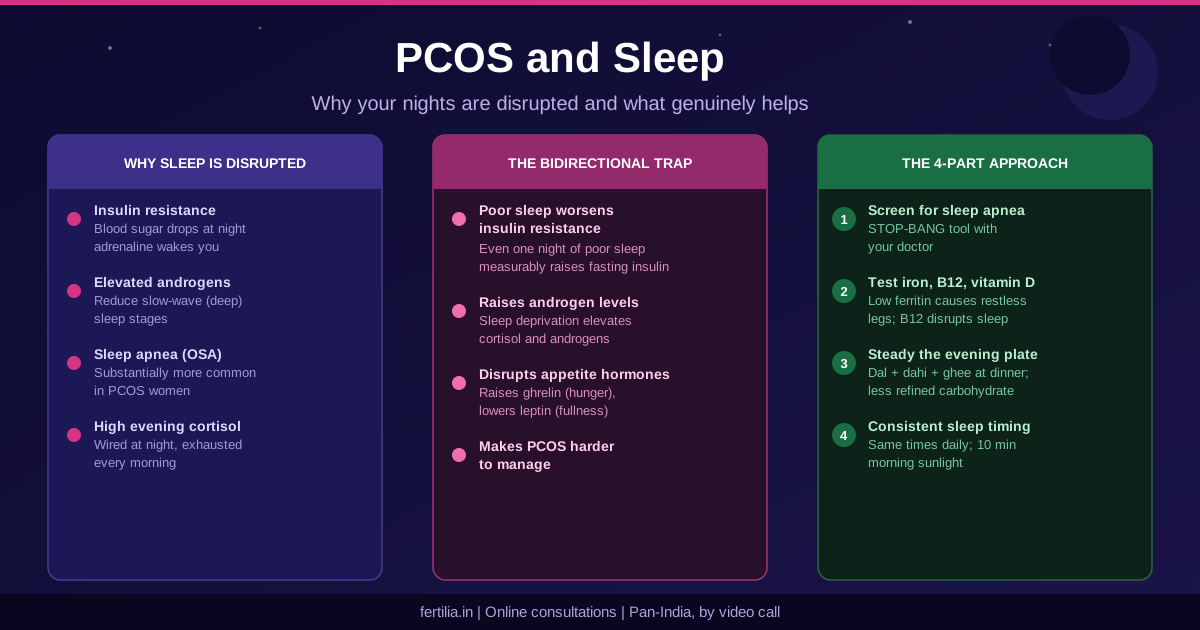
Sleep disruption in PCOS does not have one single cause. It runs through at least four interconnected mechanisms, and most women with PCOS are experiencing more than one simultaneously.
Insulin Resistance and Blood Sugar at Night
Insulin resistance is present in the majority of women with PCOS, including those who are lean. During the day, unstable blood sugar shows up as cravings and energy crashes. At night, it shows up as broken sleep.
When blood sugar drops too low during sleep, the body treats this as a mild emergency and releases adrenaline and cortisol to bring it back up. Both are alerting hormones. The result is waking in the early hours, often between 1 AM and 3 AM, with a feeling of restlessness or a racing heart, sometimes with a vague hunger that settles after eating something small.
There is also a relationship between chronically elevated insulin and melatonin, the hormone that signals the brain to prepare for sleep. Research on insulin and circadian biology suggests that hyperinsulinaemia interferes with normal melatonin rhythm, shifting the body’s internal clock toward a later timing. This is part of why women with PCOS often feel genuinely alert at 11 PM and genuinely unable to wake at 7 AM: the melatonin curve is pushed back.
A high-carbohydrate late meal amplifies this. A bowl of plain white rice at 9 PM with little protein or fat produces a blood sugar spike followed by a drop that lands squarely in the sleep window. The hormonal response to that drop disrupts sleep architecture before the night has properly begun.
Androgens and Sleep Architecture
Higher androgen levels, particularly testosterone, are a defining feature of PCOS. These same androgens affect the structure of sleep across the night.
Sleep cycles between lighter stages and deeper stages, including slow-wave sleep (sometimes called SWS or deep sleep), which is when the body does its most significant physical restoration, and REM sleep, when the brain processes emotional experiences and consolidates memory.
Research comparing sleep in women with PCOS against women without consistently finds that higher androgen levels are associated with less slow-wave sleep. The pattern resembles what is observed in men, who have naturally higher androgens and shorter slow-wave stages than women of similar age. When PCOS-related androgens are elevated, the restorative stages of sleep are shortened. Women wake feeling physically unrefreshed even after a full night in bed.
This is why the complaint in PCOS is so often not “I cannot fall asleep” but “I sleep and sleep and still feel tired.” The hours are there, but the quality is not.
Obstructive Sleep Apnea
Obstructive sleep apnea (OSA) is a condition in which the upper airway partially or completely collapses during sleep, causing breathing to pause repeatedly through the night. Each pause results in a partial arousal, even if the person never consciously wakes.
PCOS women have a substantially higher rate of OSA than women without PCOS, even after controlling for body weight. This connection has been documented by several research groups, including Vgontzas and colleagues in the Journal of Clinical Endocrinology and Metabolism. The mechanism is partly hormonal: androgens affect the tone and structure of the muscles of the upper airway, making it more prone to narrowing during the relaxed state of sleep.
OSA produces a specific pattern: the person feels they are sleeping, but wakes exhausted, often with a morning headache. Partners may report snoring or pauses in breathing. Waking to urinate at night is also common, because the repeated micro-arousals activate mechanisms that signal the kidneys.
Beyond the disrupted sleep, OSA matters because every apnoea triggers a cortisol and adrenaline surge. These suppress insulin sensitivity, raise blood sugar, and elevate androgen levels. OSA and PCOS worsen each other when neither is treated: a reinforcing loop that explains why some women see very limited improvement in their metabolic markers despite consistent dietary effort.
Cortisol and the “Wired and Tired” Pattern
In women where the adrenal component of PCOS is prominent (often evidenced by elevated DHEAS on a hormonal panel), cortisol patterns are dysregulated in a characteristic way: cortisol stays elevated into the late evening when it should be falling, and this pushes back the onset of sleep.
Cortisol normally follows a diurnal arc: high in the morning, declining through the day, reaching its lowest point in the evening to allow melatonin to take over. When this pattern is disrupted, the brain stays in a state of physiological alertness even when the body is tired.
This is the “wired and tired” pattern. Exhausted all day, a second wind after 9 or 10 PM, unable to fall asleep until midnight or later, and then impossible to wake in the morning. It is not a sleep hygiene problem at its root. It is a HPA-axis and circadian rhythm problem, and addressing only the surface behaviour (going to bed earlier) produces limited improvement without also working on the underlying cortisol picture.
Why Poor Sleep Makes PCOS Worse
This is the part that changes how many women think about sleep in the context of their condition: poor sleep does not just result from PCOS. It actively worsens PCOS.
Experimental sleep restriction in healthy people, including work from research groups studying slow-wave sleep and metabolic function, produces measurable reductions in insulin sensitivity even in the absence of any underlying hormonal condition. In women who already have PCOS-related insulin resistance, adding chronic poor sleep substantially deepens the metabolic disruption.
Sleep deprivation also raises morning cortisol, which in turn raises androgen levels. It disrupts ghrelin and leptin, the appetite-regulating hormones: ghrelin (which signals hunger) rises, and leptin (which signals fullness) falls. This drives cravings specifically for high-carbohydrate foods. It also impairs the kind of decision-making and self-regulation that makes dietary changes sustainable.
The practical consequence: a woman with PCOS who is sleeping poorly will find her dietary efforts less effective, her cravings harder to manage, and her metabolic markers harder to shift, regardless of what she is doing correctly in her waking hours. Sleep is not optional in PCOS management. It is as active a lever as food and movement.
I am Dr. Suganya Venkat, an OB-GYN with over fifteen years of experience in women’s hormonal health, and sleep is one of the first things I ask about in a PCOS consultation because it tells me a great deal about how the underlying picture is behaving. If sleep is one of the things you are trying to address alongside your PCOS, you are welcome to bring your questions to a video consultation at Fertilia. We see women from across India, online, by video call.
Start a conversation on WhatsApp: wa.me/919940270499
The Four-Part Framework for Better Sleep with PCOS
Each of the pathways above suggests a corresponding intervention. The most effective approach works across all four simultaneously, because they reinforce each other.
Screen for Sleep Apnea
If you snore, if you have been told you stop breathing during sleep, if you wake with morning headaches, or if you feel unrested regardless of how many hours you sleep, OSA should be formally assessed. Your doctor can take you through the STOP-BANG screening questions, which give a practical first indication of risk.
A sleep study (polysomnography) is the diagnostic test. Home sleep apnea tests are available in most Indian cities at a lower cost than a full in-laboratory study and are appropriate for moderate-to-high-risk presentations. Treatment, whether continuous positive airway pressure (CPAP), positional therapy, or weight-related airway improvement in mild cases, produces significant improvements in energy, insulin sensitivity, and overall PCOS management when OSA is genuinely present.
Test Iron, B12, and Vitamin D
Iron deficiency is a common and underrecognised cause of restless legs syndrome (RLS), a condition in which uncomfortable sensations in the legs prevent sleep onset. The relevant threshold is a ferritin level below 30 ng/mL, even when haemoglobin is still within normal range. Women with heavy PCOS-related periods are particularly likely to be iron-deplete. See our guide to iron deficiency anaemia for the full testing and treatment picture.
Vitamin B12 deficiency is associated with poor sleep quality and, in its more advanced forms, with peripheral discomfort that impairs rest. It is extremely common in Indian women and in women taking metformin for PCOS. Vitamin D deficiency is linked to disrupted circadian signalling and shorter overall sleep duration in population studies. Both are inexpensive to test, and correction typically produces noticeable improvement in sleep quality within four to six weeks alongside broader benefits for energy and mood.
Steady the Evening Plate
The most controllable lever for nocturnal blood sugar stability is the composition of the last meal of the day.
Shift dinner toward adequate protein (a katori of dal, a cup of dahi, a serving of paneer or eggs) with some fat (a teaspoon of ghee, a handful of groundnuts, some til stirred into the sabzi) and reduce refined carbohydrate, particularly plain white rice as the dominant component with little else alongside it. This combination slows gastric emptying and flattens the blood glucose curve through the overnight period.
Avoid eating in the two hours before sleep, and avoid the pattern of a light dinner followed by biscuits, sweets, or a second chai after 9 PM. Late eating, especially high-sugar eating, is the proximate cause of the blood sugar drop that wakes many women at 2 AM.
A small cup of haldi milk (turmeric milk, without added sugar) before bed is a settling ritual many women with PCOS find useful. It has anti-inflammatory properties and a mild warming effect. It works best as part of a consistent wind-down routine rather than as a standalone correction.
Consistent Sleep Timing and Morning Light
The single most impactful structural change is consistent sleep timing. Going to bed and waking at the same time seven days a week, including weekends, anchors the cortisol rhythm. The weekend lie-in that feels like recovery is often the opposite: it delays the morning cortisol peak, shifts the melatonin curve later, and makes Monday morning harder than it needs to be.
Blue-spectrum screen light suppresses melatonin. The timing of the late-night WhatsApp checking and scrolling is a direct physiological input to the cortisol-to-melatonin handover. Moving screens out of the bedroom, or establishing even a 30-minute screen-free window before sleep, reduces melatonin suppression meaningfully.
Ten minutes of natural daylight in the morning (outdoors, not through glass) is one of the most underused interventions for sleep. It reinforces the morning cortisol peak and sharpens its daily decline toward evening, making the nighttime drop more reliable. For women whose cortisol rhythm is genuinely dysregulated by PCOS, morning light plus consistent timing are the behavioural inputs that, over weeks, recalibrate the pattern.
When to Investigate Further
Beyond the four pathways, if sleep remains poor despite addressing these, a structured blood panel identifies remaining contributors.
Thyroid function (TSH, free T4). Hypothyroidism is more common in women with PCOS and disrupts sleep independently. See our guide on thyroid and fertility for the hormonal picture.
Fasting insulin and HOMA-IR. If insulin resistance has not been directly measured, this quantifies how significant a driver it is and informs the dietary and (where needed) medication decision.
DHEAS. If the wired-and-tired late-night alertness pattern is prominent and standard PCOS management has not shifted sleep, elevated DHEAS confirms adrenal involvement and changes the treatment approach.
What you track between visits matters for catching these patterns. Our guide to tracking PCOS between appointments gives a practical framework for noting sleep changes alongside other markers.
Sleep is part of the full PCOS picture, not a separate problem to address after everything else is sorted. For more on managing the root drivers, see our overview of PCOS and insulin resistance and the PCOS brain fog guide, which addresses how the same drivers affect concentration and memory.
If you would like to work through your specific sleep pattern as part of a broader PCOS assessment, you can start a conversation on WhatsApp. Consultations at Fertilia are online, pan-India, by video call.
WhatsApp us: wa.me/919940270499
You can also download our free PCOS Reversal Guide for the foundational approach to managing PCOS through lifestyle.
Frequently Asked Questions
Does PCOS cause insomnia? Yes, and through specific mechanisms rather than general stress. The main drivers in PCOS are insulin resistance causing nocturnal blood sugar drops that wake you, elevated androgens altering sleep architecture toward lighter stages, cortisol dysregulation that delays sleep onset in women with adrenal involvement, and a substantially higher rate of obstructive sleep apnea. Knowing which driver is most prominent guides the right intervention.
Why do I wake up at 2 or 3 AM with PCOS? Early-morning waking in PCOS is most commonly related to nocturnal blood sugar instability. When insulin resistance causes blood sugar to drop during sleep, the body releases cortisol and adrenaline to correct it. These alerting hormones wake you. A dinner with adequate protein and fat, and less refined carbohydrate, significantly reduces the frequency of this pattern.
Does poor sleep make PCOS worse? Yes, and this is one of the key reasons sleep is treated as a non-negotiable part of PCOS management. Sleep deprivation worsens insulin resistance, raises cortisol and androgen levels, disrupts appetite hormones in ways that increase cravings, and reduces the effectiveness of dietary and lifestyle changes. Women with PCOS who are sleeping poorly will find their metabolic markers harder to shift regardless of what else they are doing correctly.
What is the connection between PCOS and sleep apnea? PCOS women have a substantially higher rate of obstructive sleep apnea compared to women without PCOS, even after accounting for body weight. Androgens affect the tone of the upper airway muscles, making the airway more prone to narrowing during sleep. OSA itself then worsens insulin resistance and raises androgens through the cortisol surges each apnoea produces, creating a reinforcing loop with PCOS.
Can PCOS cause restless legs syndrome? PCOS does not cause restless legs directly, but iron deficiency is both common in PCOS (from heavy periods) and a primary driver of restless legs. The relevant threshold is ferritin below 30 ng/mL, even when haemoglobin is technically in range. Correcting iron resolves restless legs in many women and improves sleep onset significantly.
What should I eat at dinner for better sleep with PCOS? Build dinner around protein (dal, dahi, paneer, eggs) and fat (ghee, til, groundnuts), with less refined carbohydrate as the main component. Avoid high-sugar eating after 9 PM. A small cup of unsweetened haldi milk as part of a consistent wind-down routine is a reasonable addition. The goal is a stable blood glucose curve through the overnight period, reducing the drops that trigger adrenaline and early waking.
How long before sleep improves with PCOS treatment? Sleep architecture in PCOS is driven by insulin resistance and androgen levels, and changes in these take time. With consistent dietary and lifestyle changes, most women notice meaningful improvement in sleep quality within 12 to 16 weeks. If OSA is also present and treated, improvement in daytime energy and fatigue is often faster. Iron or B12 deficiency correction typically produces sleep improvement within four to six weeks.