She has already been told, more than once, that she is “just stressed.” She knows her periods are irregular. She knows the acne and the hair on her chin are from PCOS. What she has not been told is that the anxious, heavy feeling she carries most days, the one that makes ordinary decisions feel exhausting, may be connected to the same diagnosis.
I am a psychiatrist at Fertilia, and PCOS is one of the conditions I see most often sitting quietly behind a woman’s anxiety or low mood. Not because she is weak, or because she is failing to cope with a manageable health issue. Because PCOS is not only a reproductive condition. It is a hormonal and metabolic condition, and the same biology that disrupts ovulation and periods also reaches into the systems that regulate mood.
This post explains what the evidence actually shows about PCOS and mood, why the connection is real rather than incidental, and what helps, both by addressing the PCOS itself and by treating the anxiety or low mood as its own condition when that is what is needed.
The evidence: how common this is
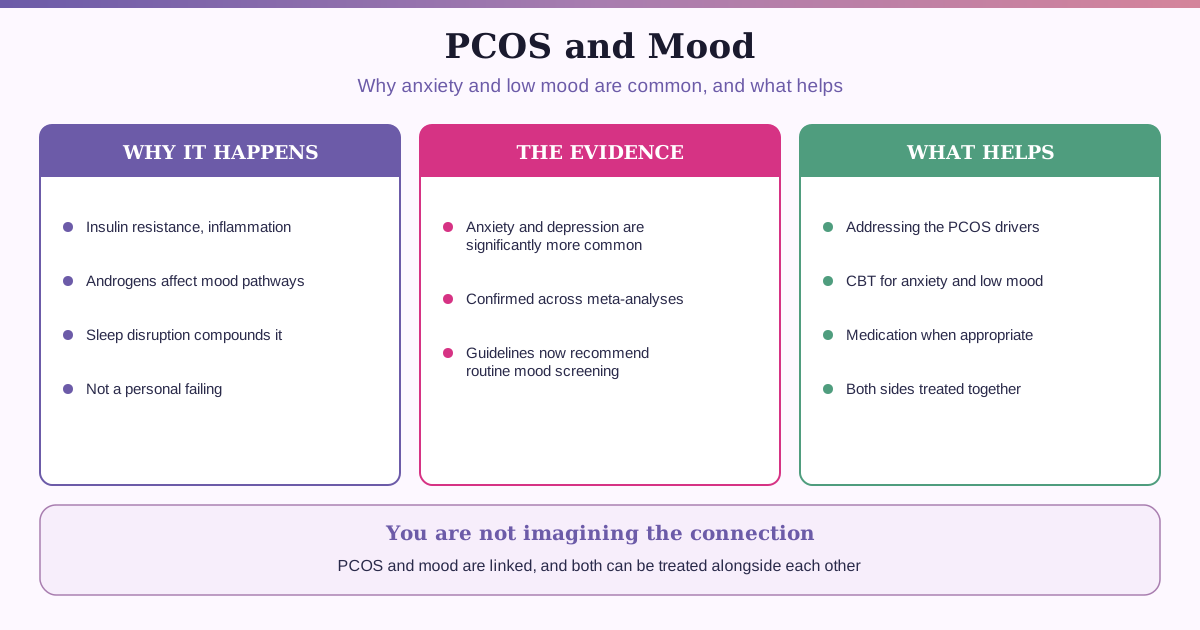
This is not a minor or occasional overlap. A systematic review and meta-analysis found that both anxiety and depression are significantly more common in women with PCOS than in women without it (Barry, Kuczmierczyk, and Hardiman, 2011, Human Reproduction, PMID 21725075). A later meta-analysis narrowed the picture further and found a high prevalence of moderate and severe depressive and anxiety symptoms specifically among women with PCOS, well above general population rates (Cooney, Lee, and Sammel, 2017, Human Reproduction, PMID 28333286).
The findings were consistent enough that the Androgen Excess and PCOS Society, the main international body for PCOS clinical guidance, issued a position statement in 2018 recommending that depression, anxiety, and quality of life be screened routinely as part of standard PCOS care, not addressed only if a woman happens to raise it herself (Dokras, Stener-Victorin, and Yildiz, 2018, Fertility and Sterility, PMID 29778388).
I want to be clear about what this evidence supports and what it does not. It supports that anxiety and low mood are a recognised, well-documented feature of PCOS at the population level. It does not mean every woman with PCOS will experience them, and it does not mean every low mood in a woman with PCOS is caused by PCOS. But if you have PCOS and you have also been struggling with anxiety or a flat, heavy mood, you are not imagining a connection. The research backs what many women have already sensed on their own.
Why PCOS affects mood: the biological drivers
Three overlapping pathways help explain why PCOS and mood difficulties travel together so often. None of them are proven to be the single cause in any individual woman. PCOS is associated with higher rates of anxiety and depression; it is not yet fully understood to cause them through one clean mechanism. But each pathway is biologically plausible and worth naming, because understanding the mechanism is often what helps a woman stop blaming her own character for what her body is doing.
Insulin resistance and its downstream effects
Insulin resistance is present in the majority of women with PCOS, including many who are not overweight. Chronically elevated insulin does not stay contained to blood sugar regulation. It is linked to low-grade systemic inflammation, and inflammation has an increasingly well-documented relationship with mood. A major review of the evidence found that chronic low-grade inflammation affects the same neurotransmitter systems, particularly serotonin, that are targeted in depression treatment, offering a biological route by which a metabolic problem can present as a mood problem (Miller and Raison, 2016, Nature Reviews Immunology, PMID 26711676).
In practical terms: the blood sugar swings that leave you shaky and irritable an hour after a carbohydrate-heavy meal, and the daily fatigue that so many women with PCOS describe, are not unrelated to your emotional state. They are part of the same underlying picture.
Androgen excess
Higher androgen levels, including testosterone, are a core feature of PCOS. Androgens influence the same neurotransmitter systems that regulate mood, and elevated androgens are one of the biologically plausible contributors to the anxiety and depressive symptoms seen more often in PCOS. This does not mean androgens explain the whole picture on their own; PCOS presents differently from woman to woman, and no single hormone accounts for the mood changes across everyone affected.
Disrupted sleep
Sleep and mood are tightly linked in general, and PCOS disrupts sleep through several of its own mechanisms, including nocturnal blood sugar drops, altered sleep architecture from androgen levels, and a higher rate of obstructive sleep apnea. We cover this in detail in our guide to PCOS and sleep. Poor sleep on its own is a well-established driver of both anxiety and low mood, so a woman with PCOS who is also sleeping badly is carrying two compounding pressures on the same nervous system, not one.
The layer that is not hormonal: living with PCOS in India
Alongside the biology, there is a psychosocial weight to a PCOS diagnosis that deserves to be named honestly, not folded quietly into “hormones.”
Visible symptoms like hirsutism, acne, and weight change are not cosmetic footnotes. For many women, they affect how they are seen and treated, in workplaces, in families, and in the marriage conversations that remain a significant part of many Indian women’s lives. Being told repeatedly to “just lose weight” when the weight gain itself is partly hormonally driven is demoralising in a specific way, and it often arrives from people who mean well.
Fertility worry adds another layer. A PCOS diagnosis is frequently, and sometimes prematurely, framed to a woman as a threat to her ability to conceive, and that framing can sit in the back of the mind for years, resurfacing every time a period is late or a family member asks when children are planned.
None of this is “just anxiety” or overreaction. It is a real, additive source of chronic stress sitting on top of a biological system that is already more prone to anxiety and low mood. Recognising both layers, the hormonal and the psychosocial, is what makes the picture make sense, and it is also why treating PCOS symptoms alone sometimes helps mood only partway.
If any of this describes what you have been carrying, you do not have to sort out on your own whether it is “the PCOS” or “just you.” I am a psychiatrist at Fertilia and I see women with PCOS regularly, alongside Dr. Suganya Venkat’s care of the hormonal side. Consultations are online, by video call, across India.
Talk to Dr. Sandhiya on WhatsApp: wa.me/919940270499
What genuinely helps
Addressing the PCOS drivers themselves. Because insulin resistance, inflammation, and disrupted sleep are plausible contributors to mood, working on these often improves mood as a secondary effect, alongside the more visible benefits of steadier cycles and clearer skin. This is not a claim that diet and lifestyle changes alone will resolve significant anxiety or depression. It is a recognition that the PCOS-management work you may already be doing (steadier meals, better sleep, regular movement) is not separate from your mental health, it is part of it.
Treating the mood symptoms in their own right when that is what is needed. If anxiety or low mood is significant, persistent, or interfering with daily life, it deserves dedicated attention, the same as it would in a woman without PCOS. Our guides to anxiety in women and depression in women cover what each condition looks like on its own terms and when self-help is not enough. Cognitive behavioural therapy has strong evidence for both anxiety and depression, and it works well alongside PCOS management rather than competing with it for attention. Medication, when appropriate, is a legitimate option, made collaboratively with a clear explanation of what to expect.
Not waiting for the “right” order to ask for help. Some women assume they need to fix their PCOS first before their mood is worth addressing, or that once the periods regulate, the anxiety will resolve on its own. Sometimes it does improve. Often it needs its own attention in parallel. There is no requirement to wait.
Screening as a routine part of PCOS care, not an afterthought. International guidance now recommends this explicitly (Dokras et al., 2018). If your gynaecologist has not asked about your mood at a PCOS visit, it is entirely reasonable to raise it yourself. This is collaborative work, not a sign that your medical care so far has been inadequate. Your PCOS treatment and your mental health treatment work alongside each other, not against each other.
FAQ
Does PCOS actually cause anxiety and depression, or is it a coincidence? The research shows a strong statistical association: women with PCOS have significantly higher rates of both anxiety and depression than women without PCOS (Barry et al., 2011; Cooney et al., 2017). Several biologically plausible mechanisms, insulin resistance and inflammation, androgen excess, and disrupted sleep, help explain why. This is not proof of a single direct cause in every woman, but it is well-established enough that PCOS clinical guidelines now recommend routine mood screening.
Can treating PCOS improve my mood without needing separate mental health treatment? For some women, yes, particularly if the mood symptoms are mild and closely tied to blood sugar swings, poor sleep, or fatigue. Addressing the underlying PCOS drivers can meaningfully improve how you feel day to day. But if anxiety or low mood is significant or persistent, it usually needs its own dedicated treatment alongside PCOS management, not instead of it.
Is it normal to feel anxious about fertility with a PCOS diagnosis, even if I’m not trying to conceive yet? Yes, this is extremely common, and it is a real psychosocial stress, not an overreaction. PCOS is often presented to women in ways that emphasise fertility risk more than the evidence supports for any individual case. If this worry is sitting with you, it is worth raising directly with your doctor, who can give you a realistic picture specific to your situation rather than the general framing you may have absorbed elsewhere.
How is PCOS-related mood difficulty different from PMDD or premenstrual mood changes? PMDD follows a distinct monthly pattern, worsening in the two weeks before a period and easing within a day or two of bleeding starting. The mood changes linked to PCOS are typically more constant, present across the month rather than cycling with hormone changes in the luteal phase. If your mood follows a clear premenstrual pattern, our guide to PMDD versus PMS may fit your experience better. The two can also coexist.
Will losing weight fix the anxiety that comes with PCOS? Weight loss is not the mechanism that resolves mood symptoms, and framing it that way can add pressure rather than relief. What helps is addressing insulin resistance, inflammation, sleep, and androgen levels, of which weight is one factor among several, not the single lever. Many women with lean PCOS experience the same mood symptoms without being overweight at all, which is itself evidence that weight is not the whole story.
Should I see my gynaecologist or a psychiatrist for PCOS-related mood symptoms? Both, generally in parallel rather than one before the other. Your gynaecologist manages the hormonal and metabolic side of PCOS. A psychiatrist can properly assess whether what you are experiencing meets the threshold for a diagnosable anxiety or depressive condition, and can offer therapy or medication where appropriate. At Fertilia, Dr. Suganya Venkat and I work with women across both sides of this picture.
What are the warning signs that my mood needs more than lifestyle changes? If anxiety or low mood is interfering with work, relationships, or daily functioning, if it persists most days for several weeks, if you have lost interest in things you used to enjoy, or if you have any thoughts of harming yourself, these are signals that professional support is needed beyond diet and lifestyle adjustment. None of these need to reach a crisis point before you are allowed to ask for help.
If what you have read here feels familiar, you do not need to have it all figured out before reaching out. I am a psychiatrist at Fertilia, and I offer online consultations by video call, across India, working alongside Dr. Suganya Venkat’s PCOS care when both are relevant to what you’re experiencing.
WhatsApp us: wa.me/919940270499 to book a ₹399 consultation, or read our free PCOS Reversal Guide for the foundational approach to managing PCOS through lifestyle.