She is not lying awake with a specific fear. There is no looming deadline or family crisis she can name. But the worry is there anyway, a low hum underneath everything she does. It is there when she makes her morning tea, when she sits down at work, when she lies down to sleep and finds her thoughts looping again. She has noticed it for years. She has called it stress, or her personality, or just the way she is.
I am a psychiatrist at Fertilia, and a lot of the women who speak to me describe this exact feeling. They are often surprised when I call it anxiety. In their minds, anxiety means panic attacks and dramatic episodes. But the kind that shows up most often in women is quieter than that. It is an always-on state of alertness and worry that the mind has simply learned to treat as background noise.
For more on this, read our guide on Panic Attacks. This post is about that kind of anxiety: the general, all-month variety that does not have a hormonal pattern or a specific trigger. It is not premenstrual anxiety, and it is not postpartum anxiety. It is anxiety as a condition in its own right, and it is far more common in women than most people know.
What anxiety feels like in the body and the mind
Anxiety rarely announces itself clearly. It shows up in a mix of physical and mental symptoms that women often attribute to other things entirely.
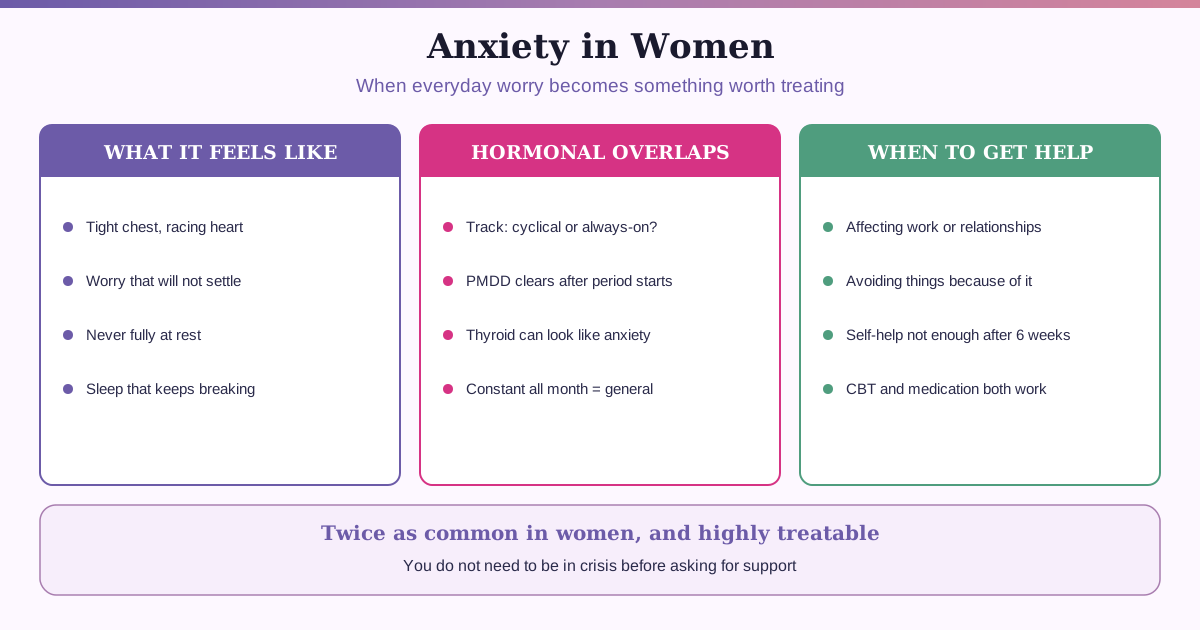
The physical side includes a chest that feels tight when there is no reason for it, a heartbeat that speeds up in ordinary situations, shallow breathing, a throat that feels constricted, persistent headaches, and a stomach that churns before anything particularly stressful. Disturbed sleep is one of the most common complaints: difficulty falling asleep, waking at 3 AM with thoughts that will not switch off, morning tiredness even after a full night.
The mental side is a mind that is always scanning for what might go wrong. Worry jumps from one subject to the next (health, children, finances, relationships, work) without ever settling. Concentration is harder because a part of your attention is always elsewhere. Irritability arrives without an obvious reason. There is a low background sense of dread that has no story behind it.
And often, an inability to relax fully, even during rest. Even enjoyable moments carry a faint edge, as though something difficult might arrive at any moment.
Many women recognise these symptoms when they see them listed together, and many report that they assumed this was how all adults feel. It is not. The fact that you have learned to live with it does not mean you have to continue doing so.
Why women are more likely to experience anxiety
Among all mental health conditions, anxiety is the most common globally. It affects roughly 284 million people across the world (Bandelow and Michaelis, 2015, Dialogues in Clinical Neuroscience, PMID 26487813). And within that number, women are affected roughly twice as often as men (McLean, Asnaani, Litz, and Hofmann, 2011, Journal of Psychiatric Research, PMID 21439576).
This gap is not a character difference. Women are not more anxious because they are less capable of coping. The disparity has biological, social, and structural explanations.
On the biological side, oestrogen has a modulating effect on the brain’s serotonin and GABA systems, both of which regulate mood and the threshold at which the nervous system perceives something as threatening. When oestrogen fluctuates, as it does across the menstrual cycle, in the postpartum period, and during perimenopause, these regulatory systems shift.
On the social side, women in India, as in most countries, carry a disproportionate share of domestic and emotional labour: managing households, children, elderly parents, and relationships alongside professional work. Chronic background demand, sustained over months and years, primes the threat-detection system to stay switched on even when there is no immediate danger. The body has learned to expect difficulty.
For more on this, read our guide on Burnout & the Mental Load. Recognising this context matters. Anxiety in women is not a sign that you cannot cope. It is a signal from a nervous system that has been carrying a great deal for a long time.
The hormonal overlap: ruling out a cyclical cause
Before working on general anxiety, it is worth spending a few weeks checking whether yours has a pattern. Some anxiety in women is tied to hormonal changes. Three specific situations are worth knowing about.
Premenstrual anxiety: If your anxiety builds in the two weeks before your period, peaks in the final few days, and then eases within a day or two of bleeding starting, the cause may be premenstrual rather than general. Our guide to premenstrual anxiety covers this in full, including what the luteal-phase GABA shift looks like and how to track the pattern.
Postpartum anxiety: Anxiety that began or significantly worsened after having a baby has its own profile: hypervigilance around the baby, intrusive “what if something happens” thoughts, difficulty sleeping even when the baby sleeps. Our postpartum anxiety guide is specific to that period.
Thyroid-driven symptoms: Hyperthyroidism produces symptoms that look exactly like anxiety: a racing heart, heat sensitivity, trembling hands, disturbed sleep, and a wired, on-edge feeling. If your anxiety arrived suddenly or is accompanied by weight change, palpitations, or heat intolerance, thyroid function is worth checking first. A simple TSH test is the starting point. For more on how thyroid function affects how you feel day to day, see our guide to thyroid and hormonal health.
Perimenopause: For women in their early-to-mid forties, fluctuating oestrogen during the perimenopausal transition can produce anxiety that feels new and out of proportion to circumstances. This is distinct from general anxiety in how it arrived and in its trajectory.
The clearest distinguishing question: Is the anxiety present all month, regardless of your cycle? Or does it follow a hormonal or life-stage pattern? If it is constant and persistent, with no clear cyclical variation, it is more likely to be a general anxiety condition worth addressing on its own terms.
If you are not certain whether your symptoms are cyclical or constant, our guide to PMDD or depression: why timing matters explains the tracking approach that makes this distinction clear.
Self-help that makes a genuine difference
For mild-to-moderate anxiety, several evidence-based approaches reduce the baseline level of nervous system activation. These are not replacements for professional support when that is what is needed, but they are a meaningful starting point.
Sleep: Anxiety and sleep disruption are bidirectional. Anxiety makes sleep harder, and poor sleep makes anxiety worse. Protecting sleep hygiene (a consistent bedtime, no screens for the thirty minutes before sleep, a room that is cool and dark) reduces the background anxiety level over weeks.
Caffeine: Chai and filter coffee are part of daily life for many Indian women, but caffeine directly activates the same adrenergic system that anxiety uses. If you are already anxious, two or three cups a day can amplify the physical symptoms (the fast heart, the tight chest, the restlessness) significantly. A gradual reduction is easier to sustain than stopping suddenly.
Breathwork: Diaphragmatic breathing activates the parasympathetic nervous system, which counteracts the stress response. One simple technique: inhale for four counts, hold for four, exhale for six. Even five to ten minutes done consistently begins to lower the baseline. The exhale longer than the inhale is the key mechanism.
Regular movement: A twenty-minute walk is enough to measurably reduce anxiety in the short term, through multiple pathways: lower cortisol, endorphin release, and a body-in-motion signal that reduces the lingering sense of threat. It does not need to be intense exercise.
Containing worry: One practical strategy is scheduling a specific window of fifteen to twenty minutes each day where you allow yourself to think through concerns deliberately. Outside that window, when a worry intrudes, you note it and defer it. Over weeks, this interrupts the habit of diffuse worry that runs as background noise all day.
Reducing symptom searching online: For women with a component of health anxiety, repeatedly searching symptoms online amplifies the worry loop rather than resolving it. Noticing this as a habit is the first step toward changing it.
For more on this, read our guide on Health Anxiety.
If you are not sure whether what you are experiencing is anxiety, or you have been trying the above and are not seeing enough change, a conversation with a psychiatrist is a practical step, not a dramatic one. I consult online by video call, across India.
For more on this, read our guide on Trying to Conceive & Mental Health. Speak to Dr. Sandhiya on WhatsApp for a ₹399 online consultation to discuss what you are experiencing.
When self-help is not enough
There are signs that anxiety has moved beyond what self-help alone can address.
If your anxiety is consistently interfering with work, relationships, or your ability to do ordinary things (not just on a particularly hard day), that is worth discussing with a professional. If you are avoiding situations or activities because of anxiety, avoidance tends to grow over time rather than resolve on its own. If you have been trying the strategies above for four to six weeks and not noticing meaningful change, that is also a signal.
What does a psychiatric consultation actually look like?
The first appointment is largely a conversation. I ask about the symptoms, when they started, what makes them better or worse, whether there is a pattern, and what you have already tried. We go through physical health history to rule out thyroid and other contributors. Nothing is invasive.
The most evidence-backed treatment for generalised anxiety is cognitive behavioural therapy (CBT), which works by helping restructure the thought patterns and behavioural responses that sustain anxiety rather than just managing symptoms in the moment. A comprehensive review of meta-analyses found CBT consistently effective for anxiety disorders (Hofmann, Asnaani, Vonk, Sawyer, and Fang, 2012, Cognitive Therapy and Research, PMID 23459093).
Medication is available and effective when needed. For generalised anxiety, SSRIs and SNRIs are the most commonly used and well-studied options (Stein and Sareen, 2015, New England Journal of Medicine, PMID 26580998). They are not a last resort, and the right approach is individual. Any medication decision is made collaboratively, with a clear explanation of what to expect.
Online consultations are available by video call, across India. There is no need to travel.
KIRAN: free, immediate support
If anxiety feels overwhelming right now and you are not sure what to do, the KIRAN Mental Health Helpline is a free, 24-hour service run by the Government of India. The number is 1800-599-0019. It is free to call from any phone in India, at any hour, and is available in multiple languages including Tamil and Hindi.
KIRAN is a useful first call if you are unsure whether what you are experiencing needs attention, or if you want to talk to someone while you decide on next steps.
FAQ
What is the difference between everyday stress and anxiety?
Stress is typically a response to a specific situation: a deadline, a difficult conversation, a financial pressure. It tends to ease when the situation resolves. Anxiety persists independently of what is happening externally. The worry continues even when there is nothing specific to worry about, and it can feel impossible to switch off. If what you are experiencing does not lift when the stressor passes, that is a meaningful distinction.
Can anxiety cause physical symptoms even without feeling mentally distressed?
Yes, and this is one of the most commonly missed aspects of anxiety. Some women experience anxiety primarily through the body: a tight chest, palpitations, muscle tension, a churning stomach, chronic headaches, persistent fatigue, or disturbed sleep. They do not necessarily feel “mentally anxious” in the way they imagine, and so the physical symptoms get investigated and treated individually without the underlying anxiety being addressed. If you have physical symptoms without a clear cause, anxiety is worth considering.
How do I know if my anxiety is general or related to PMDD?
The key is timing. Track how you feel at different points in your cycle for at least two months. If anxiety is clearly worse in the two weeks before your period and noticeably better in the week after bleeding starts, a premenstrual cause is more likely. If it is present at roughly the same level all month with no cycle variation, it is more likely to be general anxiety. Our premenstrual anxiety guide has a full tracking guide.
Is anxiety a permanent condition, or does it go away?
For many women, anxiety is highly treatable. CBT produces meaningful, lasting change in the way the anxiety system is calibrated. Some women need a period of medication to create the space in which therapy can work, and then are able to taper off medication once stable. Others manage well with therapy alone, or with lifestyle changes plus occasional support. “Permanent” is rarely the right word; “manageable” and “significantly improved” is closer to the reality for most.
Chinta hona kya anxiety ki bimari hai?
Thoda bahut chinta (worry) sab ko hoti hai. Anxiety ki bimari tab hoti hai jab yeh chinta har waqt bani rehti hai, kisi wajah ke bina bhi, aur usse kaam, neend, ya rishte prabhavit hone lagte hain. Agar aap apni ghabrahat ko control karna mushkil paate hain, ya yeh mahine bhar present rehti hai, toh ek baar psychiatrist se baat karna faydemand ho sakta hai. (Some worry is normal. Anxiety as a condition is present when the worry is constant, hard to control, and begins to affect daily functioning. If that describes what you are experiencing, speaking to a psychiatrist is a reasonable step.)
How do I know when it is time to see a psychiatrist for anxiety?
For more on this, read our guide on Psychiatrist, Psychologist, Counsellor. A few clear markers: anxiety that is affecting your work or relationships on more than an occasional basis; anxiety that is causing you to avoid things you would otherwise do; anxiety that does not reduce meaningfully even after several weeks of trying lifestyle changes; or physical symptoms (palpitations, chest tightness, disturbed sleep) that have been investigated and have no other cause. None of these need to be severe before you can ask for support. You do not need to be in crisis to consult.
Does anxiety affect fertility or hormonal health?
Chronic anxiety activates the HPA (hypothalamic-pituitary-adrenal) axis, which produces sustained cortisol. Prolonged cortisol elevation can suppress the HPG axis, the signalling pathway that governs ovulation and menstrual regularity. This is one of the mechanisms behind stress-related cycle disruption. It does not mean anxiety is “causing infertility,” and in most cases the effect on ovulation is modest and reversible. But for women who are trying to conceive or who notice cycle changes during high-anxiety periods, addressing the anxiety is worth including in the overall picture. Our guide to PMDD versus depression includes more on the hormonal-mental health connection.
If something in this post resonates with you, starting a conversation is straightforward. I am a psychiatrist at Fertilia and I offer online consultations by video call, pan-India.
WhatsApp us to book a ₹399 consultation. You can describe what you are experiencing in your own words, and we will go from there.