She wakes up before everyone else. While the house is quiet, she is already thinking: the school bag, the afternoon pickup, the vegetables that need to be bought before tonight, the relative who called yesterday and is waiting for a reply, the leave application her husband forgot to submit, the dentist appointment she keeps postponing because she cannot fit it in. None of this is on a list. It lives in her head, always running.
By 8 AM she has made breakfast, gotten the children ready, answered three work messages, and reminded her husband of two things. He will not remember doing any of this when he reflects on his morning. She will not forget a single detail.
This is what we call the mental load. And carrying it, day after day, for years, is one of the most underrecognized causes of burnout I see in women.
I am Dr. Sandhiya Loganathan, a psychiatrist at Fertilia with a focus on women’s mental health. In this post, I want to explain what the mental load is, why women disproportionately carry it, what happens to the mind when it carries that load for too long, and how to tell when you have crossed from tired into something that needs more support.
For more on this, read our guide on Low Libido in Women.
For more on this, read our guide on Coping After Pregnancy Loss.
For more on this, read our guide on Therapy in India.
For more on this, read our guide on Body Image After Pregnancy or Weight Change.
What the Mental Load Is
Most conversations about household division focus on visible tasks: who cooks, who cleans, who drops the children to school. These are things you can count.
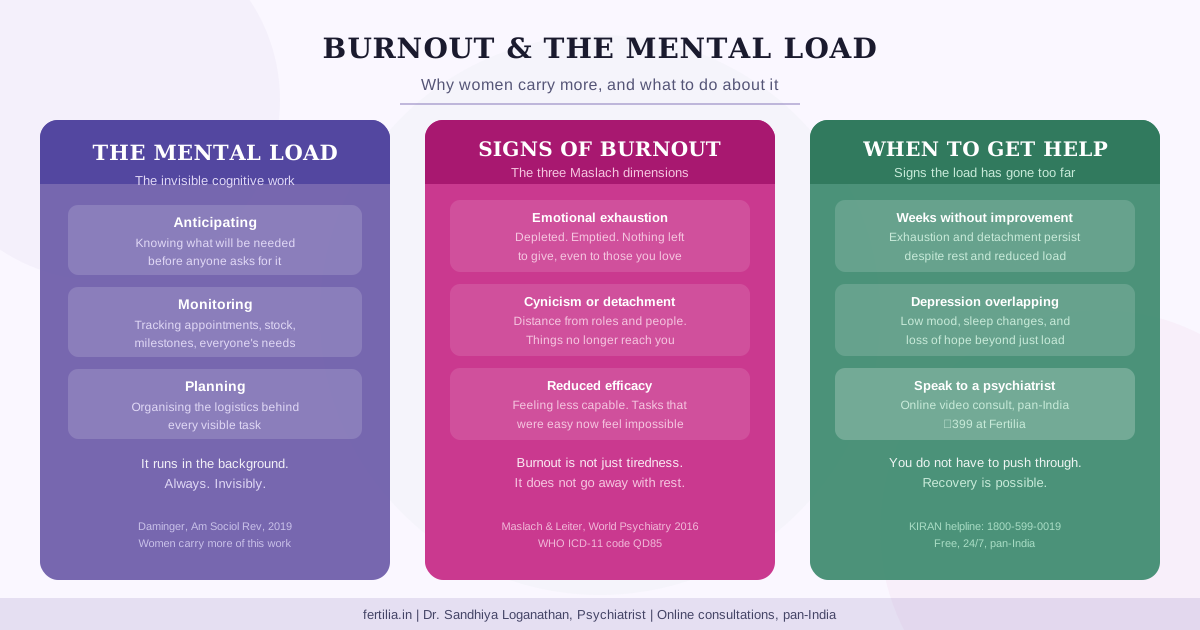
The mental load is different. It is the cognitive work that makes the visible tasks possible. It is the noticing, the anticipating, the planning, and the tracking. Who will remember that the cooking gas cylinder is nearly empty? Who will notice that the child’s shoes no longer fit and need to be ordered before the school event? Who will keep track of the last time the elders at home had their blood pressure checked?
This cognitive dimension of household labour was studied closely by sociologist Allison Daminger, whose research in the American Sociological Review (2019, 84:609-633) showed that women do a disproportionate share of the anticipation and monitoring phases of household work, not just the execution. The anticipating and monitoring are invisible. They do not appear in any task list. They do not end when the workday ends.
When you add this invisible load to full-time employment, caregiving for children, and often caregiving for aging parents, the result is something the International Labour Organization has documented consistently: women across the world do significantly more unpaid care and domestic work than men, even when both partners are employed full-time. India is no exception. In many households, a woman’s paid work is understood as her secondary role. Her primary responsibility, in the eyes of the family and often in her own internalized beliefs, is still the home.
Why Women Are More Likely to Burn Out
Burnout is not the same as tiredness. Tiredness goes away after sleep. Burnout does not.
The World Health Organization included burnout in ICD-11 (code QD85) in 2019, classifying it as an occupational phenomenon. Research by burnout experts Christina Maslach and Michael Leiter (World Psychiatry, 2016; PMID 27265691) describes three dimensions that define it:
Emotional exhaustion: Feeling depleted, with nothing left to give. Not just tired, but emptied out.
Cynicism or detachment: A growing distance from your work, your relationships, your responsibilities. Things you once cared about no longer reach you the same way.
Reduced sense of efficacy: The feeling that nothing you do is good enough, or that you are no longer effective at the things you used to manage well.
All three can develop when someone carries a prolonged, unrelenting load with no genuine recovery.
Women’s burnout has a particular shape. A meta-analysis in the Journal of Vocational Behavior (Purvanova and Muros, 2010; 77:168-185) found that women consistently report higher emotional exhaustion than men even in comparable occupational roles. When you factor in the double shift, paid work plus unpaid home and care work, the gap widens further. A woman who manages a demanding job all day and then manages the mental and physical load of the home in the evening is working without any genuine off-time. There is no recovery window. Burnout is the predictable result.
The Burnout-Depression Boundary
This distinction matters clinically, because the way these conditions respond to intervention differs.
A detailed review in Clinical Psychology Review (Bianchi, Schonfeld and Laurent, 2015; PMID 25638755) examined the overlap between burnout and depression at length. The key finding: the two overlap substantially in symptoms (exhaustion, loss of motivation, irritability, withdrawal), but burnout is typically situational and role-bound. Depression tends to be more pervasive. It reaches into parts of life that have nothing to do with the load: your sleep even on a holiday, your capacity for pleasure in general, your relationship with yourself.
In practice:
- If you feel exhausted and resentful in the context of your responsibilities but can still genuinely enjoy a quiet evening alone, a meal with a friend, or a piece of music, you are more likely in the burnout range.
- If the emptiness follows you everywhere, including into moments that used to bring you relief, depression needs to be considered alongside burnout.
It is entirely possible to have both. Prolonged burnout, left without support, can shift into depression. This is one of the reasons I take burnout seriously as a clinical concern and do not simply tell women to rest more and try harder.
For more on recognizing depression, read our guide on Depression in Women: Signs and When to Seek Help. For anxiety that overlaps with burnout, see Anxiety in Women: When It’s More Than Everyday Stress.
If you are not sure whether what you are experiencing is burnout, anxiety, or depression, a conversation with someone who can assess the full picture helps. You can reach the Fertilia team via WhatsApp for a ₹399 online consultation with Dr. Sandhiya Loganathan.
Signs You Have Gone Past Tiredness
These are the patterns I look for when a woman describes sustained exhaustion:
Emotional numbness or flatness. Not just sadness, but a going-through-the-motions quality. You are present physically but not emotionally in your own life.
Resentment that builds. A rising bitterness toward the people or roles making demands on you, even people you love deeply. This is not a character flaw. It is a sign of a depleted system.
Physical symptoms with no clear medical cause. Persistent fatigue that does not improve with rest, headaches, muscle tension, gut disturbances. The body registers what the mind is carrying.
The inability to switch off. Even when you technically have time to rest, your mind keeps running through the list. You cannot be present even in stillness.
Reduced capacity at work. Tasks you once handled with ease now feel overwhelming. You are slower, less focused, more prone to errors.
Irritability at small things. Snapping at your children or partner over minor things, then feeling guilt, which adds to the load.
Loss of interest in things that used to recharge you. The book, the walk, the phone call with a close friend, none of it feels worth the effort.
If several of these describe you consistently over weeks, it is worth taking seriously. This is not a personality trait. This is a system under sustained strain.
What Can Help
I want to give you practical options, not just a list of things to do.
Name the invisible work. One of the most relieving things for many women is the moment they put into words, in clear language, what the mental load actually consists of. Write it out. Not to hand it to someone with blame, but to make visible what has been invisible. When your partner or family can see the full cognitive map of what you manage, the conversation about sharing it becomes possible.
Redistribute, not just delegate. There is a meaningful difference between asking someone to complete a task you assign, and asking them to own the noticing and planning of that domain. True redistribution means someone else becomes responsible for tracking when the cooking gas is nearly empty, not just refilling it when you remind them. This takes explicit conversation and time to establish, but it changes the underlying load, not just the task list.
Reduce where you can, without guilt. Some things that have been on the list do not need to be there. The homemade snacks for every school event, the WhatsApp replies within the hour, the never-miss-a-function standard: some of these are negotiable. Letting go of a few is not failure. It is making space for recovery.
Protect sleep. Many women sacrifice sleep to get things done after everyone else has gone to bed, because it is the only quiet time. Sleep deprivation compounds every dimension of burnout. Even recovering one or two hours of consistent sleep changes how the system functions across the day.
Short movement, alone. A twenty-minute walk without children and without your phone has measurable effects on mood and nervous system regulation. It is not about fitness. It is about giving the mind a genuine pause from the load.
Address the internal expectations. Some of the mental load comes from external demands. But some comes from a set of beliefs absorbed over years: the good wife, the good mother, the good daughter-in-law, who never says no, never lets anything slip, never asks for too much. Recognizing where these beliefs come from, and deciding which ones you actually want to keep, is often the deeper work of therapy.
When to Seek Professional Support
Self-help is a starting point, not a ceiling.
Seek support if:
- The exhaustion, detachment, and reduced capacity have lasted more than a few weeks without improvement.
- You have withdrawn from people and activities that used to matter to you.
- You notice symptoms that feel like depression alongside the burnout: persistent low mood, changes in sleep or appetite, a sense of hopelessness.
- Resentment or irritability is damaging your relationships in ways you cannot manage on your own.
- You are struggling with guilt about struggling, which is its own kind of spiral.
A psychiatrist can assess whether what you are experiencing sits in the burnout range, the depression range, or both. Burnout-related support often includes structured rest, changes to the environment and demands where possible, and psychotherapy. When depression is part of the picture, medication may also be appropriate.
You do not have to be in crisis to reach out. Arriving at a consultation is not admitting defeat. It is recognizing that carrying this much for this long has consequences, and that you deserve the same level of care you extend to everyone else.
In India, the KIRAN helpline (1800-599-0019) is available free of charge for mental health support, 24 hours a day, 7 days a week.
A ₹399 online consultation with Dr. Sandhiya Loganathan is available via video call, pan-India. WhatsApp the Fertilia team to book.
Useful Resources
If you are also experiencing anxiety or low mood alongside burnout, these posts from the Fertilia mental health series may help:
- Trying to Conceive and Mental Health: A Psychiatrist’s Guide
- Postpartum Depression: Signs, Support and Recovery
- Postpartum Anxiety: Signs, Causes and How to Get Support
- Psychiatrist, Psychologist, or Counsellor: Who to See in India
Frequently Asked Questions
What is the mental load? The mental load is the cognitive work that makes a household run: the anticipating, planning, monitoring, and tracking that happens before any visible task is done. It is often invisible because it does not show up as a completed chore. Research by sociologist Allison Daminger (American Sociological Review, 2019) found that women carry a disproportionate share of the anticipation and monitoring work in households, even when physical tasks are shared more equally. It is the part of running a home that lives in someone’s head, not on anyone’s task list.
Is burnout a medical diagnosis? Burnout is classified as an occupational phenomenon by the World Health Organization in ICD-11 (code QD85, 2019). It is not a formal psychiatric disorder in the same way that depression or generalised anxiety disorder are, but it is a recognized health state that requires intervention. It overlaps substantially with depression in symptoms, and prolonged burnout can shift into clinical depression. A psychiatrist can assess which applies and what support is appropriate.
How is burnout different from depression? Burnout is typically role-bound and situational. A person in burnout may still experience relief in moments outside their responsibilities. Depression is more pervasive: it follows you into rest, holidays, and moments that used to bring pleasure. The two can co-exist, and it is possible to have both at the same time. Research by Bianchi, Schonfeld and Laurent (Clinical Psychology Review, 2015; PMID 25638755) documents the overlap and the distinctions in clinical detail. A proper assessment clarifies which is driving what.
Can I be burned out from home life, not a job? Yes. Burnout research originally focused on paid employment, but the sustained, unrelenting load of caregiving, domestic management, and emotional labour produces the same three dimensions: exhaustion, detachment, and reduced efficacy. Women who are not in paid employment but manage a full household and family are not immune to burnout. They are often more isolated in it, because the cultural framing in many Indian families does not recognize domestic work as a source of legitimate depletion.
Mental load kya hota hai? Burnout aur depression mein kya fark hai? Mental load matlab woh soch, planning, aur yaad rakhne ka kaam jo ghar ko chalaane ke liye har waqt kisi ke dimagh mein chalta rehta hai. Chai khatam hone se pehle khareedna, bachche ki doctor ki appointment yaad rakhna, saason ka dawai ka time, ye sab ek aurat ke dimagh mein hamesha chal raha hota hai. Burnout tab hota hai jab yeh bojh itna zyada ho jaata hai ki andar se khaali ho jaane ka ehsaas hota hai. Depression se fark yeh hai ki burnout zyaadatar ek specific role ya zimmedari se juda hota hai, jabki depression har jagah hota hai, chutti par bhi, akele bhi. Dono ka treatment alag hota hai, isliye doctor se milna sahi raasta hai.
What does recovery from burnout look like? Recovery is not dramatic or fast, and it rarely happens by simply resting for a weekend. It involves reducing the load where possible, creating genuine recovery windows that are protected from tasks and demands, addressing the internal expectations that keep the load high, and sometimes structured psychotherapy. When depression is part of the picture, medication may also help. Most women see meaningful improvement within a few weeks to a few months when the right support is in place. The goal is not to get back to the same level of output with less feeling. It is to build a way of living that does not require constant depletion.
When should I see a psychiatrist for burnout? When the exhaustion and emptiness have lasted more than a few weeks without improvement. When you have withdrawn from people and things that used to matter to you. When you notice symptoms that overlap with depression: persistent low mood, changes in sleep or appetite, feelings of hopelessness. When the irritability or resentment is damaging your relationships. When the guilt of struggling has become its own layer on top of everything else. You do not need to be in crisis to reach out. A consultation at this point is about getting a clear picture and targeted support, not about being labelled with something.