You have had one or two embryo transfers that did not work. At the follow-up, someone mentions “an immune drip” or “intralipid infusion” for the next transfer. It is a few hours in a day-care bed, a bag of white fluid, and an extra line on the bill. When you are this tired of waiting, a treatment that sounds like it calms the body down is very hard to refuse.
I’m Dr. Suganya Venkat, an OB-GYN with over fifteen years of practice, and intralipid is one of the add-ons women most often ask me about after a failed cycle, usually over a video consultation at Fertilia with their IVF quotation open on the screen. This post goes through what intralipid is, why it is offered, what the trials found, what Europe’s fertility society recommends, and how to think about the cost.
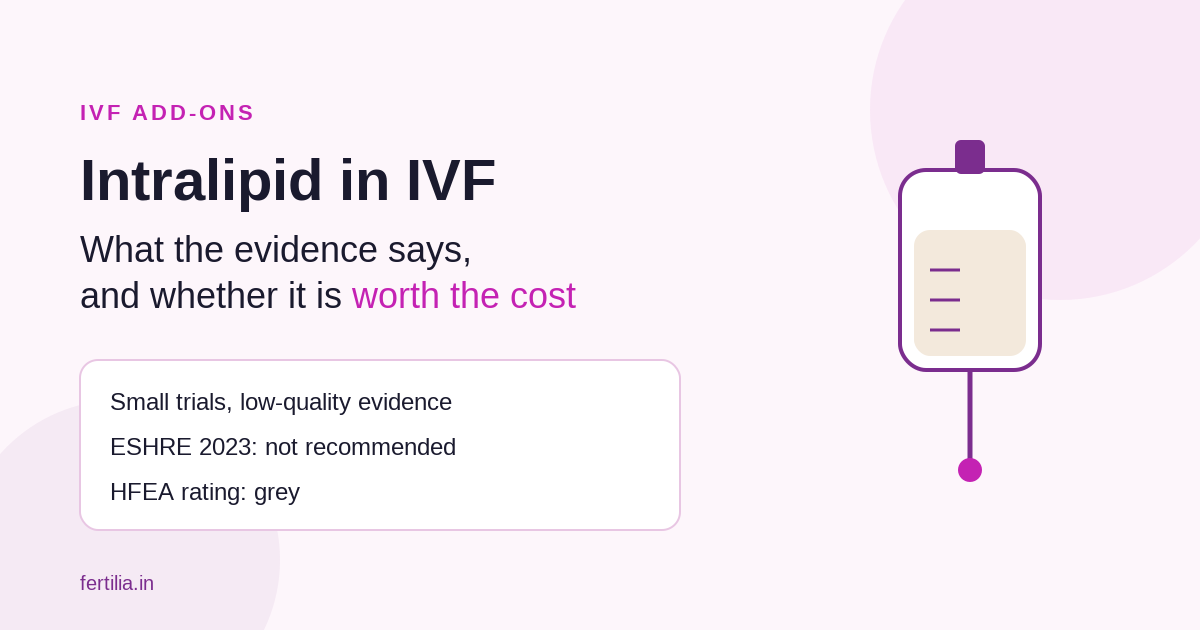
The short answer. Intralipid has some small, early trials behind it, but the reviews that pooled them rate the evidence as low quality, and the European Society of Human Reproduction and Embryology (ESHRE) does not recommend it in IVF. For most women, the money and the hospital visit are better spent elsewhere in the cycle.
What This Post Covers
- What intralipid is and why clinics offer it
- What the randomised trials and reviews found
- What ESHRE and the UK regulator say
- Side effects and safety
- How to think about the cost
- When an immune treatment is genuinely part of standard care
- Questions to ask your clinic
What Intralipid Is
Intralipid is a sterile fat emulsion, made from soybean oil, egg phospholipids and glycerine. It was designed to feed patients through a vein when they cannot eat, for example after major surgery or in neonatal intensive care. That is its licensed use.
In fertility it is used “off label” for a different idea. The theory is that some embryos fail to implant because the mother’s immune system reacts too strongly, and in particular because natural killer (NK) cells are “too active”. Intralipid has been proposed to damp down these immune signals. In IVF it is usually given as a slow drip, diluted in saline, once before or on the day of embryo transfer, and sometimes repeated in early pregnancy.
The weak point is the starting assumption. ESHRE’s 2023 recommendations on recurrent implantation failure list peripheral and uterine NK-cell testing as not recommended (ESHRE Working Group on Recurrent Implantation Failure, Hum Reprod Open, 2023, PMID 37332387). On hfea.gov.uk, the UK fertility regulator’s page on immunological tests and treatments (checked 28 Nov 2026) says there is no evidence that any immune cells, including uterine NK cells, ever do prevent a pregnancy. If you would like the full background on repeated failed transfers, our guide to recurrent implantation failure, its causes and the ERA test covers it step by step.
What the Trials Found
This is where the picture gets confusing, because some of the published numbers look encouraging.
One Indian trial. At AIIMS Delhi, 105 women with a previous failed IVF cycle were randomised to two intralipid drips (one after egg collection, one before transfer) or saline, and 102 were analysed after three were excluded for poor embryo quality. Clinical pregnancy was 34.6% with intralipid against 14% with saline, and the take-home baby rate was 28.8% against 10% (Singh N et al., Eur J Obstet Gynecol Reprod Biol, 2019, PMID 31228675). The authors themselves wrote that the literature is limited. With 52 and 50 women analysed in the two arms, this is a small study, and in small studies a large difference can appear by chance.
A pooled review of five trials. A 2021 meta-analysis combined five randomised trials with 843 women who had recurrent implantation failure. The intralipid group had higher clinical pregnancy (risk ratio 1.55) and live birth (risk ratio 1.83) rates. But the authors judged the trials to have an overall moderate risk of bias, noted the small sample size and the differing protocols, and concluded that there is limited evidence to support intralipid, with more research needed before using it in clinical practice (Rimmer MP et al., J Obstet Gynaecol Res, 2021, PMID 33754451).
Another review that tested how fragile the benefit is. A 2020 meta-analysis of four trials (544 women) also found higher live birth with intralipid, with the quality of evidence rated low. When the authors removed two studies that had been published only as conference abstracts, the difference in live birth and clinical pregnancy was no longer statistically significant. They also reported three congenital anomalies among babies of women who had received intralipid, without being able to say whether this was linked (Zhou P et al., Eur J Obstet Gynecol Reprod Biol, 2020, PMID 32622103).
A broader review of immune treatments. A 2018 meta-analysis of immunotherapy in IVF and recurrent pregnancy loss, covering intralipid among several other immune treatments, concluded that it did not show a role for immunotherapy in improving the live birth rate (Achilli C et al., Fertil Steril, 2018, PMID 30396553).
Put simply: the studies are small, the women in them are defined differently, the doses and timings vary, and the benefit shrinks when the weakest studies are removed. This is the pattern of a treatment that has not yet been shown to work, rather than one that has been shown not to.
💜 Has your clinic suggested intralipid for your next transfer? Message Dr. Suganya’s team on WhatsApp A ₹399 video consultation goes through your previous cycles and reports with you, working alongside your IVF team, from anywhere in India.
What ESHRE and the UK Regulator Say
Two professional sources matter most here, and both were checked for this post.
ESHRE, add-ons (2023). ESHRE’s good practice recommendations on add-ons in reproductive medicine do not recommend immune tests or immune treatments such as intralipid, IVIG (intravenous immunoglobulin) or steroids for women having IVF (Lundin K et al., Hum Reprod, 2023, PMID 37747409). Treating a diagnosed autoimmune condition is a separate matter, covered below.
ESHRE, recurrent implantation failure (2023). These recommendations colour-code each intervention, and intravenous intralipid infusion is among those not recommended, meaning it should not be offered routinely (ESHRE Working Group on Recurrent Implantation Failure, Hum Reprod Open, 2023, PMID 37332387).
HFEA (UK regulator). On hfea.gov.uk (checked 28 Nov 2026), intralipids are rated grey for improving the chance of a baby and for reducing miscarriage, both for most fertility patients and for patients who have had immune tests such as NK-cell blood tests. Grey means there is insufficient moderate or high quality evidence to say whether it works. By comparison, the HFEA rates IVIG and steroids red, because of potential safety concerns.
So the professional position is consistent: not recommended, because the evidence that it helps is not good enough. For how intralipid sits alongside the other common extras on an IVF quotation, our overview of which IVF add-ons are worth paying for places them side by side.
Side Effects and Safety
Intralipid is a hospital product with a long record in intravenous nutrition, and a single diluted dose is usually well tolerated. That does not make it free of risk. In their established use for intravenous nutrition, lipid infusions have been linked to effects on the liver, blood counts and fat clearance, and there is no large safety study of the fertility drip in early pregnancy.
Practical points if you are offered it:
- Tell the team about any egg or soy allergy, since the emulsion contains egg phospholipids and soybean oil.
- Mention any history of liver disease, high triglycerides or a clotting problem.
- It needs an IV line and observation, so it means a hospital or day-care visit, not a tablet at home.
How to Think About the Cost
Clinics in India price intralipid very differently. Some charge only for the drug, others bundle it with a day-care admission, nursing and a repeat dose in early pregnancy. I could not find a consistent published price to quote, so ask your clinic for the total in writing, including every planned dose and the admission charge.
Then put the number in context:
- What else could the money do? If you are paying yourself, the same amount may be better used towards a frozen embryo transfer, or towards a second full cycle. Our IVF cost breakdown for India shows what a base cycle and a frozen transfer usually include.
- What is being skipped? An intralipid drip should never replace the basic checks after a failed transfer: embryo quality, a look at the uterine cavity, thyroid function, and the transfer technique itself.
- Is it being added “just in case”? That is the situation ESHRE’s recommendations were written for. Asking for the evidence behind a just-in-case extra is reasonable, and a good clinic will not mind the question.
When Immune Treatment Is Standard Care
This is the part that matters most, and I want to be clear about it. Some women genuinely need treatment that works through the immune or clotting system, and it would be wrong to lump them in with the add-on question.
- Antiphospholipid syndrome (APS) is diagnosed from a history of blood clots or certain pregnancy complications together with antiphospholipid antibodies that stay positive on repeat tests, usually at least 12 weeks apart. A positive antibody test on its own is not APS. In pregnancy, APS is usually treated with aspirin and heparin under specialist care, with the plan depending on whether the history is of clots or of pregnancy complications.
- An underactive thyroid (hypothyroidism) is treated with thyroxine, with the dose adjusted for each woman and levels checked before and during treatment. An overactive thyroid needs different treatment, planned with the specialist.
- Diagnosed autoimmune conditions such as lupus are managed with the specialist who looks after them.
Treating a diagnosed condition like these is standard care, and a separate question from immune add-ons. It does not turn intralipid into an appropriate add-on for women without one.
Questions to Ask Your Clinic
If intralipid has been suggested, these questions will tell you most of what you need:
- What specific problem in my history is this meant to treat?
- Was a test used to decide, and is that test validated? (If the answer is an NK-cell test, ESHRE does not recommend NK-cell testing.)
- Which study supports giving it in my situation, and how many women were in it?
- How many doses, at what timing, and what is the total cost including admission?
- What would you check or change in my next cycle if I decide against it?
The fifth question often leads to the most useful conversation. After a failed transfer, the decisions with better evidence usually sit elsewhere: how many embryos are left and their grading, whether a frozen transfer is planned, and whether there is anything in the uterus to look at. Our posts on PGT-A testing and who needs it and on endometrial scratching before IVF cover two other extras that often come up at the same appointment.
Practical Takeaways
- Intralipid is a nutrition product used off label in IVF on an immune theory that has not been proven.
- The trials are small, the evidence is rated low quality, and the apparent benefit is not robust when weaker studies are removed.
- ESHRE (2023) does not recommend intralipid in IVF or for recurrent implantation failure. The HFEA rates it grey.
- Diagnosed APS, thyroid disease or autoimmune conditions need standard treatment, which is a separate matter.
- Ask for the total cost and the reason in writing, and weigh it against what else the money could do in your cycle.
Frequently Asked Questions
Does intralipid improve IVF success?
It has not been shown reliably. Small trials and pooled reviews reported higher pregnancy rates, but the quality of evidence was rated low, and one review found the benefit was no longer significant once studies published only as conference abstracts were removed (Zhou P et al., 2020, PMID 32622103). ESHRE does not recommend it.
Is intralipid infusion before embryo transfer recommended after failed IVF?
No. ESHRE’s 2023 recommendations on recurrent implantation failure state that intravenous intralipid infusion is not recommended (ESHRE Working Group on Recurrent Implantation Failure, Hum Reprod Open, 2023, PMID 37332387). If you have had repeated failed transfers, a structured review of embryos, the uterus and hormone levels is the better next step.
Does intralipid lower NK cells?
Intralipid has been proposed to reduce NK-cell activity, but ESHRE does not recommend NK-cell testing for recurrent implantation failure in the first place. Bringing down a number on a test that is not recommended does not show that the treatment helps a pregnancy.
Is intralipid safe in pregnancy?
A single diluted dose is usually well tolerated, but there is no large safety study in early pregnancy. Lipid infusions used for intravenous nutrition have been linked to liver, blood-count and fat-overload side effects. Tell your team about any egg or soy allergy or liver condition.
How much does intralipid cost in India?
It varies by clinic, and some bundle it with a day-care admission and repeat doses. Ask your clinic for the total cost in writing, covering every dose and the admission, before deciding.
I have antiphospholipid syndrome. Does this advice apply to me?
No. Confirmed APS is a diagnosed condition with standard treatment in pregnancy, usually aspirin and heparin, planned by a specialist around your own history. That is a separate question from the immune add-ons discussed here.
What can I do instead after a failed transfer?
Ask for a review of embryo quality and grading, an assessment of the uterine cavity, thyroid and other hormone checks, and a clear plan for the next transfer. Steady sleep, regular meals and movement help you cope through the cycle too.
Talk It Through Before Your Next Transfer
A failed transfer brings a lot of pressure to “do something more”. Sometimes the most useful thing is a calm look at what has already happened and what the evidence supports next.
If you would like that review, message Dr. Suganya’s team on WhatsApp to book a ₹399 video consultation, from anywhere in India. We work alongside your IVF team, and women who want continued support through treatment can join Fertilia’s IVF Support program.