The scan is booked, the date is close, and the obstetrician has said the word “caesarean”. Sometimes that was the plan from early on, perhaps because of a previous caesarean or a baby lying breech. Sometimes it is a change of plan late in the third trimester. Either way, one of the next conversations at home is about money: what will this cost, and how much of it will the insurance pay?
My name is Dr. Suganya Venkat, and in more than fifteen years as an OB-GYN I have found that families cope far better with a caesarean bill when they understood its lines before admission. This post is about those lines. It does not explain the operation itself; for that, read what to expect from a C-section delivery.
Here is what it covers:
- What a caesarean costs in government, trust and private hospitals, using prices the hospitals publish themselves
- Why a caesarean costs more than a normal delivery at the same hospital
- The five things that move a caesarean bill the most
- Whether a planned or an emergency caesarean is priced differently
- What JSSK, Ayushman Bharat and private health insurance pay for
- The questions to ask the billing desk before you are admitted
C-section cost in India: the quick answer
These are package prices published by the hospitals themselves, all checked on 19 October 2026. Treat them as planning figures. Your own hospital’s written estimate is the number that counts.
| Where you deliver | Example and source | Caesarean package | Same hospital’s normal delivery package |
|---|---|---|---|
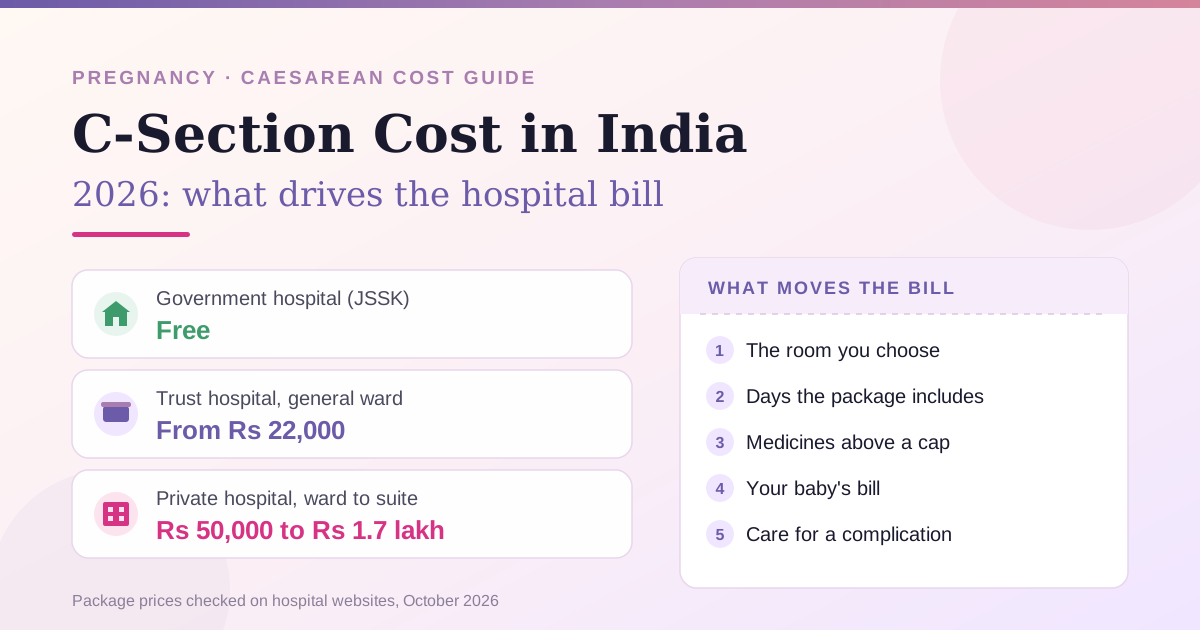
| Government hospital | Any public health facility, under JSSK (nhm.tn.gov.in) | Free | Free |
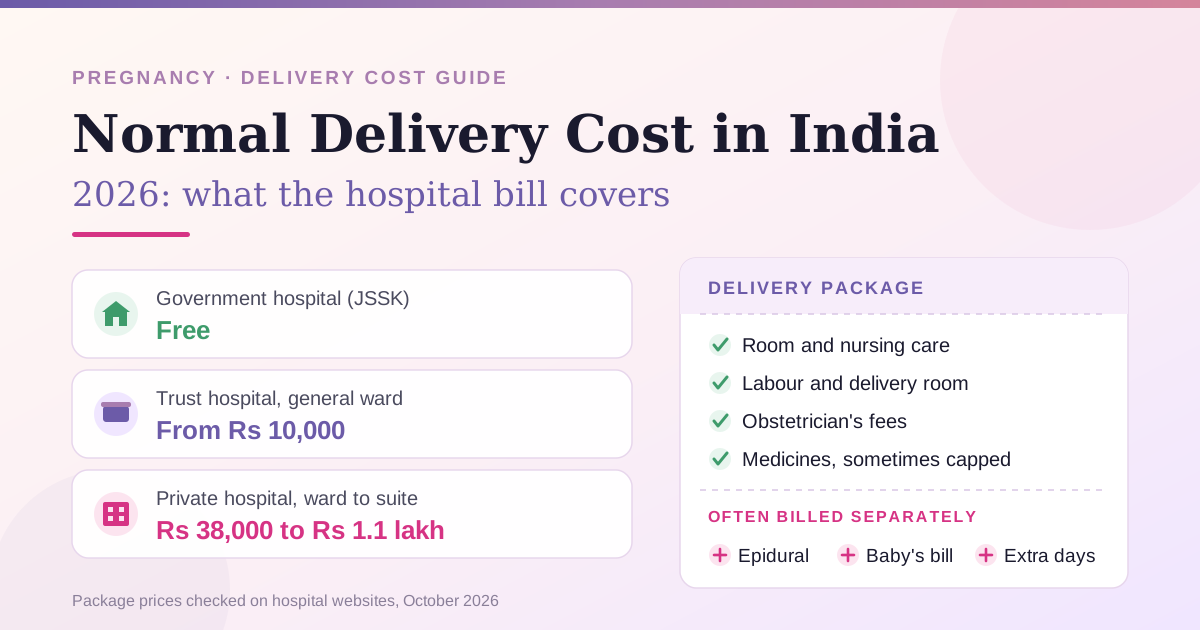
| Trust hospital, general ward | PSG Hospitals, Coimbatore, Anbudan Amma package (psghospitals.com) | Rs 22,000 | Rs 10,000 |
| Mid-range private | Vivekananda Hospital, Hyderabad (vivekanandahospital.in) | Rs 50,000 (general ward) to Rs 1,00,000 (single AC room) | Rs 38,000 to Rs 75,000 |
| Metro private | Ovum Hospitals, Bengaluru (ovumhospitals.com) | Rs 90,000 to Rs 1,60,000 | Rs 75,000 to Rs 85,000 |
| Metro private | Prashanth Hospitals, Chennai (prashanthhospitals.org) | Rs 1,30,000 (private room) to Rs 1,70,000 (suite) | Rs 90,000 to Rs 1,10,000 |
For a wider benchmark, the insurer ManipalCigna puts the indicative cost of a caesarean delivery at about Rs 95,000 nationally, about Rs 80,000 in Tier 2 cities such as Coimbatore, and about Rs 1,80,000 in Tier 1 cities such as Chennai, Bengaluru and Hyderabad (manipalcigna.com, checked 19 October 2026). The same insurer’s figure for a normal delivery is about Rs 60,000.
Survey data shows how wide the public-private gap is for what families pay themselves. An analysis of NFHS-5 (2019-21), covering 159,643 births, found that out-of-pocket spending on a caesarean averaged US$498 in private health centres against US$99 in public ones (Singh RR et al., BMC Health Serv Res, 2023, PMID 37679706). Those figures are several years old, so read them as the pattern, not today’s price.
Why a caesarean costs more than a normal delivery at the same hospital
At every hospital in the table, the caesarean package sits above the normal delivery package for the same room. The gap was Rs 12,000 at PSG, Rs 12,000 to 25,000 at Vivekananda depending on the room, and Rs 40,000 to 60,000 at Prashanth.
The published inclusion lists show what that difference pays for:
- The operation theatre and the surgical team. PSG’s caesarean package adds surgery and theatre charges, instrument charges and post-surgery recovery care to everything in its normal delivery package. Prashanth includes theatre and recovery room charges and the gynaecologist, anaesthetist and neonatologist for the admission.
- The anaesthesia. PSG includes anaesthesia and equipment use in the caesarean package, and Vivekananda includes full theatre charges with anaesthesia for a caesarean. At PSG, the separate epidural charge applies only to a normal delivery.
- More days in hospital. PSG’s caesarean package covers up to 6 days against 5 for a normal delivery, Vivekananda’s 4 to 5 days against 2 to 3, and Prashanth’s 4 days against 3.
So a caesarean bill is larger mainly because it pays for an operation and a longer stay. The care around the birth, the nursing, the monitoring and your obstetrician’s visits, is much the same.
The five things that move a caesarean bill
1. The room you choose
Look at a price sheet and you will usually find one list of inclusions with several prices beside it. Vivekananda charges Rs 50,000 for a caesarean in the general ward, Rs 70,000 in a single non-AC room and Rs 1,00,000 in a single AC room. Prashanth charges Rs 1,30,000, Rs 1,50,000 or Rs 1,70,000 for a private room, a deluxe room or a suite. On both sheets a single inclusion list covers every room, so the step-up from one column to the next pays for the room itself: privacy and comfort for you and the family member who stays with you.
The room also matters for insurance, which is covered further down. If your policy caps room rent, a costlier room can reduce what the insurer pays on the rest of the bill.
2. The days the package includes, and when they start
A caesarean package includes a fixed number of days, and every hospital above bills days beyond that separately or adjusts for them. Two practical points:
- Ask when the count starts. Prashanth’s days run from the time of admission. If you are admitted the evening before a planned caesarean, that night uses one of your package days.
- Recovery decides the discharge date, not the package. If you or your baby need to stay longer than the package allows, the extra days are a medical decision, and the bill follows. My week-by-week C-section recovery guide explains what the first days in hospital involve.
3. Medicines, consumables and food
This is where the published packages differ most in what they include. Prashanth covers pharmacy and consumables up to Rs 20,000 and bills anything above that, and it includes planned meals for you. Vivekananda includes medicines, IV fluids, injections, consumables and meals. PSG’s general-ward package bills diet and pharmacy separately. Over a stay of 4 to 6 days after an operation, that line can be sizeable, so ask whether there is a cap and what is outside it.
4. Your baby’s bill
The newborn usually has a separate account. Vivekananda lists newborn charges of Rs 10,000 to 13,000 as additional to the mother’s package, with NICU care at actual cost. Prashanth says the baby bill is charged extra, and PSG excludes the baby’s NICU care. Ovum says its packages include paediatric support for the newborn during the stay.
The timing of a planned caesarean can matter here. In a large US study of over 13,000 planned repeat caesareans, babies born at 37 or 38 weeks had more breathing problems and more NICU admissions than babies born at 39 weeks (Tita AT et al., N Engl J Med, 2009, PMID 19129525). When there is no medical reason to deliver earlier, it is reasonable to ask your obstetrician about the planned date. When there is a medical reason, such as pre-eclampsia or bleeding, that reason comes first.
5. Care for a complication
Packages are priced for a straightforward caesarean. PSG excludes high-risk pregnancy care, ICU care for the mother and blood transfusion. Prashanth excludes ICU charges and additional tests needed for a complication, and it lists twins and other multiple births as outside the standard package. If you are carrying twins, ask for a separate estimate; my twin pregnancy guide covers how delivery is planned.
Most caesareans need none of these extras. Knowing which lines sit outside the package simply means that, if one is needed, the bill will not be a surprise.
Planned or emergency caesarean: does the price change?
None of the four private price sheets above lists a separate price for an emergency caesarean. Each publishes one caesarean price per room, and under JSSK both are free in government hospitals. What tends to differ is the route to the theatre:
- A planned caesarean lets you choose the room, finish insurance pre-authorisation before admission and plan who stays with you.
- An emergency caesarean often follows several hours of labour. Ask your hospital whether time in the labour room, or an epidural placed during labour, is billed on top of the caesarean package if a planned normal delivery ends in theatre.
If you booked a normal delivery package, my guide to what a normal delivery bill covers explains how the bill moves to the caesarean package if labour changes course.
Whether your baby is born vaginally or by caesarean is a medical decision you make with your obstetrician, and the package price has no place in it. My normal delivery vs C-section decision guide explains what that decision rests on. If you had a caesarean before and are wondering whether this birth could be vaginal, the VBAC guide covers who is a good candidate.
National data shows why this question comes up so often in private care. In NFHS-5 (2019-21), 47.4% of births in private health facilities were by caesarean, against 14.3% in public facilities (NFHS-5 India fact sheet). If a caesarean is recommended for you, asking your obstetrician to walk you through the reason is part of good care, and a good obstetrician will welcome it.
If you would like to understand a caesarean recommendation or prepare questions for your hospital, you can talk it through with Dr. Suganya alongside your own obstetrician’s care:
WhatsApp Dr. Suganya: wa.me/919940270499 (₹399 video consultation, pan-India, online only)
Government hospitals: a free caesarean under JSSK
In a government hospital, a caesarean should cost you nothing. Under the Janani Shishu Suraksha Karyakram (JSSK), every pregnant woman delivering in a public health institution is entitled to a free, no-expense delivery, including a caesarean section. The entitlements include free medicines and consumables, free tests, free blood where required, exemption from user charges, free food for up to 7 days after a caesarean, and free transport from home, between hospitals on referral, and back home. Sick newborns have matching entitlements (nhm.tn.gov.in, checked 19 October 2026).
Families still report some spending: in the NFHS-5 analysis above, out-of-pocket spending on a caesarean in a public health centre averaged US$99. Carry some money for incidentals, but the operation itself should not be billed. The cash support schemes for mothers, such as JSY, PMMVY and Tamil Nadu’s Dr. Muthulakshmi Reddy Maternity Benefit, are listed in the normal delivery cost guide.
Ayushman Bharat (PM-JAY) and caesarean delivery
PM-JAY’s package list includes a caesarean delivery package. In the 2022 package master published by Kerala’s state health agency, it is priced at Rs 12,000 to 15,000 depending on city tier (HBP 2022, sachis.in). That is the rate the scheme pays the hospital, not a bill to you.
The package is steered towards government hospitals. The National Health Authority’s Health Benefit Package 2.0 user guidelines state that the C-section, high-risk delivery and hysterectomy packages are primarily for government facilities and open to private hospitals on referral by government hospitals or doctors, and they advise states to keep delivery-related packages reserved for public hospitals, with each state making the final call (HBP 2.0 user guidelines).
In NFHS-5, collected in the scheme’s early years, enrolment in PM-JAY or another government insurance scheme was not associated with lower out-of-pocket spending on caesarean deliveries (Garg S et al., BMC Res Notes, 2023, PMID 37217964). If you plan to use an Ayushman card for a caesarean in a private hospital, confirm with that hospital’s PM-JAY desk, well before your due date, whether you will be covered and on what referral.
Private health insurance: what it pays towards a caesarean
ManipalCigna’s guide to maternity cover (manipalcigna.com, checked 19 October 2026) sets out the conditions that decide whether a policy pays:
- Maternity cover is not in every policy. Some plans include it; others need a maternity add-on.
- There is a waiting period, from 9 months to 4 years depending on the policy, and pregnancy claims within it are not paid. Most insurers do not offer maternity cover to a woman who is already pregnant when she buys the policy.
- There is a caesarean sub-limit. Caesarean sub-limits are usually higher than normal delivery limits, ranging from Rs 40,000 to Rs 1 lakh or more in premium plans. In some policies the limit covers only the delivery; in others it covers the whole stay, including room rent and medicines.
- Newborn cover often starts from the first day of life, up to specified limits.
- Employer group policies sometimes include maternity cover without the long waiting periods of individual plans.
Put a sub-limit beside the table at the top and you can see the gap. A Rs 50,000 caesarean limit would cover Vivekananda’s Rs 50,000 general-ward package, but well under half of Prashanth’s Rs 1,30,000 private-room package, and the baby’s bill sits on top of both.
Check the room rent clause too. If your policy caps room rent and you choose a costlier room, the insurer may reduce what it pays for other charges in proportion (manipalcigna.com, checked 19 October 2026). For a caesarean, with its theatre and surgical charges, a room within your limit can protect much more of the claim than the room rent alone.
Even with insurance, expect to pay part of a private delivery yourself. In an NFHS-5 analysis of 145,386 women, health insurance was not enough to bring down out-of-pocket spending on deliveries in private facilities (Manna S et al., BMC Public Health, 2023, PMID 37532981). For cashless admission, most insurers need pre-authorisation papers before or at admission; the paperwork section of my hospital bag checklist lists what to keep ready.
What a caesarean is called in Tamil and Hindi
Many families search for this in their own language. In Tamil, a caesarean delivery is usually called siseriyan prasavam (சிசேரியன் பிரசவம்), the phrase PSG Hospitals uses on its own Tamil price sheet. In Hindi, it is often simply “operation se delivery” (ऑपरेशन से डिलीवरी). If you have been searching “siseriyan prasavam cost” or “operation delivery ka kharcha”, the table at the top of this post answers the same question.
Questions to ask before you are admitted
Ask these at the billing desk once a caesarean is planned or likely, and ask for the answers in writing.
- What is the caesarean package price for the room I want, and how many days does it include? Do the days count from admission or from the operation?
- Are the surgeon’s, anaesthetist’s and paediatrician’s fees all inside the package?
- Is there a cap on medicines and consumables? Are my meals included?
- What is included for my baby, and what does a day in the NICU cost?
- What does each extra day cost, for me and for my baby?
- If I go into labour before the planned date, or a planned normal delivery ends in a caesarean, which package applies, and is labour-room time billed separately?
- What is excluded if there is a complication: ICU, blood transfusion, extra tests?
- Do you accept my insurance or government scheme cashless, and what documents do you need before admission?
- Is there a booking advance, and is it adjusted against the final bill?
- Will I get an itemised final bill?
Keep the written answers with your antenatal file. At discharge, compare the itemised bill with the package; anything outside it should match an exclusion you were told about.
Frequently Asked Questions
How much does a C-section cost in India in 2026?
A caesarean is free in government hospitals under JSSK. In private and trust hospitals, packages published in October 2026 ranged from Rs 22,000 in a trust hospital general ward in Coimbatore to Rs 1,70,000 for a suite in a Chennai private hospital. The insurer ManipalCigna’s indicative national average is about Rs 95,000. Days beyond the package, the baby’s bill and care for complications can add to it.
Is a C-section free in government hospitals?
Yes. Under the Janani Shishu Suraksha Karyakram, every woman delivering in a public health institution is entitled to a free delivery, including a caesarean, with free medicines, tests, blood, food for up to 7 days and transport, and no user charges. Some families still spend on incidentals, but the operation itself should not be billed.
Why does a C-section cost more than a normal delivery?
Because the package pays for an operation and a longer stay. Hospital packages add theatre charges, the surgical team and anaesthesia, and cover 4 to 6 days in hospital instead of 2 to 5. At the hospitals in this post, the caesarean package was Rs 12,000 to Rs 60,000 more than the normal delivery package for the same room.
Does health insurance cover a C-section?
Only if your policy includes maternity cover and its waiting period, typically 9 months to 4 years, is over. Most insurers do not offer maternity cover to a woman who is already pregnant at purchase. Even when covered, a caesarean sub-limit, often Rs 40,000 to Rs 1 lakh, caps the payout, and a room above your room-rent limit can reduce the rest of the claim.
Is an emergency C-section more expensive than a planned one?
The private hospital price sheets in this post publish one caesarean price per room, not a separate emergency price. What can differ is what came before: if the caesarean follows hours of labour, ask whether labour-room time or an epidural placed in labour is billed on top. Complications such as ICU care or blood transfusion are billed separately at the hospitals reviewed.
Does Ayushman Bharat cover a C-section in a private hospital?
PM-JAY has a caesarean delivery package, but national guidelines describe it as primarily for government hospitals, open to private hospitals on referral by a government hospital or doctor, and many states reserve delivery packages for public hospitals. Confirm with the private hospital’s PM-JAY desk well before your due date.
How much does a siseriyan prasavam cost in Tamil Nadu?
A siseriyan prasavam (சிசேரியன் பிரசவம்), as a caesarean is called in Tamil, is free in Tamil Nadu government hospitals under JSSK. In private and trust hospitals the range is wide: PSG Hospitals, Coimbatore, charged Rs 22,000 in its general ward, while Prashanth Hospitals in Chennai charged Rs 1,30,000 to Rs 1,70,000 depending on the room, as checked in October 2026.
Getting ready for a caesarean birth
The bill is one part of getting ready. At Fertilia, the Pregnancy Care program offers trimester-wise guidance and birth preparation over video consultations, alongside the obstetrician who will deliver your baby, and the free normal delivery and postpartum care guide covers the weeks after you come home.
WhatsApp Dr. Suganya: wa.me/919940270499 (₹399 video consultation, pan-India, online only)