Some women put off seeing a gynaecologist for years over a question they never say out loud: if I go, will she be able to tell?
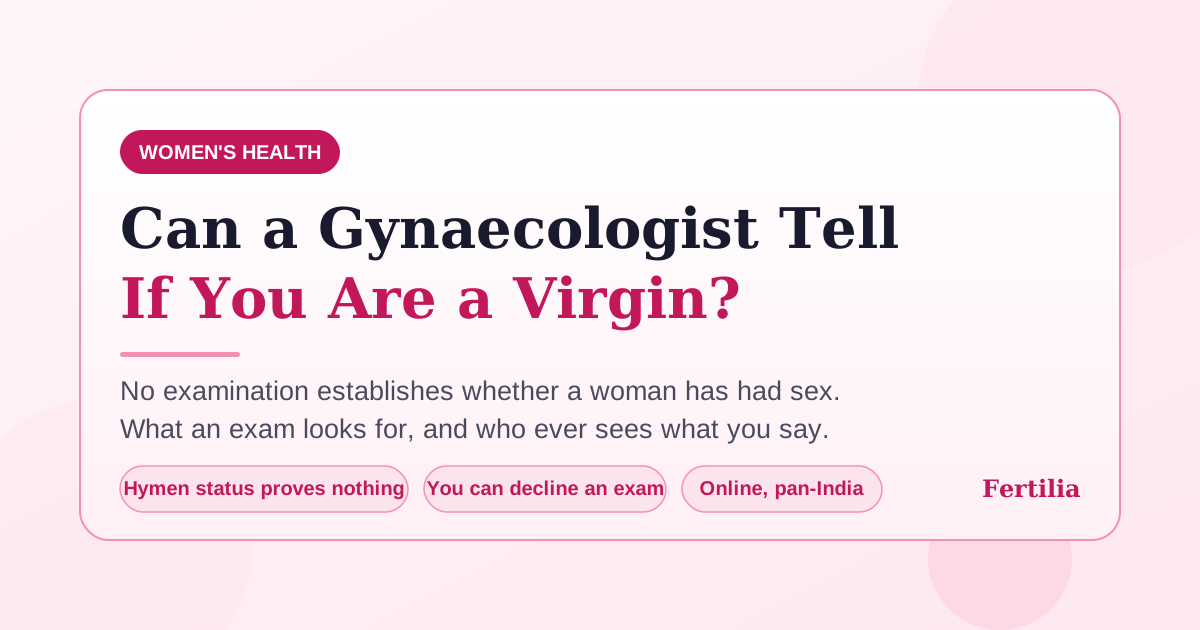
The short answer is no. There is no examination, scan or test that can read a woman’s sexual history off her body.
The question comes in both directions. Some women are afraid an examination will reveal that they have had sex. Others are afraid it will reveal that they have not, and that this will become a topic of conversation. Both versions keep women out of consultations they need, sometimes for a decade.
I am Dr. Suganya Venkat, an obstetrician and gynaecologist of over fifteen years, and I have never written down whether a woman has had sex unless she told me herself and it mattered to her care. This post is about the two things women are really asking when they ask this question: what an examination can determine, and who ever finds out what you said.
The women who eventually raise it with me are rarely there for that question. They have booked about periods that stopped, or cramps that got worse every year, or a lump they found, and the question comes out near the end of the consultation, in a lowered voice, as though it were off the agenda. It is worth putting on the agenda.
This guide covers:
- What a pelvic examination can and cannot establish about sexual history
- What a gynaecologist is looking for when she examines you, which is a different list entirely
- The two-finger test, virginity certificates, and where Indian law and guidance stand
- What changes in a consultation when you say you have not had sex
- Who has access to what you disclose, and the narrow exceptions
No examination establishes whether a woman has had sex
The belief underneath the fear is that the hymen keeps a record. It does not.
The hymen is a thin fold of tissue at the vaginal opening. Its shape varies widely between women from birth. In most it is a partial rim rather than a covering, and in some it is barely present at all. It stretches and thins through ordinary life: sport, cycling, tampons, menstrual cups, a fall in childhood. Two women with identical histories can have entirely different hymenal appearance, and two women with opposite histories can look the same.
India’s own clinical guidance says this plainly. The Ministry of Health and Family Welfare guidelines on medico-legal care for survivors of sexual violence, quoted by the Supreme Court in 2022, state: “The status of hymen is irrelevant because the hymen can be torn due to several reasons such as cycling, riding or masturbation among other things. An intact hymen does not rule out sexual violence, and a torn hymen does not prove previous sexual intercourse.” (Ministry of Health and Family Welfare, Medico-legal care for survivors / victims of sexual violence, 19 March 2014, quoted at paragraph 64 of State of Jharkhand v. Shailendra Kumar Rai, Criminal Appeal No. 1441 of 2022, judgment dated 31 October 2022, sci.gov.in.)
The research says the same thing. The first systematic review of the medical utility of examining the hymen to assess sexual history screened 1,269 studies and included 17. It concluded that hymen examination does not accurately or reliably predict virginity status, and that the practice carries physical, psychological and social harm for the person examined (Olson RM, García-Moreno C, Reproductive Health, 2017, PMID 28521813).
So the answer to the question in the title is no. Not by looking, not by touching, not by scanning. There is no finding that separates one history from another with any reliability, which is why no clinician should be offering an opinion on it.
What a gynaecologist is looking at during an examination
It helps to know what the examination is actually for, because the list is nothing like what most women imagine.
An external examination looks at the vulval skin: colour, texture, fissures, thinning, any lesion, any area that is tender when touched with a cotton swab. A speculum examination, when one is needed, lets a clinician see the vaginal walls and the cervix, take a smear, or take a swab if infection is suspected. An internal examination with a gloved finger assesses the size and position of the uterus, whether the ovaries are tender, and in conditions like vaginismus, how the pelvic floor muscle responds to gentle contact.
Every item on that list is a question about your health right now. We are asking whether there is an infection, whether the pain sits at the entrance or deep inside, and whether a tilted uterus explains the cramps.
None of these questions are answered by, or asked about, your sexual history. Where sexual history is genuinely relevant, and sometimes it is, the way we find out is by asking you. We ask because it changes what we look for. If you are not sexually active, a whole category of cause becomes unlikely and a different category becomes more likely, and knowing that saves you tests you do not need. It is a clinical variable, in the same way that your age or your last period is.
You are also allowed to not answer. A woman who says she would rather not discuss it is not obstructing her own care. She has simply set a boundary, and a clinician works around boundaries all the time.
The two-finger test, and virginity certificates
There is one specific practice worth naming, because women ask about it and because it still surfaces.
The two-finger test, also called a per vaginum test, involves inserting fingers into the vagina to form an opinion about whether a woman is “habituated to sexual intercourse”. In the context of examining a person alleged to have been sexually assaulted, the Supreme Court of India dealt with it directly in 2022. The judgment records that the test “has no scientific basis and neither proves nor disproves allegations of rape”, that it “re-victimizes and re-traumatizes women”, and that it “must not be conducted” (paragraph 60). The Court referred back to its own 2013 decision in Lillu v. State of Haryana, which held that the test violates a survivor’s right to privacy, physical and mental integrity and dignity (paragraph 61). At paragraph 68 it directed that any person who conducts the test in contravention of those directions “shall be guilty of misconduct”. The Court also directed that medical school curricula be reviewed so the test is no longer taught as a procedure (paragraph 66). (State of Jharkhand v. Shailendra Kumar Rai, Criminal Appeal No. 1441 of 2022, 31 October 2022, sci.gov.in.)
Those directions are addressed to the medico-legal examination of sexual assault survivors, which is the setting the case arose from. The anatomical point underneath them is not confined to that setting. A finding that proves nothing in a courtroom proves nothing in a consulting room either.
Families sometimes ask for a certificate or a confirmation. Two things are worth holding side by side. There is no examination that could support such a document, for the reasons above. And the code of ethics regulations for registered medical practitioners, published by the Medical Council of India in 2002 and hosted today by the National Medical Commission at nmc.org.in, treat signing a certificate or report “which is untrue, misleading or improper” as grounds for removal from the register (Indian Medical Council (Professional Conduct, Etiquette and Ethics) Regulations, 2002, clause 7.7). Read those together and a document attesting to virginity has nothing behind it.
If a doctor has previously told you something about your hymen, that is worth putting in context rather than carrying as a verdict. This was taught in Indian medical curricula for a long time, which is precisely why the Supreme Court asked for the curriculum to be reviewed. A clinician working from what they were taught two decades ago is not acting in bad faith. The teaching moved, and you are entitled to the current version of it.
💬 Worried about the examination more than the appointment? You can describe what is going on in your own words first and decide about an examination later, or not at all. A consultation with Dr. Suganya is ₹399. Message her on WhatsApp. Fertilia consults over video across India, so there is no clinic waiting room in the picture. If an examination does turn out to be needed, we tell you exactly what to ask for and you have it done with a clinician near you.
What changes when you say you have not had sex
Telling a clinician you are not sexually active is useful information, and it changes the practical shape of the appointment rather than the quality of the care.
The examination is often not done at all. A great deal of gynaecology is history, an abdominal examination, and a scan. If you have come about irregular periods, acne, cramps or a suspected ovarian issue, an internal examination frequently adds nothing.
A scan can usually be done a different way. A transvaginal scan gives the clearest images of the uterus and ovaries, but a transabdominal scan with a full bladder is often sufficient, and it is the routine alternative when a woman has not had penetrative sex. It has real limits, which you should know before choosing it: the bladder has to be genuinely full for it to work, small ovarian findings and endometrial thickness are harder to see, and body habitus can make the images harder to read. Where the abdominal scan does not answer the question, we say so and talk through what else could be done. Nobody proceeds to an internal scan without your agreement. Our post on what a transvaginal scan shows and why it is done covers what each approach can and cannot see, so you can ask for the alternative knowingly rather than apologetically.
If a speculum examination is genuinely needed, the equipment changes. Speculums come in different sizes, including narrow ones. Lubricant is used. The clinician goes slowly and stops when you say stop.
You can decline on the day. “I would rather not have an internal examination today” is a complete sentence. It is not a refusal of treatment and it does not mean starting again. Many women are examined weeks into a treatment plan, and some never are.
You can ask for a second person in the room. A female attendant or nurse chaperone is standard practice and you can request one without giving a reason.
If the examination itself is what frightens you, rather than what it might reveal, that fear has been studied on its own and there are specific adjustments that help. Our psychiatrist Dr. Sandhiya Loganathan has written about them in fear of pelvic exams and how to make your visit easier.
Who sees what you say
This is the part that most often goes unasked, so let me set out how it works.
What you tell a clinician is confidential. The same code of ethics regulations put it directly: a practitioner “shall not disclose the secrets of a patient that have been learnt in the exercise of his / her profession”, with three listed exceptions, being an order of the presiding judge in a court of law, a serious and identified risk to a specific person or the community, and notifiable diseases (Indian Medical Council (Professional Conduct, Etiquette and Ethics) Regulations, 2002, clause 7.14, nmc.org.in). Disclosing outside those exceptions sits in the chapter of the regulations headed misconduct.
In practice this is what that means for an adult woman:
Being booked or paid for by a family member does not create a right of access. A parent who fixed the appointment is not a party to it. If someone asks to be present and you would rather they were not, saying so to the clinician is enough, and it is a request clinicians handle routinely.
A prescription is not a summary of the conversation. It carries what you have been asked to take. A scan request carries what is being looked for. Neither is a transcript.
An online consultation removes most of the exposure people worry about. There is no clinic address, no waiting room where you might be recognised, no travel to account for. It is one of the underrated reasons women who would never walk into a gynaecology clinic will take a video call.
You choose what to say. If a detail is not needed for your care, it does not need to be in the conversation. And if you want something kept out of a written record, say so at the time and ask what can be accommodated.
One boundary on all of this: it is written for adult women. If you are under eighteen, the rules around consent and disclosure are not the same, and the right move is to ask at the start of the consultation what applies to you, so you know before you speak rather than after.
If the real question is about the wedding night
For some women this is not about a doctor at all. It is about the belief that a first night produces evidence, and that its absence will be noticed.
It does not. Bleeding at first intercourse is common but far from universal, and not bleeding says nothing about what came before. Pain at first penetration also has a range. When it is severe, or when entry is not possible at all, the reason I see most often by a wide margin is a pelvic floor condition called vaginismus, which responds well to treatment. Less often there is an anatomical reason such as a rigid or microperforate hymenal rim or a vaginal septum, which is also treatable, usually with a small procedure. Both are worth having assessed rather than endured, and telling the two apart is a large part of what a first consultation is for. We cover the presentation in first time sex: painful, normal, or vaginismus, and if you are unmarried and thinking about getting this looked at before a wedding, vaginismus before marriage answers the practical questions about timing and privacy.
What is worth an appointment sooner
Most of this post is about taking your time. A few things are worth booking for sooner rather than at a comfortable moment, because they are easier to sort out early:
- Bleeding between periods, or bleeding after intercourse
- Periods stopping for three months or more when you are not pregnant
- A lump in the breast or around the vulva
- Pelvic pain strong enough to interrupt an ordinary day
- Discharge with a strong smell, especially with fever
Most of the time these turn out to be treatable and not serious. They are simply the ones where an early answer is a better answer, and every one of them can be raised in a consultation without an examination.
Frequently Asked Questions
Can a gynaecologist tell if you are a virgin?
No. There is no examination finding that reliably establishes whether a woman has had sex. Hymenal tissue varies widely from birth and stretches through ordinary activity such as sport, cycling and tampon use. A systematic review of the evidence concluded that hymen examination does not accurately or reliably predict virginity status (Olson RM, García-Moreno C, Reproductive Health, 2017, PMID 28521813), and India’s Ministry of Health and Family Welfare guidelines state that an intact hymen does not rule out sexual violence and a torn hymen does not prove previous intercourse.
Will the doctor know I have had sex if I do not tell her?
No. Nothing in a routine gynaecological examination reveals it. A clinician learns your sexual history only if you tell her, and she asks about it because it changes which causes are likely and which tests are worth doing, not to form a judgment about you.
Can a doctor tell if my hymen is broken?
A clinician can describe what hymenal tissue looks like, but that description carries no information about sexual history. The tissue is a partial rim in most women, differs between women from birth, and changes with ordinary activity. There is no before-and-after state to compare against, which is why the appearance cannot be read backwards into an event.
Is the two-finger test still done in India?
The Supreme Court of India held in 2022 that the two-finger test has no scientific basis, must not be conducted, and that anyone who conducts it in contravention of the Court’s directions shall be guilty of misconduct, in the context of examining people alleged to have been sexually assaulted (State of Jharkhand v. Shailendra Kumar Rai, Criminal Appeal No. 1441 of 2022, 31 October 2022). The Court also directed that medical school curricula be reviewed so it is no longer taught. It records that the practice had nonetheless continued at that time.
Is what I tell my gynaecologist confidential in India?
Yes. The professional conduct regulations for registered medical practitioners state that a practitioner shall not disclose secrets learnt in the exercise of the profession, with three exceptions: an order of the presiding judge in a court of law, a serious and identified risk to a specific person or the community, and notifiable diseases (Indian Medical Council (Professional Conduct, Etiquette and Ethics) Regulations, 2002, clause 7.14).
Will my parents find out what I discussed if they booked the appointment?
Booking or paying for a consultation does not give someone access to it. For an adult woman the consultation is hers. If a family member wants to be in the room and you would rather they were not, telling the clinician is enough, and it is a routine request rather than an awkward one.
Can a doctor issue a virginity certificate in India?
There is no examination that could support one. Hymenal appearance does not establish sexual history, so a document attesting to virginity has nothing behind it, and the code of ethics regulations for registered medical practitioners treat signing a certificate or report “which is untrue, misleading or improper” as grounds for removal from the register (Indian Medical Council (Professional Conduct, Etiquette and Ethics) Regulations, 2002, clause 7.7, nmc.org.in). If a family member or an institution asks you to produce one, a clinician can put that position in writing for you, which is often easier to hand over than to argue.
Can I refuse an internal examination and still be treated?
Yes. Declining an examination on a given day is a normal part of care, not a refusal of treatment. Most gynaecological assessment starts with history, and many conditions can be worked up with an abdominal examination and a scan. If an internal examination is genuinely necessary later, it can be done then, at a point you agree to.
If this question has been sitting between you and an appointment, that is common, and it is a solvable problem rather than a permanent one.
💬 Ask the question before you book, not after. You can tell me what you are worried about and I will tell you what would and would not be involved, including whether an examination is needed at all. Message Dr. Suganya on WhatsApp. If pain or fear of penetration is part of the picture, Fertilia’s online vaginismus treatment program runs entirely over video across India, with a gynaecologist, a psychiatrist and a pelvic floor physiotherapist working from one plan.