Most of what is written about vaginismus in India assumes you are already married. The advice arrives framed around a husband, a shared bed, a marriage that is not working the way someone expected it to. If you are unmarried, that framing quietly tells you the door is not open yet.
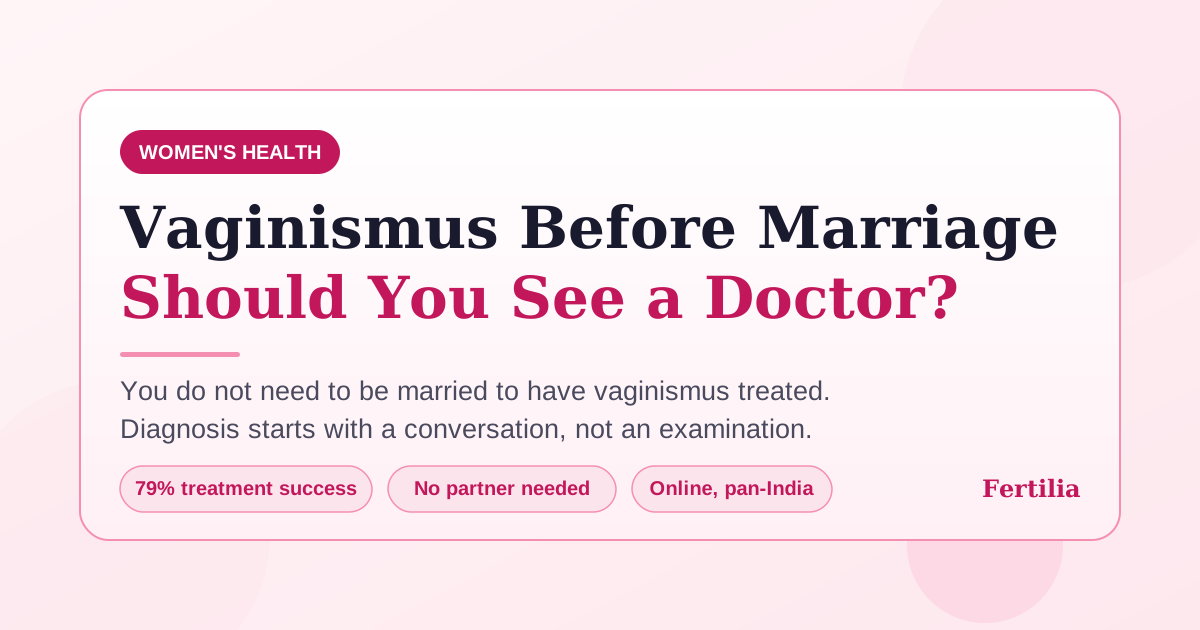
It is open. Vaginismus is a condition of the pelvic floor muscles, and pelvic floor muscles do not check your marital status. Women come to me having known something was wrong since their first attempt at using a tampon at nineteen, and having waited years to ask about it because every article they found seemed to be addressed to someone else.
I am Dr. Suganya Venkat, an OB-GYN with over fifteen years of clinical experience, and this post is written for the woman who is not married, is not necessarily planning to be, or has a wedding date approaching and no idea whether there is time.
This guide covers:
- Why being unmarried changes nothing about whether you can be treated
- What actually happens at a first consultation, including whether anyone examines you
- How treatment works when you are not sexually active
- Whether there is enough time if a wedding is weeks away
- What to do when you cannot tell your family yet
Being unmarried does not change the diagnosis or the treatment
Vaginismus is an involuntary tightening of the pelvic floor muscles when something approaches or enters the vagina. It shows up long before anyone’s wedding: with tampons, with menstrual cups, with a first cervical smear, with a routine gynaecological examination. Plenty of women meet it for the first time in a clinic, not a bedroom.
The treatment is the same regardless of whether you are married, single, engaged, or have no intention of marrying at all. It is graded desensitisation of those muscles, breathing work that teaches the nervous system to stand down, and where fear is a strong driver, psychological support alongside. None of that requires a partner, and none of it requires a reason.
A 2018 systematic review of 43 studies found an overall treatment success rate of 79%, rising to 82% in the higher-quality trials (Maseroli E, Scavello I, et al., The Journal of Sexual Medicine, 2018, PMID 30446469). Those numbers are not conditional on marital status.
If you have already seen a gynaecologist and come away feeling brushed off, that is worth naming. In my experience most Indian gynaecologists see very little sexual pain, simply because so few women raise it. A doctor who does not treat vaginismus often is not a bad doctor. They are simply not the right person for this particular problem, and asking for someone who sees it regularly is a reasonable thing to do rather than an accusation.
What happens at a first consultation
The single biggest reason women delay is not embarrassment about the condition. It is the assumption that walking into an appointment means an internal examination on the first day.
It does not. Vaginismus is diagnosed largely from history: what happens when you try, at what point the tightening begins, whether it has always been this way or started after something, whether it happens with tampons and examinations as well as with a partner. A careful conversation gets a clinician most of the way to the diagnosis.
A physical examination can help confirm it and rule out other causes of pain, and it is genuinely useful information when it can be done. But it is not the first move, it is not urgent, and it is not something that should happen before you are ready for it. If a clinician wants to examine you and you are not ready, saying so is a complete answer. Many women are examined for the first time several weeks into treatment, once the muscles have already begun to settle, and some are never examined at all.
Because we consult over video, an examination is not something that happens in our appointments at all. When one is genuinely needed, we arrange it with a clinician near you, at a point you choose, and it is never a precondition for starting treatment.
If the examination itself is the part that frightens you, that fear is common enough to have been studied on its own, and there are specific adjustments that make it easier. Our psychiatrist has written about them in fear of pelvic exams and how to make your visit easier.
Who sees what you discuss
A consultation is between you and the clinician. Your family does not receive a summary of what you discussed because they drove you there or because you are living at home. If you are paying for the consultation yourself and attending it yourself, the conversation is yours.
💬 Not sure whether what you have is vaginismus at all? You can describe what happens in your own words over a video consultation, with no examination involved, and get a clear answer about what it is and what would help. A consultation is ₹399, and what the full course of treatment costs in India is broken down step by step if you want to know the number before you start. Message Dr. Suganya on WhatsApp. Fertilia consults online across India, so there is no waiting room to sit in.
Treatment when you are not sexually active
This is where being unmarried is genuinely an advantage, and almost nobody says so.
The core of treatment is graded work you do on your own body, at your own pace, in private. You are not managing a partner’s disappointment, negotiating whose turn it is to be patient, or carrying the weight of a shared expectation about what tonight was supposed to be. A woman working on this alone is working under considerably less pressure than one who is trying to treat vaginismus and preserve a marriage at the same time.
The protocol is the same one described in our 12-week at-home dilator protocol: breathing and pelvic floor release work first, then graded insertion practice, progressing only when the current stage is genuinely comfortable. Dilators are the usual tool, and where to buy them in India and which sizes to start with is a practical question with a practical answer, including discreet delivery.
The evidence on doing this without sitting in a clinic is reassuring. A 2017 randomised controlled trial of internet-based guided self-help for vaginal penetration difficulties found that a structured programme still worked when it was delivered online rather than in a clinic room (Zarski AC, Berking M, et al., The Journal of Sexual Medicine, 2017, PMID 28161080).
What dilator use does and does not do to the hymen
This is the question that stops many unmarried women before they begin, and it deserves a direct answer.
The hymen is a thin fold of tissue at the vaginal opening. In most women it is a partial rim rather than a covering, and it has usually been stretched or thinned by ordinary activity long before any dilator appears. Graded dilator work stretches that tissue slowly, which is the whole point of it being graded. Some women notice slight spotting in the first few sessions. Many notice nothing at all.
What matters more is what hymenal appearance does not tell anyone. It is not a record of sexual history, and no clinician can examine it and determine whether a woman has had sex. Bleeding on a first night is equally unreliable: plenty of women do not bleed, for reasons that have nothing to do with what came before.
“My wedding is in two months. Is there enough time?”
I hear this version of the question more than any other, and it needs answering in two parts, because the first part is good news and the second part matters more.
Yes, two months is meaningful time. In the women I treat, comfortable insertion of mid-range sizes usually comes somewhere around six to eight weeks of consistent work, though the spread is wide. Progress in the early stages is often faster than women expect, because a large part of what is holding the muscle shut is anticipation, and anticipation responds quickly once the body starts collecting evidence that nothing bad happens.
Now the part that matters more. A wedding date is not a deadline your body is required to meet. I want to say that plainly, because the pressure women put themselves under here does real harm, and it works directly against the mechanism of the treatment. Vaginismus tightens under threat. A countdown is a threat. Women who approach dilator work as an exam they must pass by a fixed date frequently stall, and then read the stalling as personal failure, which tightens things further.
Nothing catastrophic happens if the work is still in progress on your wedding night. Penetrative sex is not a task to be completed on a schedule, and no part of a marriage is decided by whether it happens in a particular week. The couples I see who begin married life with this unresolved, and who keep working on it, generally do well. The condition is treatable at any point, including afterwards. Our post on unconsummated marriage exists precisely because that situation is common and it resolves.
So: start now, because starting now genuinely helps. Do not turn the date into a target. Those two things are compatible.
When you cannot tell your family yet
For many unmarried women in India, the practical obstacle is not the doctor. It is the household.
A few things that are true and worth knowing. You do not owe anyone an explanation of why you are seeing a gynaecologist. Gynaecologists are consulted for irregular periods, cramps, discharge, acne, thyroid checks, and a long list of ordinary things, and “I am seeing a doctor about a period problem” is both a complete sentence and, in most cases, not even inaccurate, since vaginismus so often surfaces alongside difficulties with tampons and examinations.
An online consultation removes most of the logistics. There is no clinic address, no waiting room where you might be recognised, no travel to explain. Dilators from Indian online pharmacies and marketplaces usually arrive in plain outer packaging with no indication of the contents, though it is worth checking the seller’s packaging note before ordering rather than assuming.
If you would rather have one person in your corner, it does not have to be a parent. A sister, a cousin, a close friend, or your future partner can be the person you tell. What helps is not who it is but that the secrecy stops costing you the treatment.
When it is worth bringing in more help
Structured self-directed work suits many women, particularly milder presentations. There are signals that say it is time to add a clinician rather than continue alone:
- You cannot get past the very first stage after several weeks of consistent attempts
- The anxiety before sessions is climbing rather than settling
- You are experiencing burning, itching, or pain that is present even without any attempt at insertion, which points towards something else that needs assessment
- There is a history of trauma that surfaces during the work
None of these mean the treatment is failing. They mean the next step involves someone else, and the sooner that happens the shorter the path. Choosing a vaginismus doctor in India covers what to ask before you book.
Frequently Asked Questions
I am unmarried and think I have vaginismus. Should I see a doctor?
Yes. Vaginismus is diagnosed and treated regardless of marital status, and there is no requirement to be sexually active or planning to be. Women commonly discover it through tampons, menstrual cups, or a routine gynaecological examination rather than through intercourse. Seeing someone earlier generally means a shorter treatment path, because the fear component has had less time to consolidate.
Will the doctor need to examine me internally at the first appointment?
No. Vaginismus is diagnosed primarily from your history: when the tightening happens, what triggers it, whether it has always been this way. An examination can help confirm the diagnosis and rule out other causes, but it is not required at a first consultation and should not happen before you are ready. Many women are examined only several weeks into treatment, once the muscles have begun to settle.
How can I overcome fear of penetration before marriage?
Through graded exposure rather than willpower. The sequence is diaphragmatic breathing to settle the nervous system, reverse Kegels to teach the pelvic floor to release rather than grip, and then slow, progressive insertion practice that advances only when each stage is genuinely comfortable. Trying to push through the fear directly tends to reinforce it, because the muscle tightens in response to threat.
I am getting married in two months and cannot insert a finger. Is there enough time?
There is time to make real progress. In the women I treat, comfortable insertion of mid-range dilator sizes usually comes somewhere around six to eight weeks of consistent work, though the spread is wide. Equally important: a wedding date is not a deadline your body has to meet. Treating the date as a target tends to slow progress, because the pelvic floor tightens under pressure. Start now, and let the timeline be what it is.
Can I be treated without my parents finding out?
In most cases yes. Consultations are between you and the clinician, online care removes the clinic visit entirely, and dilators from Indian online pharmacies arrive in plain packaging. What you discuss in a consultation is not reported to your family because you live with them.
Does vaginismus mean I will have trouble conceiving later?
Not in the physiological sense. Vaginismus affects penetration, not ovulation, tubal function, or the uterus. When it prevents intercourse it makes natural conception difficult, which is a mechanical problem rather than infertility, and it resolves as the vaginismus is treated. We cover this in vaginismus and fertility.
Is it too late if I have had this for ten years?
No. In the largest pooled analysis of vaginismus outcomes, the duration of the condition did not have a significant effect on treatment success, and neither did age nor whether it was primary or secondary (Maseroli E, Scavello I, et al., The Journal of Sexual Medicine, 2018, PMID 30446469). In the women I treat, those who have lived with this since adolescence respond to the same protocol as women who noticed it last month.
If you have read this far, the hardest part is already behind you. You let yourself find out what this is called.
💬 You can start with a conversation, not an examination. Tell me what happens in your own words and I will tell you honestly what it looks like and what the next step would be. Message Dr. Suganya on WhatsApp. Fertilia’s online vaginismus treatment program runs entirely over video across India, with a gynaecologist, a psychiatrist, and a pelvic floor physiotherapist working from one plan.