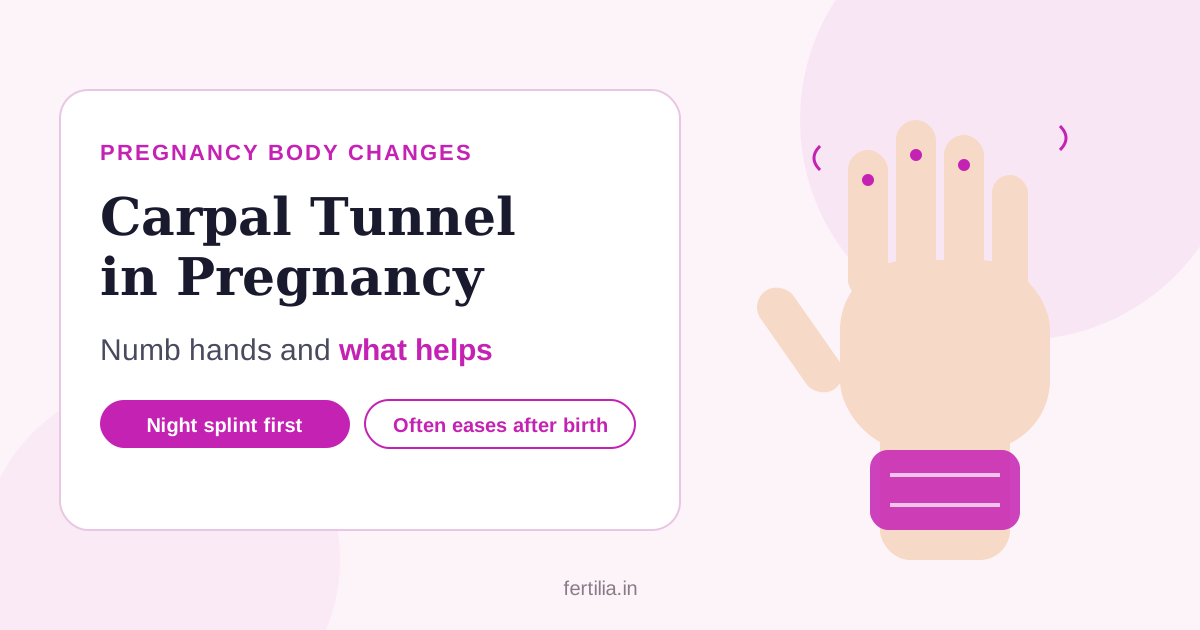
You wake up at 3 in the morning and your hand feels like it belongs to someone else. The thumb and first two fingers are tingling, or completely numb, and you shake your hand hard until the feeling slowly comes back. In the day, it is harder to button a blouse, hold a steel tumbler or type a message without dropping your phone.
If this sounds familiar, you are very likely dealing with carpal tunnel syndrome, and pregnancy is one of the most common times for it to appear. I’m Dr. Suganya Venkat, an OB-GYN with over fifteen years of experience, and in my video consultations with pregnant women, numb hands come up far more often than most women expect. The reassuring part is that it is usually mild, there are simple things that help, and for many women it settles after the baby arrives.
Here is what this post covers:
- What carpal tunnel feels like, and which fingers it affects
- How common it is in pregnancy, and when it tends to start
- Why it happens: fluid, hormones and a narrow space in the wrist
- What helps, starting with a night splint
- Which signs need urgent assessment the same day
- What happens after delivery
What Carpal Tunnel Feels Like
The carpal tunnel is a narrow passage on the palm side of your wrist. Through it run the tendons that bend your fingers and one important nerve, the median nerve, which gives feeling to the thumb, index finger, middle finger and half of the ring finger.
When that nerve is squeezed, women usually describe:
- Tingling or “pins and needles” in the thumb, index and middle fingers
- Numbness, often worse at night or on waking
- A burning or aching feeling that can spread up into the forearm
- Clumsiness or a weaker grip, such as dropping things or struggling with small buttons
- Relief from shaking or flicking the hand, which is one of the most typical clues
The little finger is usually spared, because a different nerve supplies it. Both hands can be affected, though one is often worse.
How it differs from other hand symptoms
| Feature | Carpal tunnel | Sudden swelling with pre-eclampsia |
|---|---|---|
| Where | Thumb, index, middle fingers | Hands, face, around the eyes |
| When | Night and early morning, with gripping | Can appear over a day or two |
| Other signs | Eases with shaking the hand | May come with headache, blurred vision, upper tummy pain |
| What to do | Splint, positioning, mention at your next visit | Contact your doctor or maternity unit urgently |
How Common Is It in Pregnancy?
Very common. In a Dutch study that followed 639 pregnant women, 34% reported carpal tunnel symptoms during pregnancy. Symptoms were more troublesome after 32 weeks than before, and most women had mild to moderate symptoms rather than severe ones (Meems M et al., BJOG, 2015, PMID 25778497).
Figures vary widely between studies, mostly because of how carpal tunnel is measured. A systematic review found that clinically diagnosed pregnancy-related carpal tunnel ranged from 31% to 62%, and nerve-test-confirmed cases from 7% to 43% (Padua L et al., Muscle Nerve, 2010, PMID 20976778). Either way, if you are noticing it, you have plenty of company.
Why Does It Happen?
The carpal tunnel has rigid walls of bone and a tough ligament across the top. It cannot stretch. So anything that takes up extra room inside it presses on the nerve.
In pregnancy, that extra room is mostly taken up by fluid. Your body holds on to more water as pregnancy goes on, and some of it collects in the soft tissues of the wrist. A 2026 systematic review describes pregnancy-related carpal tunnel as caused by gestational hormonal changes and fluid retention that raise the pressure inside the tunnel and compress the median nerve (Kumari O et al., J Clin Orthop Trauma, 2026, PMID 42761408).
The Dutch study supports this. Women with carpal tunnel symptoms reported clearly more fluid retention through pregnancy than women without them, even after accounting for weight, age and number of previous pregnancies (Meems M et al., BJOG, 2015, PMID 25778497).
This also explains why it is worse at night. When you lie down, fluid that collected in your legs during the day moves around the body, and many of us sleep with our wrists bent, which narrows the tunnel further. That same study found carpal tunnel symptoms were independently linked with sleeping problems, which matches what women tell me: it is the broken sleep that wears them down most.
If your feet and ankles are swelling too, our post on swollen feet in pregnancy covers that side of fluid retention.
💜 Waking up with numb, tingling hands? Message Dr. Suganya on WhatsApp to book a ₹399 video consultation. Tell us how many weeks pregnant you are, which fingers are affected, and your latest blood pressure reading.
What Helps
The good news is that the first steps are simple and safe in pregnancy. That 2026 review included twelve studies on conservative treatment in pregnancy and breastfeeding and concluded that night splinting remains the first-line treatment (Kumari O et al., J Clin Orthop Trauma, 2026, PMID 42761408). The authors rated the overall certainty of the evidence as low, because the studies were small, so think of these as sensible, low-risk steps rather than guaranteed cures.
1. A wrist splint at night
A wrist splint keeps your wrist straight, or nearly straight, while you sleep, so the tunnel stays as open as possible. In the review, night splinting consistently improved symptoms in mild to moderate cases.
- Choose a splint that holds the wrist in a neutral position, not bent back.
- Wear it at night, and during the day if a particular task brings symptoms on.
- It should feel snug, not tight. If your fingers swell or go pale, loosen it.
- These are widely available at pharmacies and online. A physiotherapist can help you pick the right size.
2. Gentle nerve and tendon gliding exercises
The same review found splinting worked particularly well when combined with nerve and tendon gliding exercises. These are slow, gentle movements of the fingers and wrist that help the nerve and tendons move smoothly. A physiotherapist can show you the sequence so you do them correctly. They should never be painful.
3. Watch your wrist position
- Sleep: try not to tuck your hands under your pillow or curl them under your chin with the wrists bent.
- Phone and typing: keep your wrists level, take short breaks, and avoid long spells of scrolling with a bent wrist.
- Kitchen work: heavy gripping, grating coconut or squeezing a cloth hard can bring symptoms on. Share these jobs where you can, or take breaks.
4. Raise your hands and move your fingers
Resting your arm on a pillow so your hand sits a little higher can help fluid drain. When you wake with numbness, gently open and close your fist a few times rather than shaking violently.
5. Look after fluid balance and movement
Gentle daily walking and a relaxed lying-on-your-side position for rest help your circulation. Our guide to the best sleeping position in pregnancy explains which positions are comfortable and safe later in pregnancy.
When more is needed
If symptoms are severe, keep you awake despite a splint, or your hand is getting weak, your doctor may refer you to an orthopaedic or hand specialist. The review found that ultrasound-guided steroid injections gave short-term relief in severe or hard-to-treat cases, though evidence on their safety in pregnancy is limited, so this is a decision made with a specialist, weighing benefit against risk. Surgery is rarely needed during pregnancy.
Please do not take painkillers or supplements for this on your own. Many women ask me about vitamin B6 after reading about it online. There is no good pregnancy research supporting it for carpal tunnel, and any supplement in pregnancy should go through your doctor first.
When to Get Checked Urgently
Carpal tunnel itself is not dangerous to you or your baby. But hand swelling and tingling can sometimes overlap with something that does need attention.
Contact your doctor or maternity unit straight away, the same day, if you notice:
- Sudden swelling of your hands, face or around your eyes, especially if it appears over a day or two
- A headache that does not go away, or blurred vision or flashing lights
- Pain under the ribs, on the right side or in the upper tummy
These can be signs of pre-eclampsia, a blood pressure condition of pregnancy that is very manageable when it is picked up early. Our post on pre-eclampsia signs and what happens in hospital explains this clearly. Do not wait to check your blood pressure at home first, and do not let a normal home reading reassure you if these symptoms are still there. You need to be seen and assessed urgently.
See your doctor promptly, rather than waiting for a routine visit, if:
- Numbness is constant, not just at night
- Your grip is getting weaker or you keep dropping things
- The muscle at the base of your thumb looks flatter than on the other hand
- Symptoms are in the little finger, or spread into the neck and shoulder, which suggests a different cause
Weakness or a flatter thumb muscle can mean the nerve is under more pressure, and your doctor may refer you to a hand or orthopaedic specialist. Severe pressure on the nerve that goes on for a long time can cause lasting numbness or weakness, so this is worth acting on early.
What Happens After Delivery?
For many women, the numbness eases as the extra pregnancy fluid clears in the weeks after the birth, and the 2026 review notes that symptoms often resolve postpartum.
It does not settle for everyone, though, and I would rather you know that than be surprised. The 2010 systematic review found symptoms persisted in more than half of women a year after delivery, and in about 30% after three years (Padua L et al., Muscle Nerve, 2010, PMID 20976778). That review included only a few small studies, so the true figure is uncertain, but it is a good reason not to simply wait it out.
New mothers can also find that lifting and feeding a baby, with the wrist bent for long spells, brings symptoms back. Supporting the baby’s head with a pillow during feeds rather than with a bent wrist helps. If tingling is still there at your postnatal check, mention it, because a splint, exercises or a specialist referral can still help. Our post on back pain after delivery has more on protecting your body during the lifting-and-feeding months.
Practical Takeaways
- Numb, tingling thumb and fingers at night are common in pregnancy, especially after 32 weeks.
- The cause is mostly fluid and hormonal changes pressing on the median nerve in a tight wrist tunnel.
- A wrist splint at night is the first-line step, ideally with gliding exercises a physiotherapist teaches you.
- Keep wrists straight during sleep, phone use and kitchen work, and raise your hands on a pillow.
- Sudden swelling of the face or hands, a headache that will not go away, vision changes or upper tummy pain need urgent assessment the same day, not just a home BP check.
- Many women improve after delivery, but if symptoms continue, mention them at your postnatal check.
Frequently Asked Questions
Is carpal tunnel in pregnancy harmful to my baby?
No. Carpal tunnel affects the nerve in your wrist and your comfort, not your baby. The main reason to treat it is to protect your sleep and the use of your hands. The one thing to rule out is that hand swelling is not part of a blood pressure problem.
Why are my hands numb in the morning when I’m pregnant?
Fluid builds up in the wrist during pregnancy, and at night many women sleep with their wrists bent, which narrows the carpal tunnel further. That combination presses on the median nerve, so numbness is often worst on waking and eases as you move your hands.
When does carpal tunnel start in pregnancy?
It can start at any time, but it is most common in the third trimester. In the Dutch study of 639 women, symptoms were noticeably worse after 32 weeks than before.
Does carpal tunnel go away after pregnancy?
For many women it improves as the extra fluid clears after delivery. In some it lasts longer, sometimes a year or more, so if it is still there at your postnatal check, tell your doctor. Treatment can still help.
Is it safe to wear a wrist splint during pregnancy?
Yes. A night wrist splint is the first-line treatment for pregnancy-related carpal tunnel, it involves no medicine, and it can be worn as long as it is comfortable. Make sure it holds your wrist straight and is not so tight that your fingers swell.
Can carpal tunnel be a sign of pre-eclampsia?
Carpal tunnel on its own is not a sign of pre-eclampsia. But sudden swelling of the hands or face, especially with a headache, vision changes or upper tummy pain, can be. If you notice any of these, contact your doctor or maternity unit straight away for an urgent check.
Should I take vitamin B6 for numb hands in pregnancy?
Please do not start it on your own. There is no good pregnancy research supporting vitamin B6 for carpal tunnel, and supplement doses in pregnancy should be decided with your doctor. A night splint is a better first step.
Talking It Through
Numb hands can feel like a small complaint next to everything else in pregnancy, but losing sleep night after night is not small. If you are unsure whether what you have is carpal tunnel, or you want a plan that fits your stage of pregnancy, you can talk it through with Dr. Suganya Venkat over a video consultation at Fertilia.
💜 Want help with numb or tingling hands in pregnancy? Message Dr. Suganya on WhatsApp to book a ₹399 video consultation, available online across India. You can also download our free pregnancy guide for trimester-by-trimester support.