Your husband mentions it one morning, half joking: “You were snoring last night.” You have never snored in your life. Then it happens again, and again, and somewhere around the fifth month you start to wonder whether this is just another strange pregnancy change or something you should mention at your next antenatal visit.
Both can be true. For most women, snoring in pregnancy is a side effect of a congested nose and a changing body, and it settles after delivery. For a smaller group, it is worth a closer look, because snoring that starts in pregnancy has been linked in research to higher blood pressure later in the pregnancy.
I’m Dr. Suganya Venkat, an OB-GYN with over 15 years of experience, and snoring is one of those things women often feel a little embarrassed to bring up. Please do bring it up.
How Common Snoring Is in Pregnancy
Snoring is very common in pregnancy, and many women snore for the first time while they are expecting. In a study of 1,719 women in the third trimester at a large tertiary medical centre, 34% reported snoring regularly, and 25% said their snoring had started during the pregnancy (O’Brien LM et al., Am J Obstet Gynecol, 2012, PMID 22999158).
So if you have started snoring, you are in very large company. What helps is knowing whether your snoring is the ordinary kind or the kind that deserves a check.
Why Pregnancy Makes You Snore
Snoring happens when air moving through a narrowed airway makes the soft tissues of the throat vibrate. Pregnancy narrows that airway in a few ways at once.
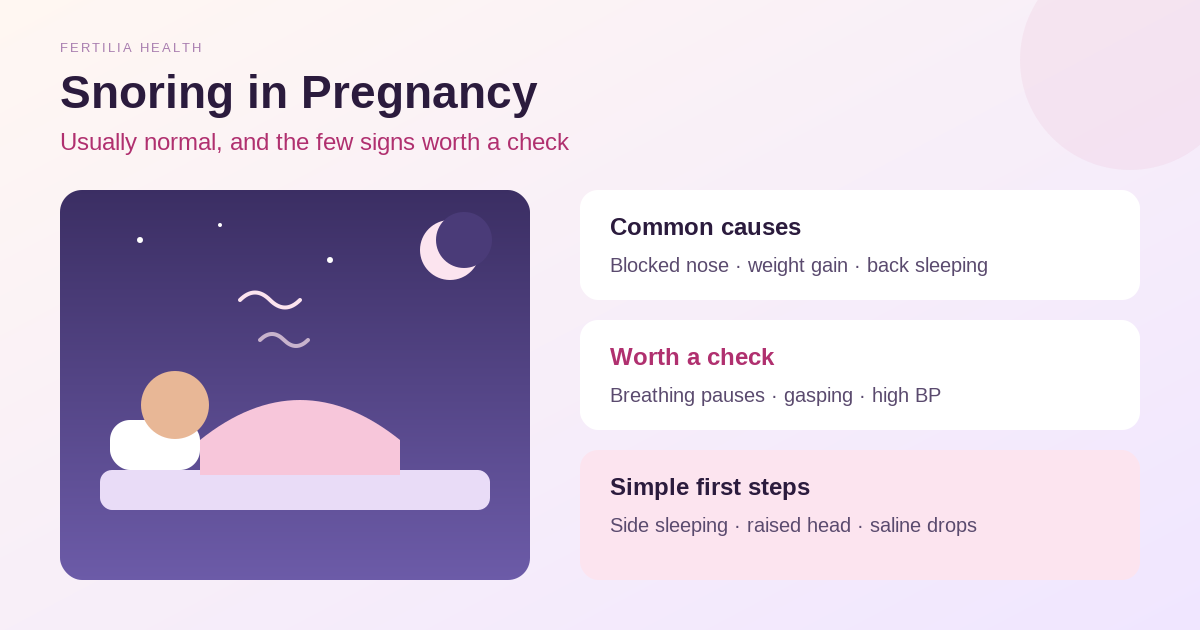
1. A blocked nose that does not go away. Pregnancy hormones make the lining of the nose and throat swell slightly, which narrows the airway. Many pregnant women have a stuffy nose for weeks without any cold or allergy behind it. Doctors call this pregnancy rhinitis. In a Swedish study of 599 pregnant women, 22% developed it at some point, and it could begin in any week of pregnancy (Ellegård E et al., Gynecol Obstet Invest, 2000, PMID 10671815). When the nose is blocked, you breathe through your mouth at night, and mouth-breathing during sleep is a common route to snoring. The same blocked nose explains why some women also notice more nosebleeds; I have written about that in nosebleeds in pregnancy and what helps.
2. Weight gain and a fuller neck. Some of the weight gained in pregnancy sits around the neck and throat. In a study that followed 155 women through pregnancy, symptoms of disturbed breathing during sleep rose as pregnancy went on, and they were higher in women who started with a higher body mass index and in those whose neck circumference grew more (Pien GW et al., Sleep, 2005, PMID 16295215). Healthy weight gain is part of a healthy pregnancy; for the ranges that apply to you, see pregnancy weight gain by trimester.
3. The growing uterus. In the later months, the uterus pushes up against the diaphragm, so the amount of air left in your lungs at rest falls, especially when you lie down. That makes the airway in the throat a little easier to narrow, and lying flat on your back tends to make snoring louder.
4. Lying on your back. Snoring is usually worst on the back. Side sleeping helps the airway and, after about 28 weeks, is also the position doctors recommend for other reasons. I have covered the research on that in sleeping position in pregnancy.
Ordinary Snoring Versus Sleep Apnoea
Most pregnancy snoring is simple snoring: noisy, but your breathing carries on normally. Obstructive sleep apnoea is different. The airway closes repeatedly during sleep, breathing pauses for a few seconds, oxygen dips, and the brain briefly wakes you to restart breathing, often without you remembering it.
Sleep apnoea is much less common than snoring. In a large study of first-time mothers who wore a home sleep monitor, sleep-disordered breathing was found in 3.6% of women in early pregnancy and 8.3% in mid-pregnancy (Facco FL et al., Obstet Gynecol, 2017, PMID 27926645).
These are the signs that make it worth mentioning to your doctor:
- Someone has noticed you stop breathing for a few seconds in your sleep, then gasp or snort as you start again.
- You wake up choking or gasping for air.
- You are very sleepy during the day in a way that goes beyond normal pregnancy tiredness, such as nodding off while sitting and reading, or feeling unsafe driving. Do not drive when you feel drowsy, and tell your doctor promptly.
- Your snoring is loud and happens every night, not just when you have a cold.
- You wake with headaches most mornings.
- Your snoring began in pregnancy and you also have high blood pressure readings, swelling of the face or hands, or a history of high blood pressure.
The breathing and sleepiness signs above do not mean something is definitely wrong. They simply mean your doctor can decide whether a sleep assessment would be useful.
Blood pressure and swelling are different, and they should not wait for a sleep assessment. If you have a new high blood pressure reading, or sudden swelling of your face or hands, contact your doctor or maternity unit the same day, because these can be early signs of preeclampsia. Go to hospital straight away if you have a severe headache, blurred vision or flashing lights, pain under the ribs or in the upper abdomen, or a very high blood pressure reading.
If any of this sounds like you and you would like to talk it through, WhatsApp Dr. Suganya to book a video consultation. Consultations are online, pan-India.
The Link Between Snoring and Blood Pressure
This is the part of the research that makes snoring worth a mention rather than a shrug.
In the O’Brien study above, women whose snoring started during pregnancy were more likely to develop gestational hypertension (odds ratio 2.36) and preeclampsia (odds ratio 1.59), after the researchers adjusted for other factors. Women who had snored since before pregnancy did not show the same link with blood pressure in this study (O’Brien LM et al., Am J Obstet Gynecol, 2012, PMID 22999158).
The Facco study, which measured breathing directly with a sleep monitor rather than asking about snoring, found that women with sleep-disordered breathing had roughly twice the odds of preeclampsia in both early and mid-pregnancy, and higher odds of gestational diabetes as well (Facco FL et al., Obstet Gynecol, 2017, PMID 27926645).
Two points help keep this in proportion:
- These studies show an association, not proof that snoring causes high blood pressure. Women who gain more weight, for example, may be more likely to both snore and develop high blood pressure.
- An association in a large group is not a prediction for you. Most women who snore in pregnancy have entirely normal blood pressure throughout.
What it does mean is practical: if you have started snoring, your routine blood pressure checks at each antenatal visit are worth keeping up, and it is reasonable to tell your doctor about the snoring so they have the full picture. If you would like to know which symptoms of preeclampsia need prompt attention, see preeclampsia signs and what happens in hospital. And since the Facco study also linked disturbed sleep breathing with gestational diabetes, the early signs of gestational diabetes before the OGTT are worth knowing too.
What You Can Do at Home
These steps are simple and safe in pregnancy, and many women find they make a noticeable difference.
Sleep on your side. Side sleeping may help reduce snoring, especially if it is worse on your back, and after about 28 weeks it is the recommended position anyway. A pillow behind your back makes it harder to roll over in your sleep, and a pillow between the knees keeps the hips comfortable.
Raise your head a little. An extra pillow, or raising the head end of the bed slightly, can ease both snoring and a blocked nose.
Treat the blocked nose gently. Saline nose drops or a saline rinse are a safe way to ease pregnancy congestion (Ellegård EK, Clin Rev Allergy Immunol, 2004, PMID 15208461). Ready-made saline drops from the pharmacy can be used as they are. If you make a saline rinse at home, use sterile or distilled water, or water that has been boiled and then cooled, never plain tap water, and wash and dry the rinse bottle after each use. Be careful with medicated decongestant sprays: they work quickly, but regular use can cause a rebound blocked nose. Ask your doctor before using any medicated spray or tablet.
Keep the bedroom air comfortable. Dry air from an AC running all night can make congestion worse. A bowl of water in the room or a slightly higher AC temperature can help.
Keep weight gain within your recommended range. Pregnancy is not a time to diet. Regular meals built around dal, vegetables, curd and whole grains like ragi or millets, with short walks after meals, support steady weight gain, which may also help keep snoring in check.
Avoid lying down straight after a heavy dinner. An early, lighter dinner reduces heartburn, which can otherwise add to night-time throat irritation. For more on overall sleep in pregnancy, see insomnia in pregnancy and safe strategies.
Do not take sleeping pills or sedating antihistamines without advice. Some can relax the throat muscles further. Check with your doctor first.
What Happens If Your Doctor Suspects Sleep Apnoea
If your symptoms suggest more than ordinary snoring, your doctor may ask a few questions about daytime sleepiness and breathing pauses, check your blood pressure, and if needed refer you for a sleep study. Many sleep studies can now be done at home with a small monitor worn overnight.
If sleep apnoea is confirmed, treatment is planned together with a sleep specialist, and your obstetrician will usually keep a closer eye on your blood pressure and sugar levels through the rest of the pregnancy. This is a team effort between your gynaecologist and the sleep specialist, and the aim is simply better sleep and steady readings for you.
What It Is Called in Tamil, Hindi and Telugu
| Language | Word for snoring | How women often search |
|---|---|---|
| Tamil | Kurattai (குறட்டை) | “pregnancy kurattai” |
| Hindi | Kharrate (खर्राटे) | “pregnancy me kharrate aana” |
| Telugu | Guraka (గురక) | “pregnancy lo guraka” |
Practical Takeaways
- Snoring in pregnancy is common, and in most women it is caused by a blocked nose, weight gain and lying on the back.
- It usually settles after delivery as the nose clears and the body changes back.
- Mention it to your doctor if someone notices you stop breathing, you wake gasping, you are very sleepy in the day, or your blood pressure has been on the higher side.
- Snoring that starts in pregnancy has been linked to higher blood pressure, so keep up your routine BP checks.
- Side sleeping, a raised head, saline for the nose and steady weight gain are safe first steps.
At Fertilia, this is the kind of everyday question we go through in pregnancy consultations.
Frequently Asked Questions
Is snoring normal in pregnancy?
Yes. About a third of women snore regularly by the third trimester, usually because of a blocked nose and body changes, and it settles after delivery.
When does snoring start in pregnancy?
It can start at any stage, but it most often appears or gets louder in the second and third trimesters, as weight gain, a blocked nose and the growing uterus all add up.
Pregnancy me kharrate aana normal hai kya?
Snoring (kharrate) in pregnancy is usually normal and is mostly caused by nasal congestion and weight gain. Mention it to your doctor if it comes with breathing pauses, gasping, strong daytime sleepiness or high blood pressure readings.
Can snoring in pregnancy harm the baby?
The evidence on effects on the baby is limited. Research links pregnancy-onset snoring and sleep apnoea with higher chances of high blood pressure in the mother, so the practical step is to tell your doctor and keep up your regular blood pressure checks.
Is snoring a sign of preeclampsia?
No, snoring is not a symptom of preeclampsia. Studies have found that women whose snoring starts in pregnancy are somewhat more likely to develop high blood pressure, which is why it is worth mentioning, but most women who snore never develop preeclampsia.
What can I do to stop snoring while pregnant?
Side sleeping, a slightly raised head and saline for a blocked nose help most. Avoid medicated sprays or sleeping pills unless your doctor advises them.
Will the snoring go away after delivery?
For most women, yes. As the nasal congestion settles and pregnancy weight comes down over the following weeks and months, snoring usually fades. If it continues long after delivery, mention it to your doctor.
Talking It Through
If snoring, poor sleep or blood pressure readings are on your mind, you do not have to sort it out alone. WhatsApp Dr. Suganya Venkat to book a video consultation and we can go through your sleep symptoms and your blood pressure readings from home and the clinic, and help you decide with your obstetrician whether a sleep study is needed. For care through the whole pregnancy, see the Fertilia pregnancy program.