She had been sitting with a mild backache for three days when she picked up her phone and typed her symptoms into a search engine. Twenty minutes later, she had convinced herself she might have a kidney problem. She went to her doctor, had a urine test, got a clean report. The backache faded. But two weeks on, she noticed a small lump near her collarbone. She googled again. By morning she had read about lymphoma.
Her investigations came back normal. She felt enormous relief, for about a week. Then she noticed that her heartbeat sometimes felt a little irregular.
I am a psychiatrist at Fertilia, and this is health anxiety. It is not about being dramatic or weak, and it is not about enjoying the attention of medical investigations. It is a recognisable pattern of thought that gets stuck in a loop, and the loop has specific mechanics that we understand well. More importantly, it responds to treatment.
This post explains what health anxiety is, why the worry cycle keeps going, why googling symptoms tends to make it worse rather than better, and what actually helps.
What health anxiety is
Health anxiety is a persistent, distressing preoccupation with the possibility that you have, or are developing, a serious illness. The key word is persistent. Most of us worry about our health sometimes. A new symptom can reasonably prompt a visit to a doctor. That is normal and appropriate. Health anxiety is different because the worry does not settle when investigations come back normal, or it settles only briefly before the next symptom triggers a fresh cycle of concern.
The condition was previously called hypochondriasis. In the current diagnostic framework (DSM-5), it sits within two categories: illness anxiety disorder, where the distress centres on the fear of illness even when physical symptoms are mild or absent, and somatic symptom disorder, where there is significant distress about bodily symptoms themselves. The mechanisms overlap considerably, and in clinical practice the distinction matters less than recognising that the worry is out of proportion to the evidence and is causing real interference in daily life.
Research by Sunderland, Newby and Andrews (2013) in the British Journal of Psychiatry found that health anxiety affects a meaningful proportion of the general population, with significant associated disability and under-treatment (PMID 22500013). The condition is common, and it is commonly not identified for what it is.
How the worry loop works
Health anxiety runs on a cycle. Understanding the cycle is useful because once you can see it, you can start to interrupt it.
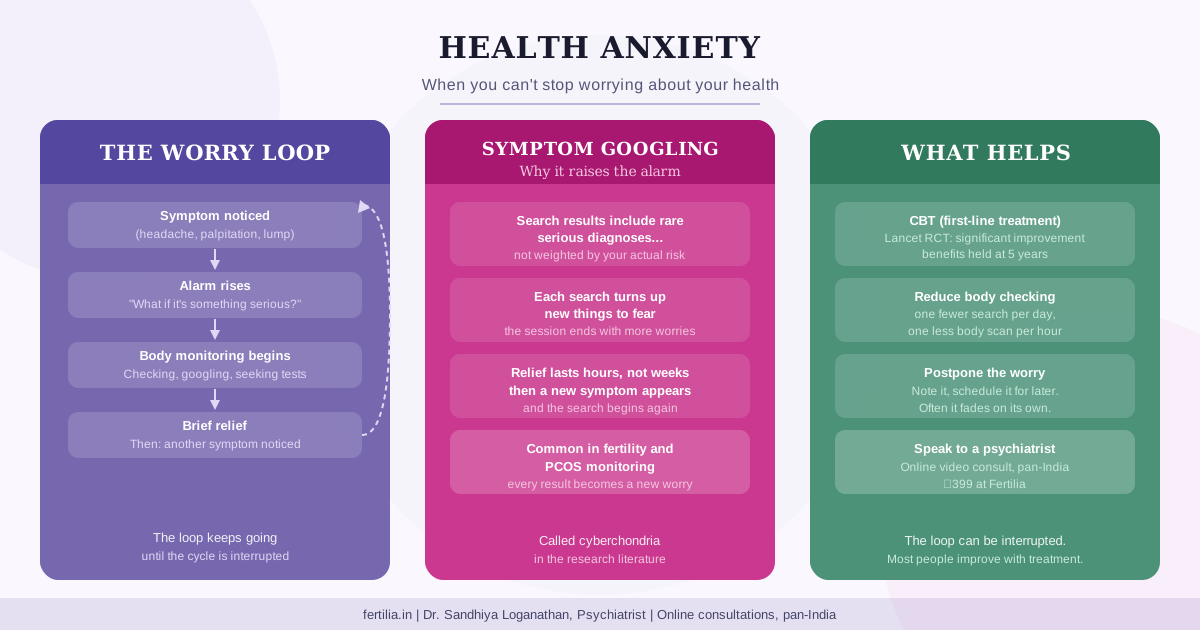
It begins with a trigger. That might be a physical sensation (a headache, a palpitation, a skin change), a news story about a serious illness, or simply noticing that someone else has been unwell. The trigger activates a thought: what if something is wrong with me?
For most people, that thought passes fairly quickly. But in health anxiety, the thought is followed by attention that narrows onto the body. You start monitoring. You check the headache: is it worse? Is it in a different place? You feel your neck for lumps. You notice your heartbeat. And here is the important thing about body monitoring: it reliably produces more to worry about. Normal body sensations that most people do not notice become vivid and alarming when you are actively looking for them.
The monitoring leads to seeking reassurance. You might google the symptom. You might phone a family member. You might book a doctor’s appointment. You get the result you hoped for: nothing serious. There is genuine relief. But that relief is brief, and it does not solve the underlying cycle. It confirms that checking is how you manage the fear, so the checking continues. And over time, the bar for reassurance rises. One GP appointment becomes two. One normal test result is not quite convincing enough. The checking that was supposed to settle the anxiety is part of what maintains it.
This is the cognitive model of health anxiety, developed in the research of Salkovskis, Warwick and colleagues, and formalised in the Health Anxiety Inventory (Salkovskis, Rimes, Warwick 2002, PMID 12171378). The model is the basis for the treatment that works best, which I will come to shortly.
Why googling symptoms makes things worse
Symptom searching online has a name in the research literature: cyberchondria. A 2025 scoping review in the Journal of Medical Internet Research (Yang and Xu, PMID 41343800) examined the impact of online health information seeking on health anxiety and quality of life, finding consistent evidence that health-related internet searching is associated with increased anxiety rather than reassurance for people who are already prone to health worry.
The reason is structural. Search algorithms and health websites are not calibrated to match your actual risk profile. When you type in “headache on one side”, you will encounter information about migraines, yes, but also about subarachnoid haemorrhage and brain tumours. That is not because those conditions are likely. It is because they exist, and health content tends to include them for completeness. Your worried brain does not weight that information by probability. It weights it by severity.
So you read the serious possibilities, your alarm rises, you search more specifically to rule them out, and each new search finds another serious possibility you had not considered before. The average session of symptom googling in health anxiety does not end with reassurance. It ends with a longer list of things to worry about.
If you have noticed that you feel briefly calmer after reading that something is probably fine, and then find yourself googling again within hours or days, this is the maintenance cycle in action.
Health anxiety and women’s health
Women who are navigating fertility concerns, PCOS, or pregnancy are at particular risk of health anxiety patterns, and I want to name this directly.
Living with PCOS means living with a condition that has many possible symptoms, an evolving evidence base, and a lot of conflicting information online. Women learn to track their cycles, monitor their periods, check their progesterone results, and interpret their ultrasound reports. That attentiveness is clinically useful and often encouraged. But for some women, the monitoring tips over into a cycle where every bodily change becomes a potential signal of something going wrong.
The same happens during the two-week wait after ovulation when trying to conceive. Every twinge, every change in discharge, every fluctuation in temperature becomes a data point to analyse and re-analyse. A woman might check her basal body temperature multiple times a day. She might google “implantation symptoms” so many times that she has memorised the top results. The monitoring is driven by hope, but it can also carry a strong current of health anxiety.
For more on this, read our guide on Body Image After Pregnancy or Weight Change. If you have noticed this pattern in yourself, it does not mean you are wrong to care about your health or your fertility. It means the worry has started working against you, and that is something that can be changed.
Health concern versus health anxiety: where is the line?
This is a question I hear often, and it is a fair one. Appropriate attention to your health is not the same as health anxiety, and it is worth being clear about the difference.
Appropriate health concern looks like this: you notice a symptom, you consider whether it warrants investigation, you consult a doctor, you get a result, and you move on. The worry has a purpose and an endpoint.
Health anxiety looks like this: you notice a symptom, the worry escalates, you seek reassurance repeatedly, the reassurance gives temporary relief before the cycle restarts, and the monitoring or checking becomes a daily or near-daily occupation that interferes with your ability to work, rest, or enjoy your life.
Some useful questions to ask yourself:
- When I get a normal test result, how long does the relief last? (Hours? Days? Or barely until I leave the clinic?)
- Do I find myself checking the same area of my body repeatedly?
- Has my use of symptom-checking websites increased over time?
- Am I avoiding things I used to enjoy because I am worried about my health?
- Do the people close to me express concern about how much I focus on my health?
No single question is diagnostic, but if several of these resonate, it is worth speaking to someone about it. That conversation is not a sign that your worries are being dismissed. It is an acknowledgment that the worry itself has become the problem that needs attention.
What helps: the evidence for CBT
Cognitive behavioural therapy is the treatment with the strongest evidence base for health anxiety. Two landmark studies from the CHAMP (Cognitive behaviour therapy for Health Anxiety in Medical Patients) research programme, published in the Lancet (Tyrer, Cooper, Salkovskis et al. 2014, PMID 24139977), and followed up at five years (Tyrer, Salkovskis, Tyrer et al. 2017, PMID 28877841), demonstrated that CBT significantly outperformed treatment as usual for health anxiety in medical patients, with benefits maintained over the longer term.
What does CBT for health anxiety actually do? It works on the cycle described above, at each of the points where the cycle can be interrupted.
Changing the interpretation of symptoms. CBT helps you practise noticing a bodily sensation and considering a range of possible explanations, rather than defaulting to the most alarming. A palpitation might be anxiety, caffeine, tiredness, or a normal cardiac variation, not only a cardiac event. Training yourself to hold the realistic explanations in mind is a skill that improves with practice.
Reducing body checking and reassurance-seeking. This is the part that feels counterintuitive. In CBT for health anxiety, you gradually reduce the behaviours that give you short-term relief: the symptom googling, the repeated body checks, the requests for reassurance from doctors or family members. Reducing these behaviours is uncomfortable at first, because they have been managing the anxiety. But over time, reducing them breaks the cycle. The anxiety settles without the checking, and you learn that you can tolerate uncertainty.
Behavioural experiments. Your therapist might ask you to test what happens if you don’t check. You notice a sensation, you sit with it, you wait. Most of the time, it passes. That is direct experience of the fact that you can tolerate the discomfort without needing to investigate it immediately.
A CBT therapist can be a psychiatrist, a clinical psychologist, or a trained counsellor. In India, sessions can be conducted online, which removes the practical barriers. Our guide to which mental health professional to see, and what each one does, is here.
What you can try on your own
CBT is the evidence-based treatment, and working with a therapist is the most effective approach. But there are things you can do on your own that are consistent with the same principles.
Set a search limit. If symptom googling is part of the cycle for you, agree with yourself on a rule: one search per symptom, once. If the first reliable result (from a hospital, medical college, or national health authority) says the symptom is usually benign, you accept that result and do not search further for the same symptom that day.
Postpone the worry. Rather than trying to eliminate the worried thought (which rarely works), schedule a fixed time for it. When the worry arises, note it down and tell yourself you will address it at 7 pm. When 7 pm arrives, often the worry has diminished on its own. This is a technique drawn from CBT’s worry-postponement method.
Reduce body checking. Choose one area where you check regularly and commit to checking it less. This will feel uncomfortable initially. Allow the discomfort to be there without acting on it. Most bodily sensations fluctuate and often pass when attention is withdrawn from them.
Name the pattern when it is happening. There is something useful about being able to say to yourself: “This is the health anxiety cycle. I am in it right now. It does not mean there is something wrong with my body. It means the worry is running its course.” Putting words to the pattern helps you hold it at a slight distance rather than being entirely inside it. The worry does not have to be argued away; it just needs to be observed for a moment from the outside.
Talk to someone. Health anxiety tends to worsen in isolation. Whether that is a trusted person in your life or a mental health professional, putting the worry into words often reduces its intensity.
Regular movement and sleep. Both anxiety and the cognitive vigilance that drives health anxiety respond to consistent physical movement and adequate sleep. These are not substitutes for therapy when the anxiety is clinically significant, but they support the conditions in which worry is less likely to spiral.
When to seek professional help
If the worry about your health is:
- Occupying several hours a day
- Causing you to seek multiple medical opinions for the same concern
- Leading you to avoid social situations, work, or activities you used to value
- Not settling with normal investigations
- Causing significant distress in your relationships
then it is time to speak to a mental health professional. A psychiatrist can assess whether medication would be helpful alongside therapy. The antidepressants used for anxiety disorders (SSRIs and SNRIs) have evidence in health anxiety as well. This is not because health anxiety is about depression. It is because these medications work on the neural pathways involved in worry and hypervigilance.
[If you are in crisis or need to speak to someone immediately, the KIRAN Mental Health Helpline is available 24/7 at 1800-599-0019 (toll-free).]
For health anxiety that is connected to ongoing fertility or PCOS concerns, the relationship between trying to conceive and mental health is explored here, and our page on anxiety in women more broadly covers how anxiety presents across different life stages. If you have also been experiencing sudden surges of intense fear alongside the health worry, the post on panic attacks explains the overlap and what to do.
If you want to speak with someone directly about what you are experiencing, I am available for online video consultations.
Book a ₹399 consultation with Dr. Sandhiya Loganathan via WhatsApp.
Frequently asked questions
Is health anxiety a real condition? Yes. Health anxiety (also called illness anxiety disorder or, in older terminology, hypochondriasis) is a recognised psychiatric condition with diagnostic criteria and an established evidence base for treatment. It causes genuine distress and interferes with daily functioning. The worry is real, even when the feared physical illness is not present.
How do I know if I have health anxiety or a genuine medical problem? This is a question worth exploring with a doctor and a mental health professional together. The two are not mutually exclusive. You can have both a health condition and health anxiety. What distinguishes health anxiety is that the level of worry is out of proportion to what the evidence supports, and that reassurance from investigations provides only temporary relief. If you have had multiple normal investigations for the same concern and the worry has not settled, speaking to a psychiatrist or clinical psychologist is a reasonable step.
Why do I feel better after seeing a doctor, but the worry comes back? This is the reassurance cycle. The relief from a normal result is real, but it works on the anxiety only temporarily because it addresses the content of the worry (is this symptom serious?) rather than the process driving the worry (why do I keep interpreting sensations as serious?). CBT addresses the process, which is why it produces more lasting change than repeated investigations.
Is googling symptoms bad? Occasional, purposeful symptom searching is not harmful. Looking up what a side effect means, checking what to do after an injury, or reading about a new diagnosis are all reasonable uses of health information online. The pattern that becomes harmful is repeated, escalating searches that end with greater alarm than you started with, and that compel you to search more. If you notice that pattern, it is worth reducing the searching as part of working on health anxiety.
Kya health anxiety sirf zyada chintit hona hai? (Is health anxiety just being too worried?) Nahi. Health anxiety ek recognisable psychiatric condition hai jisme worry ek specific cycle mein phans jaati hai. Iska simple solution “chinta mat karo” nahi hai, kyunki worry apne aap se band nahi hoti jab tak uske mechanisms ko address nahi kiya jata. CBT aur kabhi kabhi medication se yeh cycle tod jaati hai, aur zyada tar log behtar feel karte hain.
How common is health anxiety? Research suggests health anxiety affects a meaningful proportion of the general population and is associated with significant disability and healthcare use (Sunderland et al., Br J Psychiatry 2013). It is considerably under-recognised and under-treated. Many people with health anxiety are seen repeatedly in primary care and cardiology or gastroenterology clinics for investigations, without the underlying anxiety pattern ever being identified.
Can health anxiety get better without therapy? For mild presentations, self-help strategies based on CBT principles can make a significant difference. The techniques described above (worry postponement, reducing body checking, limiting symptom searches) are evidence-informed and worth trying. For moderate to severe health anxiety, where the worry is taking up several hours a day or significantly affecting your life, working with a trained therapist produces better and more sustained outcomes.