You are eating well, you take your folic acid and iron, and then a blood report comes back with “25-OH Vitamin D: 14 ng/mL” flagged in red. Many pregnant women in India see a result like this, often in their first trimester, and the first question is almost always the same: is my baby getting enough?
I’m Dr. Suganya Venkat, an OB-GYN with more than fifteen years of practice, and vitamin D is one of the reports women most often bring to Fertilia’s online pregnancy consultations. The short version is reassuring: low vitamin D is very common, it is easy to correct, and the research on supplementing in pregnancy is mostly encouraging. This post walks you through what the evidence says, how much vitamin D a pregnant woman needs, which foods help, and how to work with your antenatal doctor on a plan.
Here is what we will cover:
- Why vitamin D matters in pregnancy
- How common low vitamin D is among pregnant women in India
- What the trials show about supplementing
- How much vitamin D you need, and why your dose is set individually
- Which foods carry vitamin D, and why food alone is rarely enough
- Testing: who benefits and how to read the result
If you want the broader picture outside pregnancy, our guide to vitamin D deficiency in women covers signs, causes and correction in detail. This post is specifically about pregnancy.
Why Vitamin D Matters While You Are Pregnant
Vitamin D helps your gut absorb calcium and phosphate. During pregnancy, your baby builds an entire skeleton, and most of that calcium comes from you. Vitamin D is part of the system that makes enough calcium available for both of you.
Researchers have also looked at whether vitamin D affects pregnancy outcomes beyond bones, such as blood pressure problems and blood sugar. That is where the trials below come in, and the findings are more encouraging than many women expect.
How Common Is Low Vitamin D in Pregnancy in India?
Living in a sunny country does not protect most Indian women from low vitamin D. Indoor work, covered clothing, darker skin (which makes vitamin D more slowly from sunlight), air pollution and largely vegetarian diets all play a part.
A systematic review of 20 studies with 7,804 pregnant women across South Asia found that about 65% had vitamin D insufficiency, with India at 67% (Siddiqee MH et al., Br J Nutr, 2022, PMID 34725002). A separate meta-analysis of Indian studies put the pooled prevalence of deficiency among pregnant women above 30%, though the authors noted high variation between studies (Jeyakumar A et al., J Health Popul Nutr, 2021, PMID 34187594).
The two numbers differ because the studies used different cut-offs and different populations. What they share is the message: if your report shows low vitamin D, you are in very large company, and it does not mean you did anything wrong.
What the Trials Show About Supplementing
The most complete summary is a Cochrane review that pooled 30 trials with 7,033 women (Palacios C et al., Cochrane Database Syst Rev, 2019, PMID 31348529). Comparing vitamin D alone with placebo or no supplement, the review found that vitamin D:
| Outcome | What the Cochrane review found | Certainty of evidence |
|---|---|---|
| Pre-eclampsia (high blood pressure in pregnancy) | Probably reduces the risk (risk ratio 0.48) | Moderate |
| Gestational diabetes | Probably reduces the risk (risk ratio 0.51) | Moderate |
| Baby with low birthweight (under 2,500 g) | Probably reduces the risk (risk ratio 0.55) | Moderate |
| Preterm birth before 37 weeks | May make little or no difference | Low |
Source: Palacios C et al., Cochrane Database Syst Rev, 2019, PMID 31348529. The pre-eclampsia and gestational diabetes results each came from only four trials with fewer than 500 women, which is why the authors call the certainty moderate and ask for larger trials.
The same review looked at vitamin D combined with calcium. That combination probably reduced pre-eclampsia, but in a smaller set of low-certainty trials it may have increased preterm birth, a finding the authors say needs more research. This is one reason I do not suggest starting combination tablets on your own. Your doctor will usually already have you on a calcium plan; you can read more in our guide to calcium in pregnancy.
Guideline bodies read this evidence slightly differently. The Endocrine Society’s 2024 guideline suggests empiric vitamin D supplementation for people who are pregnant, because of its potential to lower the risk of pre-eclampsia, intrauterine death, preterm birth, small-for-gestational-age birth and neonatal death (Demay MB et al., J Clin Endocrinol Metab, 2024, PMID 38828931). The WHO’s antenatal guidance, last updated in August 2023 on its e-Library of Evidence for Nutrition Actions (who.int/tools/elena), does not recommend vitamin D for all pregnant women, and instead encourages a healthy, balanced diet, while noting that supplementation improves vitamin D status and may reduce pre-eclampsia, low birthweight and preterm birth.
In practice, the disagreement is mainly about giving vitamin D to every pregnant woman without a reason. For a woman whose level is already low, correcting it under her doctor’s guidance is standard antenatal care.
How Much Vitamin D Do You Need in Pregnancy?
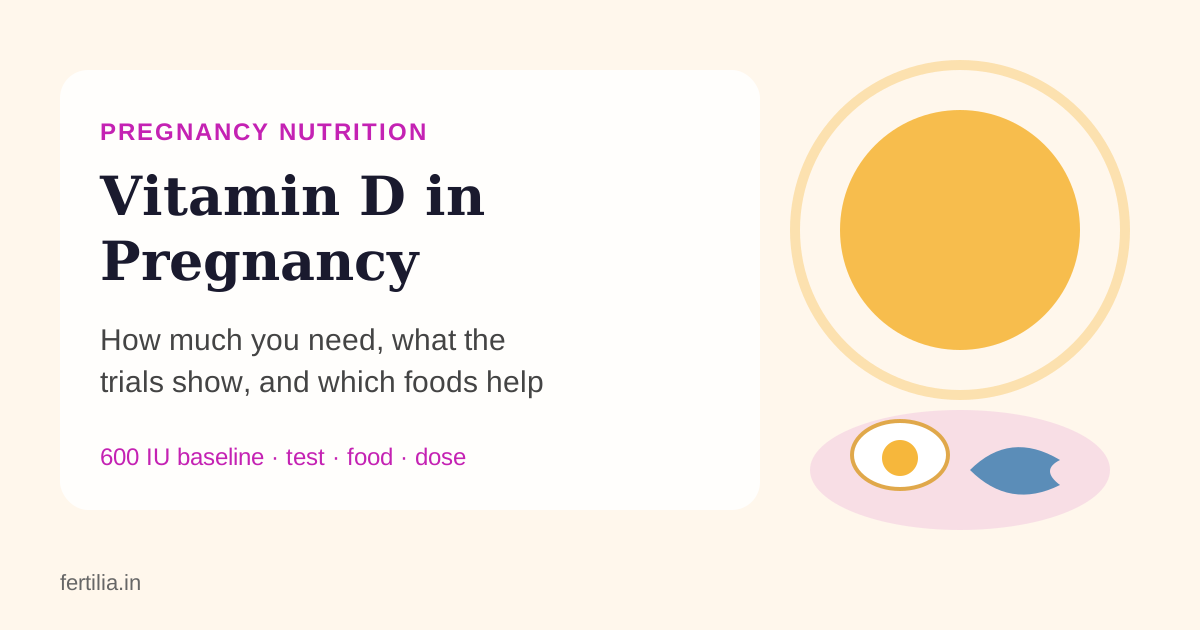
The baseline daily requirement. The Institute of Medicine (now the US National Academy of Medicine) set the Recommended Dietary Allowance for vitamin D at 600 IU a day for ages 1 to 70, which includes pregnancy, based on bone health and assuming minimal sun exposure (Ross AC et al., J Clin Endocrinol Metab, 2011, PMID 21118827). That level was matched to a blood level of at least 20 ng/mL.
Why your own dose may be different. If your blood level is low, your doctor will usually prescribe a correction dose for a set period, then switch to a maintenance dose. The Endocrine Society guideline states plainly that the trial doses varied so much that the optimal dose for empiric supplementation in pregnancy remains unclear (Demay MB et al., 2024, PMID 38828931). So there is no single correct number for every woman, and the right dose depends on your level, your weight, your diet and what else is in your prenatal tablets.
Three practical points I share with women:
- Check your prenatal multivitamin label first. Many already contain some vitamin D. Adding a separate tablet without counting what is already there is the commonest way women end up doubling up.
- Weekly sachets and daily tablets both work when taken as prescribed. Pick the one you will remember.
- Take it with a meal that has some fat, such as your lunch with dal and a little ghee or curd, because vitamin D is absorbed better that way.
Please do not start a high-dose sachet that a friend or relative used. Vitamin D is stored in the body, and very high doses taken without a level check can raise calcium too much. A prescription matched to your report is the safe route.
Want your vitamin D report read alongside your other antenatal results? Dr. Suganya Venkat reviews pregnancy blood reports over a video consultation, from anywhere in India. WhatsApp Dr. Suganya to book a ₹399 online consultation (US $20 if you are consulting from outside India). Please keep your antenatal doctor involved; this consultation adds a second explanation, it does not replace their care.
Which Foods Give You Vitamin D?
The Endocrine Society panel points to the scarcity of natural food sources of vitamin D (Demay MB et al., 2024, PMID 38828931). Food helps, but on its own it rarely corrects a low level.
Foods that carry vitamin D, from more to less:
- Oily fish: Indian mackerel (bangda, or ayala in Malayalam) and sardines (mathi or chaala) are the richest everyday sources. Two servings of well-cooked oily fish a week is a sensible pattern in pregnancy.
- Egg yolk: a modest amount per egg. The vitamin D is in the yolk, so do not skip it.
- Fortified foods: some packaged milk and edible oils in India are fortified with vitamin D. Look for the “+F” fortification logo and read the label for the amount.
- Mushrooms exposed to sunlight or UV light: mushrooms can make vitamin D when exposed to UV light, but the amount varies widely. Treat them as a small top-up.
If you are vegetarian: your realistic food sources are fortified milk, fortified edible oil, and UV-exposed mushrooms. That is why most vegetarian women in India will need a supplement prescribed by their doctor to reach a healthy level. This is not a failure of your diet; it is simply how few plant foods carry vitamin D.
What about sunlight? Your skin does make vitamin D from sun on bare arms and legs. Short, regular exposure helps, but it is hard to rely on in cities, with office hours, pollution, sunscreen and covered clothing. In pregnancy, avoid long spells in the midday heat, stay hydrated, and see sunlight as a helper rather than the whole plan.
Testing: Who Benefits and How to Read the Result
Whether every pregnant woman needs a vitamin D test is debated. The Endocrine Society suggests against routine testing in healthy people without a specific reason (Demay MB et al., 2024, PMID 38828931). In India, many antenatal doctors test at the first visit because low levels are so common here, and that is a reasonable practice.
Testing makes particular sense if you:
- Are vegetarian and rarely eat fortified foods
- Spend most of your day indoors or mostly covered
- Have a BMI above 30
- Have a history of low vitamin D, bone pain or a malabsorption condition
Reading the number. Your report shows 25-hydroxyvitamin D, usually in ng/mL. The Institute of Medicine treated 20 ng/mL as the level that covers bone needs for nearly everyone (Ross AC et al., 2011, PMID 21118827). Labs print slightly different reference ranges, so read your result against the range on your own report. If you are curious about the cost and test types, see our guide to the vitamin D test cost in India.
A repeat test after about three months of treatment tells you and your doctor whether the plan is working.
What It Is Called in Tamil and Hindi
Women often search for this in their own language. In Tamil, many say “vitamin D kuraivu” for low vitamin D, and in Hindi people commonly search phrases like “pregnancy me vitamin D kab lena chahiye” (when should I take vitamin D in pregnancy). The test itself is called the same on every Indian lab report: 25-OH Vitamin D or 25-hydroxyvitamin D. Whatever the words, the answer is the same: get a level if your doctor advises it, and take a dose matched to that level.
What You Can Do This Week
- Find your latest vitamin D report, if you have one, and note the number and the lab’s range.
- Read your prenatal multivitamin label for the vitamin D amount.
- Add two vitamin D foods to your week: oily fish twice if you eat fish, eggs with the yolk, or fortified milk if you are vegetarian.
- Ask your antenatal doctor whether you need a test, a correction dose, or just a maintenance amount.
- Keep calcium separate in your mind. It is a related but separate plan, and your doctor will usually set it independently.
If you also have gestational diabetes or blood pressure concerns, vitamin D is one helpful piece among several. Our guide to gestational diabetes in India explains the bigger plan.
Frequently Asked Questions
How much vitamin D should I take during pregnancy?
The Recommended Dietary Allowance for pregnant women is 600 IU a day (Institute of Medicine, 2011). If your blood level is low, your doctor will usually prescribe a higher correction dose for a few weeks or months before moving you to a maintenance dose. Because trial doses varied widely, there is no single best dose for everyone, so follow the dose prescribed for your level.
When should I start vitamin D in pregnancy? (Pregnancy me vitamin D kab lena chahiye?)
Many doctors in India start it at the first antenatal visit, often after a blood test in the first trimester. If your level is already low before conception, correcting it while you are trying to conceive is even better. Discuss timing with your antenatal doctor.
Is it safe to take vitamin D while pregnant?
Yes, at prescribed doses. The Cochrane review found no cases of high blood calcium in the trial that reported it, though the authors note that data on side effects in pregnancy are limited. The safe approach is a dose matched to your blood level, not a high-dose sachet taken without testing.
Can I get enough vitamin D from food during pregnancy?
Usually not on its own. Oily fish, egg yolks, fortified milk or oil and UV-exposed mushrooms help, but very few foods carry much vitamin D. Most women, and especially vegetarian women, need a supplement prescribed by their doctor to reach a healthy level.
Does low vitamin D harm my baby?
Most babies of mothers with low vitamin D are born healthy. Research links low levels with a higher chance of some complications, and the Cochrane review found that supplementing probably lowers the risk of pre-eclampsia, gestational diabetes and low birthweight. The useful step is simply to correct the level once you know it.
Should I take vitamin D and calcium together?
Your doctor may prescribe both, often as separate tablets at different times of the day. The Cochrane review found that combined vitamin D and calcium probably reduced pre-eclampsia but raised a question about preterm birth in a small set of trials, so take the combination your doctor prescribes rather than adding one on your own.
Do I need to keep taking vitamin D after delivery?
Many women continue through breastfeeding, especially if their level was low. Your baby’s paediatrician may also prescribe vitamin D drops for the baby. Ask both doctors at your postnatal check.
Talk It Through
Vitamin D is one of the simpler pieces of pregnancy care to get right: a level, a dose matched to it, a few good foods, and a recheck. If you would like help making sense of your antenatal reports and putting a plan together with your own doctor, Dr. Suganya Venkat consults online, across India and abroad.
WhatsApp Dr. Suganya to book a ₹399 online consultation (US $20 from outside India).