A woman told me last month that she has taken a sick day on the first day of every period for six years. Not because she wanted to. Because by mid-morning she is doubled over, and staying at her desk stopped being an option a long time ago. She had never mentioned this to a doctor before. She assumed this was just what her body did.
It might be. Some women do have genuinely severe primary period pain with no underlying disease behind it, and there is real treatment for that too. But pain that consistently takes you out of work, most cycles, for years, is also the pattern I see behind four specific and very treatable conditions. The only way to know which one, if any, applies to you is to look at the pattern closely.
This post walks through how to tell ordinary period pain from pain that needs investigation, and how endometriosis, adenomyosis, PCOS, and fibroids each tend to show up differently when the pain is severe enough to interrupt your day.
Why “Just Take a Painkiller” Is Not Always the Right Answer
Most period pain is what doctors call primary dysmenorrhea. It is caused by prostaglandins, the chemical compounds your uterine lining releases as it sheds, which make the uterus contract and briefly reduce its own blood supply. This is uncomfortable, sometimes very uncomfortable, but it follows a predictable pattern: it starts around the first day of bleeding, it eases within two to three days, and it responds reasonably well to an anti-inflammatory like ibuprofen taken on time and at an adequate dose.
Secondary dysmenorrhea is different. It means the pain has a specific underlying cause in the pelvis, and managing the pain symptom alone will not resolve it because the cause is still there. Endometriosis, adenomyosis, and fibroids are the three most common structural causes. PCOS can also produce pain, though usually through a different mechanism, which I will come to.
The distinction matters because the two need different responses. Primary dysmenorrhea needs good pain management and, often, hormonal regulation. Secondary dysmenorrhea needs the underlying condition identified and treated. Painkillers alone will keep a woman with undiagnosed adenomyosis or endometriosis missing work every month indefinitely, because they are managing a symptom while the condition underneath continues.
Two Questions That Tell You Whether to Investigate
Before getting into which condition might be responsible, it helps to establish whether investigation is warranted at all. Two questions do most of the work.
Does the pain stop you functioning? Missing work, cancelling plans, being unable to sit through a full day at your desk or on your feet, this is functional impairment. It is a clinical signal, not a sign that you cope less well than other women. A cross-sectional study of 1,800 women found that over a third reported needing to take sick leave for menstrual pain, though fewer than half of those actually did, most often because they worried about how it would be seen at work (Leon-Larios et al. 2024, Reprod Health, PMID 38374080). If this has happened more than once or twice, it is worth naming out loud to a doctor rather than filing away as a private inconvenience.
Does standard medication actually control it? Ibuprofen at 400mg every six to eight hours, taken with food and started at the very first sign of pain rather than waiting for it to build, should bring primary dysmenorrhea down to a manageable level within about an hour. If it barely touches the pain, or the pain returns strongly before the next dose is due, that response pattern is itself diagnostic information. Pain that does not respond to prostaglandin-inhibiting medication is behaving like secondary dysmenorrhea, whatever the eventual cause turns out to be.
If you answered yes to both, the next section is the useful part. If your pain is manageable with standard doses and does not interfere with your day, what you are describing is likely within the range of normal, and there is nothing further you need to chase down.
The Four-Condition Differential
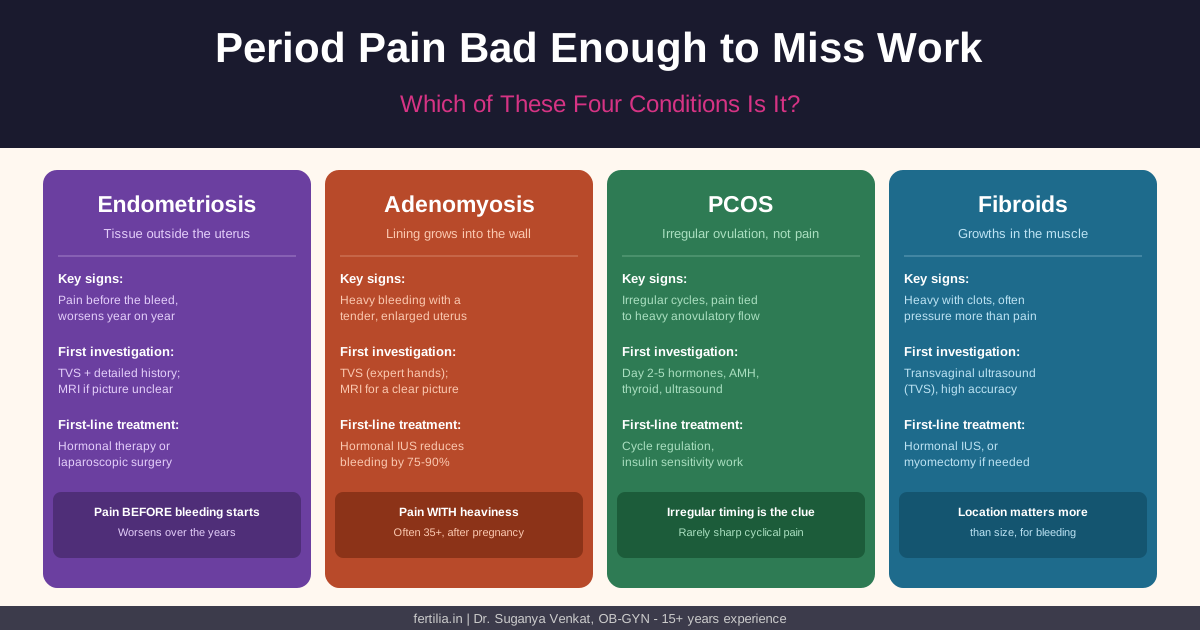
No single symptom confirms any of these on its own. What matters is the overall pattern: when the pain starts relative to your bleed, how it has changed over the years, what else comes with it, and how your cycle behaves alongside it.
Endometriosis: pain that starts before the bleed and gets worse over time
Endometriosis is tissue similar to the uterine lining growing outside the uterus, most often on the ovaries, the fallopian tubes, and the ligaments and peritoneum around the pelvis. It affects roughly 10 percent of women of reproductive age worldwide (Zondervan et al. 2020, N Engl J Med, PMID 32212520), and the average time from first symptom to diagnosis is seven to ten years (Nnoaham et al. 2011, Fertil Steril, PMID 21718982). That delay is precisely why “missing work every month” often gets normalised for years before anyone investigates it properly.
The features that point toward endometriosis over ordinary cramping:
Pain that begins one to two days before bleeding starts, rather than on day one. A trajectory that has clearly worsened year on year rather than staying stable or easing, particularly after adolescence. Pain during or after sex, especially with deep penetration. Pain with bowel movements or urination that is specifically timed to your period, distinct from any infection. A background pelvic ache present through parts of the month, not confined to bleeding days. And pain that barely responds to standard-dose ibuprofen, because the pain is coming from tissue deposits rather than prostaglandins alone.
If three or more of these describe you, that combination is worth raising directly with a gynaecologist. I have written a fuller diagnostic walkthrough in the period pain and endometriosis guide, including what a transvaginal ultrasound can and cannot rule out.
Adenomyosis: heavy, tender, and typically later onset
Adenomyosis is the uterine lining growing into the muscular wall of the uterus itself, rather than outside it. The uterus often becomes enlarged and tender because it can no longer contract efficiently to limit the bleed, so pain and heavy flow tend to arrive together.
Adenomyosis typically shows up later than endometriosis, most often in women in their mid-thirties and older who have had at least one pregnancy, though it can occur in younger and nulliparous women too. The pain usually starts one to two days before the period and continues through the heaviest bleeding days, alongside clots and a sense of pelvic fullness or tenderness that a doctor may be able to feel on examination.
The two conditions overlap more often than most people realise, and having one is a reasonable prompt to ask your gynaecologist whether the other should be evaluated too. The adenomyosis guide covers diagnosis and the full treatment ladder, including the hormonal IUS, which reduces bleeding by 75 to 90 percent for most women.
PCOS: irregular cycles are the marker, not severe cyclical pain
This is the one I want to correct directly, because it is a common misattribution. PCOS is diagnosed using the Rotterdam Criteria: irregular or absent ovulation, clinical or biochemical signs of excess androgens, and polycystic ovarian morphology on ultrasound, any two of the three. The Androgen Excess and PCOS Society task force report sets out these diagnostic features in detail (Azziz et al. 2009, Fertil Steril, PMID 18950759). Severe, sharply cyclical dysmenorrhea is not part of that clinical picture, and it is not the pain pattern PCOS typically produces.
Where PCOS-related pain does show up, it tends to look different: cramping tied to irregular or unpredictable bleeding, discomfort from a uterine lining that has built up over a long anovulatory gap and then sheds heavily, or a general pelvic ache and bloating rather than the sharp, clockwork, worsening-over-years pain of endometriosis. If your periods are irregular and you also have severe, predictable, worsening cyclical pain, that combination is a reason to look for a coexisting cause, not to assume PCOS explains the pain by itself. Undiagnosed endometriosis in a woman who also happens to have PCOS is a real and easily missed scenario.
The full symptom picture for PCOS, including how the Rotterdam Criteria are applied, is in the PCOS symptoms, root causes and treatment guide.
Fibroids: heavy and bulky more often than sharply painful
Fibroids are benign growths of the uterine muscle. Most fibroids cause little or no pain; their effect on your cycle depends far more on where they sit than on their size. A small fibroid inside the uterine cavity (submucosal) can cause disproportionate heaviness and clotting. A larger one within the muscle wall that does not distort the cavity may cause no change at all.
When fibroids do cause pain, it is usually described as pressure, heaviness, or a dragging sensation rather than the sharp cramping of endometriosis or adenomyosis, unless a fibroid is large enough to twist on its stalk, which produces sudden, severe pain requiring urgent assessment. The more consistent fibroid pattern is heavier, longer periods with clots and a gradual, cumulative fatigue from the blood loss itself. The heavy periods guide covers the treatment ladder from medication to myomectomy.
If you have been missing work for period pain most months, a structured review is the fastest way to find out which of these, if any, applies to you. Message Dr. Suganya on WhatsApp for a ₹399 video consultation. It is available online, pan-India.
What a Workup Looks Like
A gynaecological assessment for pain this severe follows a fairly consistent sequence.
History first. Come with specifics rather than “it’s really bad”: when the pain starts relative to your bleed, how it scores out of ten on the worst day, what medication you take and whether it helps, how the pain has changed over the years, and how many days it has cost you at work or with plans over the last six months. This detail is what lets a doctor tell these conditions apart quickly instead of guessing.
Pelvic examination, which can pick up tenderness or nodularity suggestive of endometriosis or an enlarged, tender uterus suggestive of adenomyosis.
Transvaginal ultrasound (TVS), the standard first-line imaging. It is reasonably sensitive for fibroids and for adenomyosis in experienced hands, and it can pick up endometriomas (ovarian cysts from endometriosis). It is far less reliable for the more common peritoneal form of endometriosis, so a normal scan does not rule that condition out if your history strongly suggests it.
MRI, when the ultrasound is inconclusive or when deep infiltrating disease is suspected, particularly before surgical planning (Rule 14: your treating gynaecologist decides which imaging fits your specific picture).
Laparoscopy, the only test that definitively confirms endometriosis, is not the first step for most women. Many are appropriately started on medical management based on a convincing history and imaging, with laparoscopy reserved for when medical treatment has not worked, when imaging suggests significant disease, or when fertility investigation makes a definitive answer necessary.
A Note on Naming It in Tamil and Hindi
Severe period pain is described in different ways depending on the language. In Tamil, “mudhugu vali” or “vayitru vali” during periods, and the broader question “maadhavidaay niruththam” relating to cycle changes, come up often in searches and conversations. In Hindi, “mahavari ka dard kitna normal hai” (how much period pain is normal) is one of the most common ways this question actually gets typed into a search bar or asked in a family WhatsApp group. Whatever language the question comes in, the clinical assessment and the four conditions above are the same.
Workplaces Are Starting to Recognise This, Even If Your Own Assessment Should Not Wait for That
As of November 2025, Karnataka has a state government-notified menstrual leave policy giving eligible women employees paid leave for period-related discomfort, and courts have since directed its implementation. Whatever your own workplace’s policy is or is not, that kind of shift reflects something clinicians have known for a long time: period pain severe enough to affect work is common enough to warrant an official response, not an individual one. Fertilia does not offer HR or employment-law guidance, and none of this is a substitute for checking your own organisation’s actual leave policy. But it is worth knowing that “I can’t function today” is increasingly recognised as a legitimate reason to seek both time off and a proper diagnosis, not a personal failing to manage around quietly.
Practical Steps While You Are Investigating
None of the following treats an underlying condition, but each can make the wait for an appointment, or the days between diagnosis and treatment, more manageable.
Start ibuprofen (400mg with food) at the very first twinge, rather than waiting for the pain to peak. Prostaglandin-inhibiting medication works far better taken early than taken as rescue treatment. A hot water bag or heating pad on the lower abdomen provides genuine, evidence-supported relief alongside medication, not instead of it. Haldi (turmeric) with a pinch of black pepper for absorption is a reasonable anti-inflammatory addition to your regular meals, alongside whatever your doctor recommends, not as a replacement for it. Track your pattern for two to three cycles: when the pain starts, what score it reaches, what helps and by how much, and how many days it costs you. That record is exactly what a gynaecologist needs to move quickly from history to a working diagnosis.
At Fertilia, this is the kind of pattern Dr. Suganya’s video consultations are built to work through carefully, because getting the underlying cause right the first time avoids years of managing symptoms that were never going to resolve with painkillers alone.
Frequently Asked Questions
How much period pain is actually normal? Some cramping in the first one to two days, manageable with an over-the-counter anti-inflammatory, is within the normal range. Pain that stops you from working, studying, or carrying out your normal day, especially if it happens most cycles, is not something to simply tolerate. A useful marker: if standard-dose ibuprofen taken early does not bring the pain down within about an hour, that response pattern itself is worth investigating.
Can PCOS cause period pain bad enough to miss work? It is not the typical picture. PCOS is defined by irregular ovulation, androgen excess, and ovarian morphology, not by severe cyclical pain. When women with PCOS do have significant pain, it is usually connected to irregular or heavy anovulatory bleeding rather than the sharp, worsening, clockwork pain seen in endometriosis. If you have PCOS and also have severe, predictable cyclical pain, it is reasonable to ask your gynaecologist whether a second condition, most often endometriosis, could be present alongside it.
What is the difference between endometriosis and adenomyosis pain? Endometriosis pain often starts before bleeding begins, worsens progressively over years, and commonly comes with pain during sex or with bowel movements timed to the period. Adenomyosis pain tends to arrive with heavy bleeding and a tender, sometimes enlarged uterus, and shows up more often in the mid-thirties and beyond. The two frequently coexist, so having features of one is a reasonable prompt to ask about the other.
My ultrasound was normal. Does that rule out endometriosis or adenomyosis? Not necessarily, particularly for endometriosis. A standard transvaginal ultrasound is reasonably good at detecting endometriomas and adenomyosis but frequently misses peritoneal endometriosis, the most common form. If your symptom pattern strongly suggests endometriosis, a normal scan does not close the conversation. It means the next step is a more detailed clinical discussion, and sometimes an MRI, rather than dismissing the possibility.
Should I ask for a laparoscopy straightaway if I suspect endometriosis? Usually not as the first step. Most women begin with a thorough history, examination, and imaging, followed by a trial of medical management if the clinical picture is convincing. Laparoscopy, the only test that definitively confirms endometriosis, is generally reserved for when medical treatment has not adequately controlled symptoms, when imaging suggests significant disease, or when fertility investigation requires a definitive answer.
Is it normal to need painkillers every single month just to get through work? Needing an anti-inflammatory for one or two days a cycle, with the pain settling reliably, is common and generally within the normal range. Needing to escalate doses, taking multiple tablets that only partially help, or missing work despite medication most months is not something to accept as your baseline. That pattern is exactly the signal that a gynaecological assessment is overdue, not a sign you simply have a low pain tolerance.
Does my workplace have to give me leave for period pain? This varies by employer and, as of late 2025, by state. Karnataka has introduced a state-notified menstrual leave policy, and its implementation has been the subject of ongoing court direction. Fertilia cannot advise on your specific workplace’s HR policy or your legal entitlements. What we can help with is finding out, clinically, whether your pain has an underlying cause that can be treated, which is often the more durable fix regardless of what leave policy applies to you.
If you have been quietly missing work for period pain and telling yourself this is just how your body is, it is worth finding out for certain. A video consultation with Dr. Suganya at Fertilia gives you a structured review of your symptom pattern and a clear next step, whether that is reassurance, further investigation, or a treatment plan.
Book a ₹399 video consultation on WhatsApp
For a broader look at tracking your cycle and knowing what patterns matter, the Period Health Guide is a good place to start.