You are trying to conceive, and every month you notice a twinge on one side of your lower abdomen. Some months it is on the right, some months on the left. It lasts a few hours and disappears. You want to know exactly what is happening inside your body, and whether this pain is actually useful information for timing.
It is. Ovulation pain (called mittelschmerz in clinical medicine, from the German for “middle pain”) is one of the more reliable cycle signals available to women who are paying attention to their bodies. The key to using it well is understanding the biology behind it.
This post focuses on the mechanism: what happens inside the ovary in the days leading up to ovulation, why the pain occurs at the moment of rupture, why it moves from side to side, and what changes in PCOS or during fertility treatment. For the reassurance and red-flag sections (when ovulation pain needs medical attention), the companion post Ovulation Pain (Mittelschmerz): Is It Normal? covers those in detail. This post assumes your pain is typical and focuses on understanding and using it.
The follicle story, day by day
Ovulation pain cannot be understood without understanding how a follicle develops. The pain is the end point of a 12 to 14 day process.
Days 1 to 5: a field of candidates
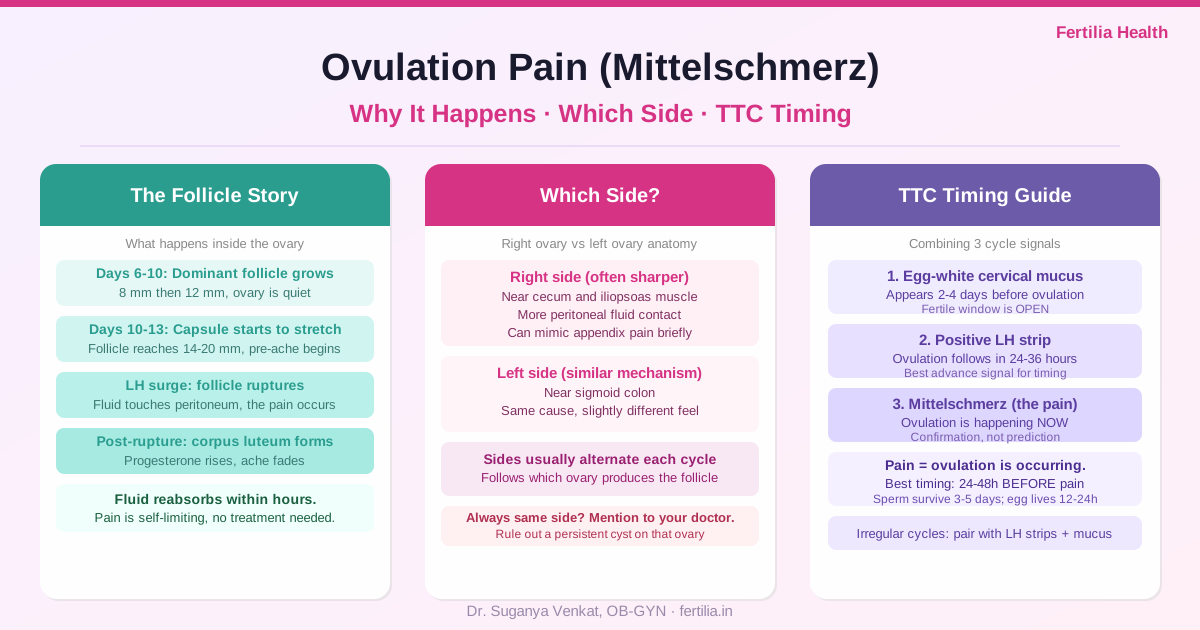
When menstrual bleeding begins, both ovaries contain a group of small follicles responding to a rise in follicle-stimulating hormone (FSH). Each follicle is a fluid-filled sac containing an immature egg. At this stage, they are each roughly 2 to 5 mm in diameter. None cause any sensation.
Days 6 to 10: one follicle takes the lead
By around day 6 to 8, one follicle in one of the ovaries becomes dominant. It begins growing faster than the rest, which gradually stop developing and are reabsorbed. The dominant follicle grows from roughly 8 mm to around 12 mm during this phase. The ovary on the dominant side may be slightly enlarged, though this is not felt.
Days 10 to 13: growth accelerates and the ovarian capsule stretches
This is where the first pre-ovulation ache can begin. The dominant follicle reaches 14 to 20 mm in the days before ovulation. As it enlarges, it pushes against the outer capsule of the ovary. The ovarian cortex is not especially elastic, and this mechanical stretching produces a dull pressure or ache on the side where the follicle is developing. Some women feel this beginning two to three days before ovulation itself.
The LH surge: the trigger
A sharp rise in luteinising hormone (LH), typically 24 to 36 hours before ovulation, signals the follicle to complete the egg’s final maturation and prepare for rupture. This is what LH strips detect. At this point the follicle is fully grown and under significant internal pressure.
The moment of rupture: why the pain happens
When the follicle ruptures and releases the egg, it releases follicular fluid into the pelvic cavity. This fluid, along with a small amount of blood from the ruptured follicle wall, briefly contacts the peritoneum, the sensitive membrane lining the abdominal cavity. The peritoneum responds to this contact with the characteristic twinge, cramp, or ache of mittelschmerz.
The fluid is reabsorbed within hours, which is why the pain is self-limiting. It does not worsen with time, and it resolves without treatment.
After rupture: the corpus luteum
The empty follicle transforms into the corpus luteum, a temporary gland that produces progesterone across the second half of the cycle. Some women notice a brief, milder ache in the first 12 to 24 hours after ovulation as the corpus luteum forms and begins producing progesterone. This is part of the same process and also resolves quickly.
Why the pain moves from side to side
Most women notice that mid-cycle pain does not occur on the same side every month. The reason is that the dominant follicle develops in a different ovary from cycle to cycle.
Each month, both ovaries begin with a pool of competing follicles. Whichever ovary happens to produce the follicle that first responds most strongly to FSH tends to become dominant for that cycle. This is not a perfectly organised alternation. Some women lean toward the right ovary, some toward the left, some genuinely alternate. But across multiple cycles, most women who track carefully will find the side changes.
Right-side pain: anatomy matters
Right-sided ovulation pain tends to feel slightly sharper than left-sided pain in many women, and there is an anatomical reason for this. The right ovary sits near the iliopsoas muscle and in close proximity to the cecum, the area where the appendix is located. Follicular fluid released during right-side ovulation can pool in this region and produce peritoneal irritation that is more intense and more localised. This is also why right-sided ovulation pain is occasionally mistaken for appendicitis in women who experience it for the first time.
The key clinical distinction: appendicitis pain begins near the navel, migrates to the lower right, worsens progressively over several hours, and comes with nausea or fever. Ovulation pain begins at mid-cycle on one side, is mild to moderate, and fades within hours on its own.
Left-side pain: slightly different terrain
The left ovary sits near the sigmoid colon, a section of the large intestine. Left-sided ovulation pain is clinically identical to right-sided pain in terms of cause and significance, but the adjacent anatomy means the sensation can occasionally be experienced differently in terms of character or spread.
Always the same side: when to mention it
If your ovulation pain consistently comes from one side only, over three or more cycles, that is worth noting at your next ultrasound appointment. In most cases it simply reflects a more active ovary on that side. Occasionally, a persistent functional cyst on one ovary can mimic ovulation pain. An ultrasound can confirm whether the finding is a normal dominant follicle or a structural cyst that warrants monitoring.
Ovulation pain in PCOS: a different picture
PCOS changes the ovulation pain story in two important ways.
Anovulatory cycles: no pain because no ovulation
In PCOS cycles where ovulation does not occur, no follicle reaches full maturity, and no dominant follicle ruptures. There is no follicular fluid released into the pelvic cavity, so there is no mittelschmerz. Women with PCOS who have irregular cycles often notice that in months when their period does not arrive on schedule, they also did not feel mid-cycle pain. The absence of pain in an expected mid-cycle window can be informative: it may reflect that the cycle was anovulatory.
Multiple competing follicles: diffuse or bilateral discomfort
PCOS often involves multiple small follicles on both ovaries, none of which develops dominance cleanly. In cycles where some follicular activity occurs without a proper dominant follicle forming, the sensation may be more diffuse, bilateral, or simply vague around the lower abdomen. It lacks the clean, one-sided character of typical mittelschmerz. Women with PCOS frequently describe this as “a different kind of crampiness” rather than the sharp or precise ovulatory twinge.
During letrozole or clomiphene cycles
If you are taking letrozole (Femara) or clomiphene for ovulation induction, expect the ovulation pain to be more noticeable than in natural cycles. Here is why.
In a stimulated cycle, the dominant follicle develops to a larger size before rupture: often 22 to 26 mm, compared to the usual 18 to 20 mm in a natural cycle. A larger follicle contains more follicular fluid. When it ruptures, more fluid is released into the pelvic cavity, and the peritoneal irritation is proportionally greater. This is expected and is not a sign that anything has gone wrong.
If during a stimulated cycle the pain is severe, bilateral, or accompanied by significant abdominal bloating, breathlessness, or a marked drop in urine output, that is a different pattern and should be discussed with your treating doctor that day. These are symptoms that can occasionally indicate ovarian hyperstimulation syndrome (OHSS), particularly in women with PCOS on higher doses of stimulation medication.
For women having a follicular study (serial ultrasound to track follicle growth), the scan tells you when rupture has occurred far more precisely than pain alone, as described in the follicular study guide.
If you are working out your cycle timing, trying to conceive, or navigating a PCOS diagnosis and want to understand how your pain pattern fits into the picture, I see patients across India over a video call.
Using ovulation pain for TTC timing
Understanding the mechanism tells you exactly how to use this signal, and also where its limits are.
When in the cycle the pain occurs
The peritoneal irritation of mittelschmerz occurs at or just after the moment of rupture. By the time you feel the pain, ovulation is happening or has just completed. The egg has a lifespan of roughly 12 to 24 hours after release.
This timing matters because the best conception probability comes from intercourse in the 24 to 48 hours before ovulation, not the moment of ovulation itself. Sperm survive in the female reproductive tract for three to five days, so sperm that are already present when the egg is released have the highest success rate (Wilcox et al., New England Journal of Medicine, 1995, PMID 7477165).
Mittelschmerz, on its own, is a confirmation signal, not a predictive signal. It tells you ovulation has occurred. An LH strip turning positive is a more useful advance signal because it appears 24 to 36 hours before rupture.
Pairing three signals for the clearest picture
The combination of pain with two other body signals gives you the best practical tool for natural cycle timing:
-
Egg-white cervical mucus (EWCM): clear, stretchy discharge similar in consistency to raw egg white. This appears in the two to four days before ovulation as oestrogen peaks. Its presence means the fertile window is open. EWCM is the most valuable advance signal the body produces.
-
A positive LH strip: confirms the surge has happened and ovulation will follow in 24 to 36 hours. This is the most precise advance signal.
-
Mittelschmerz: confirms ovulation has occurred.
Practical protocol
When you are tracking for conception and mid-cycle pain appears:
- If your LH strip turned positive yesterday or today and you still have egg-white mucus: the fertile window is fully open. Continue with your usual TTC timing.
- If your LH strip was positive two days ago and EWCM is no longer present: ovulation has likely completed. The current cycle’s most fertile window has passed. Continue monitoring next cycle with the aim of timing intercourse during the LH-positive window before pain appears.
For more on this, read our guide on HPV Vaccine Before Pregnancy.
- If pain is present but LH strip is still negative: you may be in the follicular-stretch phase (the dull pre-rupture ache), with the LH surge and actual rupture still one to two days away. This is an ideal time to time intercourse.
For irregular cycles, where the fertile window shifts month to month, relying on pain alone is less reliable because the timing varies significantly. Combining LH strips with mucus tracking gives a wider and more accurate window. The ovulation tracking guide walks through how to use each method, and the fertile window guide explains the full conception-probability window across the six fertile days.
What Indian women call mid-cycle pain
Women across Tamil Nadu and across India search for this experience in several languages. If you arrived here through one of these terms, you are reading the right post.
Tamil searches commonly use “ovulation vali” or “karumuttai vali” (the ovary is the karu muttai, meaning the seed/egg, and vali is pain). “Beej nikalne ka dard” and “andotsarg dard” are common Hindi phrasings. Regional variants also include “karupurai vali,” “madham naduvil vali” (pain in the middle of the month), and “periya follicle vali” in clinical Tamil conversations.
The experience these searches describe is identical to what is covered in this post.
FAQ: Mid-cycle ovulation pain
Q: Does ovulation pain always alternate sides?
Not always, and not in a perfectly predictable pattern. Most women alternate over several cycles, but some consistently ovulate from one side more often than the other. A few women always feel pain on the right because that ovary reliably produces the dominant follicle. Neither pattern is a problem unless the pain from one side is progressively worsening, in which case an ultrasound to check for a persistent cyst is worthwhile.
Q: Does feeling the pain confirm I am ovulating?
Pain strongly suggests ovulation is occurring, but it is not a definitive confirmation on its own. Roughly 40% of women with regular cycles notice mid-cycle pain. The other 60% ovulate without it. Pain also cannot rule out a follicle that partially ruptured without releasing an egg (an unruptured follicle). The most reliable confirmation of ovulation is a mid-luteal progesterone level (usually drawn around day 21 of a 28-day cycle, or 7 days after presumed ovulation in longer cycles), as described in the day-21 progesterone guide.
Q: Why is my pain so much stronger during letrozole cycles?
The follicle grows larger under letrozole stimulation (often 22 to 26 mm) than in a natural cycle (18 to 20 mm). More fluid is released at rupture, and the peritoneal irritation is proportionally greater. Stronger ovulation pain during letrozole cycles is expected and is a reasonable sign the medication is producing ovulation. Inform your doctor if the pain is severe, bilateral, or accompanied by significant bloating, as these patterns can occasionally indicate overstimulation, especially in PCOS.
Q: I have PCOS and I almost never feel mid-cycle pain. Is that a concern?
In PCOS, many cycles are anovulatory, and anovulatory cycles produce no ovulation pain because no follicle ruptures. The absence of pain in PCOS is common and does not, by itself, indicate anything additional is wrong. However, if you are trying to conceive and consistently not feeling mid-cycle pain, it is worth discussing with your gynaecologist whether your cycles are ovulatory. An LH strip protocol across a full cycle is a simple starting point. If strips consistently show no LH surge, that is a prompt for a cycle assessment.
Q: My pain is always on the right. Could something be wrong?
Consistently right-sided ovulation pain usually reflects a more active right ovary rather than a structural problem. If the pain is only at mid-cycle, brief, and fading on its own, observation is appropriate. If it is severe on the right, worsens over hours rather than fading, or comes with nausea and fever at any point in the cycle, those changes warrant a clinical assessment to rule out appendix pathology or a complex cyst on the right ovary.
Q: I feel pain but my LH strip is negative. What is happening?
A few scenarios explain this. First, the LH surge may have already peaked and fallen by the time you tested. LH strips can miss the surge if you test at the wrong time of day (mid-morning is most reliable). Second, the pain may be from follicular stretching in the day or two before the LH surge begins. Third, the pain may not be ovulatory at all. If this pattern repeats across cycles, a timed follicular study (serial ultrasound) maps the follicle’s actual growth and rupture, giving you a precise picture of your ovulation timing that no strip can match.
Q: How do I know if mid-cycle pain is from ovulation versus an ovarian cyst?
Ovulation pain occurs mid-cycle, is one-sided, lasts a few hours up to 24 hours, and resolves on its own. A cyst that causes pain tends to produce discomfort that persists beyond one to two days, may be present throughout the second half of the cycle, and does not follow the predictable mid-cycle timing. An ultrasound during a pain episode is the only way to tell with certainty. If you have been told you have cysts on your ovaries and experience recurring mid-cycle pain, it is worth mentioning the pattern at your next scan. The ovarian cyst post covers what different cyst findings mean and when they need attention.
Ovulation pain is one of the body’s most direct signals that the reproductive cycle is functioning. Understanding the mechanism makes it less mysterious and more useful. If you are trying to conceive and want to use your cycle signals well, or if you are navigating PCOS and want to understand whether your cycles are ovulatory, a consultation is a good starting point for mapping your specific pattern.