A lab report arrives between 16 and 18 weeks of pregnancy. It lists four unfamiliar abbreviations, AFP, hCG, uE3, inhibin A, alongside MoM values and possibly the phrase “screen positive.” Your obstetrician may have explained it briefly during a busy appointment. By the time you reached home, those two words had grown much larger than the piece of paper they were printed on.
This guide explains what the quadruple marker test measures, what each of the four markers means, how to read MoM values and risk ratios, what the different result patterns suggest, and what the pathway forward looks like if your result is screen-positive.
What the Quadruple Marker Test Is
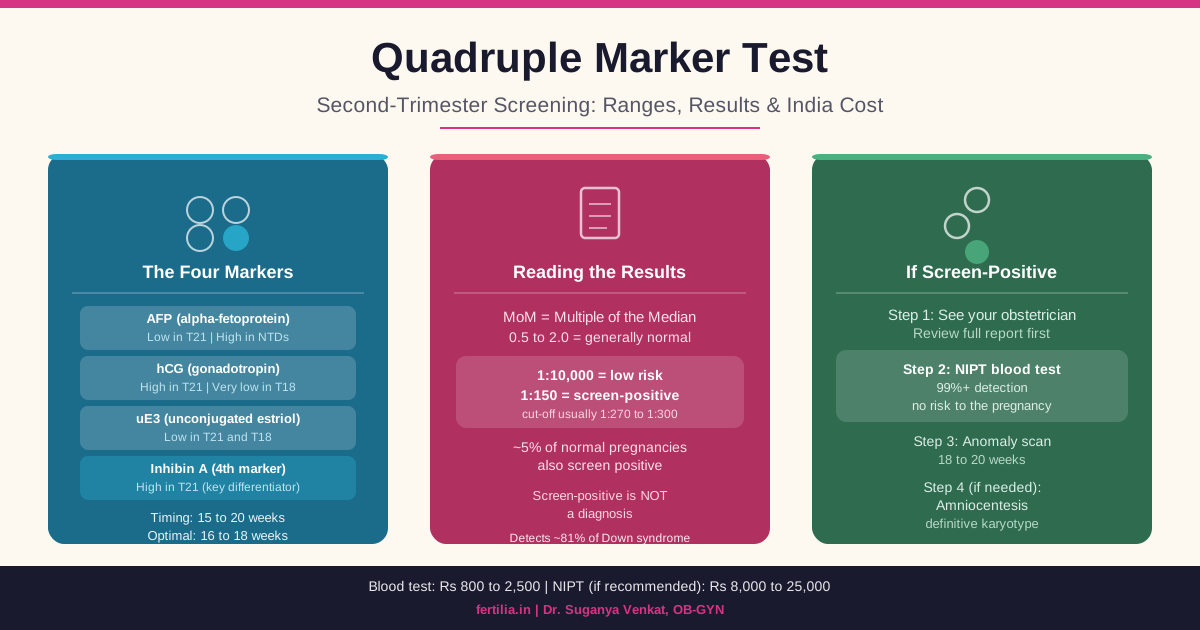
The quadruple marker test (also called the quad screen or quad test) is a second-trimester blood test that screens for chromosomal conditions and neural tube defects. It is done between 15 and 20 weeks of pregnancy, with 16 to 18 weeks considered the optimal window.
The test measures four substances in the mother’s blood and combines these measurements with maternal age, weight, gestational age, and whether the pregnancy was conceived through IVF, to produce a risk estimate for:
- Down syndrome (trisomy 21)
- Edwards syndrome (trisomy 18)
- Open neural tube defects (spina bifida, anencephaly)
- Open abdominal wall defects
It is a screening test, not a diagnostic test. A screen-positive result is a signal to investigate further. It is not a confirmation that a condition is present.
The quadruple screen is the standard prenatal screening option for women who missed the first-trimester window (11 to 13+6 weeks). If you had the double marker test and NT scan in the first trimester, you generally do not need the quadruple screen as well, unless your obstetrician requests it for a specific reason.
The Four Markers and What Each One Measures
AFP (alpha-fetoprotein)
AFP is a protein produced by the fetal liver. It passes from the fetal bloodstream into the amniotic fluid and then in small amounts into the mother’s blood. AFP rises steadily through the second trimester.
In pregnancies with Down syndrome, AFP tends to be lower than expected. In pregnancies affected by open neural tube defects (spina bifida, anencephaly) or open abdominal wall defects, AFP is higher than expected, because these conditions allow more AFP to leak from the fetal compartment into the amniotic fluid.
hCG (human chorionic gonadotropin)
hCG is produced by the placenta and is the same hormone a home pregnancy test detects. In Down syndrome pregnancies, hCG is typically higher than expected. In Edwards syndrome pregnancies (trisomy 18), hCG is very low. In a normal pregnancy, it falls within a range expected for the gestational age.
uE3 (unconjugated estriol)
Estriol is a form of estrogen produced by the fetal-placental unit working together. The fetal liver, adrenal glands, and the placenta all contribute. Low uE3 is associated with Down syndrome and Edwards syndrome. Very low or undetectable uE3 can occasionally indicate a rare condition called Smith-Lemli-Opitz syndrome, though this is uncommon.
Inhibin A
Inhibin A is produced by the placenta. It is the marker that distinguishes the quadruple screen from the older triple screen (AFP, hCG, uE3 alone). In Down syndrome pregnancies, inhibin A is higher than expected.
Adding inhibin A to the triple markers substantially improved the test’s ability to detect Down syndrome. The FASTER Research Consortium (Malone FD et al., New England Journal of Medicine, 2005; PMID 16282175), which studied over 38,000 women, reported that the second-trimester quadruple screen detects approximately 81 percent of Down syndrome cases at a 5 percent false-positive rate, compared to approximately 69 percent for the triple screen alone.
Reading Your Report: MoM Values Explained
Each marker on your report is expressed as a MoM value (Multiple of the Median). The laboratory calculates the median level of each marker for women at your exact gestational age, weight, and demographic group, then expresses your result as a multiple of that figure.
A MoM of 1.0 means your result is exactly at the expected median for your gestational age. A MoM of 0.5 means your level is half the median (lower than average). A MoM of 2.0 means your level is double the median (higher than average).
Generally expected ranges in an unaffected pregnancy:
- AFP: 0.5 to 2.0 MoM
- hCG: 0.5 to 2.5 MoM
- uE3: 0.6 to 1.6 MoM
- Inhibin A: 0.5 to 2.0 MoM
These are approximate reference ranges. Individual lab software may use slightly different parameters. More important than any single MoM value is the combined risk ratio the software produces after accounting for all four markers, maternal age, weight, gestational age, and IVF status together.
Marker Patterns for Different Conditions
The four markers produce recognisable patterns when a chromosomal condition is present.
Down syndrome (trisomy 21): AFP is low. hCG is high. uE3 is low. Inhibin A is high. The elevated inhibin A alongside high hCG is the feature that distinguishes the quad screen from the triple screen. Both markers pointing upward while AFP and uE3 point downward produces a consistent combined signal.
Edwards syndrome (trisomy 18): All four markers tend to be low. AFP is low, hCG is very low, uE3 is very low, and inhibin A is low or normal. The pattern of uniformly depressed markers is characteristic.
Open neural tube defects (spina bifida, anencephaly): AFP is elevated (often above 2.5 MoM). The other three markers remain within the normal range. An isolated AFP elevation prompts follow-up with a detailed anomaly scan. Not every elevated AFP indicates a neural tube defect: multiple pregnancies, an incorrect gestational age calculation, and fetal bleeding can also raise AFP.
What Screen-Positive and Screen-Negative Mean
Screen-negative (low risk): If your combined risk ratio is above the lab’s cut-off, the result is screen-negative. Most labs use 1:250 to 1:300 as the threshold for Down syndrome. A result such as 1:5,000 or 1:1,200 is screen-negative. The majority of women receive a screen-negative result.
Screen-positive (high risk): If your combined risk ratio falls at or below the cut-off, the result is screen-positive. A result such as 1:180 or 1:85 would be screen-positive using a 1:250 cut-off. Your specific threshold will be printed on your report.
The false-positive rate for the quad screen is approximately 5 percent. This means that for every 100 women carrying chromosomally normal pregnancies, approximately 5 will still receive a screen-positive result. A screen-positive result does not mean the baby has Down syndrome. It means the combined profile warrants a closer look.
I am Dr. Suganya Venkat, and in my years as an OB-GYN, the quad screen result that causes the most distress is one that arrives without explanation. A risk ratio like 1:120 sounds alarming in isolation. Once a woman understands that this still means roughly 119 in 120 pregnancies with that exact profile are chromosomally normal, and that NIPT can give a much clearer picture without any risk to the pregnancy, the path forward becomes manageable.
If you have received a quad screen result you want to talk through, I am available over a video call. WhatsApp me at +91 99402 00330 and we can go through your specific numbers together.
If Your Result Is Screen-Positive: What Happens Next
Step 1: Go back to your obstetrician first
The result should be interpreted alongside the complete report, not the risk ratio alone. Your obstetrician will review the individual MoM values, identify which marker is driving the result, consider how far the ratio sits from the cut-off, and factor in your full history. An isolated AFP elevation, for example, leads toward a structural scan rather than chromosomal screening.
Step 2: NIPT is usually the recommended next step
NIPT (Non-Invasive Prenatal Testing), also called cell-free fetal DNA testing or cfDNA testing, analyses fragments of fetal DNA circulating in the mother’s blood. It requires only a blood draw and carries no risk to the pregnancy whatsoever.
NIPT detects more than 99 percent of Down syndrome cases and more than 97 percent of Edwards syndrome cases. It is considerably more accurate than the quadruple screen. For most women who receive a screen-positive quad result, NIPT provides sufficient clarification without any need for an invasive procedure.
In India, NIPT is available at Apollo, Fortis, Manipal, Rainbow Hospitals, and through private diagnostic labs in major cities. Brands available include Harmony, Panorama, Verifi, and NIFTY. Cost ranges from approximately Rs 8,000 to Rs 25,000 depending on the panel (basic trisomy screen versus extended panel) and the lab. Confirm pricing directly before booking.
Step 3: Detailed anomaly scan
An anomaly scan (TIFFA or level-2 ultrasound) at 18 to 20 weeks is part of standard antenatal care for all pregnancies, regardless of quad screen results. It checks the baby’s anatomy, organ development, and structural soft markers. A normal anomaly scan alongside a normal NIPT provides a high level of reassurance.
Step 4: Amniocentesis, when a definitive answer is needed
Amniocentesis involves taking a sample of amniotic fluid from 15 weeks onwards, under ultrasound guidance, and provides a definitive chromosomal diagnosis (karyotype). The added risk of miscarriage from the procedure is approximately 0.1 to 0.3 percent above background, in experienced hands. Most families who receive a screen-positive quad result and a reassuring NIPT choose not to proceed to amniocentesis. Others prefer the definitiveness of a karyotype. Your fetal medicine specialist will guide you through whichever path suits your situation.
Quadruple, Triple, and Double Marker: Which Test Is Which
These three test names create confusion, and it is worth being clear about each one.
Double marker test (first trimester): Measures PAPP-A and free beta-hCG in blood. Done at 11 to 13+6 weeks. When combined with the NT scan (nuchal translucency ultrasound) at the same stage, this forms the first-trimester combined screen. Detection rate for Down syndrome: approximately 85 to 87 percent at a 5 percent false-positive rate. The first-trimester combined screen is generally the more accurate option when timing allows.
Triple marker test (second trimester): Measures AFP, hCG, and uE3. Done at 15 to 20 weeks. Detection rate for Down syndrome: approximately 69 percent. This was the standard second-trimester screen before inhibin A was added.
Quadruple marker test (second trimester): Measures AFP, hCG, uE3, and inhibin A. Done at 15 to 20 weeks. Adding the fourth marker (inhibin A) raised detection to approximately 81 percent at the same false-positive rate. Most private labs in India now offer the quad screen rather than the triple. Confirm with your lab which markers they run.
If you had the first-trimester combined screen (double marker plus NT scan), you do not need the quad screen as well. If you missed the first-trimester window, the quad screen is the appropriate alternative. Both are legitimate prenatal screening paths; they simply apply at different gestational stages.
Quadruple Marker Test Cost in India
The figures below reflect pricing at the time of writing (July 2026). Costs vary by city and change over time. Confirm directly with your lab or hospital before booking.
Quad blood panel alone (AFP, hCG, uE3, inhibin A): Rs 800 to Rs 2,500 at private diagnostic labs including SRL Diagnostics, Metropolis, Thyrocare-affiliated centres, and similar. Some labs price each marker separately; others offer a combined quad panel. Confirm that inhibin A is included in the panel, as some labs still run a three-marker triple test under the same booking heading.
Government hospital sector: Many government hospitals offer the triple or quadruple screen at subsidised or minimal cost. Availability of the fourth marker (inhibin A) varies. Ask specifically whether inhibin A is included if you are booking at a government facility.
If NIPT is recommended as a next step: Rs 8,000 to Rs 25,000 depending on the panel and provider. NIPT is not routinely covered under government health schemes. Check your private insurance terms before booking.
If amniocentesis is required for a definitive diagnosis: Rs 8,000 to Rs 25,000 at private centres. Government hospitals provide amniocentesis at significantly lower cost; confirm availability and waiting time.
For a comprehensive breakdown of all prenatal tests and their costs, the pregnancy resource guide covers the full antenatal schedule.
Practical Notes Before You Go
No fasting is required. Eat normally before the blood draw.
Bring your antenatal card or a copy of your most recent ultrasound report showing the current gestational age in weeks and days. The lab needs an accurate gestational age to calculate your MoM values. If your dates are uncertain, confirm with a dating scan before the blood draw, because an incorrect gestational age is one of the most common reasons for a misleading result.
The test window is 15 to 20 weeks. If you are approaching 19 or 20 weeks, book promptly. Beyond 20 weeks, the quad screen is no longer valid. The missed window is not a clinical emergency; it means the second-trimester screen is no longer available, and your obstetrician will guide you on whether an anomaly scan alone is sufficient going forward.
Frequently Asked Questions
What is the quadruple marker test in pregnancy?
The quadruple marker test (quad screen or quad test) is a second-trimester blood test done between 15 and 20 weeks of pregnancy. It measures four substances in the mother’s blood: AFP (alpha-fetoprotein), hCG (human chorionic gonadotropin), uE3 (unconjugated estriol), and inhibin A. Combined with maternal age, weight, and gestational age, it generates a risk estimate for Down syndrome, Edwards syndrome, and open neural tube defects. It is a screening test, not a diagnostic test.
What is the normal range for the quadruple marker test?
Each marker is expressed as a MoM (Multiple of the Median). Generally expected ranges in an unaffected pregnancy: AFP 0.5 to 2.0 MoM, hCG 0.5 to 2.5 MoM, uE3 0.6 to 1.6 MoM, and inhibin A 0.5 to 2.0 MoM. The combined risk ratio matters more than any individual value. A ratio above 1:250 to 1:300 is typically screen-negative (low risk); below that threshold is screen-positive.
What does screen-positive on the quadruple marker test mean?
It means your combined risk ratio falls at or below the cut-off the lab uses, usually around 1:270 to 1:300. It is not a diagnosis. The false-positive rate is approximately 5 percent, meaning about 5 in every 100 normal pregnancies will also receive a screen-positive result. The next step is usually NIPT (a blood test with no risk to the pregnancy), not immediate invasive testing.
What is the difference between the triple marker test and the quadruple marker test?
The triple marker test measures three substances: AFP, hCG, and uE3. The quadruple marker test adds a fourth: inhibin A. The addition of inhibin A improved detection of Down syndrome from approximately 69 percent (triple screen) to approximately 81 percent (quad screen) at the same false-positive rate of 5 percent. Most private labs in India now offer the quadruple screen. Confirm which markers your lab includes before booking.
What is the difference between the double marker test and the quadruple marker test?
The double marker test (PAPP-A plus free beta-hCG) is a first-trimester blood screen done at 11 to 13+6 weeks, combined with an NT scan. Together they form the first-trimester combined screen, which detects approximately 85 to 87 percent of Down syndrome cases. The quadruple marker test is a second-trimester screen (15 to 20 weeks), measuring AFP, hCG, uE3, and inhibin A, and detects approximately 81 percent of Down syndrome cases. If you had the first-trimester combined screen, you generally do not need the quad screen as well.
What is the quadruple marker test cost in India?
At the time of writing (July 2026), the quad blood panel costs approximately Rs 800 to Rs 2,500 at private diagnostic labs. Government hospitals often offer it at lower cost, though availability of inhibin A (the fourth marker) varies. NIPT, if recommended as a next step, costs Rs 8,000 to Rs 25,000. Confirm all pricing with your lab or hospital before booking, as costs vary by city.
What happens after a low-risk quadruple marker result?
Antenatal care continues on the regular schedule. The next major milestone is the anomaly scan (TIFFA or level-2 scan) at 18 to 20 weeks, which examines the baby’s anatomy and organ development. This scan is part of standard antenatal care for all pregnancies regardless of quad screen results. See our pregnancy week-by-week guide for the full timeline of tests and appointments.
A quadruple marker report with unfamiliar numbers can be difficult to interpret alone. Most women receive a screen-negative result and continue their antenatal care on the usual schedule. For those who receive a screen-positive result, the next step is clear: NIPT as a non-invasive, high-accuracy follow-up, then if needed, a detailed anomaly scan and consultation with a fetal medicine specialist. Among women who receive a screen-positive quad result, the large majority find their NIPT is normal.
For comprehensive support through your pregnancy, from the first antenatal visit to delivery, see our Pregnancy Care program.
If you have a quad test result you want to talk through, WhatsApp me at +91 99402 00330 and we can go through your specific numbers over a video call.
Dr. Suganya Venkat, OB-GYN (DNB, GKNM Hospital, Coimbatore), consults online via video call across India.