You may have replaced white sugar with jaggery after being told it was better for PCOS or pregnancy. The difference is much smaller than that advice often suggests.
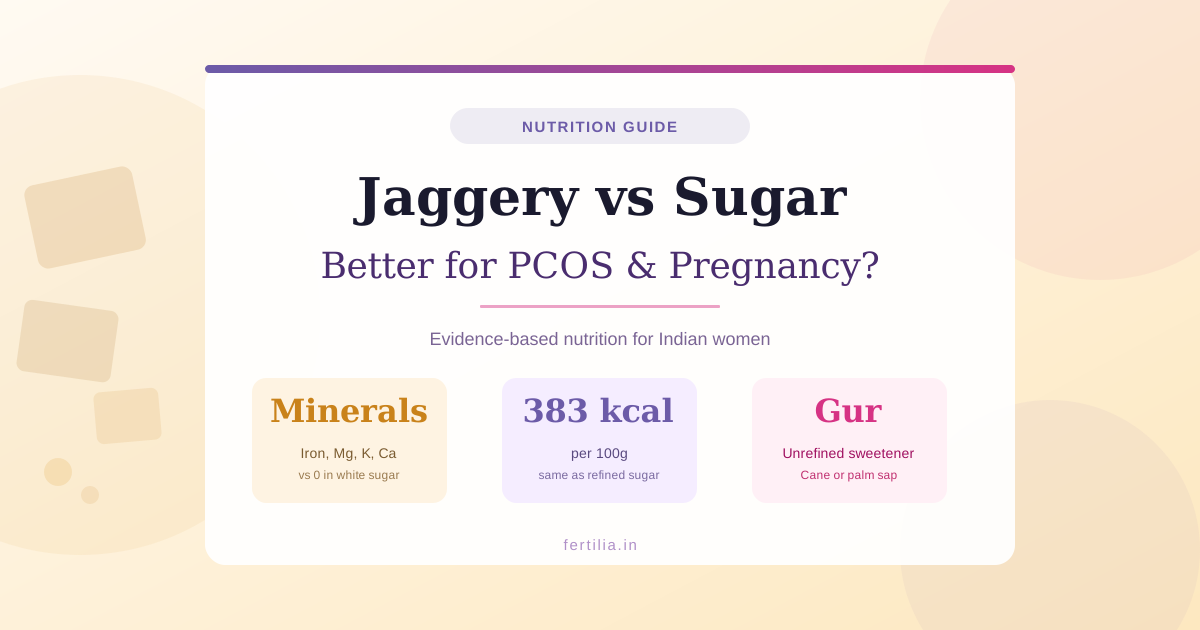
Jaggery is only marginally more nutritious than white sugar. It has almost the same calories and sugar, but keeps trace iron, magnesium, potassium, and calcium. Swap it for sugar in the same portion; do not use more of it.
In an everyday pregnancy diet, 1-2 teaspoons (10-20 g) of jaggery a day is a reasonable amount, spread across chai, cooking, or snacks; it adds a little iron and minerals alongside its sweetness.
If you are managing diabetes or gestational diabetes, jaggery portions are a question for your doctor or dietitian.
What Is Jaggery?
Jaggery is an unrefined sweetener made by boiling sugarcane juice or palm sap until much of the water evaporates, then cooling the concentrate into blocks or powder. White sugar goes through further refining. That extra processing is why white sugar is nearly pure sucrose while jaggery keeps some water, colour, flavour, and minerals from the original juice.
In India, jaggery has many names. It is gur in Hindi, vellam in Tamil, bellam in Telugu, and bella in Kannada. Karuppati in Tamil Nadu is palm jaggery, while Bengal’s seasonal date-palm jaggery is nolen gur. These products differ in taste and texture, so the best one for a dish is often the one whose flavour you prefer.
Jaggery vs Refined Sugar: What the Numbers Show
Values below are for solid sugarcane jaggery from published composition data; jaggery varies with type and processing. The jaggery figures come from Rao GP and Singh P, “Value Addition and Fortification in Non-Centrifugal Sugar (Jaggery),” Sugar Tech 24, 387-396 (2022), PMID 34334974. Section 2.8.4(1) of the FSSAI Gur standard requires at least 90% total sugars and at least 60% sucrose for palm, date, or coconut gur; section 2.8.4(2)(1) requires at least 90% total sugars and at least 70% sucrose for cane gur. The refined-sugar comparison is from USDA FoodData Central, Sugars, granulated, FDC 169655.
| Nutrient | Jaggery (per 100g) | Refined White Sugar (per 100g) |
|---|---|---|
| Calories | ~383 kcal | ~387 kcal |
| Sucrose | ~65 to 85% | ~99.9% |
| Total sugars | ~90 to 95% | ~99.9% |
| Iron | ~10 to 13 mg (solid sugarcane jaggery; varies widely, and some comes from the iron vessels used in traditional processing) | ~0.05 mg |
| Magnesium | ~70 to 90 mg | 0 mg |
| Potassium | ~1050 mg (the review reports 1056 mg) | ~2 mg |
| Calcium | ~40 to 100 mg | ~1 mg |
The iron-vessel contribution is described in Manimozhi, Mathialagan, and Mohan’s 2022 review of jaggery making.
Jaggery’s total sugars, about 90-95%, are only a little lower than refined sugar, about 99.9%, because it retains some water and plant compounds from the raw juice; it is still predominantly sugar. The calorie difference is similarly small. What jaggery adds is flavour and a modest amount of minerals.
You may see claims that jaggery has a lower glycemic index. Published figures differ, so that is not a benefit this comparison relies on. For food planning, count jaggery as sugar.
What Do Those Minerals Mean in a Real Portion?
The table uses 100 g so both sweeteners can be compared on the same basis. A measured 10 g portion of solid sugarcane jaggery contains roughly:
- Iron: 1 to 1.3 mg, with wide variation between products
- Magnesium: 7 to 9 mg
- Potassium: about 105 mg
- Calcium: 4 to 10 mg
Those are modest contributions, not a reason to increase the portion. Build meals around iron-containing foods such as leafy greens, dal, ragi, and sesame rather than treating jaggery as the iron source. For a closer look at one of those foods, read Ragi Benefits: Why Every Indian Woman Should Eat It.
The teaspoon and gram ranges in this article are two practical ways to estimate jaggery. Powdered jaggery, sticky jaggery, and broken pieces fill a spoon differently. Use the gram range if you have a kitchen scale; otherwise use the spoon range without packing the spoon tightly.
Jaggery in Pregnancy: How Much
As an everyday amount, 2 to 3 teaspoons (16-25 g) is reasonable for most women; in pregnancy a slightly more conservative 1 to 2 teaspoons (10-20 g) is sensible. Either way, the point is to replace the sweetener you would use anyway, not add extra.
The lower pregnancy range leaves room for jaggery already present in foods such as ragi laddoos, payasam, or chai. It is portion guidance, not a safety ceiling. Count all uses toward the same daily amount.
Jaggery for Women with PCOS
A jaggery-for-sugar swap gives you trace minerals for essentially the same calories and sugar. It does not make a sweetener “PCOS-friendly” or free. Keep portions small and treat jaggery as added sugar.
The portion and accompanying food matter more than the swap. Jaggery in a ragi laddoo with ghee and nuts is a different food combination from jaggery stirred into tea on an empty stomach. The laddoo still counts as a sweet, but it also contains ragi, fat, and nuts; the tea is a sweetened drink.
A useful first step is a one-day sweetener check:
| Where it appears | What to record |
|---|---|
| Chai or coffee | Every cup, including a refill |
| Ragi laddoo, sesame urundai, or chikki | The whole piece and how many you ate |
| Payasam or sakkarai pongal | The serving, even when homemade |
| Dal or sambar | The jaggery added to the pot, divided across servings |
For homemade foods, Fertilia’s nutrition team starts with the batch: record how much jaggery went into the recipe, how many servings it made, and how many you ate. This makes the sweetener in each serving visible. Then replace the sugar you already use with the same portion of jaggery, without adding it to foods that were previously unsweetened.
For the wider food picture, read the Insulin Resistance and PCOS guide.
Practical Ways to Use Jaggery
For chai or coffee, replace the sugar you normally add and count every cup. Jaggery has a stronger caramel flavour, so you may enjoy the drink with a smaller piece.
In a ragi laddoo, sesame urundai, or peanut chikki, keep the piece small enough that the portion is visible. Payasam and sakkarai pongal remain sweets when made with jaggery, even when every ingredient is prepared at home.
A little jaggery in dal or sambar serves a different kitchen purpose. It rounds out the sharpness of tamarind without making the dish taste sweet. When one small piece sweetens a pot shared by four people, divide it across those servings rather than counting the whole piece for one plate.
Palm jaggery is not automatically better than sugarcane jaggery. Choose karuppati, nolen gur, or regular cane jaggery for flavour, price, and the dish you are making. Dark colour alone is not a reliable measure of mineral content or quality.
For complete Indian meal examples, see the PCOS Diet Chart: Full Indian Meal Plan and PCOS-Friendly Indian Breakfast Ideas.
If you want help turning a one-day food list into a practical plan, ask Fertilia’s nutrition team on WhatsApp.
How Much Jaggery Can I Eat During Pregnancy?
Use the pregnancy portion above across the whole day. Choose where you most enjoy it: a little in morning chai, a small amount in dal or sambar, or the jaggery in one ragi laddoo. A laddoo may account for most of the day’s portion, depending on its recipe.
For a homemade batch, divide the jaggery used by the number of servings. This gives you a practical estimate for each piece without repeating a fresh allowance for every dish.
FAQ
Is jaggery safe during pregnancy? Yes, in everyday amounts. A practical portion is 1 to 2 teaspoons (10-20 g) a day, spread across chai, cooking, or snacks.
Is jaggery actually better than sugar? Barely. The calories and total sugar are almost the same. Jaggery keeps small amounts of iron, magnesium, potassium, and calcium that refined white sugar has virtually none of. Choose it for flavour and those modest mineral differences, not as a health food.
Does jaggery have a lower glycemic index than sugar? Published values vary by jaggery type and testing method, so there is no dependable lower-GI advantage to use for meal planning. Count jaggery as sugar.
Can I eat jaggery if I have PCOS? Yes, as a small portion of added sugar. The practical advantage over white sugar is limited to trace minerals and flavour. The amount used and the rest of the food matter more than the swap.
Does jaggery contain iron? Yes. An 8 g portion contributes roughly 0.8 to 1 mg based on the composition range above, but products vary. Leafy greens, dal, ragi, and sesame remain more useful foods around which to build a meal.
Is palm jaggery better than sugarcane jaggery? Not automatically. Palm and sugarcane jaggery differ in flavour, colour, texture, and composition. Choose the type that suits the dish, your budget, and what is reliably available in your region.
Can I give jaggery to children? Jaggery is used in children’s foods such as ragi laddoos, chikki, and puffed rice laddoos. For babies under one year, added sweeteners including jaggery are generally not recommended; your paediatrician can guide first foods.
Jaggery earns its place in an Indian kitchen for flavour. Nutritionally, the gain over white sugar is real but modest: a little iron and minerals for almost the same calories and sugar. Use the swap where you enjoy it, keep the portion visible, and count every sweetened food across the day.
Food is one part of PCOS care. If you would like help building an Indian food plan around the meals you already eat, start a WhatsApp conversation or see how food fits into Fertilia’s 90-day PCOS Symptom Reversal program.