Couples who have already worked through whether they need ICSI usually ask me the same follow-up question in the next breath: what will it actually cost, and why does one clinic quote Rs 15,000 and another Rs 50,000 for what sounds like the same procedure?
I’m Dr. Suganya Venkat, an OB-GYN with fifteen years in fertility care, and I see this confusion often in the online consultations I run at Fertilia. ICSI pricing varies for real reasons, some of which are worth paying for and some of which are not. This post is about the price specifically: what drives it, what a fair quote looks like, and how it sits inside your total IVF budget. If you are still deciding whether ICSI applies to your case at all, ICSI vs IVF: The Difference & Who Needs It covers that decision in full.
The Short Answer
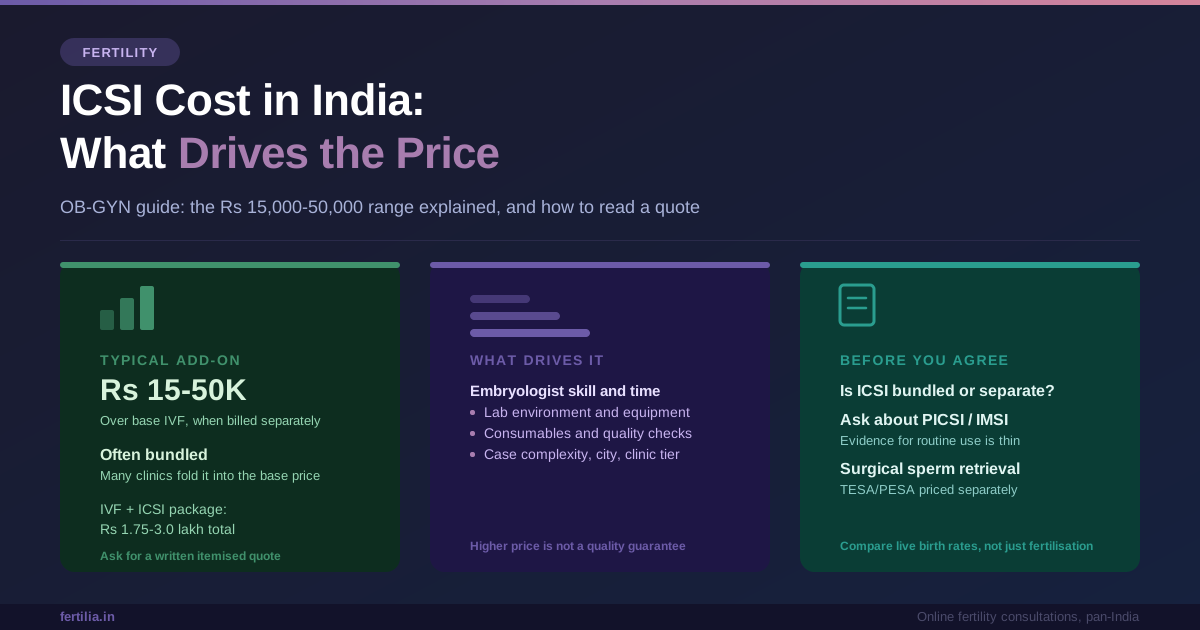
At most Indian fertility centres in 2026, ICSI adds approximately Rs 15,000 to Rs 50,000 to a standard IVF cycle when it is billed as a separate line item. A workable mid-range figure for budgeting is Rs 25,000 to Rs 40,000. Some premium metro clinics quote up to Rs 50,000. Many clinics now fold ICSI into their standard IVF package rather than pricing it separately, in which case the add-on cost at the patient level is effectively zero, though the base package itself may be priced higher to account for it.
A complete IVF cycle that includes ICSI typically totals Rs 1.75 lakh to Rs 3 lakh for the procedure package alone, before medications, monitoring scans, and any freezing or storage. The full IVF cost breakdown by city has the detailed all-in numbers for total cycle budgeting.
Why the Range Is So Wide
Rs 15,000 and Rs 50,000 are both real prices for the same named procedure, and the gap is not random. A handful of concrete factors explain most of it.
The embryologist’s time and skill
ICSI is not automated. An embryologist selects a single sperm under high magnification and injects it into each mature egg individually, one at a time, using a micromanipulator. This takes meaningful hands-on time per cycle, and the skill of the person doing it affects fertilisation outcomes. Clinics with experienced senior embryologists and a sustainable caseload per embryologist generally carry higher running costs than centres stretching one embryologist across a heavy patient volume.
Laboratory environment and equipment
Embryos are sensitive to temperature, air quality, and handling conditions. A well-run embryology lab invests in filtered air systems, calibrated incubators with continuous monitoring, backup power, and validated equipment maintenance. None of this is visible to a patient sitting in the consultation room, but it shows up in the fee. A lower price does not automatically mean a worse lab, and a higher price does not guarantee a better one, but the infrastructure genuinely costs money to run well.
Consumables and quality checks
Each ICSI cycle uses single-use sterile injection pipettes, holding pipettes, culture dishes, and tested media. Reputable clinics also run identity-witnessing systems, sometimes electronic, to prevent sample mix-ups. These recurring costs are part of what a serious lab charges for.
Case complexity
Straightforward ICSI with a fresh ejaculated sample costs less to perform than ICSI using surgically retrieved sperm (from a TESA or PESA procedure) or frozen sperm that needs additional processing. If your case involves surgical sperm retrieval or a prior fertilisation failure requiring extra precautions, ask specifically whether that changes the ICSI fee.
City and clinic positioning
Metro locations, hospital brand recognition, and physician consultation fees all factor into the final number, sometimes more than the underlying lab work does. A standalone fertility specialist in a tier-2 city can deliver comparable lab standards to a metro chain at a meaningfully lower price, simply because the overhead is different.
When ICSI Is Worth the Add-On Cost
ICSI has strong evidence behind it in specific situations: severe male factor infertility, azoospermia requiring surgically retrieved sperm, frozen or thawed sperm samples with limited counts, and a prior cycle with total fertilisation failure. In these cases, the add-on fee buys something concrete, a real reduction in the risk of a cycle producing zero fertilised eggs.
For couples with normal semen parameters and no history of fertilisation failure, multiple large trials have not found a difference in live birth rates between conventional IVF and ICSI. In that situation, the add-on cost is not buying a better outcome, though some clinics apply it as standard protocol regardless. ICSI does not confirm or guarantee fertilisation, and a cycle can still end with no fertilised eggs after it. The full clinical picture of who needs ICSI walks through each indication in detail. It is a fair question to ask your clinic directly why ICSI is being recommended for your specific case.
If you are trying to make sense of a quote or unsure whether ICSI applies to your situation, an online consultation can help you go through it together. WhatsApp us at +91 99402 70499 to set up a video call with Dr. Suganya.
PICSI, IMSI, and Other Add-Ons: What You’re Paying For
Some clinics offer PICSI (physiological ICSI, where sperm are pre-selected based on their ability to bind hyaluronic acid) or IMSI (which uses very high magnification to examine sperm morphology before selection) as upgrades on top of standard ICSI, usually at an additional cost.
These are technologies clinics sometimes suggest when there is a specific concern, such as unusually high sperm DNA fragmentation, though even in that situation the benefit is unproven. But it is worth knowing that the evidence for routine use is thin. ESHRE’s 2023 good practice recommendations on add-ons in reproductive medicine reviewed 42 such recommendations across fertility care and found that none could be based on high-quality evidence, with only four supported by moderate-quality evidence (Lundin K et al., Human Reproduction, 2023, PMID 37747409). That does not mean these add-ons never help. It means a clinic recommending one should be able to explain why it applies to your specific case, not offer it as a default upgrade.
A reasonable question to ask before agreeing to any add-on: what problem is this meant to solve in our case specifically, and what is the evidence that it improves the chance of a live birth rather than just a laboratory measurement like fertilisation rate or embryo appearance?
What Andrology Testing Adds to the Bill
Some testing bundled into an ICSI cycle is foundational: a semen analysis, infection screening required by the clinic, and for significant male factor cases, hormonal or genetic evaluation. Understanding what your semen analysis report shows is worth reading before this stage.
Other tests, such as sperm DNA fragmentation panels or advanced morphology assessments, are useful in selected situations like recurrent pregnancy loss or repeated ART failure, but are not a routine requirement for a first ICSI cycle. If a test is being added to your bill, it is fair to ask what changes in your treatment plan depending on the result. If the answer does not change management, the test may not be necessary for your case.
How to Read an ICSI Quote
Ask whether ICSI is included in the quoted IVF package or billed separately. If it is bundled, the base package price should reflect that; if it is separate, get the exact figure including GST.
Request a written itemised estimate, not a verbal number during a consultation. A written breakdown that separates the IVF laboratory fee from the ICSI fee, and lists PICSI, IMSI, or other add-ons individually, is the only way to compare two clinics fairly.
Ask what happens if there are no eggs, no mature eggs, or no fertilisation. Some clinics have different billing rules depending on how far a cycle proceeds. This is worth confirming before starting, not after.
Ask whether surgical sperm retrieval is priced into the estimate, if that applies to your case. TESA, PESA, or micro-TESE are separate procedures with their own costs, and combining them with ICSI is a different total than ICSI with an ejaculated sample.
Compare live birth rates, not just fertilisation rates, when a clinic presents its outcomes for a recommended add-on. A test or technique that improves how many eggs fertilise in the dish does not automatically translate into a higher chance of a baby.
Where ICSI Fits in Your Total IVF Budget
| Component | Typical Cost (2026) |
|---|---|
| Base IVF procedure (retrieval, culture, transfer) | Rs 90,000-1,50,000 |
| ICSI add-on (when billed separately) | Rs 15,000-50,000 |
| IVF + ICSI procedure package (priced as a bundle, not the sum of the two rows above) | Rs 1.75-3.0 lakh |
| Stimulation medications | Rs 40,000-90,000+ |
| PICSI or IMSI (optional, case-specific) | Additional, varies by clinic |
| Surgical sperm retrieval (TESA/PESA, if needed) | Separate procedure cost |
A clinic package price is not the base procedure fee plus the ICSI fee added together. Packages are quoted as bundles and what they cover differs between centres, so ask for the written inclusion list before comparing a package price against the itemised rows above. Figures reflect current published clinic and aggregator pricing for India, checked September 2026. Always request a written itemised quote, since ranges vary by city and centre. A full city-by-city and component-by-component IVF budget is in the IVF cost guide.
FAQ
How much does ICSI cost in India? ICSI typically adds Rs 15,000 to Rs 50,000 to a standard IVF cycle when priced separately, with Rs 25,000 to Rs 40,000 being a workable mid-range budgeting figure. A combined IVF plus ICSI procedure package usually totals Rs 1.75 to Rs 3 lakh. Many clinics bundle ICSI into their standard package rather than charging separately, so ask specifically how your clinic prices it.
Why does ICSI cost more at some clinics than others? The main drivers are embryologist experience and caseload, laboratory infrastructure (air quality, incubator monitoring, backup systems), consumables and identity-witnessing quality checks, case complexity (fresh versus surgically retrieved or frozen sperm), and general clinic positioning including city and brand. A higher price can reflect a genuinely better-resourced lab, but it is not a guarantee, so ask what specifically the fee covers.
Is ICSI always billed separately from IVF? No. Some clinics include ICSI in their standard IVF package at no extra charge, in which case the base package price is usually set higher to account for it. Others bill it as a distinct line item. Ask your clinic directly which model they use and request the written breakdown either way.
Do I need ICSI, or is it being added as a default? ICSI is clearly indicated for severe male factor infertility, azoospermia with surgically retrieved sperm, frozen or limited sperm samples, and prior total fertilisation failure. For couples with normal semen parameters and no fertilisation failure history, evidence does not show a benefit over conventional IVF, though some clinics use it as a standard protocol for all cycles. The complete decision framework covers this in depth.
Are PICSI and IMSI worth paying extra for? They are sometimes suggested in specific circumstances, such as significantly elevated sperm DNA fragmentation, but a live birth benefit has not been established even in that situation, and the broader evidence for routine use across all ICSI cycles is limited. A review of 42 recommendations on fertility add-ons found none backed by high-quality evidence. Ask your clinic what specific problem the add-on addresses in your case and what evidence supports it improving your chance of a live birth, not just a lab measurement.
What other costs come with ICSI that I might not expect? If sperm needs to be surgically retrieved (TESA or PESA), that is a separate procedure cost on top of ICSI. Andrology tests beyond a basic semen analysis, such as DNA fragmentation panels, are billed separately and are not always necessary. Ask what is included in your written quote and what would be added only if the situation calls for it.
ICSI ka kharcha kitna hota hai India mein? ICSI ka alag se kharcha aam taur par Rs 15,000 se Rs 50,000 ke beech hota hai, jo IVF cycle ke upar add hota hai. Kai clinics ICSI ko apne standard IVF package mein hi shamil kar dete hain, isliye patient ke liye alag se charge nahi dikhta. Pura IVF plus ICSI package Rs 1.75 se 3 lakh tak ho sakta hai, city aur clinic ke hisaab se.
The most useful next step, if you are weighing a quote or deciding whether an add-on makes sense for your case, is a direct conversation about your specific reports and history rather than a general price range. Dr. Suganya offers online video consultations pan-India at Fertilia, at Rs 399. Message on WhatsApp to set up a time.
Consultation is online, pan-India, via video call or phone.