A few weeks ago a woman came to me with a printed lab report. Three numbers in bold. FSH: 12.4. LH: 8.1. Estradiol: 98.
She had typed each number into a search engine the previous night. She was 31 years old and had spent the evening reading articles about premature ovarian failure.
What she had found online was not wrong exactly, but it was incomplete in a way that had frightened her considerably more than was warranted. Her FSH of 12.4 was mildly elevated, worth following up. But the estradiol of 98 on Day 3 was actively suppressing that FSH number, which meant the actual picture was somewhat different from the number on paper. And the LH of 8.1, read alongside her irregular cycles, was pointing toward a different question altogether.
None of this was visible from the numbers alone.
The Day 3 hormone panel is one of the most commonly ordered fertility tests, and one of the most consistently misread. Part of the reason is that the numbers vary by lab, by cycle, and by what the other hormones on the same panel are doing. Another part is that the reference ranges printed on reports are often calibrated to a general population, not to a 30-year-old woman trying to understand her fertility.
What I want to cover here: why the test is timed to Day 3, what each of the three hormones is measuring, how to read them together, and what the results actually point you toward.
Why Day 3 Specifically
Your cycle is not a flat line. Hormones move through a pattern across the month, and most of that movement is directional: FSH rises to recruit follicles, estradiol climbs as those follicles grow, LH surges to trigger ovulation, progesterone peaks in the second half, and then everything drops back down at the end of a cycle.
The only phase where hormones are genuinely at rest is the early follicular phase, the first two to four days of a new period.
At that point, the previous cycle’s corpus luteum has dissolved. Progesterone has dropped. No follicle is yet being actively recruited. Estradiol is at its lowest. FSH and LH are at their un-stimulated, resting levels.
This is why Day 3 (or Day 2, or Day 4, which most labs will accept) is the right moment to measure these hormones. Test on Day 10 and you are catching FSH in the middle of follicle recruitment. Test on Day 14 and you may be measuring LH mid-surge. The only baseline reading comes from the early follicular window.
One practical note for India: most labs will accept blood drawn on Days 2, 3, or 4 of your period for this panel. If Day 3 falls on a Sunday or a public holiday, Day 2 or Day 4 is generally fine. The key is that you are within the first few days of bleeding, not counting from the day bleeding becomes heavy.
FSH: What It Is and What the Number Means
FSH stands for follicle-stimulating hormone. It is produced by the pituitary gland and its primary job, at the start of each cycle, is to recruit follicles in the ovaries and stimulate them to grow.
The clinically important feature of FSH is that its levels are partly determined by how well the ovaries are responding. When ovarian reserve is healthy and follicles are plentiful and responsive, the ovaries send back hormonal signals that tell the brain: we are managing, ease off on FSH. The Day 3 level stays in a lower range.
When ovarian reserve is reduced and the ovaries cannot respond as readily, the pituitary compensates by raising FSH. It is trying harder to get a response. A rising FSH is the brain’s way of turning up the signal because the ovaries are harder to reach.
This is why Day 3 FSH functions as a measure of ovarian reserve, at least in part.
Typical reference ranges for Day 3 FSH:
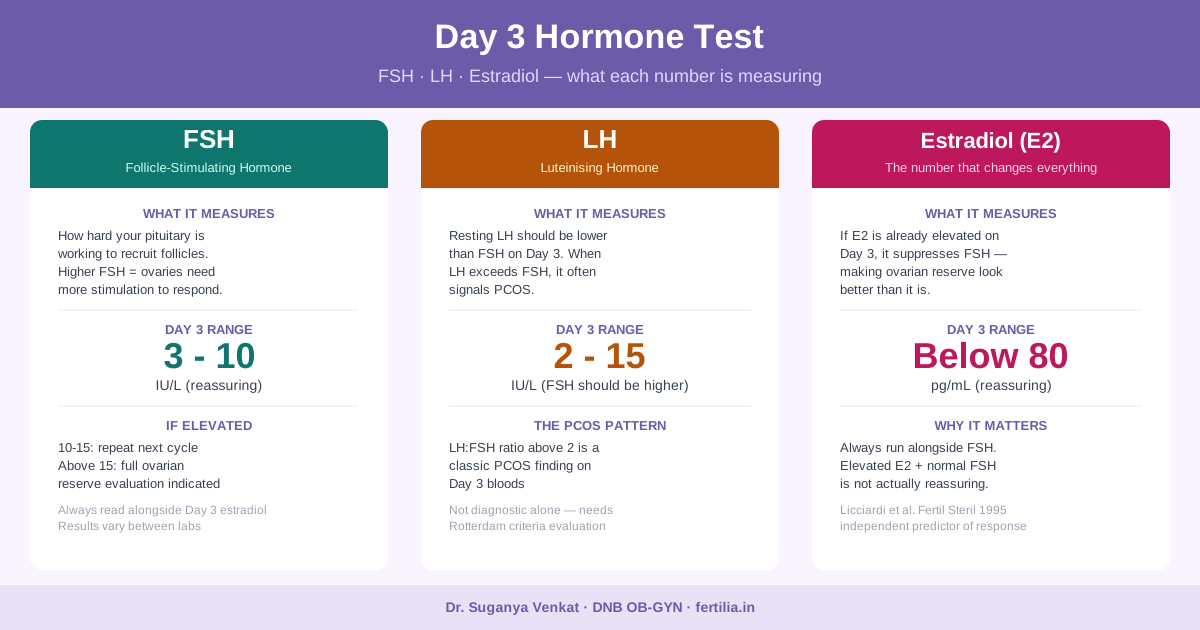
- 3 to 10 IU/L: within the expected range for this phase
- 10 to 15 IU/L: mildly elevated; worth repeating the following cycle alongside an antral follicle count scan
- Above 15 IU/L: more clearly elevated; a full ovarian reserve evaluation is indicated
These numbers vary between laboratories. Different assay kits are calibrated differently, so an FSH of 11 on one platform can correspond to an FSH of 9 on another. This is not a flaw in the test; it is a known property of hormone assays, and it means that comparing FSH results from different labs is unreliable. What matters is comparing results from the same lab across cycles.
It also means that a single elevated FSH result does not tell the complete story. Research published by Scott et al. in Fertility and Sterility (1990) documented significant cycle-to-cycle variation in Day 3 FSH. A woman can have an elevated reading one month and a normal reading the following month. Two or three elevated readings in a row carry considerably more clinical weight than one elevated result. If your FSH has come back elevated for the first time, the first step is to repeat it the next cycle, not to act on the single number.
LH: The Signal That Points Toward PCOS
LH (luteinising hormone) is produced by the same pituitary gland and works in close coordination with FSH. Its major event in the cycle is the LH surge around Day 12-14, which triggers ovulation. But on Day 3, before any of that, LH should be at a low resting level.
The typical Day 3 LH reference range is 2 to 15 IU/L, though most labs consider values above 10 as elevated for this phase.
Taken alone, the absolute LH number on Day 3 is less informative than the ratio between FSH and LH. In a typical cycle, FSH is slightly higher than LH at the start. When this ratio flips, and LH is equal to or higher than FSH, it is a pattern that frequently accompanies polycystic ovary syndrome.
An LH:FSH ratio above 2 on Day 3 is a classic finding in PCOS. It reflects the altered hormonal drive that characterises the condition: the pituitary is putting more emphasis on LH than FSH, which affects follicle development, ovulation frequency, and androgen production in the ovaries.
To be clear: an elevated LH:FSH ratio on Day 3 is not a diagnosis of PCOS. The Rotterdam criteria (ESHRE/ASRM 2003) require at least two of three findings: irregular or absent ovulation, clinical or biochemical signs of excess androgens, and polycystic ovarian morphology on ultrasound. A Day 3 hormone panel can contribute to the picture, but it does not replace a full evaluation.
If your LH is elevated or your ratio is inverted, ask your doctor whether PCOS needs to be evaluated. A pelvic ultrasound to look at follicle distribution and a clinical review of your periods and any androgen-related symptoms (acne, facial hair, irregular cycles) would be the appropriate next step.
Estradiol: The Number That Changes How You Read Everything Else
Estradiol (E2) is the main form of oestrogen your ovarian follicles produce. On Day 3 of the cycle, before any follicle has been significantly recruited, estradiol should be at its lowest level of the cycle.
A typical Day 3 estradiol is below 60 to 80 pg/mL. Some lab reference ranges extend to 100 pg/mL, but most fertility specialists treat values above 60-80 as worth noting.
Here is why estradiol matters more than most reports make clear.
Estradiol feeds back to the pituitary gland and suppresses FSH. This is a normal part of the regulatory system: as follicles grow and produce more estradiol during the cycle, the brain gradually reduces FSH output so that one follicle pulls ahead and the others stop growing. It is a fine-tuned feedback loop.
On Day 3, if estradiol is already elevated, it means something is already actively producing oestrogen when the cycle should be at its most quiet. A dominant follicle that did not regress properly from the previous cycle is one possible cause. Ovarian cysts are another. The result is that the elevated estradiol is suppressing FSH below where it would naturally sit, making ovarian reserve look better than it is.
Research by Licciardi et al. (Fertility and Sterility, 1995, 592 IVF cycles) found that higher Day 3 estradiol was associated with fewer eggs retrieved and lower pregnancy rates, and that the best outcomes were in women with both low FSH and low estradiol. A woman with an FSH of 8 and an estradiol of 110 on Day 3 has a less reassuring ovarian reserve picture than a woman with an FSH of 9 and an estradiol of 35. The FSH of 8 only looks reassuring because the elevated estradiol is pushing it down.
This is why FSH must always be read alongside Day 3 estradiol, not in isolation. A result sheet that shows only FSH is giving you half the information. When you get this test done, confirm that estradiol is included in the panel. Many standard hormone panels include it, but it is worth verifying when you book.
If your estradiol was elevated on Day 3, request a repeat the following cycle. If it is elevated twice, an antral follicle count scan alongside the repeat bloods will give a more complete picture of where your reserve actually stands.
Reading the Three Numbers Together
In practice, four patterns come up most often.
Normal FSH, normal estradiol, FSH higher than LH: This is the expected Day 3 baseline. It does not guarantee anything about conception, and it says nothing about egg quality, but it confirms the hormonal axis is functioning as expected for this phase of the cycle.
Elevated FSH with normal or low estradiol: This is a genuine signal. The ovaries are not suppressing FSH the way they should, which suggests fewer follicles are responding. A repeat test the following cycle and an antral follicle count scan are the immediate next steps.
Normal FSH with elevated estradiol: FSH looks normal, but the elevated estradiol has pushed it below its natural level. The clinical implication is the same as an elevated FSH: ovarian reserve needs to be assessed through an AFC scan and, if not yet done, an AMH test.
For more on this, read our guide on AMH vs AFC. Elevated LH with normal or low FSH, or LH above FSH on Day 3: The ovarian reserve question becomes secondary. The primary question is whether PCOS is present and what is driving the LH elevation. An ultrasound and a clinical review of cycle and androgen-related symptoms are the appropriate next steps.
If you want to understand the full range of tests that belong in a fertility workup, our complete fertility workup guide covers which tests to run, when to run them, and how to interpret the whole panel together. For how the AFC scan specifically reads your follicle count on ultrasound, see Antral Follicle Count: How to Read Your Ultrasound.
Book a WhatsApp consultation with Dr. Suganya
₹399 consultation · Online, pan-India · Video call
What to Do After Getting Your Results
If your FSH is between 10 and 15 IU/L: Do not act on one result. Book the same test for the following cycle and request that an antral follicle count scan be done alongside it. Two elevated readings in a row are when this number becomes clinically meaningful.
If your FSH is above 15 IU/L: Request a full ovarian reserve evaluation: AFC scan and an AMH blood test if not done recently. This helps your doctor understand whether the elevated FSH is part of a pattern or a cycle variation. You can read more about what AMH tells you and what AFC adds to understand how the tests complement each other.
If your estradiol is above 60-80 pg/mL on Day 3: Repeat the panel next cycle. If elevated twice, a pelvic scan alongside the bloods will give a clearer picture. Do not assume a single elevated estradiol means something is seriously wrong, but do follow it up.
If your LH is elevated or higher than FSH: Ask your doctor to evaluate for PCOS. A pelvic ultrasound looking at follicle count and distribution, together with a review of your period history and any symptoms of androgen excess, is the standard next step. The Day-21 progesterone test is also useful in this context to confirm whether ovulation is occurring regularly.
If you are also tracking your cycle to time tests or understand your fertile window, the Ovulation Tracking Resource has a practical guide to reading your body’s signals throughout the month alongside blood tests.
On the practical side for India: Most commercial labs offer FSH, LH, and estradiol as a combined panel. Thyrocare, Redcliffe, Metropolis, and SRL all include it. The test typically costs Rs 700 to Rs 1,800 depending on city and lab. It can usually be self-booked, though interpretation needs to happen with a doctor. For a full picture of what a fertility workup costs in India, see our fertility workup cost guide.
A note on timing: blood needs to be drawn on Days 2 to 4 of your period. Fasting is not required, but the blood should be taken before 10 am for the most stable reading, since FSH and LH show mild diurnal variation. This is standard practice at most labs.
FAQ
What is a normal Day 3 FSH level? Most labs consider 3 to 10 IU/L reassuring for Day 3 FSH. Values between 10 and 15 IU/L are mildly elevated and worth repeating the following cycle. Values above 15 IU/L are a clearer signal of reduced ovarian reserve and indicate that a full evaluation, including an antral follicle count scan and AMH, is the appropriate next step.
Can I still get pregnant if my Day 3 FSH is high? Yes. A single elevated FSH result is not a prediction of whether you can or cannot conceive. Many women with intermittently or mildly elevated FSH conceive naturally or with minimal support. What an elevated FSH does indicate is that the workup should not be delayed. Understanding your full picture, including AFC, AMH, and your cycle history, gives you and your doctor the information to plan well.
Why does the estradiol level matter if FSH is what everyone talks about? Estradiol on Day 3 can suppress FSH through normal hormonal feedback, making FSH look lower (and therefore more reassuring) than it actually is. If estradiol is elevated and FSH looks normal, the reassurance is artificial. This is why FSH and estradiol need to be read together on the same report, not FSH in isolation.
What does a high LH or inverted ratio on Day 3 mean? An LH:FSH ratio above 2, or LH higher than FSH on Day 3, is a common finding in women with PCOS. It reflects the altered hormonal drive that characterises the condition. It does not mean ovarian reserve is necessarily reduced. It points toward a different question: whether PCOS needs to be properly evaluated, through a pelvic ultrasound and a review of your menstrual and androgen-related history.
My estradiol was not included in my Day 3 results. What should I do? Request a repeat test on Days 2 to 4 of the following cycle and specifically ask for FSH, LH, and estradiol together. An FSH result without estradiol is incomplete information. Many standard panels already include all three, but it is worth confirming when booking.
My FSH was elevated last cycle but normal this cycle. Which number do I trust? Neither result in isolation. FSH varies from cycle to cycle, and a single reading in either direction is not enough to draw conclusions. Two or three readings showing the same pattern (both elevated, or both normal) carry clinical weight. If you have had one elevated and one normal reading, repeat it once more to see which pattern predominates.
Is the Day 3 FSH test the same as an AMH test? No, they measure different aspects of ovarian reserve. AMH (anti-Mullerian hormone) reflects the pool of small follicles currently available and can be tested on any day of your cycle. It tends to be more stable across cycles. Day 3 FSH reflects how hard the pituitary is working at the start of the cycle to stimulate follicle growth. Both tests are useful and complement each other. If you have had one but not the other, it is worth discussing with your doctor whether both are indicated in your workup.
If your Day 3 results have left you with more questions than they answered, or you are not sure what the next step in your workup should be, Dr. Suganya is available for online consultations across India via video call. You can reach her directly on WhatsApp to book.
Book your consultation with Dr. Suganya
These baseline results are the starting point of Dr. Suganya’s Fertility program.
₹399 · Online, pan-India · Video call
Sources: Scott RT et al. Intercycle variability of day 3 follicle-stimulating hormone levels and its effect on stimulation quality in in vitro fertilization. Fertil Steril 1990;54(2):297-302 (PMID 2116330). American Society for Reproductive Medicine Practice Committee: Testing and interpreting measures of ovarian reserve. Fertil Steril 2015;103(3):e9-17 (PMID 25585505). Licciardi FL et al. Day three estradiol serum concentrations as prognosticators of ovarian stimulation response and pregnancy outcome in patients undergoing in vitro fertilization. Fertil Steril 1995;64(5):991-4 (PMID 7589648). Rotterdam ESHRE/ASRM-Sponsored PCOS Consensus Workshop Group. Revised 2003 consensus on diagnostic criteria and long-term health risks related to polycystic ovary syndrome (PCOS). Hum Reprod 2004;19(1):41-7 (PMID 14688154).