Many women reach a point where they know they want to speak to a mental health professional but are not sure which type. Psychiatrist, psychologist, counsellor. The words surface in conversations, on app listings, and in WhatsApp forwards. In India, where mental health care is still becoming familiar to most people, nobody quite explains what each role involves or how to choose between them.
The result is that people delay, or pick at random, or ask a friend who went to therapy once and receive information based on that single experience. Some end up with a counsellor when their symptoms need psychiatric care. Some arrive at a psychiatrist expecting, or dreading, an immediate prescription.
I am a psychiatrist at Fertilia Health. I get this question regularly, sometimes from women who say they were not entirely sure what they had booked when they sat down for a first consultation. This post is a direct answer to that question, written for the Indian context specifically.
What each professional does
These three roles have distinct training, tools, and regulatory standing in India.
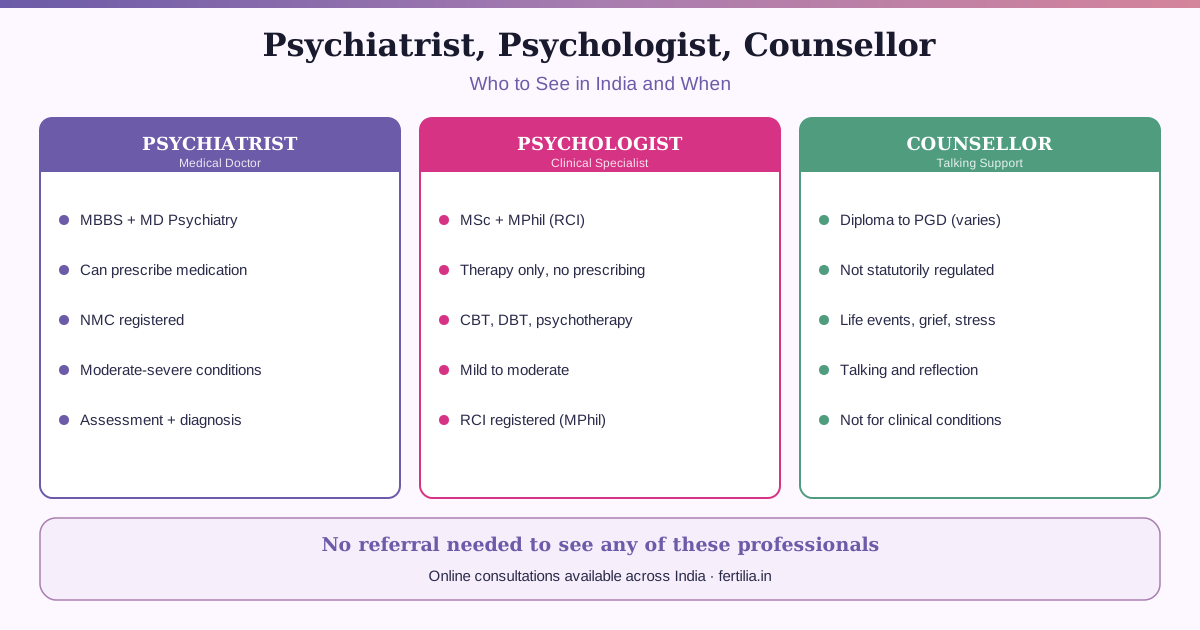
Psychiatrist
A psychiatrist is a medical doctor who has completed additional training in mental health. In India, the qualification pathway is:
- MBBS (5.5 years including internship)
- MD Psychiatry or DNB Psychiatry (3 years of residency, hospital-based)
Because a psychiatrist is a medical doctor, they can assess, diagnose, and prescribe medication. This includes antidepressants, anti-anxiety medications, mood stabilisers, and other psychiatric medicines when clinically indicated.
Most psychiatrists in clinical practice combine medication management with structured counselling and psychoeducation alongside it. Extended psychotherapy (such as a full course of CBT or DBT) is more commonly provided by clinical psychologists, though psychiatrists with additional training do offer it.
In India, psychiatrists are registered with the National Medical Commission (NMC, formerly the Medical Council of India). A practitioner’s registration is verifiable through the NMC register.
Clinical Psychologist
A psychologist has studied psychology rather than medicine. The standard clinical pathway in India is:
- BA or BSc in Psychology (3 years)
- MA or MSc in Psychology (2 years)
- MPhil Clinical Psychology (2 years, at NIMHANS or an RCI-recognised institution)
The MPhil in Clinical Psychology, regulated by the Rehabilitation Council of India (RCI), is what qualifies a psychologist to provide formal diagnostic assessment and structured psychotherapy: CBT (cognitive behavioural therapy), DBT (dialectical behaviour therapy), psychodynamic therapy, and related approaches. A clinical psychologist cannot prescribe medication.
Many practitioners in India also offer therapy with an MA or MSc in psychology without the MPhil Clinical qualification. This is common in practice and often genuinely helpful. The MPhil qualification becomes particularly relevant when formal diagnostic assessment or specific accredited protocols are needed.
When medication is also warranted, a psychologist typically works alongside a psychiatrist as part of a coordinated care plan.
Counsellor
A counsellor provides talking support. In India, counsellor training ranges from short certificate courses to postgraduate diplomas. Unlike psychiatrists and clinical psychologists, the title “counsellor” is not statutorily regulated in India, which means the depth of training and scope of practice can vary widely between practitioners.
Good counsellors are genuinely useful for processing difficult life events: grief, relationship difficulties, work pressure, major transitions, worry about the future. Counselling is not a substitute for psychiatric or psychological treatment when a clinical condition is present, but for the kinds of emotional difficulty that come with living, a skilled counsellor can provide real and meaningful support.
When medication is or is not needed
Medication in psychiatry is a tool, not a default. I prescribe it when:
- Symptoms are severe enough to significantly impair daily functioning (work, relationships, sleep, eating)
- Therapy alone has not provided sufficient improvement after a genuine trial
- The clinical picture points toward a condition with a strong neurobiological component, such as major depression, panic disorder, OCD, or bipolar disorder
Medication is generally not the first step for:
- Situational distress tied to a specific life event (bereavement, a relationship difficulty, exam pressure, a health scare) where symptoms are mild to moderate and the person is otherwise managing
- Anxiety or low mood that responds to structured therapy and lifestyle support
- Adjustment difficulties without a diagnosable disorder
The most common misconception I hear is that seeing a psychiatrist automatically means starting medication. It does not. A good psychiatric consultation looks at the full picture, considers the least intensive effective approach first, and discusses all options before any decision is made. Cognitive behavioural therapy is one of the most robustly evidenced interventions for both anxiety and depression (Hofmann, Asnaani, Vonk, Sawyer, and Fang, 2012, Cognitive Therapy and Research, PMID 23459093). For many women, therapy is the right first step, even if medication becomes part of the plan at a later point.
If you want to speak with someone about what you are going through before deciding, reach Dr. Sandhiya on WhatsApp for a ₹399 online consultation. You can describe the situation in your own words and we go from there.
Which professional to start with
Use this as a practical guide, not a rigid rule.
Start with a psychiatrist if:
- Symptoms are severe or significantly affecting daily life: not sleeping properly, not eating, finding it hard to get through work or routine
- You have had thoughts of harming yourself
- You are not sure whether your symptoms are mental health-related or might have a physical cause (a psychiatric assessment can help differentiate, and can flag thyroid conditions, anaemia, and other physical issues that present as mood or energy problems)
- You have tried therapy before without meaningful improvement
- You want a comprehensive assessment that can coordinate both medication and therapy if needed
Start with a psychologist or therapist if:
- Symptoms are mild to moderate and you want structured psychological work
- You have already had a psychiatric evaluation and want ongoing therapy alongside any medication
- You prefer to explore therapy before considering medication
Start with a counsellor if:
- You are going through a specific life difficulty and want support processing it
- You want a space to reflect and be heard, rather than formal clinical treatment
- Your symptoms do not suggest a clinical condition
There is no fixed hierarchy. For many women, the most useful step is whichever professional they can actually access first. A good clinician in any of these roles will refer you onward if your needs fall outside their scope.
What things cost in India
Here is a realistic picture of fees in 2026.
Psychiatrist: Private consultations typically range from ₹500 to ₹2,500 per session, depending on city, experience level, and whether it is a first or follow-up visit. Government psychiatry through district hospitals, medical college outpatient departments, and the District Mental Health Programme is available at little or no cost, though waiting times vary.
Clinical Psychologist or Therapist: Private therapy sessions typically range from ₹500 to ₹3,000 per session. Lower-cost and sliding-scale options are available through iCall (supported by NIMHANS, online), the Vandrevala Foundation helpline (free, multilingual), and NIMHANS’s own outpatient clinic in Bangalore.
For more on this, read our guide on Therapy in India. Counsellor: Fees range from free (through NGOs and community services) to ₹500 to ₹1,500 per session in private practice.
Online: All three professional types are now available online in India. The Telemedicine Practice Guidelines (Ministry of Health and Family Welfare, 2020) govern online medical consultations, including psychiatric ones, and set out the standards that practitioners must follow. For assessments requiring a physical examination, an in-person visit may be needed. For most psychiatric and therapeutic work, including medication management, psychoeducation, and structured therapy, online is a valid and practical option.
The National Mental Health Survey of India 2015-16 (NIMHANS, Bengaluru) found that the treatment gap for mental disorders in India, meaning the proportion of people with a diagnosable condition who receive no treatment at all, is approximately 70 to 92 percent depending on the disorder. Online availability has meaningfully reduced the access barrier, particularly for women in cities without specialist provision or who cannot travel easily to a clinic.
A note on the terms you will see
In India, the words “therapist,” “counsellor,” and “psychologist” are used interchangeably in many online listings. This can make it harder to understand what you are booking.
A few things to check before booking anyone:
- Ask about their qualification and the institution it is from. A clinical psychologist should have an MPhil Clinical Psychology from an RCI-recognised programme. A psychiatrist should have an MD or DNB Psychiatry and be NMC-registered.
- Ask how many years they have been in practice and what kinds of presentations they typically see.
- Any reputable practitioner will answer these questions readily. Hesitation or vagueness about credentials is a reason to look elsewhere.
The title “psychotherapist” is not separately regulated in India. Someone calling themselves a psychotherapist may be a psychiatrist, a clinical psychologist, or someone with a counselling diploma. Ask about the underlying qualification.
For women managing reproductive health concerns
Women at Fertilia come to me across a range of presentations. Some are managing anxiety that has built up during the TTC journey, where the monthly cycle of hoping and waiting carries a real emotional weight. Some are dealing with anxiety that goes beyond everyday stress and has been present for a long time. Some want support with PMDD, which sits at the intersection of reproductive health and psychiatry (see which doctor to see for PMDD for how that care is typically structured). Some are navigating postpartum depression or postpartum anxiety in the months after a birth.
What these presentations have in common is that they all respond to professional support, and that the reproductive context matters for how care is planned. Hormonal transitions, cycle patterns, the perinatal period, and fertility treatment all affect mood and mental health in ways that a psychiatrist working alongside an obstetrician understands better than either working in isolation.
In my consultations at Fertilia, I do not arrive at a prescription automatically. I assess, listen, explain what I observe, and help you understand which next step makes the most sense for your situation. If therapy alone is the right starting point, I will say so. If coordination with Dr. Suganya is useful, we work together.
The ₹399 consultation is a genuine clinical conversation, not a screening questionnaire. We go from there together.
WhatsApp Dr. Sandhiya to book a ₹399 online consultation. Describe what you are looking for in your own words. There is no particular way you need to frame it.
Frequently asked questions
What is the difference between a psychiatrist and a psychologist in India?
A psychiatrist is a medical doctor with MBBS plus MD or DNB Psychiatry, and can prescribe medication. A clinical psychologist holds a postgraduate psychology qualification and an MPhil Clinical Psychology (regulated by the RCI), and provides therapy without prescribing. Both can diagnose mental health conditions and provide psychotherapy. The practical difference is whether medication forms part of the clinical picture.
Can a psychologist or counsellor prescribe medication in India?
No. Only a registered medical practitioner can prescribe medication in India. Psychiatrists, as medical doctors, can prescribe. Psychologists and counsellors cannot, regardless of their experience.
Do I need a referral to see a psychiatrist?
No. You can book a psychiatric consultation directly, including online, without a GP or gynaecologist referral. A referral may help you access certain hospital-based services faster, but it is not required for private psychiatric care.
Psychiatrist aur psychologist mein kya fark hai? Kaun se shuru karein? (Hindi: What is the difference, and who to start with?)
Psychiatrist ek medical doctor hain jinhone MBBS ke baad MD Psychiatry ki training li hai. Woh dawai bhi likh sakte hain. Psychologist ने psychology padhi hoti hai aur therapy dete hain, lekin dawai nahi likh sakte. Agar symptoms bahut zyada severe hain ya aap pehle se samajh nahi pa rahi kya ho raha hai, psychiatrist se shuru karein. Agar aap mainly therapy explore karna chahti hain, psychologist ya therapist theek rahega. Dono ek saath bhi kaam kar sakte hain. (Psychiatrist is a medical doctor who can prescribe. Psychologist provides therapy, no prescription. For severe symptoms, start with a psychiatrist. For therapy as the first step, a psychologist works well.)
Is online psychiatry as effective as in-person?
For the majority of psychiatric and therapeutic work, online consultations are clinically valid. The Telemedicine Practice Guidelines (MoHFW, 2020) set out the standards for online medical consultations in India, including psychiatric ones. Some assessments that require a physical examination may still need an in-person visit at some point. For medication management, psychoeducation, structured therapy, and most follow-up care, online is a practical and valid option for most people.
How do I check whether a mental health professional is properly qualified in India?
For psychiatrists, verify their NMC registration number (available on the NMC portal). For clinical psychologists, ask for their RCI registration and the institution where they completed their MPhil Clinical Psychology. For counsellors, ask specifically about the qualification, the institution, and the duration of the programme. A reputable practitioner will share this information without hesitation.
Can I see Dr. Sandhiya if I am not in Coimbatore or Tamil Nadu?
Yes. I consult online, via video call, across India. You do not need to be in Tamil Nadu or any particular city. The Fertilia consultation (₹399) is available to women anywhere in India. A large part of the value of working within Fertilia is that your mental health care and your gynaecological care are coordinated rather than separate.