You may want contraception that lasts for years but feel unsure about choosing a device that could change your periods. You can weigh that choice with your gynaecologist before booking insertion. Your bleeding pattern, health history, preference about hormones and budget all matter.
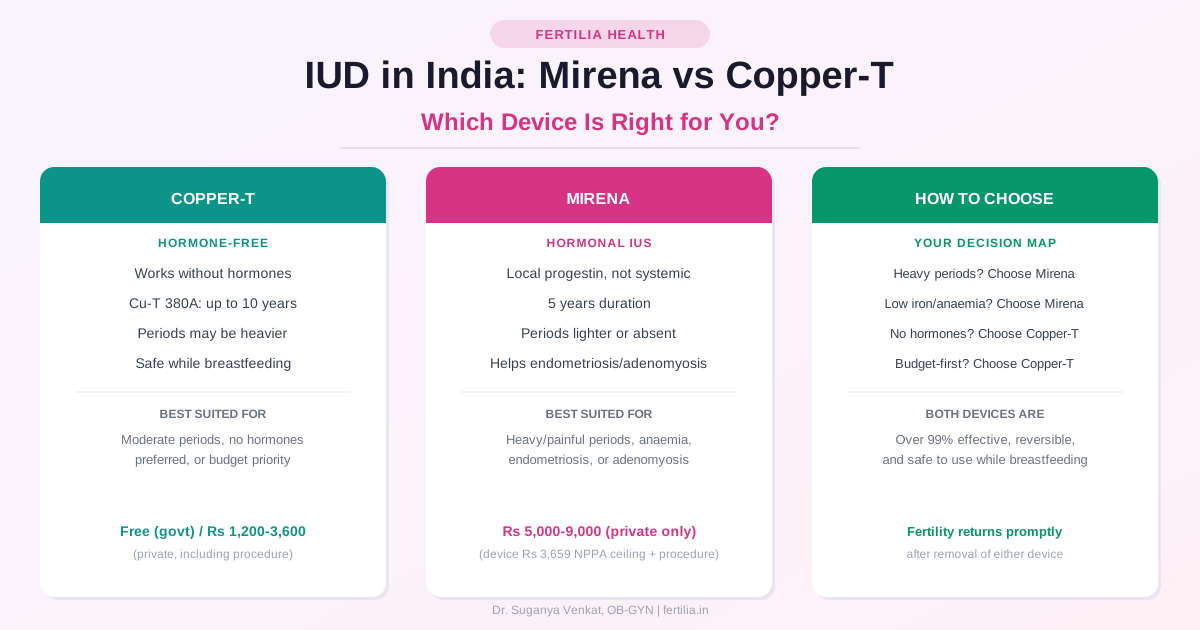
Copper-T is hormone-free and may make periods heavier. Mirena releases levonorgestrel and usually makes bleeding lighter over time. Neither is the best choice for everyone, and you can ask to have either removed if it no longer suits you.
This guide focuses on which device fits your situation and how to compare costs. Our Copper IUD and Mirena side-effects and fertility guide covers insertion, period changes, aftercare and fertility after removal in more detail.
What this guide covers
- The difference between the two devices
- Eight situations to discuss with your doctor
- Copper-T and Mirena costs in India, with named sources
- How to compare longer-term costs without assuming a replacement interval
- Questions to ask before the insertion appointment
The core difference in two sentences
Copper-T releases copper that interferes with sperm movement and fertilisation; it contains no hormones and does not work by suppressing ovulation. Mirena releases levonorgestrel, mainly acting within the uterus to thicken cervical mucus, inhibit sperm and thin the lining; some hormone also reaches the bloodstream, so hormonal side effects remain possible.
The WHO IUD fact sheet describes both as highly effective: fewer than one pregnancy per 100 women in the first year. Both are reversible and suitable for many women, including those who have not had a baby. Neither prevents sexually transmitted infections, so condoms remain important when there is exposure risk.
Which device suits your situation
If your periods are already heavy or painful
An LNG-IUD such as Mirena may offer a useful bleeding benefit alongside contraception. The CDC’s 2024 practice recommendations describe bleeding generally decreasing with LNG-IUD use. Its endometriosis evidence review reports reductions in period pain, pelvic pain and pain during sex. Unexplained or newly heavy bleeding should be assessed before choosing it as treatment; not every cause of bleeding can be managed with a device.
Copper-T may be less comfortable if increased bleeding or cramps would be difficult for you. Discuss the cause of bleeding and the treatment options with your clinician before booking a device.
If your periods are manageable and you prefer no hormones
Copper-T is an option. It avoids hormone exposure, but you still need to consider the possibility of heavier or longer periods. The CDC’s 2024 recommendations describe bleeding and spotting as particularly common in the first three to six months, often decreasing with continued use.
If anaemia or iron levels are a concern
Tell your clinician about known anaemia, fatigue or heavy bleeding. An LNG-IUD may be preferable because it usually reduces menstrual blood loss. Copper-T is not automatically unsafe with anaemia: the CDC’s 2024 eligibility table classifies iron-deficiency anaemia as category 2 for copper IUDs (benefits generally outweigh risks) and category 1 for LNG-IUDs (no restriction for that condition).
A ferritin test is not a prerequisite for every woman choosing an IUD. The CDC’s 2024 practice recommendations do not require routine haemoglobin screening before insertion. Testing and treatment should follow your symptoms and history, rather than a universal before-insertion and six-month schedule.
If the replacement interval matters most
India’s NHM family-planning booklet, 2022 lists Cu IUCD 380A for 10 years and Cu IUCD 375 for 5 years. Ask for the exact model and replacement date in writing.
For Mirena, ask your clinician to confirm the current Indian package insert and the indication for use. We could not verify a current publicly accessible Indian prescribing document at this review. Bayer’s US label specifies 8 years for contraception and 5 years for heavy menstrual bleeding, but a US approval is not an Indian replacement instruction. Do not extend or shorten your planned interval based on an online comparison alone.
If budget is your primary concern
Copper-T is provided through public family-planning services without charge, according to the NHM booklet. Ask which device and insertion service are available locally. At a private facility, compare the full itemised appointment cost rather than only the device price.
If you are breastfeeding or recently delivered
Both IUD types can be used during breastfeeding, as described in the WHO IUD fact sheet. Insertion timing needs a separate discussion: immediate postpartum placement has different expulsion considerations from later placement, and postpartum infection can rule out insertion at that time. Your maternity team should use the applicable postpartum guidance and the supplied product’s instructions.
Do not choose Mirena on the assumption that no hormone reaches breast milk. Bayer’s prescribing information, section 8.2, reports small amounts in milk and isolated reports of reduced milk production. It also notes higher perforation risk with breastfeeding and recent delivery. These are counselling points, not a reason to rule out IUDs for all breastfeeding women.
If you have migraines with aura
The CDC’s 2024 eligibility table places both copper and LNG-IUDs in category 1 for migraine with aura. Combined oestrogen-containing contraception is category 4 for that condition and should not be used. This makes either IUD a possible alternative, subject to the rest of your medical history. It does not make one IUD better than the other solely because of migraine.
If you have never delivered a baby
You can consider either device. The CDC’s 2024 eligibility guidance classifies both as category 2 for nulliparous users; having no previous birth is not a prohibition. Discuss pain relief before insertion, because the experience varies and a brief procedure can still be painful.
A few situations need assessment before insertion: possible pregnancy, current pelvic infection, unexplained concerning bleeding or a uterine cavity distorted so the IUD cannot fit properly. Current breast cancer rules out an LNG-IUD. These restrictions are set out in the CDC’s 2024 eligibility guidance; your clinician considers the whole history, not just one row of a comparison.
WhatsApp Dr. Suganya if you would like to discuss your options. She offers online consultations, pan-India, by video call or phone. Fertilia does not provide in-person IUD insertion or removal; arrange the examination and procedure with a local trained clinician.
Verified India costs in 2026
Sources checked 13 September 2026. The figures below distinguish an official device-price ceiling from a hospital’s procedure bill.
Copper-T
The National Health Mission’s 2022 booklet lists both copper IUCD models and states that available programme methods are provided free through public services. Check where insertion is offered and what aftercare is arranged.
For Copper-T at a private hospital, request a written quote. We do not have a verified nationwide private tariff, so this guide does not present a guessed range as a standard price. Ask for these items separately:
- Device brand and model, with its pack price
- Consultation and insertion fee
- Pain-relief options and any additional charge
- Tests or ultrasound, only when indicated for your situation
- Follow-up arrangements and later removal charges
Mirena
NPPA S.O. 1575(E), dated 25 March 2026, row 365 sets Rs 4,202.06 per 52 mg levonorgestrel hormone-releasing IUD, excluding applicable GST, effective 1 April 2026. This is the scheduled formulation used in Mirena, not a brand-specific all-inclusive price.
Check the supplied pack’s MRP and the device charge on the invoice. Consultation, insertion, anaesthesia when needed and other indicated services are separate. The ceiling must not be read as a guarantee that your whole appointment will cost Rs 4,202.06.
Check public-hospital availability locally. The National List of Essential Medicines 2022, section 18.2.2 includes the 52 mg levonorgestrel hormone-releasing IUD at tertiary-care level. That does not establish current stock, brand or free supply at any particular public hospital. Ask its gynaecology department directly before buying a device.
The ten-year cost picture
Use a written quote and the confirmed replacement interval for your device and indication. We cannot support a fixed “two Mirenas in ten years” calculation without confirming the applicable Indian instructions. Nor can one insertion quote predict future removal, replacement or service charges.
For your own comparison, add the current device and procedure charges, any planned reviews, later removal and replacement costs, and travel. If treating heavy bleeding is also a goal, discuss that benefit with your doctor rather than assuming guaranteed savings on medicines or consultations.
Check coverage with your insurer or employer plan before booking. Do not assume either inclusion or exclusion from a general statement about Indian health insurance.
The Copper-T 375 vs 380A: a detail that matters
The NHM booklet lists both 375 (5 years) and 380A (10 years). It does not establish that one is normally used in government hospitals and the other in private facilities.
If your discharge summary only says “IUCD”, request the insertion record, device card or product sticker from the service that fitted it. A scan can check location when needed, but is not a routine way to replace missing product records. Do not assume your device has another eight years left just because it was inserted two years ago.
Three questions to ask before your appointment
“Given my bleeding pattern and medical history, which options suit me?” Mention symptoms, current medicines, breastfeeding or recent delivery, and any plans for pregnancy.
“What is the exact device, replacement date and full appointment cost?” Ask for the product name and indication-specific interval in writing, and separate device charges from services.
“What is our pain-relief and aftercare plan?” Ask what can be offered, how to pause the procedure, when extra contraception is needed, and whom to contact if symptoms develop. The CDC’s 2024 recommendations support an individual pain plan; topical lidocaine or a paracervical block may help, while routine misoprostol is not recommended.
If you are comparing a device with a daily tablet, the birth-control pill guide discusses pill-related considerations. An IUD decision does not have to be made at the first conversation; ask your clinician what to use while you decide.
What these devices are called in India
“Copper T”, “Copper-T” and “copper IUCD” refer to copper-bearing devices; Mirena is a brand of hormonal intrauterine system (IUS). “IUD” is the broader term. Ask for the exact brand and model because a general name does not tell you its replacement date.
FAQ
Which is safer, Copper-T or Mirena? Neither is universally safer. Copper-T avoids hormone exposure but may increase bleeding; Mirena often reduces bleeding but has hormonal effects and its own contraindications. The CDC’s 2024 eligibility table helps clinicians assess specific conditions. Your own history determines the choice.
Can I switch from a Copper-T to a Mirena, or the other way around? Often yes, without waiting for the old device to expire. Tell the clinician about recent sex before removal and agree on contraception during the change. An LNG-IUD may require condoms or abstinence for seven days after insertion, depending on timing; switching from copper to LNG also needs consideration of recent intercourse. Follow the CDC’s switching guidance with your clinician rather than assuming every same-day switch is immediately protective.
Is Mirena available at government hospitals in India? Ask the specific hospital. The NLEM 2022 includes a 52 mg levonorgestrel IUD at tertiary-care level, but that does not guarantee a particular brand, stock or free supply. Copper IUCDs are listed in the public family-planning programme; access to a hormonal device must be checked locally.
I have PCOS. Which IUD is better for me? If periods are infrequent because you are not ovulating regularly, discuss protection of the uterine lining as well as contraception. A copper device does not provide progestogen protection of that lining. RCOG’s PCOS information, updated 2022, includes Mirena among the options for endometrial protection. Neither IUD treats every PCOS symptom or helps you conceive while it is in place. The choice depends on your bleeding, other treatment and pregnancy plans.
My discharge paper only says “IUCD inserted.” How do I know which type it is? Ask the inserting service for its records, device card or product sticker and the replacement date. Do not infer the model from the hospital type. An ultrasound may assess location if clinically indicated, but a routine scan is not a substitute for confirming the product record.
I have migraines. Does that change which IUD I should choose? Both are category 1 for migraine with aura in the CDC’s 2024 eligibility table. Unlike combined oestrogen-containing contraception, migraine with aura alone does not rule out either IUD. Other medical conditions and your bleeding preferences still matter.
My Copper-T was inserted two years ago and my periods have become very heavy. Can I replace it with Mirena now? You can ask to switch before the replacement date, but a new heavy-bleeding pattern needs assessment first. The CDC’s 2024 recommendations advise considering displacement, pregnancy, infection and other uterine causes when indicated. Testing for anaemia may also be appropriate. The clinician can then plan treatment or a switch, including any temporary contraceptive precautions. Severe bleeding with dizziness or fainting needs urgent local care.
Dr. Suganya Venkat, OB-GYN, offers online advice at Fertilia to help you discuss these choices with your local clinician. WhatsApp Dr. Suganya for a video-call consultation, pan-India. For more on insertion, bleeding patterns and future pregnancy, read our Copper IUD and Mirena side-effects and fertility guide.