A friend forwards a list. AMH, FSH, LH, estradiol, inhibin B, “egg count scan”. The lab offers a fertility package with twelve tests on it. You want to know how many eggs you have left, and it is hard to tell which of these will answer that and which will only add numbers you then have to worry about.
I’m Dr. Suganya Venkat, an OB-GYN with more than fifteen years of practice, and “which ovarian reserve test should I do?” is one of the most common questions in Fertilia’s online consultations. The short version: two tests do most of the work, one is a useful supporting test, and several others add little. More important than which test you pick is knowing what any of them can tell you, because that is where most of the worry comes from.
Here is what this post covers:
- What “ovarian reserve” means, and what it does not mean
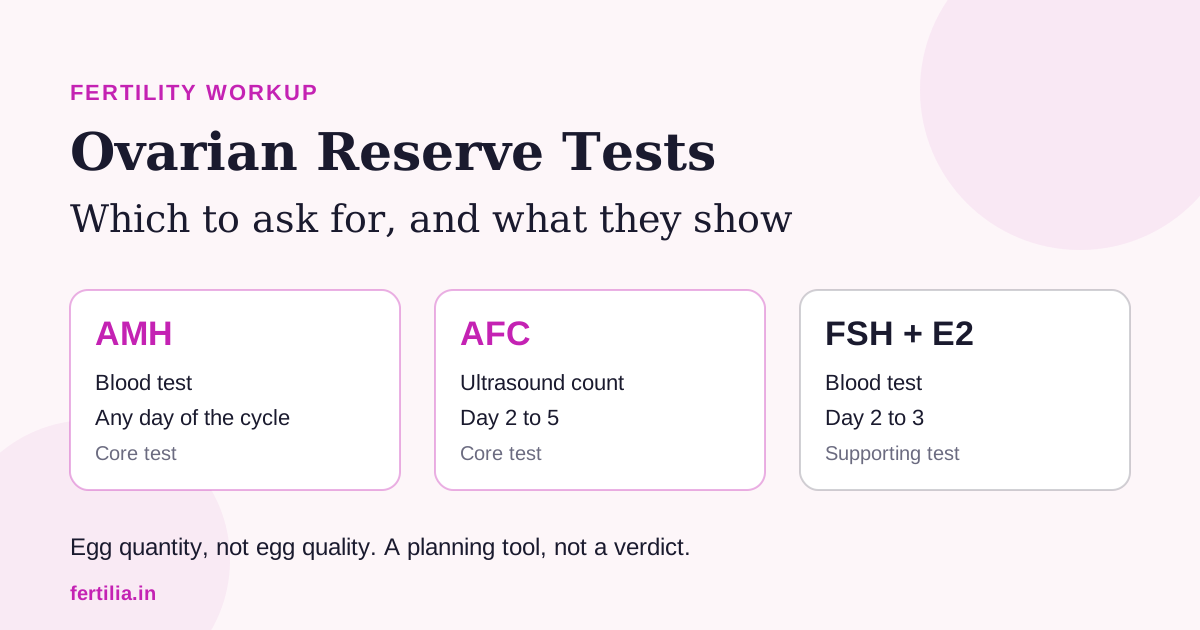
- The main tests: AMH, antral follicle count (AFC) and Day 3 FSH with estradiol
- Tests that are rarely worth asking for
- What a reserve result can and cannot predict
- Who benefits from testing, and when to do it
- What to do with your result
What “Ovarian Reserve” Means
Ovarian reserve is the number of eggs remaining in your ovaries. That is the whole definition. The American Society for Reproductive Medicine’s 2020 committee opinion on testing ovarian reserve defines it as oocyte quantity, and says the markers are useful for predicting how many eggs will be collected after IVF stimulation, but are poor predictors of reproductive potential independent of age (ASRM Practice Committee, Fertil Steril, 2020, PMID 33280722).
Two words in that sentence matter. Quantity, not quality: no reserve test tells you whether your eggs are chromosomally healthy. And independent of age: your age already carries most of the information about your chances of pregnancy, and a reserve marker adds less on top of it than most women expect.
Keeping this definition in front of you makes every result easier to read. A reserve test estimates a count, which makes it most useful for planning treatment.
The Main Tests, One by One
AMH (Anti-Müllerian Hormone)
AMH is a blood test. The hormone comes from the small follicles in your ovaries, so a higher level broadly reflects more of them.
What it shows well: an estimate of how many follicles are available, which helps predict how the ovaries will respond to IVF stimulation. It is also often raised in PCOS, which can support that picture alongside other findings.
Practical advantage: it can usually be drawn on any day of the cycle, which makes it the easiest of the reserve tests to arrange.
Limits: hormonal contraception can lower AMH temporarily, and values differ between laboratories and assay methods, so compare repeat tests from the same lab where you can. For what the numbers mean at each age, see the AMH normal range by age guide, which covers the values in detail.
Antral Follicle Count (AFC)
AFC is a transvaginal ultrasound, usually done early in the cycle (around Day 2 to 5), in which the sonologist counts the small resting follicles in both ovaries.
What it shows well: a direct count of the follicles that could be recruited in a stimulated cycle. It also shows the ovaries themselves, so cysts, endometriomas or a polycystic pattern can be seen in the same scan.
Limits: it depends on the timing, the machine and the person scanning. Two scans a few months apart can differ by a few follicles without anything having changed. Our AFC ultrasound reading guide walks through what a report line like “8 follicles right ovary” means.
AMH or AFC: Which One?
These two are the core of ovarian reserve testing. A meta-analysis comparing them in IVF patients found no significant difference between AMH and AFC in predicting a poor response to stimulation, and found poor performance for both in predicting whether pregnancy would occur (Broer SL et al., Fertil Steril, 2009, PMID 18321493).
So you do not usually need to choose “the better test.” In practice:
- If you need only one, AMH is often simpler because it does not depend on the cycle day.
- If you are heading toward IVF or egg freezing, most clinics want both, because AFC also shows the ovaries and AMH gives a lab number to track.
- If the two disagree, that disagreement is worth a conversation rather than a repeat of both.
The detailed side-by-side comparison of the two, including cost, is in AMH vs AFC: which test tells you more.
Day 3 FSH and Estradiol
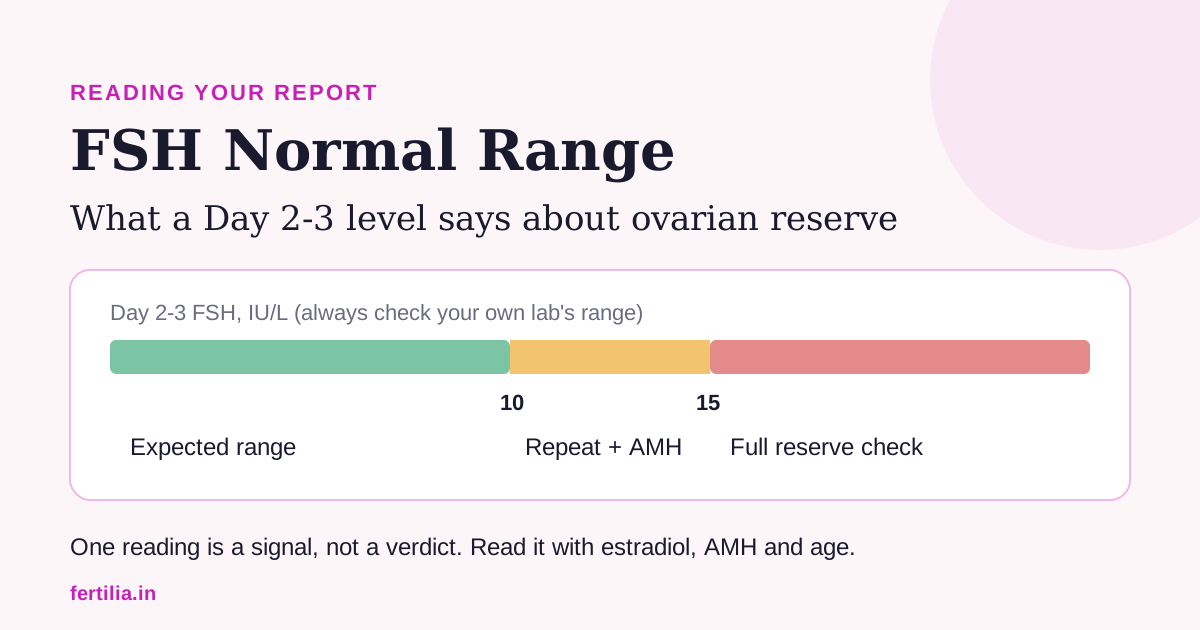
FSH (follicle-stimulating hormone) is drawn early in the cycle, usually Day 2 to 3, together with estradiol. When reserve is lower, the brain tends to push harder, so FSH can rise.
Why it is a supporting test, not the main one: FSH varies quite a lot from cycle to cycle, and a high estradiol on that same day can push FSH down and make it look falsely reassuring. That is why the two are always read together. A single FSH reading on its own is a less steady guide than AMH or AFC.
Where it still helps: it is part of a standard early-cycle hormone panel, it is inexpensive, and LH from the same draw helps when PCOS is in question. The values and how to read them are in the Day 3 FSH, LH and estradiol guide.
Need help deciding which tests make sense for you? You can go through your situation with Dr. Suganya Venkat over a video consultation, from anywhere in India. WhatsApp Dr. Suganya to book a ₹399 online consultation (US $20 if you are consulting from outside India).
Tests That Rarely Add Much
Lab packages sometimes include tests that were used more in the past. A large systematic review of ovarian reserve tests looked at basal FSH, estradiol, inhibin B, AMH, AFC, ovarian volume, ovarian blood flow and several stimulation tests, including the clomiphene citrate challenge test. It concluded that the tests available at the time had only modest-to-poor predictive properties, and that predicting pregnancy with them was very limited (Broekmans FJ et al., Hum Reprod Update, 2006, PMID 16891297).
In my practice that translates into a simple rule: I rarely order inhibin B, ovarian volume or a clomiphene challenge test today. AMH and AFC give the same planning information more simply. If one of these shows up on your report because it came in a package, it does not need separate worry.
What a Reserve Result Can and Cannot Predict
This is the part I spend the most time on with women, because it changes how the result feels.
It does help predict: how many eggs are likely to be collected in IVF or egg freezing, and so which stimulation approach and dose a fertility specialist chooses.
It does not predict well: whether you will conceive naturally. The clearest evidence comes from a prospective study of 750 women aged 30 to 44 with no history of infertility who had been trying for three months or less. After adjusting for age and other factors, women with a low AMH (below 0.7 ng/mL) did not have a significantly different chance of conceiving by 6 or 12 cycles than women with normal AMH, and the same held for a high serum FSH (above 10 mIU/mL). The authors concluded the findings do not support using FSH or AMH tests to assess natural fertility in women like these (Steiner AZ et al., JAMA, 2017, PMID 29049585).
It does not tell you: egg quality, whether you are ovulating, whether your tubes are open, or anything about your partner’s sperm. Each of these carries as much weight in getting pregnant as the reserve number does.
Put plainly, a lower number usually means fewer eggs, not worse eggs and not no chance. If you have already had a low result, our low AMH and pregnancy guide covers what it means for trying naturally.
Who Benefits From Testing, and When
Reserve testing is most useful when the answer will change a decision. These are the situations where I usually recommend it:
- You are planning IVF or IUI with stimulation. The result guides the stimulation plan.
- You are considering egg freezing. It helps estimate how many eggs one cycle might give.
- You are 35 or older and have been trying for six months, or under 35 and trying for a year, as part of a full fertility workup.
- You have had ovarian surgery, endometriomas, chemotherapy or pelvic radiation, all of which can reduce reserve.
- Your cycles have become noticeably shorter or irregular in your late thirties, or there is a family history of early menopause.
- PCOS is being assessed, where a high AMH and a high follicle count are part of the picture.
Where testing helps less: a woman in her twenties or early thirties, with regular cycles, who has just started trying and wants a number for reassurance. A normal result does not guarantee pregnancy and a low one does not rule it out, so the test can create worry without changing anything she should do.
Timing tips:
- AMH: any day, but avoid testing while on the pill if you can, or let your doctor know you are on it.
- AFC and FSH with estradiol: book for Day 2 to 5 of your cycle (Day 1 is the first day of full flow).
- Do the reserve tests as part of a complete workup, not on their own. Our fertility workup guide lists what else belongs in it.
What to Do With Your Result
Normal for your age: good news for planning, but it is one piece. Keep checking ovulation, tubes and semen analysis if you have been trying for a while.
Lower than expected: ask for it to be read with your age, your AFC and your cycle history. If you were planning to wait a year or two, it is a reasonable prompt to talk about timing, and about whether egg freezing or an earlier fertility referral makes sense for you. It is not a sign that you have to rush into IVF.
Higher than expected: often seen with PCOS. Ask whether your cycles, androgens and scan fit that pattern.
AMH and AFC disagree: check the timing and lab of each, then decide together which picture fits your history. Repeating every test is rarely the answer.
Throughout, the right person to interpret the result is the doctor who knows your full history, whether that is your gynaecologist or your IVF specialist. At Fertilia, Dr. Suganya Venkat, who has seen more than 1,000 pregnancies in her care, works alongside your treating doctor to make the numbers mean something for your plan.
Practical Takeaways
- Ask for AMH and, if planning treatment, an AFC scan. These are the two core ovarian reserve tests.
- Add Day 3 FSH with estradiol as part of an early-cycle hormone panel, read together, not alone.
- Skip packages heavy on older tests like inhibin B or a clomiphene challenge unless your doctor has a specific reason.
- Remember what reserve means: egg quantity, not quality, and a weak predictor of natural conception.
- Test when the answer changes a decision, and keep it inside a full workup.
Frequently Asked Questions
Which is the best ovarian reserve test?
There is no single best test. AMH and antral follicle count (AFC) are the two most useful, and research comparing them found similar accuracy for predicting response to IVF stimulation. AMH is easier because it can be done on any day; AFC also shows the ovaries on ultrasound. If you are planning IVF or egg freezing, most specialists want both.
Can an ovarian reserve test tell me if I can get pregnant naturally?
Not reliably. In a study of 750 women aged 30 to 44 who had recently started trying, low AMH and high FSH were not linked to a significantly lower chance of conceiving within 6 or 12 cycles. Reserve tests estimate egg quantity; natural conception also depends on ovulation, tubes, sperm and age.
Egg count test kaise hota hai? (How is the egg count test done?)
The “egg count” usually means two tests. AMH is a simple blood test that can be done on any day of the cycle. The antral follicle count is a transvaginal ultrasound done around Day 2 to 5 of your period, where the follicles in each ovary are counted. Neither needs fasting or a hospital stay.
Does a low AMH mean my eggs are poor quality?
No. AMH reflects how many follicles are left, not the quality of the eggs inside them. Egg quality is mainly linked to age. A younger woman with a low AMH may have fewer eggs but still good-quality ones.
When in my cycle should I do ovarian reserve tests?
AMH can be done on any day. The antral follicle count scan and Day 3 FSH with estradiol should be done early in the cycle, usually Day 2 to 5, counting the first day of full bleeding as Day 1.
Should I test my ovarian reserve if I am not trying to conceive yet?
Only if the result will change a decision, such as whether to consider egg freezing or how long to wait before trying. For a young woman with regular cycles and no risk factors, a reserve test on its own is unlikely to change what she should do, and a low or normal number can be misleading.
Can I improve my ovarian reserve?
The number of eggs you have cannot be increased, and AMH is not something to chase with supplements. What you can work on is your overall reproductive health, timing, and getting the rest of your workup done, so that the eggs you have get the best chance.
Talk It Through With a Doctor
If you have a list of tests and are not sure which ones you need, or you have a result and are not sure what it means for you, a short conversation usually settles it.
WhatsApp Dr. Suganya to book a ₹399 online consultation (US $20 from outside India). Consultations are over video call, from anywhere in India or abroad.