The woman who has never been able to use a tampon carries a different story from the woman who had a comfortable, pain-free marriage for several years and then, after her second delivery, found that sex became something to quietly avoid. Both are living with vaginismus. Both deserve a clear path forward. But the history matters, because understanding when and how vaginismus began shapes the questions a clinician asks and, in certain situations, which first step fits best.
Primary and secondary are the two clinical categories. The distinction is not a measure of severity. It does not tell you how serious your situation is, how long recovery will take, or whether you can be helped. It tells you one thing: when the spasm started, and whether there was ever a period without it.
What “Primary” and “Secondary” Actually Mean
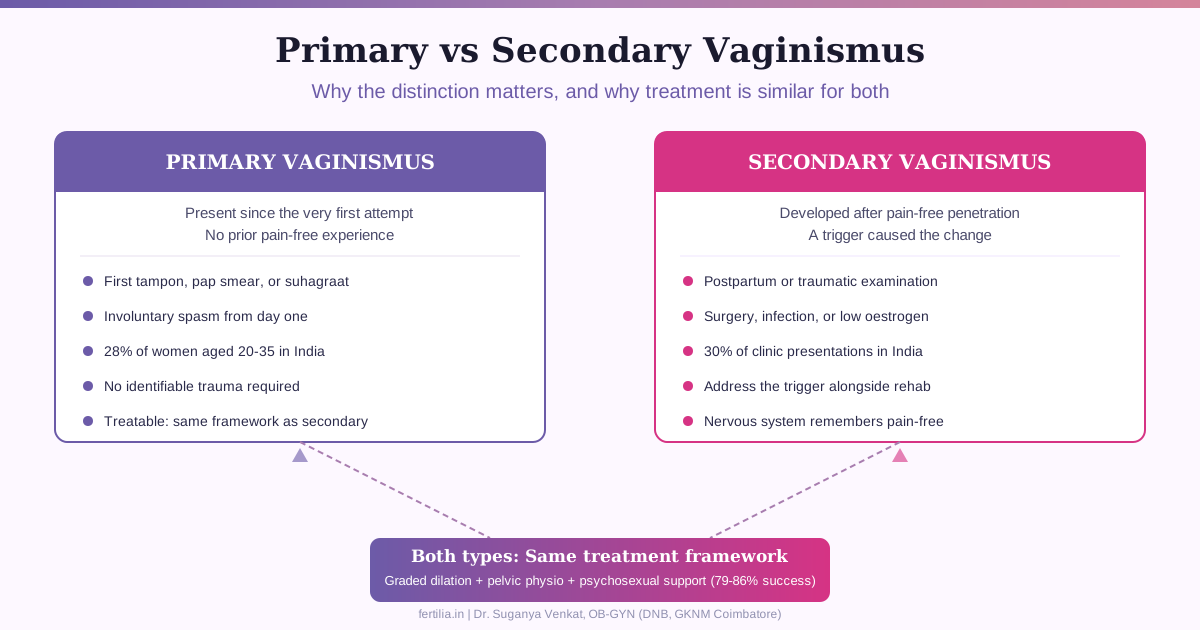
Primary vaginismus is present from the very first time penetration is attempted. There has never been a comfortable or pain-free experience of penetration. The spasm at the vaginal opening has been consistent since day one, whether that was a first tampon attempt in adolescence, a gynaecological examination, or a wedding night.
Secondary vaginismus is acquired. Penetration was comfortable or at least possible for a period, and then something changed. The spasm developed later, after a period without it.
Both are now classified under Genito-Pelvic Pain/Penetration Disorder (GPPPD) in the DSM-5 (2013), which merged earlier separate categories of vaginismus and dyspareunia under one umbrella. In ICD-11, these presentations are grouped under sexual pain-penetration disorder (code HA20). Despite the reclassification, the primary and secondary distinction remains clinically useful. It shapes the questions a doctor asks and, in particular, whether there is an active underlying cause to identify and address before starting pelvic rehabilitation.
In Indian clinical practice, secondary vaginismus often goes unrecognised for longer. A woman who experienced pain-free sex in earlier years may assume that the change is her fault, age-related, or permanent. It is none of these. It is a condition with a name, a cause, and a treatment path.
Primary Vaginismus: When the Body Has Never Said Yes
Population figures for pain during intercourse should not be read as figures for primary vaginismus. In a nationally representative study of 84,644 currently married Indian women, 12.6% reported pain during intercourse (Padmadas et al., 2006, Journal of Sexual Medicine, PMID 16409224). A separate study in Belagavi, Karnataka, reported 28% primary vaginismus in a hospital-based convenience sample of 160 married, sexually active women aged 20-35, drawn from 500 women approached (Bulbuli and Kokate, Journal of South Asian Federation of Obstetrics and Gynaecology, 2024, DOI 10.5005/jp-journals-10006-2395). That selected sample cannot establish the prevalence of primary vaginismus in Indian women generally.
The defining feature of primary vaginismus is that the involuntary muscle spasm has been present since the first penetration attempt. This is not stubbornness, tightness from insufficient arousal, or inexperience. The pelvic floor muscles contract before a conscious decision to stop can be made. Tampons enter a few millimetres and stop. Pap smears are aborted. Penetration feels like a wall that the body has put up without permission.
Importantly, many women with primary vaginismus have no history of sexual trauma, abuse, or any identifiable event that caused it. In some cases a strong anxiety-pain-avoidance loop is established very early; in others the origin is harder to trace. What matters clinically is not finding a cause to assign blame to, but addressing the muscle memory that is currently maintaining the spasm.
The 12-week dilator protocol gives the nervous system a new, safe reference experience, gradually replacing the learned spasm with a response the body learns to trust. This is not a quick fix. It is a process of re-education.
Secondary Vaginismus: When It Stops Working
Secondary vaginismus develops in a woman who previously had comfortable, pain-free penetration. The spasm develops at some point after that period, following a specific trigger.
The most common triggers seen in clinical practice:
After childbirth. Perineal trauma, episiotomy healing, and the vaginal dryness caused by breastfeeding-related low oestrogen are among the most frequent triggers for secondary vaginismus in India. The body has experienced an event at the vaginal opening that involved significant pain, and the protective spasm that follows is the nervous system’s response. Painful sex after delivery affects 35 to 40% of women at three months postpartum (PMID 33300122) and is a common onset point for secondary vaginismus that goes unaddressed for months or years.
After a traumatic gynaecological examination. A rough or poorly managed pap smear, an IUD insertion that caused significant pain, a colposcopy, or a hysteroscopy can be enough to trigger the protective spasm response in any subsequent penetration attempt. Women in this situation often describe confusion: they cannot understand why they “can’t” do what they were able to do before. The examination changed the nervous system’s learned association between vaginal touch and safety.
After vaginal infection or chronic irritation. Recurrent thrush, bacterial vaginosis, lichen sclerosus, or persistent vulvovaginal irritation can establish an ongoing pain-at-penetration pattern that becomes a conditioned spasm response even after the infection itself is cleared. If an active infection is currently present, it needs to be treated before pelvic rehabilitation begins. Treating the spasm while inflammation is still active is counterproductive.
For more on this, read our guide on Vaginal Yeast Infection. Declining oestrogen. Women moving through perimenopause or experiencing oestrogen loss after surgical menopause or cancer treatment may develop vaginal atrophy and tissue changes, the cluster of symptoms now called genitourinary syndrome of menopause (GSM). Penetration becomes painful as the tissue thins and loses elasticity, and over time this pain-at-penetration experience can trigger secondary vaginismus. This group has both a tissue-level component and a muscular one, and addressing the tissue change is typically the first clinical step.
After gynaecological surgery or pelvic radiation. Adhesions, scar tissue, and radiation-induced tissue changes can all create the conditions for secondary vaginismus to develop.
After a significant relationship change. Loss of trust in a relationship, a shift in partnership, or a traumatic relational experience can also be a secondary trigger, even in the absence of any physical event. The brain-body connection in sexual function is real and bidirectional.
What these triggers share is a common pathway: the body has connected penetration with a threatening, painful, or unsafe experience, and the pelvic floor now contracts protectively ahead of any attempt. The spasm is, in a real sense, the body trying to protect you. It is no longer serving its purpose, and treatment is the process of teaching the nervous system that the threat no longer applies.
💬 You don’t need to figure this out alone. Whether sex has never worked or it stopped working after something changed, I can help you understand what is happening and what to do about it. Message Dr. Suganya on WhatsApp
📘 Want the full picture in one place? Download Dr. Suganya’s free 39-page Navigating Vaginismus: Information, Support, and Recovery. It covers both primary and secondary presentations and the treatment paths for each. Get the guide →
Prefer Instagram? Comment PAINLESS on any @fertilia.health post and we’ll DM you the guide directly.
Does the Type Change Treatment?
Here is the answer most women asking this question are hoping to hear: treatment for primary and secondary vaginismus follows the same core framework, and outcomes across both types are broadly similar in the evidence.
The multimodal treatment approach (combining pelvic floor physiotherapy, graded dilation practice, and psychological support) achieves approximately 79% success in a systematic review of vaginismus management (Maseroli et al., 2018, Journal of Sexual Medicine, PMID 30446469). A 2026 systematic review and meta-analysis by Zulfikaroglu et al. (PMID 41148166) confirms high success rates across specific modalities: dilator therapy 78%, pelvic floor physiotherapy 85%, combined psychosexual therapy 86%, and Botox within a multimodal programme 85%.
These are good numbers. And they apply across the spectrum of vaginismus presentations.
What changes treatment outcomes in practice is not primarily whether a woman has primary or secondary vaginismus. It is:
- The Lamont grade (the clinical severity grading 1 to 4 that determines where to begin the dilation protocol). A grade 4 presentation, where the spasm fires at any suggestion of touch near the vaginal opening, requires a much more graduated start than a grade 1 or 2.
- Whether an active underlying cause is still present (an ongoing infection, active atrophy, untreated lichen sclerosus) that must be addressed before rehabilitation makes sense.
- The psychological context, including any associated anxiety, trauma history, or relationship dynamics that need to be part of the treatment picture.
For a full overview of the vaginismus treatment framework from diagnosis to the 12-week conservative protocol, the OB-GYN guide to vaginismus covers the complete path.
What Does Change: Addressing the Trigger
The one area where secondary vaginismus requires a different first step is this: if there is an active trigger still present, identifying and addressing it is a clinical priority before or alongside pelvic rehabilitation.
For postpartum secondary vaginismus: The first question is whether breastfeeding-related vaginal atrophy is contributing. A consistent water-based lubricant and, in some cases, a short course of topical vaginal oestrogen under clinical guidance can significantly change the tissue environment. Pelvic floor down-training, which includes the reverse Kegel technique, works best when the tissue is not actively dry and uncomfortable.
For infection-related secondary vaginismus: Full clearance of the infection is a prerequisite. Dilating into active candidiasis or active lichen inflammation extends the timeline and adds discomfort that reinforces the spasm cycle. Confirm clearance first.
For GSM-related secondary vaginismus: Local vaginal oestrogen is typically the first-line recommendation before physiotherapy. Addressing the tissue-level change substantially improves the effectiveness of the pelvic floor work that follows.
For traumatic-examination-related secondary vaginismus: The pacing of treatment needs to account carefully for the association between clinical settings and fear. A trauma-informed OB-GYN or pelvic physiotherapist who allows the woman to control the pace of any examination is not a luxury in this context. It is a clinical requirement for treatment to work.
Primary vaginismus does not carry this same “active trigger to clear” step. The starting point is the breath work and body familiarisation exercises that begin to lower the resting tension in the pelvic floor, followed by the graded dilation progression.
The good news for women with secondary vaginismus is this: your nervous system has the memory of pain-free penetration. That memory exists somewhere in your body’s experience. Treatment is helping you access it again, not building something from scratch.
Where to Begin, for Both Types
If you have had vaginismus since your first attempt: the absence of any prior comfortable experience is not a permanent state. Your nervous system is trainable. The protocol works because it gives the pelvic floor hundreds of safe, controlled, predictable pressure experiences. The muscles learn, through repetition, that this touch does not warrant a protective response.
If sex worked before and no longer does: the most useful first step is identifying the trigger with your doctor. “When did this start, and what was happening around that time?” are the questions that direct the clinical approach. Knowing the answer shapes which first intervention fits. If there is no identifiable trigger, the same framework as primary vaginismus applies from that point forward.
One important clarification for women who are also concerned about fertility: vaginismus and the ability to conceive are not permanently linked. With the right treatment path, the conception plans most couples come in with remain achievable.
And if the question of whether this is a sexual pain condition like dyspareunia, a vulvodynia variant, or vaginismus is still unclear, that differential is something a clinical assessment with a gynaecologist familiar with pelvic pain conditions can resolve.
💬 The first message is the hardest part. After that, it is a conversation about your body with someone who sees this every week and will not judge what you’re dealing with. Message Dr. Suganya on WhatsApp
Frequently Asked Questions
1. Can primary vaginismus turn into secondary vaginismus?
No. The categories are defined by when the condition started. Primary means penetration was never comfortable before the vaginismus was identified. Secondary means it developed after a period without it. These are fixed descriptors of onset history, not stages that convert from one to the other.
2. Is secondary vaginismus easier or harder to treat than primary?
Not as a consistent rule. The treatment literature shows broadly similar outcomes for both. In some cases, secondary vaginismus tied to a single reversible trigger, such as postpartum atrophy that resolves with lubrication and time, responds more quickly. In other cases, secondary vaginismus with a complex origin, such as a trauma-related trigger or long-standing chronic pain association, follows a similar timeline to primary.
3. My vaginismus started after my IUD was inserted. Is this primary or secondary?
If you had pain-free intercourse or penetration before the IUD insertion, this is secondary vaginismus. The painful insertion created a fear-pain-spasm loop that now fires ahead of any penetration attempt. A differential assessment with an OB-GYN will confirm this and identify whether any local irritation from the IUD itself is a contributing factor.
4. I have never been able to use a tampon. Does that mean I have primary vaginismus?
It suggests it. But a clinical assessment is needed to confirm the diagnosis, because vulvodynia, a hymenal variant, or heightened vestibular sensitivity can produce a similar picture without the same pelvic floor spasm mechanism. The difference between vulvodynia and vaginismus is something your OB-GYN will assess as part of the initial workup.
5. What if I had a difficult past but sex was comfortable for years before it became painful?
This is secondary vaginismus, even when there is a prior history of trauma. Secondary vaginismus is defined by the period of pain-free penetration that preceded the onset of spasm, not by the absence of any difficult history. A trauma-informed psychosexual therapist as part of a multimodal treatment team is valuable in this context.
6. Can secondary vaginismus resolve without treatment?
Some cases do, particularly postpartum secondary vaginismus where vaginal atrophy resolves once breastfeeding ends and hormonal balance returns. But waiting without addressing the pelvic floor component frequently extends the timeline by months or years, and the anxiety-spasm cycle often deepens in that time. Pelvic floor physiotherapy shortens the recovery window considerably.
7. Will I need Botox or surgery for either type?
Almost never, and not as a first-line treatment for either. Conservative multimodal therapy achieves high success rates as a first approach. Botox in vaginismus is considered at Lamont grade 3 to 4 when a genuine course of conservative therapy has not produced adequate progress. Surgery for vaginismus is almost never required.
8. How is secondary vaginismus treated?
The core treatment is the same as primary, graded dilator therapy plus pelvic floor down-training, often with psychosexual support, but secondary vaginismus has the added step of identifying and addressing the underlying trigger. Postpartum cases benefit from topical oestrogen if there is lactation-related atrophy. IUD- or infection-triggered cases need the local issue resolved or ruled out first. Trauma-linked cases benefit from trauma-informed psychological support running alongside the physical work. Once the trigger is addressed, the conservative protocol succeeds in most women, and whether the vaginismus was primary or secondary did not significantly affect the outcome in the largest review (Maseroli E et al., 2018, PMID 30446469); in my practice that typically takes 8 to 12 weeks.
9. What is the difference between vaginal atrophy and vaginismus?
They are distinct conditions that sometimes coexist. Vaginal atrophy is thinning, dryness, and reduced elasticity of the vaginal tissues, usually caused by low oestrogen (menopause, postpartum lactation, surgical menopause); the pain is a tissue and lubrication problem, eased by topical oestrogen and moisturisers. Vaginismus is an involuntary spasm of the pelvic floor muscles; the muscles, not the tissues, are the problem, and the treatment is dilator therapy and pelvic floor down-training. Postpartum and perimenopausal women can have both: the atrophy creates pain, the pain teaches the muscles to guard, and secondary vaginismus develops on top. Treating both layers gives the most reliable resolution.
Taking the Next Step
If you are reading this because something has always been difficult, or because something that once worked has stopped working, the most important thing to know is this: both situations have a name, both are common, and both have a well-mapped treatment path.
The type of vaginismus you have shapes some of the early clinical questions. It does not determine your outcome.
Whichever type you have, Fertilia’s online vaginismus treatment program follows the same structured 12-week path, adapted to where you are starting from. If cost is part of your decision, what vaginismus treatment costs in India breaks down each step of care.
Message Dr. Suganya on WhatsApp
For further reading in this series: Vaginismus: An OB-GYN’s Honest Guide for Indian Women covers the complete framework, and Unconsummated Marriage: What Indian Doctors See and Do addresses the specific context that many women with primary vaginismus come in carrying.