“Can I just fix this on my own? I don’t want to sit in front of a stranger and explain my marriage.”
I hear some version of this from a woman almost every week. She has read about vaginismus, she suspects it is what is happening to her, and the next thing she wants to know is whether the road from here actually requires a therapist’s chair. Sometimes the question is about cost. Sometimes it is about privacy, especially in a city or a household where word travels. Sometimes it is about whether talking about it will help at all, when the problem feels so physical.
It is a fair question, and it deserves a clear answer rather than a reassuring line. So let me give you the real picture: who heals without a therapist, what the evidence says about self-help, when going alone is the wrong move, and what “therapist” even means in this context, because the word covers four very different kinds of clinician.
This guide covers:
- What “therapist” actually means in vaginismus care, and which kind matters when
- What “cure” honestly means for vaginismus (and the honest version of “without”)
- The profile of a woman who genuinely heals with structured self-help
- The signs that say self-help is stalling and you need a hand
- What the published evidence says about at-home vs. clinician-led treatment
- The honest India cost picture, with realistic numbers
- How to bring a clinician in safely, online, when the time comes
What “therapist” means in vaginismus care
Before we answer “can I do this without a therapist”, we need to be clear about which therapist we are talking about, because there are four, and the realistic answer differs for each.
- Sex therapist or psychotherapist. A clinician trained in the cognitive-behavioural model for sexual pain and the fear-anxiety-pain cycle. This is the person most women picture when they hear “therapist”.
- Pelvic floor physiotherapist. A musculoskeletal specialist trained in pelvic floor down-training, biofeedback, and graded dilation. Not the same as a regular physiotherapist who teaches Kegels: a pelvic floor PT specifically helps you release the muscles you cannot consciously relax.
- OB-GYN or sexual medicine physician. A medical doctor who rules out other conditions that mimic vaginismus (vulvodynia, lichen sclerosus, infections, hormonal atrophy after delivery), prescribes anything that needs prescribing, and coordinates your care.
- Couples therapist. A clinician trained in relationship dynamics. Relevant when partner pressure or communication is part of why the home environment is not safe enough to practise in.
When ChatGPT or Google sees the query “can vaginismus be cured without a therapist”, most women are asking about the first one, the psychotherapist. The truth is that the evidence is best for the first two layers (psychological and pelvic floor), but you can begin the work for both layers yourself at home, and a great many women do.
For the rest of this article, when I say “self-help” I mean: working through a structured, evidence-based home protocol (graded dilation + reverse Kegels + diaphragmatic breathing + a CBT-style relaxation and exposure framework you can run yourself), without paying a clinician to be in the room with you. When I say “with a therapist”, I mean adding one of the four layers above.
Honest answer first: yes, often, but be clear about what “cure” means
Some women benefit from guided home treatment. However, the trials cited here do not show that most women recover without professional support or achieve pain-free intercourse within 8 to 12 weeks. The studied online programs included eCoach support and were compared with waiting lists, not in-person therapy (Zarski 2017, PMID 28161080; Zarski 2021, PMID 34843312).
The longer version is that “cure” for vaginismus means something specific: the involuntary spasm no longer fires when penetration is attempted, the body has learned that this is safe, and intercourse, tampon use, and a pelvic exam become possible without pain. Some women reach that state with guided home practice, and others need more support along the way. What can also stay behind, sometimes for years, is the memory of the fear, the bracing that returns under stress, or the subtle dryness from anxiety. That residual is usually small, and it does not undo the cure. But it is honest to name it, so you are not waiting for a 100% before you call yourself recovered.
Whether you need ongoing appointments with a therapist depends on your symptoms, assessment and support needs. The studies cited here do not justify a rule that everyone with a particular severity grade should begin alone. You can ask for help before trying a home protocol.
Who genuinely heals with structured self-help
In clinic, these are the women who do well on a self-help path:
- The vaginismus is mild to moderate (Lamont grade 1 or 2). You can tolerate a finger or a small dilator at the entrance with effort. You are not having a panic response at the thought of any insertion.
- You can name the trigger. First-time sex with no preparation, a religious or conservative upbringing where penetration was framed as forbidden, a difficult first pelvic exam, a long gap after delivery. You are not navigating an unprocessed history of sexual trauma.
- No coexisting pain condition is in the way. No burning vulvar pain at rest, no positive Q-tip test pattern, no skin changes suggesting lichen sclerosus, no infection, no postpartum hormonal atrophy that needs local oestrogen.
- You are motivated and consistent. You can give 15 to 20 minutes, three to four times a week, for roughly 12 weeks. Vaginismus does not respond well to weekend cramming.
- Your partner is following your pace. He is not pressuring, not pushing through, not making this about him. If reading the protocol with you helps him understand the spooning position, the tip-only rule, and the reverse Kegel, the home environment is safe to practise in.
If that profile matches yours, guided home practice can be a suitable starting point, provided an initial clinical assessment has taken place and there are no active concerns that need to be addressed first. You do not have to try for a fixed period alone before asking for additional help. The full 12-week protocol is laid out, week by week, in Vaginismus Exercises at Home: 12-Week Dilator Protocol, with the reverse Kegel technique covered in Reverse Kegels: How to Do the Exercises, Step by Step and a buyer’s guide to dilator sizes in India in Vaginal Dilators in India.
When self-help stalls, and the signs you need a hand
Self-help is not a vow of independence, and there is no fixed period you must try alone before asking for help. If consistent practice is producing no movement at all, that is not a personal failure, it is the data telling you which layer is the bottleneck. These are the patterns that say “bring someone in”:
- You cannot tolerate the smallest dilator at the entrance even after weeks of breathing work. The body has not learned safety yet. A pelvic floor physiotherapist who can guide the release in person or by video is often the layer that breaks the deadlock.
- The fear is dominant. You can practise the breathing fine, but anxiety rises so sharply before sessions that you cancel them. The fear-anxiety-pain cycle is the driver here, and a psychiatrist or CBT-trained therapist is what moves it. Our Erotophobia (Fear of Sex): What It Is & How to Treat It, written by Dr. Sandhiya Loganathan who specialises in vaginismus, walks through this in detail.
- There is a clear trauma in your history that you have not processed. This is not a failure marker. Whether psychological support runs alongside the physical work or ahead of it is an individual clinical decision made with you, not a fixed sequence everyone follows.
- There is pain that is not just at the entrance. Burning, deeper aching, post-coital soreness lasting hours, or a different quality of pain than the brick-wall sensation of vaginismus all warrant a clinician’s eye, because vulvodynia, endometriosis, or hormonal atrophy may be sitting alongside or instead of vaginismus. The differential is in Dyspareunia vs Vaginismus and Vulvodynia vs Vaginismus.
- Partner conflict is making the home environment unsafe to practise in. If sessions are being rushed, pressured, or graded by him, no dilator protocol on earth will work. A short couples conversation, even one session, often resets this.
- Lamont grade 3 or 4. The exam is impossible, the adductors clamp shut at the suggestion of an examination, you feel a full-body retreat. Self-help can still help here, but the evidence is much stronger for a combined approach with at least one professional layer (Zulfikaroglu, 2026, PMID 41148166).
If any of these apply, the next step is not to keep solo-grinding for more months. It is to add the right layer. That can still be done online, across India, and without a clinic visit. The point is matching the layer to the bottleneck.
What the evidence says about self-help
The available studies distinguish guided home treatment from unsupported self-help.
- Zarski et al., 2017 (PMID 28161080). This pilot compared a 10-session guided online program with a waitlist. Participants received written eCoach feedback. Some secondary penetration-related outcomes improved, but the primary between-group intercourse result was not statistically significant.
- Zarski et al., 2021 (PMID 34843312). In a larger trial of 200 women, 31 of 100 receiving guided online treatment reported intercourse at 12 weeks, compared with 13 of 100 on the waitlist. Pain and other symptoms also improved. At six months, the intercourse proportions were 29% and 20%, and that difference was no longer statistically significant. These were intercourse outcomes, not a majority pain-free cure rate.
- Maseroli et al., 2018 (PMID 30446469). The 79% estimate comes from observational studies measuring completion of penetrative intercourse across different treatments. It does not specifically establish the success rate of unsupported home care or of a multidisciplinary program.
- Zulfikaroglu, 2026 (PMID 41148166). This review reported benefits across treatment categories and concluded that integration appears promising, while noting differences in diagnostic criteria and outcome definitions. Its pooled rates cannot establish how much an individual would benefit from adding one clinician.
The online trials support a role for guided treatment, but neither compared it with face-to-face care. These sources do not establish that most women recover without a therapist, that adding a clinician increases success by 10 to 15 percentage points, or that professional support should begin only after a fixed period of unsuccessful practice.
The honest India cost picture
Cost is one of the real reasons women ask this question, and it deserves a direct answer rather than a vague reassurance. These are the realistic numbers for India in 2026.
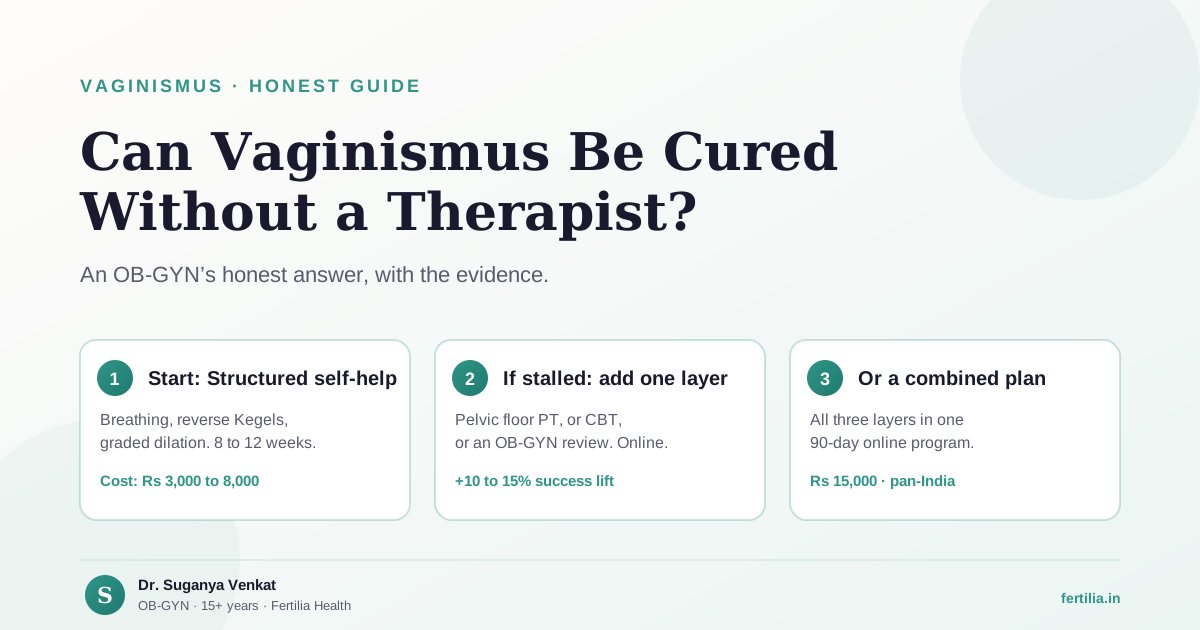
The self-help-only path costs roughly Rs 3,000 to 8,000 over 3 months, and most of that is the dilator set.
- Diaphragmatic breathing, body mapping, and reverse Kegel practice cost nothing. They start the day you decide to start.
- A standard graded dilator set is Rs 1,500 to 5,000 for an Indian-made silicone set, Rs 4,500 to 6,500 for the Amielle Comfort Kit (commonly available on 1mg or PharmEasy), or Rs 8,000 to 15,000 for an imported set like Intimate Rose. You only need one good set for the whole journey.
- A water-based lubricant is Rs 200 to 500.
- If you want to see an OB-GYN once to confirm the diagnosis and rule out coexisting conditions, that adds roughly Rs 600 to 1,500 for an online consultation.
Adding professional layers, when needed:
- Pelvic floor physiotherapy: roughly Rs 800 to 2,000 per session, 4 to 8 sessions for most women. Online video sessions exist in India and work well for vaginismus, because the work is largely guided breathing, palpation by the woman herself, and dilator placement coaching.
- CBT or sex therapy: Rs 1,500 to 3,500 per session, 6 to 10 sessions typically.
- Botox into the pelvic floor (only after conservative therapy has been genuinely tried): Rs 30,000 to 60,000 in a hospital, effect lasting 3 to 6 months. This is a Lamont grade 3 or 4 tool, not a first step.
A structured online program that brings all three layers (medical, psychological, pelvic floor) together is another option, including ours, the Fertilia Vaginismus Recovery Program at Rs 30,000 for the 12-week program plus the dilator set. The honest framing is that this is the middle path: more than pure self-help, less than assembling three separate clinicians yourself, and entirely online.
The full breakdown of where each rupee goes, and what most women actually spend, is in Vaginismus Treatment Cost in India. It is reasonable to start with self-help and escalate only if you stall. That is the path most of my patients take, and it is the one the evidence supports.
When self-help is the wrong first move
A short list, because the cost of getting this wrong is real:
- An active history of sexual trauma that you have not addressed. Dilator work, by design, asks your body to repeatedly approach the same site. Trauma-informed support matters here, and whether it begins alongside the physical work or ahead of it is a clinical decision made with you, not a fixed sequence.
- Severe anxiety or depression that is independently affecting your daily life. This is its own diagnosis, with its own treatment, and it does not have to wait. Treat it in parallel.
- Pain or bleeding with every attempt that does not match the vaginismus pattern. Sharp, burning, deeper, or post-coital pain warrants a medical examination, not a dilator set.
- Lamont grade 4. You cannot tolerate any exam, any insertion, any approach. A supported program with a clinician involved from the start is the safer starting point here.
- You have been doing structured at-home work for 12 weeks and have not progressed beyond Phase 1. This is the data telling you which layer is missing.
None of these are failure markers. They are start-with-a-clinician-layer markers. A good clinician will tell you the same thing, and will respect that you wanted to try the autonomous path first.
If you are reading this list and you are not sure whether your situation fits self-help or needs a layer, the answer rarely comes from more reading. It usually comes from a 10-minute private conversation about what is happening for you specifically. If you would like that conversation, message me on WhatsApp. Online, across India.
How to bring a clinician in safely, online
If you reach the point where adding a layer makes sense, you do not need to walk into a clinic, and you do not need to compromise on privacy.
The questions worth asking before you commit to anyone are in How to Choose a Vaginismus Doctor in India: the five questions that quickly tell you whether a clinician treats this conservatively first or reaches for Botox, whether they involve a pelvic floor physiotherapist, whether they include the psychological layer, whether they involve your partner respectfully, and whether they offer telehealth.
Online care suits vaginismus particularly well. The assessment is conversation. The physical guidance is verbal coaching of work you do on your own body. The psychological work is talking. None of it requires a waiting-room visit, and the privacy of doing all of it from your own home is, for many women, the difference between starting at all and waiting another year.
That is the whole point of structuring the care this way: the autonomy of self-help when it is the right answer, the layered support of a clinical team when it is not, and the option to move between the two without either path feeling like a defeat.
Where to go deeper
- The pillar: Vaginismus: Symptoms, Causes & Treatment in India
- The structured 12-week home protocol: Vaginismus Exercises at Home: 12-Week Dilator Protocol
- The foundational skill that makes the protocol work: Reverse Kegels: How to Do the Exercises, Step by Step
- Buyer’s guide with current Indian prices: Vaginal Dilators for Vaginismus in India: Sizes & Use
- When fear is the driver, by Dr. Sandhiya Loganathan: Erotophobia (Fear of Sex): What It Is & How to Treat It
- The full cost breakdown: Vaginismus Treatment Cost in India
- When and how to bring a clinician in: How to Choose a Vaginismus Doctor in India
- If conception is the underlying worry: Vaginismus & Fertility: How to Conceive When Sex Hurts
- The middle path, all three layers in one online program: Fertilia Vaginismus Recovery Program
FAQ
Can vaginismus be cured without a therapist? The evidence cited here does not establish that most women achieve pain-free intercourse without professional support. Guided online programs include support rather than simply a set of exercises, and their research results should not be presented as a guarantee for unsupported self-help (Zarski 2017, PMID 28161080; Zarski 2021, PMID 34843312). The support you need should be considered individually.
Can vaginismus go away on its own without any treatment? Usually no. Vaginismus behaves like an automatic protective response of the pelvic floor, and that response does not usually fade by waiting. It fades through repeated, slow, controlled exposure that teaches the body that penetration is safe. That said, “treatment” does not have to mean a therapist. A structured self-help protocol is a form of treatment, and a highly effective one.
How long should I try self-help before seeing a clinician? There is no fixed period you must complete alone before asking for help. Some women benefit from working mainly at home with regular check-ins; others benefit from more regular sessions from the start, and what is appropriate is assessed individually. If consistent practice is producing no measurable progress, that is a signal to add support now rather than to wait. If you are making slow progress, keep going: the protocol works on your timeline, not anyone else’s.
Can I cure vaginismus with just dilators and no other treatment? The 2026 review reported a pooled 78% success rate for vaginal dilator therapy, but diagnostic criteria and definitions of success varied across studies (PMID 41148166). This is not a personal probability of pain-free recovery using dilators alone at home. Whether dilation is appropriate and what support to use with it require individual consideration.
Should I see a psychiatrist, a pelvic floor physiotherapist, or a gynaecologist for vaginismus? Start with the gynaecologist if you do not yet have a formal diagnosis, then match the clinician to what is driving your case. If fear and anxiety are dominant (you cancel sessions, your nervous system spikes at the thought of dilator work, there is unprocessed trauma), the psychiatrist or CBT therapist is the layer that moves it. If you can do the breathing fine but physically cannot get the muscle to release, the pelvic floor physiotherapist is the layer. If you are not yet sure whether what you have is vaginismus or something coexisting with it, the gynaecologist is the layer that clarifies it. Many programs, including ours, combine all three in one online plan.
Can my husband help me with vaginismus exercises instead of a therapist? A supportive partner is genuinely useful, but in a specific way: as a steady presence who follows your pace, holds you while you breathe, and respects the tip-only rule when the protocol gets to that stage. He should not be your therapist, your physiotherapist, or your pacer. The protocol works on your timeline. The most common reason home practice stalls is that the partner, even with the best intentions, is pushing the pace.
Is online vaginismus treatment without an in-person therapist legitimate? Yes. The randomised evidence is specifically on guided self-help delivered online (Zarski 2017). Vaginismus care lends itself unusually well to telehealth because the assessment is conversation, the physical work is guided practice on your own body, and the psychological work is talking. Online care, across India, is the modality our team uses, and the privacy of doing this from home is, for many women, what makes starting possible at all.
Will the vaginismus come back if I stopped treatment without seeing a therapist? Symptoms can return for some women, and the evidence does not establish how often, so no reassuring percentage belongs here. The patterns that tend to bring symptoms back are major life events, a long gap in sexual activity, postpartum healing, infections, or perimenopausal dryness. None of these require shame: they require returning to practice or, if needed, a check-in with your clinician.
💬 Self-help is a legitimate path, and so is adding a layer when you need one. If you want a private conversation about which path makes sense for your situation, message me on WhatsApp. Online, across India. The first message is the hardest. After that, it is just a conversation.