A pelvic ultrasound report comes back with one line at the very top, before any of the detailed findings: “uterus bulky in size.” Nothing else on the page explains what that means, and by the time the report reaches the woman who was scanned, “bulky” has already started to sound like a diagnosis. She searches the phrase that evening and finds pages that jump straight to cancer, tumours, and worst-case outcomes.
I’m Dr. Rajashree NS, a consultant radiologist, and “bulky uterus” is one of the most common phrases I write, and one of the most misunderstood. In most reports, it is a size observation, not a disease label. This guide walks through what “bulky” actually measures, the range of ordinary reasons a uterus reads bulky, and how to tell a benign finding from one that needs a closer look.
What this post covers:
- What radiologists mean by “bulky uterus” on a scan
- The measurement behind the word, and why parity changes the expected range
- Common benign causes, including recent pregnancy and normal variation
- When a bulky uterus points to fibroids or adenomyosis
- What typically happens next, and when it doesn’t need to be anything
What “bulky uterus” means
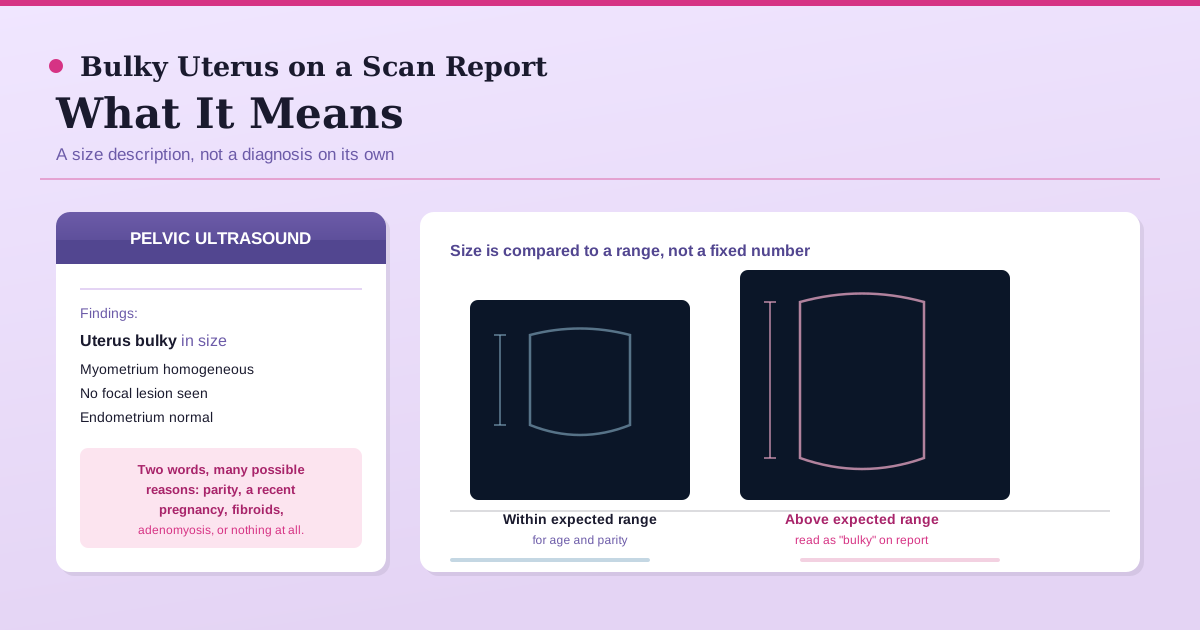
“Bulky” is a descriptive term radiologists use when a uterus measures larger than the expected size range for a woman’s age and parity (whether or not she has been pregnant, and how many times). It is not a named condition on its own. It describes what the tape measure showed on the day of the scan, nothing more.
On ultrasound, the uterus is measured in three dimensions along the midline image: length (from the top of the fundus down to the cervix), width (the widest point across), and the front-to-back depth, usually written as AP diameter. A radiologist compares these three numbers to typical ranges and writes “bulky” when the uterus sits above the expected size for that woman.
There is no single centimetre cutoff that applies to every woman, because a woman who has never been pregnant is expected to have a smaller uterus than a woman who has had two or three children. As a general guide, a uterus that has never carried a pregnancy typically measures in the range of roughly 6 to 8.5 cm in length, while a uterus that has carried one or more pregnancies to term is commonly larger, often in the range of roughly 8 to 10 cm in length, and this larger size on its own is not abnormal.
A report that reads “uterus bulky, measuring 9.4 x 5.6 x 4.8 cm, in a woman with two prior deliveries” may simply be describing a uterus that is at the upper end of what pregnancy and childbirth normally leave behind, rather than flagging a new problem.
Why the word alone worries women more than it should
“Bulky” sounds alarming in everyday English. In a radiology report, it carries none of that weight. It sits in the same category as words like “anteverted” (tilted forward) or “homogeneous” (uniform in texture): a technical description meant for the referring doctor, written before anyone knows the full clinical picture.
The reason it appears on so many reports is simple: a uterus that is even slightly above the expected range for its parity gets the word “bulky” attached, as a factual note for the doctor reading the report. It is written the same way whether the underlying cause turns out to be entirely benign or whether it needs further evaluation. The word itself does not tell you which one it is. What matters is everything else on the report and in your history alongside it.
Common reasons a uterus reads bulky
Recent pregnancy. After childbirth, the uterus takes time to return to its pre-pregnancy size, a process called involution. It shrinks rapidly over the first two weeks after delivery and continues gradually over the following weeks, but it does not return all the way to a pre-pregnancy baseline immediately, and in many women it remains slightly larger than it was before that pregnancy, permanently. A scan done any time in the weeks or months after delivery can reasonably read as bulky.
Parity itself. Independent of any specific recent pregnancy, having carried one or more pregnancies to term generally leaves the uterus somewhat larger than it was before the first pregnancy, for life. This is a normal, expected difference, not a finding that needs monitoring.
Being closer to your period, or mid-cycle changes. The uterus and its lining vary slightly across the menstrual cycle. A scan timed differently across two visits can show slightly different measurements even in a healthy uterus, which is one reason doctors sometimes ask for a scan on a specific cycle day for comparison.
Fibroids. Non-cancerous growths of the uterine muscle are the single most common reason for a uterus to measure larger than expected, particularly when multiple fibroids are present or one is sizeable. The report will usually describe the fibroids separately, in addition to noting the uterus is bulky as a result. Our companion guide on reading a fibroid ultrasound report walks through what those specific findings mean.
Adenomyosis. This is when the tissue that normally lines the inside of the uterus grows into the muscular wall instead, causing the whole uterus to swell diffusely rather than forming a discrete lump the way a fibroid does. A uterus with adenomyosis is often described as bulky and, on closer questioning, tender or uneven in texture. Our full guide on adenomyosis symptoms, causes and treatment covers this in detail, including how it differs from fibroids on imaging and in symptoms.
No identifiable cause at all. Some women simply have a uterus at the larger end of the normal range for their parity, without fibroids, adenomyosis, or any other finding on the scan. This is uncommon enough to be worth a follow-up scan if there are also symptoms, but it is a real and benign category, and “bulky” alone, with an otherwise clean report, is frequently exactly this.
If your report says “bulky uterus” and you are not sure which of these applies to you, or your report lists other findings alongside it that you do not understand, a video consultation is the fastest way to get a specific answer.
Dr. Suganya Venkat is available online, pan-India, for a Rs. 399 video consultation. You can share your scan report directly in the conversation.
Bulky uterus with symptoms: what changes the picture
A bulky uterus with no symptoms and no other finding on the report is usually not something that needs treatment. What changes the picture is what comes with it:
Heavy or prolonged periods. If bleeding has become noticeably heavier, lasts longer than it used to, or involves passing clots, this combination, together with a bulky uterus, is the classic presentation of either fibroids or adenomyosis, and is worth discussing with your doctor rather than monitoring on your own. Our guide on heavy periods after 35 separates out the main causes.
Deep, dragging pelvic pain, particularly pain that has been present for months and tends to worsen just before or during periods, points more towards adenomyosis than towards an incidental size finding.
A feeling of pressure or fullness low in the abdomen, sometimes described as looking a few months pregnant by the end of the day, can accompany a bulky uterus from fibroids large enough to be felt.
Difficulty conceiving, or a history of miscarriage. A bulky uterus found during a fertility workup is worth a closer look specifically at what is causing the size increase, since fibroids that distort the uterine cavity and adenomyosis can both affect fertility, while an incidentally larger uterus with no other finding usually does not.
If none of these apply, and the rest of your report reads as normal, a bulky uterus on its own is rarely something to be worried about.
What typically happens next
Usually nothing further is needed: a bulky uterus noted with no other abnormal finding, in a woman with no symptoms, especially with a history of pregnancy or delivery that explains the size.
Usually a follow-up scan or clinical review: a bulky uterus combined with new or worsening heavy bleeding, pelvic pain, or difficulty conceiving, so that fibroids or adenomyosis can be specifically looked for and characterised if present.
Usually further imaging (an MRI, in some cases): when the ultrasound picture is unclear, when surgery is being considered, or when the pattern on ultrasound does not clearly fit either fibroids or adenomyosis.
The report line “uterus bulky” is a starting point for your doctor to look further, not a conclusion in itself. What decides what happens next is the rest of the report, your symptoms, and your history, read together.
Frequently asked questions
Is a bulky uterus serious?
Not usually. On its own, “bulky uterus” is a size description, not a diagnosis of a disease. Many women with a bulky uterus have no symptoms and no other finding on their scan, particularly if they have had children. It becomes more significant when it appears alongside heavy bleeding, pelvic pain, or fertility difficulty, or alongside a specific finding like fibroids or adenomyosis.
Is bulky uterus normal after delivery?
Yes, in most cases. The uterus takes weeks to shrink back after childbirth, and even after it has fully recovered, it commonly remains somewhat larger than it was before that pregnancy. A scan done in the months after delivery reading “bulky” is often simply describing this normal, expected change.
Does bulky uterus mean fibroids?
Not always, but fibroids are one of the most common causes. If fibroids are present, your report will usually describe them separately with their size and location, in addition to noting the uterus is bulky overall. A bulky uterus with no fibroids listed and no other finding is a different, generally more reassuring picture.
Can a bulky uterus affect fertility?
It depends entirely on the cause. A uterus that reads bulky simply because of parity or a prior pregnancy does not typically affect fertility. A bulky uterus caused by fibroids that distort the uterine cavity, or by adenomyosis, can affect fertility, which is why the underlying cause matters more than the word “bulky” itself.
Does a bulky uterus need treatment?
A bulky uterus with no other finding and no symptoms usually does not need treatment, only monitoring if symptoms develop later. Treatment decisions are made based on what is causing the size increase (such as fibroids or adenomyosis) and how it is affecting you, not based on the word “bulky” on its own.
What is the difference between a bulky uterus and a normal uterus?
A normal-sized uterus falls within the expected measurement range for a woman’s parity and age. A bulky uterus measures above that expected range. The dividing line is not a fixed number that applies to everyone; it depends on whether a woman has been pregnant, since childbirth normally leaves the uterus somewhat larger for the rest of her life.
Should I be worried if my scan says bulky uterus but everything else looks normal?
Generally, no. When the rest of the report describes a normal texture, no fibroids, no cysts, and a normal endometrial lining, a bulky uterus alone, especially in a woman who has had children, is one of the more common and least concerning findings on a pelvic ultrasound. If you remain unsure, discussing the full report with your doctor is the most direct way to be reassured.
If your report says “bulky uterus” and you would like to understand what it means for your specific situation, speaking with an OB-GYN gives you a specific answer rather than a general one.
Dr. Suganya Venkat is available online, pan-India, for a Rs. 399 video consultation. You can share your scan report directly in the conversation and get an answer specific to your findings.
Dr. Rajashree NS is a Consultant Radiologist with an MD in Radio-diagnosis from Sree Mookambika Institute of Medical Sciences. She interprets pelvic and fertility ultrasound reports as part of the Fertilia Health team.