A woman comes to me already on an antidepressant. She has taken it for a year, and for most of the month she feels steady. But for about a week before every period, the floor falls out. The hopelessness, the tears, the sense that nothing will ever feel better, all of it comes back in full force, and she wonders whether the medication has quietly stopped working.
Another woman, on no medication at all, describes the same dark week. The difference is that once her period starts, she feels completely well again, all the way until the next cycle.
These two women have different conditions, even though their worst days look almost identical. I am a psychiatrist, and I contribute educational content to Fertilia’s blog on women’s mental and hormonal health. Sorting out which pattern a woman actually has changes what helps, because the clue is rarely the symptoms themselves. The clue is timing.
The same symptoms, two different stories
Depression and PMDD share a surface. Low mood, loss of interest, tearfulness, fatigue, poor concentration, a heavy sense of hopelessness: all of these can belong to either condition. If you only describe how you feel on your worst day, no doctor can reliably tell them apart.
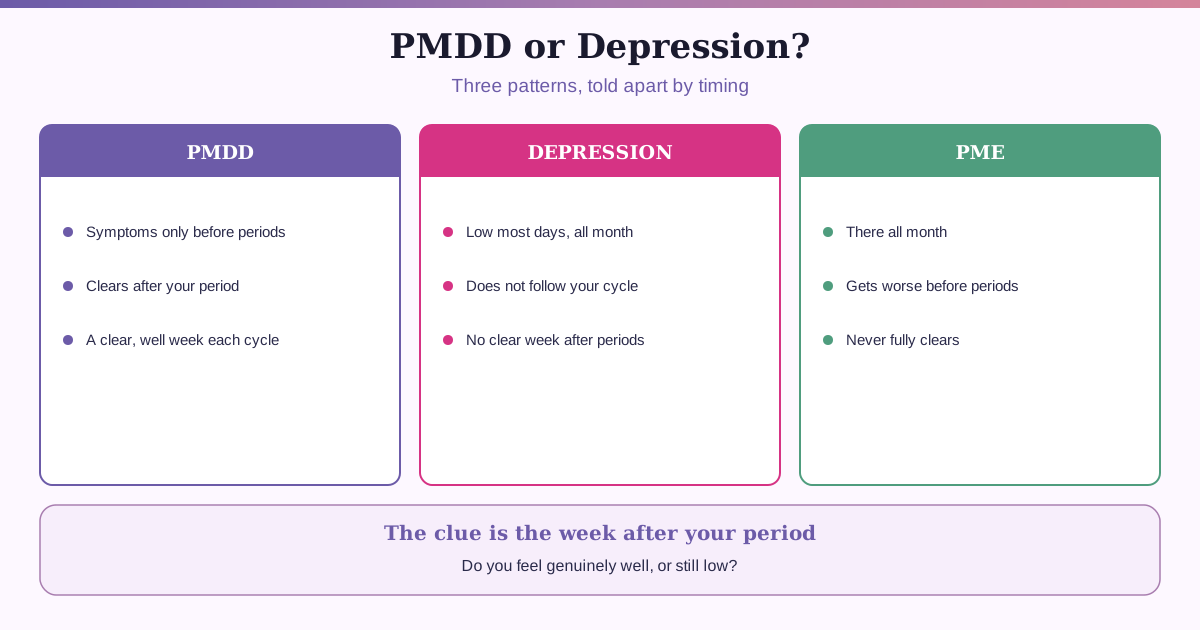
What separates them is when the symptoms appear and, just as importantly, when they lift. To see that clearly, it helps to recognise that there are really three patterns hiding inside the question “is this PMDD or depression.”
Pattern one: PMDD
In premenstrual dysphoric disorder, the mood symptoms live in the luteal phase, the roughly two weeks between ovulation and your period. They build through that stretch, peak in the last few days, and then fade within a day or two of bleeding starting. The week after your period is genuinely clear. You feel like yourself.
This on-off pattern, severe symptoms followed by a real symptom-free interval every single cycle, is the signature of PMDD. It affects around 8% of reproductive-age women in Indian studies (Dutta et al., 2021, Health Promotion Perspectives, PMID 34195039). If this is your pattern, our psychiatrist’s guide to PMS and PMDD walks through the full diagnosis.
Pattern two: depression
In major depression, the low mood is present most of the day, nearly every day, for two weeks or longer, and it does not respect your menstrual calendar. It is there before your period, during your period, and in the week after. There may be good days and worse days, but there is no clean week of feeling fully well that arrives on schedule with your cycle.
Depression is its own condition with its own treatment, and it is common: it does not need a hormonal trigger to exist. If your low mood is steady and unrelenting rather than cyclical, that points here.
Pattern three: premenstrual exacerbation (PME)
This is the one that gets missed most often, and it is probably the most common of the three. In premenstrual exacerbation, a woman has an underlying condition, usually depression or an anxiety disorder, that is present all month, but it becomes noticeably worse in the days before her period.
So her baseline is not well. It is a low hum of depression or anxiety that she lives with, and then the premenstrual week turns the volume up sharply. Because the premenstrual crash is the most dramatic part, she may believe her whole problem is hormonal, when in fact the cycle is amplifying a condition that needs treating in its own right (Kuehner and Nayman, 2021, Current Psychiatry Reports, PMID 34626258).
PME is not PMDD. In PMDD the symptoms switch off after the period. In PME they never fully switch off, they only ease back to the everyday baseline.
Why this is so easy to get wrong
Two ordinary quirks of memory make this hard to sort out from feeling alone.
The first is that bad weeks dominate our recollection. A woman with depression who crashes premenstrually often remembers the crashes and forgets that the rest of the month was also quietly heavy, so she assumes it is all about her period. A woman with PMDD, looking back, may feel she has been “depressed for years,” because the bad weeks loom so large that the clear weeks fade from memory.
The second is that both conditions get worse before the period, so the premenstrual crash is not, by itself, a distinguishing clue. Almost everything feels worse premenstrually. The real question is what your mood is like in the week after your period, and that is the part memory is least reliable about.
The one tool that tells them apart
Because memory blurs the pattern, the answer is not to think harder about the past. It is to track forward.
The standard of care is to chart your mood every day across at least two menstrual cycles, marking the days your period starts and ends (Craner et al., 2014, Women & Health, PMID 24512469). A simple 0 to 10 mood rating, noted once a day, is enough. After two cycles, the shape of the problem becomes visible in a way no single conversation can match. If you would like the full method, our guide to tracking your cycle for a PMDD diagnosis walks through exactly what to rate and how to read the result.
What you are looking for is the week after your period. If your mood reliably returns to genuinely well in that week, the picture leans toward PMDD. If you are still low in that week, even if less low than before your period, the picture leans toward depression or PME. That one observation, the state of the post-period week, does more diagnostic work than any blood test, because there is no blood test for any of these conditions.
Why the distinction changes everything about treatment
This is not a labelling exercise. The three patterns are treated differently, and matching the treatment to the pattern is what gets women better.
PMDD responds to treatments aimed at the cycle. SSRIs work here, and unusually, they can be taken only in the luteal phase rather than every day, and they act faster than they do for ordinary depression (Hantsoo and Epperson, 2015, Current Psychiatry Reports, PMID 26377947). A drospirenone-containing combined pill is another option. Our PMDD treatment guide for India lays out the full ladder.
Depression needs continuous treatment, because the condition is present continuously. A luteal-only approach would leave most of the month untreated. Here the work is the steady, everyday management of a mood disorder, which an antidepressant, therapy, or both can provide.
PME needs the underlying condition treated properly first, because that baseline is where most of the suffering actually lives. Once the baseline depression or anxiety is well managed, the premenstrual spike often becomes much smaller. Sometimes a clinician will add a targeted premenstrual adjustment on top, but the foundation is treating the all-month condition, not just the bad week.
You can see why guessing is expensive. A woman with PME who is told she “just has PMDD” and given a luteal-only plan will keep suffering for three weeks out of four. A woman with true PMDD who is put on a daily antidepressant when a luteal dose would have done may take more medication than she needs. Getting the pattern right is what makes the treatment fit.
What if it is both, or you already see a doctor?
Overlap is common, and you do not have to disentangle it yourself. Many women have a genuine baseline mood condition and a strong premenstrual amplification on top, and a clinician’s job is to weigh both and treat both.
If you are already under the care of a doctor for depression or anxiety, none of this is about second-guessing them. It is the opposite. A clear two-cycle chart is one of the most helpful things you can bring to your existing doctor, because it shows them something an ordinary appointment cannot: how your mood moves with your cycle. That lets the two of you fine-tune a plan together. A good clinician works alongside the doctors you already see, never around them.
The one thing that cannot wait
There is a single part of this I never ask anyone to track quietly for two months. If your low mood, whatever its cause, brings thoughts that life is not worth living or thoughts of harming yourself, please do not wait for the pattern to become clear. Cyclical or constant, those thoughts deserve help now. You can speak to a doctor, confide in someone you trust, or call the free national mental health helpline KIRAN on 1800-599-0019, available around the clock. We cover this more fully in our guide to premenstrual depression and dark thoughts.
Frequently Asked Questions
1. How do I know if it is PMDD or depression?
The deciding clue is the week after your period. In PMDD, your mood returns to genuinely well in that week, every cycle. In depression, the low mood is present most days all month and does not clear after your period. Tracking your mood daily across two cycles is the reliable way to see which pattern you have.
2. Can you have both PMDD and depression?
Yes. A woman can have an underlying depression that is present all month and a strong premenstrual worsening on top of it. This combination, where a baseline condition flares before the period, is called premenstrual exacerbation, and it is treated by managing both the baseline condition and the premenstrual spike.
3. What is premenstrual exacerbation (PME)?
PME is when an existing condition, usually depression or an anxiety disorder, gets noticeably worse in the days before your period but never fully clears afterward. It differs from PMDD, where the symptoms switch off completely after the period. PME is common and often mistaken for PMDD.
4. Why does my depression get worse before my period?
The hormonal shifts of the luteal phase affect the brain’s mood chemistry, so an existing depression or anxiety condition is commonly amplified before a period. This does not mean your problem is only hormonal. It usually means an underlying condition is being made temporarily worse by the cycle.
5. Is there a blood test to tell PMDD from depression?
No. Neither PMDD nor depression has a blood test, and hormone levels are usually normal in PMDD. The diagnosis comes from your symptom pattern over time, which is why a daily mood chart kept across two cycles is the single most useful tool.
6. Does the treatment really differ between them?
Yes, and meaningfully. PMDD can be treated with an SSRI taken only in the two weeks before the period, or with a specific combined pill. Depression needs continuous treatment because it is present continuously. Premenstrual exacerbation needs the underlying condition treated first. Matching the treatment to the pattern is what works.
7. Should I stop my antidepressant if I still crash before my period?
Please do not stop or change any medication on your own. A premenstrual crash while on an antidepressant often points to premenstrual exacerbation, which may need a dose review or an added premenstrual adjustment, not stopping the medication. Bring a mood chart to the doctor who prescribed it so the two of you can decide together.
What to do next
If you have read this and you are still not sure which pattern is yours, that uncertainty is normal, and it is also solvable. Start a simple daily mood note today, mark your period days, and let two cycles show you the shape of it. The week after your period will tell you more than any amount of looking back.
Two months of honest daily tracking is the single most valuable thing you can bring to any doctor. If you would like the method, our tracking guide shows you how.
If your symptoms are affecting your daily life, please seek help from a doctor.