Your scan report came back, and somewhere in that block of terms you did not ask for, it says: “placenta: anterior.” You have been reading it for the last twenty minutes, trying to decide whether it means something is wrong.
It does not. But I understand why you are asking.
I’m Dr. Suganya Venkat, an OB-GYN with fifteen years of clinical experience, and “anterior placenta” is one of the phrases I explain most often in the second trimester. It appears on the scan report, nobody at the scan explains it, and women spend the rest of the day searching. This post answers the question properly.
In this post:
- What “anterior” means on a scan report
- Why the placenta ends up in front
- How an anterior placenta affects what you feel when the baby moves
- Whether it changes how you deliver
- The one situation that genuinely needs monitoring
- A guide to the other placenta terms on your report
What does anterior placenta mean?
The uterus has a front wall (anterior), a back wall (posterior), a top (the fundus), and two sides. The placenta grows wherever the fertilised egg implants in the uterine lining.
If implantation happened on the front wall, the placenta develops on the front wall. That is anterior placenta. If it happened on the back wall, the placenta is posterior. At the top, it is fundal. On one side, it is lateral.
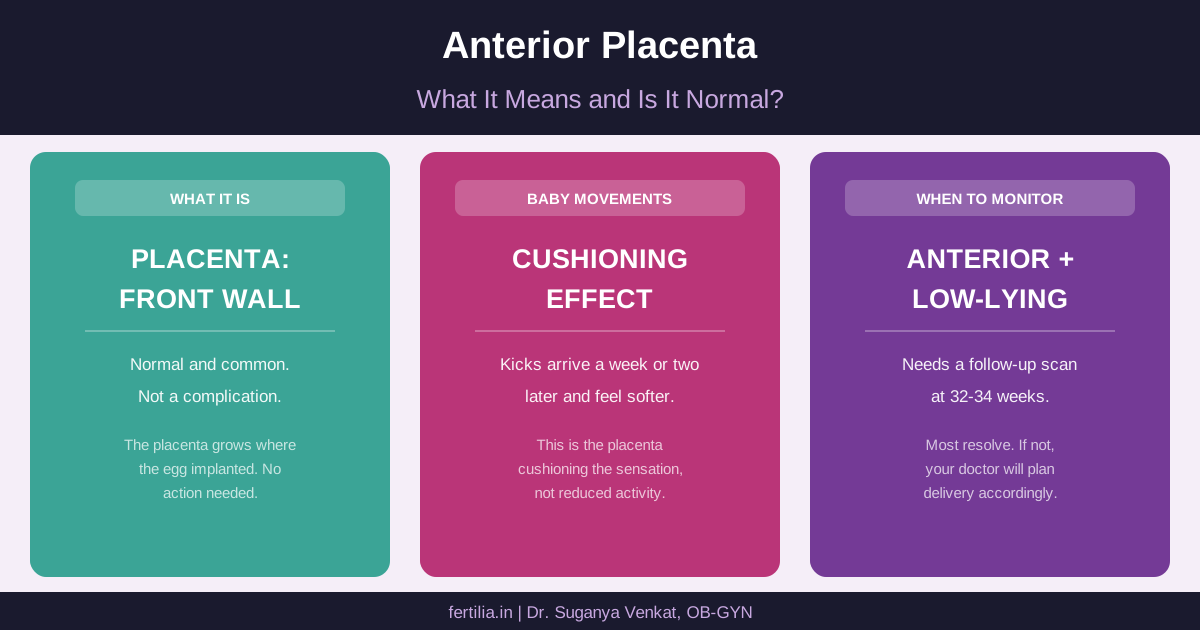
These are descriptions of location, nothing more. Roughly half of all placentas are anterior. There is no meaningful difference in outcomes between an anterior and a posterior placenta at the same height in the uterus.
An anterior placenta does not affect the blood supply to the baby. It does not affect the growth of the placenta. It is not a sign that something went wrong in the implantation. It is a coordinate on a map.
Why does the placenta land in front?
The embryo travels down the fallopian tube and enters the uterus over several days. Once inside, it finds a site in the uterine lining and implants. The placenta then grows outward from that site.
The uterus does not steer the embryo toward one wall or another. Implantation happens where the conditions in the lining are right at that moment. There is nothing you did, ate, or lay in a particular way during the two-week wait that placed the placenta in front rather than behind. An anterior placenta in one pregnancy does not predict what the next pregnancy will do. Each one implants independently.
How an anterior placenta affects baby movements
This is the part that matters most, and where an anterior placenta genuinely does make a difference to experience.
The placenta is soft tissue, roughly 2 to 3 centimetres thick at term and full of blood vessels. When it sits on the front wall, it acts as a cushion between the baby and your abdominal wall. The baby’s kicks, rolls, and hiccups all happen at the same frequency and strength as in any other pregnancy. You just feel them through that cushion rather than directly through the wall.
This has two practical effects.
Movements often come a little later. Most women with a posterior placenta feel the first clear sensations (called quickening) between 18 and 22 weeks. With an anterior placenta, the first clear movements often arrive a week or two later, sometimes not until 22 to 24 weeks. The Royal College of Obstetricians and Gynaecologists (RCOG Green-top Guideline No. 57, Reduced Fetal Movements) lists anterior placental position explicitly as a reason why a woman may feel movements later or less strongly. This is expected, and it does not mean the baby is less active.
The sensations may feel different. Instead of sharp, distinct kicks on the front of the abdomen, you may notice rolls, waves, or a kind of soft pressure. Movements are often clearer on the sides or lower down, where the baby’s limbs are closer to the abdominal wall without the placenta between them. Partners placing a hand on the front may also feel less than they would with a posterior placenta.
Kick counting with an anterior placenta
In the third trimester, every woman is asked to monitor fetal movements. With an anterior placenta, the instruction is the same: pay attention to your baby’s own pattern and report any significant change from what is usual for you.
Counting against a fixed threshold (“feel ten movements in two hours”) can create unnecessary anxiety in women who feel movements differently because of the placenta position. What matters is whether your baby seems as active as it normally is for you.
If your baby has been quieter than usual for a few hours, drink something cold, lie on your left side, and wait for 30 minutes. If you are not reassured after that, contact your doctor. Do not wait until the next appointment. This applies to every pregnant woman, not only those with anterior placentas.
For a complete week-by-week guide to what is normal for fetal movements, see the fetal movement guide.
Does an anterior placenta affect delivery?
For the large majority of women, it does not.
Vaginal delivery is not affected by placenta position when the placenta is sitting in the upper or mid part of the uterus. The placenta does not block the birth canal in anterior fundal, anterior mid-segment, or anterior lateral positions. Labour and pushing proceed the same way as with any other placenta position.
Planned C-section is also not materially different when the anterior placenta is in a normal position. The lower-segment transverse incision used for a C-section goes below where the placenta sits in most cases. Your surgeon reviews the scan beforehand and knows exactly where the placenta is. An anterior placenta in a normal position does not increase your bleeding risk or make the procedure more complicated.
The scenario that does require extra planning is an anterior placenta that is also low-lying, which is covered in the next section.
The one situation worth monitoring
An anterior placenta in the upper or mid segment of the uterus: no additional monitoring needed beyond your routine antenatal scans.
An anterior placenta that is also low-lying (meaning the lower edge is within 2 cm of the cervical opening) needs a repeat scan later in the pregnancy. The lower segment of the uterus stretches considerably between 20 and 36 weeks, and in most cases a low-lying placenta at 20 weeks will have moved to a safe distance by 32 to 34 weeks. This is not dangerous while it is being monitored. Most of these women go on to a normal delivery.
If the placenta has not migrated by the third trimester and remains close to or covering the cervix, that becomes placenta praevia, which changes the delivery plan. The low-lying placenta guide explains this in detail, including what the follow-up scan checks for and what outcomes to expect. For the full picture of what placenta praevia means for pregnancy and delivery, the placenta praevia post covers that specifically.
There is one additional consideration for women who have had a prior C-section: if a subsequent pregnancy has an anterior low-lying placenta, the placenta can embed into the prior scar. This abnormal attachment (called placenta accreta, increta, or percreta) carries specific risks. Silver et al. (Obstet Gynecol, 2006, PMID 16738145) documented how this risk increases with each additional C-section. This does not apply to women with an anterior placenta in a normal position and no prior uterine surgery. If you have had a C-section before and your current placenta is anterior and low, mention it at every appointment and ask your doctor about specialist review.
If your anterior placenta is in a normal position and the report does not say low-lying, there is nothing to do differently from any other pregnancy.
If you have questions about your scan report or want to understand what your specific findings mean for your pregnancy, you can speak with Dr. Suganya Venkat over a video consultation. The consultation is online, available across India.
Start the conversation on WhatsApp
A guide to other placenta terms on the report
Scan reports use a consistent vocabulary. Here is what the common terms mean:
Anterior fundal: the placenta is on the front wall and also at the top of the uterus. Baby movements are often clearest lower down and on the sides.
Posterior: the placenta is on the back wall. Movements are typically felt earlier and more clearly through the front.
Fundal: the placenta is at the top. Normal position.
Lateral: the placenta is on one side. Normal.
Anterior low-lying: front wall, with the lower edge close to the cervix. Needs a follow-up scan at 32 to 34 weeks.
Grade 0, I, II, III placenta: these describe placental maturity (how much calcification has developed as the pregnancy advances), not position. The Grannum classification runs from Grade 0 to Grade III; there is no Grade IV, so if you see one written on a report it is worth querying. Grade III is common in the late third trimester and is not automatically a problem, though Grade III appearing well before term may prompt additional monitoring. Ask your doctor what the grade means in your specific context.
The anomaly scan at 20 weeks, also called the TIFFA scan, reports placenta position as a standard part of its findings. For a complete guide to what is assessed at the 20-week scan, see the anomaly scan guide.
For understanding your third-trimester growth scan alongside placenta position, the growth scan and Doppler guide explains what the report measures.
What to expect going forward
If your anterior placenta is in a normal (not low-lying) position:
- Continue your routine antenatal schedule. No extra scans are needed for placenta position alone.
- Begin noticing your baby’s movement pattern in the second trimester, keeping in mind that the first clear sensations may arrive a week or two later than average.
- In the third trimester, focus on what is normal for your baby, not a fixed textbook number.
- If movements feel quieter than usual, act on it by calling your doctor rather than waiting.
If the report says anterior low-lying:
- Attend the follow-up scan at 32 to 34 weeks.
- Avoid intercourse and vigorous physical activity if your doctor has advised pelvic rest.
- Report any vaginal bleeding, painless or otherwise, to your doctor immediately.
In either case, your pregnancy guide resource covers the full antenatal schedule and what each trimester involves.
Frequently asked questions
Is anterior placenta common? Yes, very common. The placenta implants wherever the fertilised egg lands in the uterine lining, and the front wall is just as likely a landing site as the back. There is nothing unusual about an anterior placenta.
Will I feel my baby moving with an anterior placenta? Yes. The sensations may come a week or two later than in pregnancies with a posterior placenta, and kicks may feel more like rolls or waves rather than sharp jabs. Movements on the sides and lower abdomen are often clearer. By the third trimester, most women feel their babies clearly regardless of placenta position.
Does anterior placenta mean I will need a C-section? Not if the placenta is in a normal position. Your delivery plan is determined by your baby’s position, the progress of labour, and your obstetric history, not by an anterior placenta that sits in the upper or mid segment of the uterus.
Anterior placenta kya hota hai? (What does anterior placenta mean in Hindi?) Anterior placenta ka matlab hai ki aapki naal (placenta) garbhashay (uterus) ki agli deewar par hai. Yeh bilkul normal aur aam baat hai. Iska matlab koi dikkat nahi hai. Agar report mein “low-lying” bhi likha hai, toh 32-34 hafte par ek aur scan hoga, warna koi alag ilaj ya savdhani zaroori nahi hai.
Can an anterior placenta affect the growth scan or Doppler findings? No. The growth scan measures the baby’s estimated weight, head, and limb measurements. The Doppler measures blood flow through the umbilical cord. Neither is affected by placenta position. Both are interpreted the same way regardless of where the placenta sits.
My scan says anterior low-lying. Should I be worried? A low-lying placenta at 20 weeks is common and resolves on its own in around 9 out of 10 cases as the uterus grows. Your doctor will arrange a follow-up scan at 32 to 34 weeks to recheck the position. In the meantime, follow your doctor’s advice on pelvic rest and attend the follow-up scan. For a detailed explanation, the low-lying placenta guide covers exactly this.
I had a previous C-section and now I have an anterior placenta. Is that a concern? The combination of a prior C-section scar and an anterior placenta in a normal position is not a specific concern. The situation that needs specialist review is a prior C-section combined with an anterior low-lying placenta, because the placenta can embed into the scar. If both apply to you, raise it directly with your doctor so the right monitoring is arranged from early in the third trimester.
An anterior placenta in a normal position is a description, not a diagnosis. The scan has told you where the placenta is, and where it is happens to be the front wall. That is all.
If your report mentioned low-lying alongside anterior, or if you have a prior C-section and want to understand what that means for this pregnancy, that conversation is worth having directly with your doctor.
Dr. Suganya Venkat sees women across India over video consultation through Fertilia. If you would like to talk through your scan findings, the consultation is available at ₹399.