Your waters break, or your doctor checks during labour, and instead of the clear fluid you expected, someone mentions the word “meconium.” It can come with a shift in tone in the room, more people at your bedside, a paediatrician suddenly present who was not there a few minutes ago. If nobody explains what is actually happening, that shift alone can feel frightening.
This guide walks through what meconium-stained amniotic fluid actually is, why it happens, how common it is, what changes in how your delivery is managed once it is noticed, and what meconium aspiration syndrome is, honestly, including how often it happens and how it is treated. The goal is for you to understand the room, not just be in it.
What this post covers:
- What meconium-stained fluid is and why it happens
- How common it is, and why it usually is not a sign of danger
- What changes in delivery-room management once meconium is found
- What meconium aspiration syndrome is, how common it actually is, and how it is treated
- Questions to ask your doctor if this comes up in your own labour
What Meconium-Stained Fluid Is
Meconium is the baby’s first stool. It is thick, sticky, and dark greenish-black, made up of everything swallowed in the womb: skin cells, lanugo (the fine hair that covers a baby before birth), bile, and amniotic fluid itself. Normally, a baby passes meconium for the first time after birth, usually within the first day or two.
Sometimes, though, the baby passes it before birth, while still inside the amniotic sac. When that happens, the clear or pale amniotic fluid takes on a green, brown, or yellow tinge, depending on how much meconium is present and how long it has been in the fluid. This is what “meconium-stained amniotic fluid” or “meconium-stained liquor” refers to. Your doctor or the labour ward team may describe the colour more specifically, as light, moderate, or thick staining, because that detail affects how closely the baby is watched.
There are two broad reasons this happens, and it is worth naming both honestly rather than picking the reassuring one and leaving out the other, because that is not a service to you.
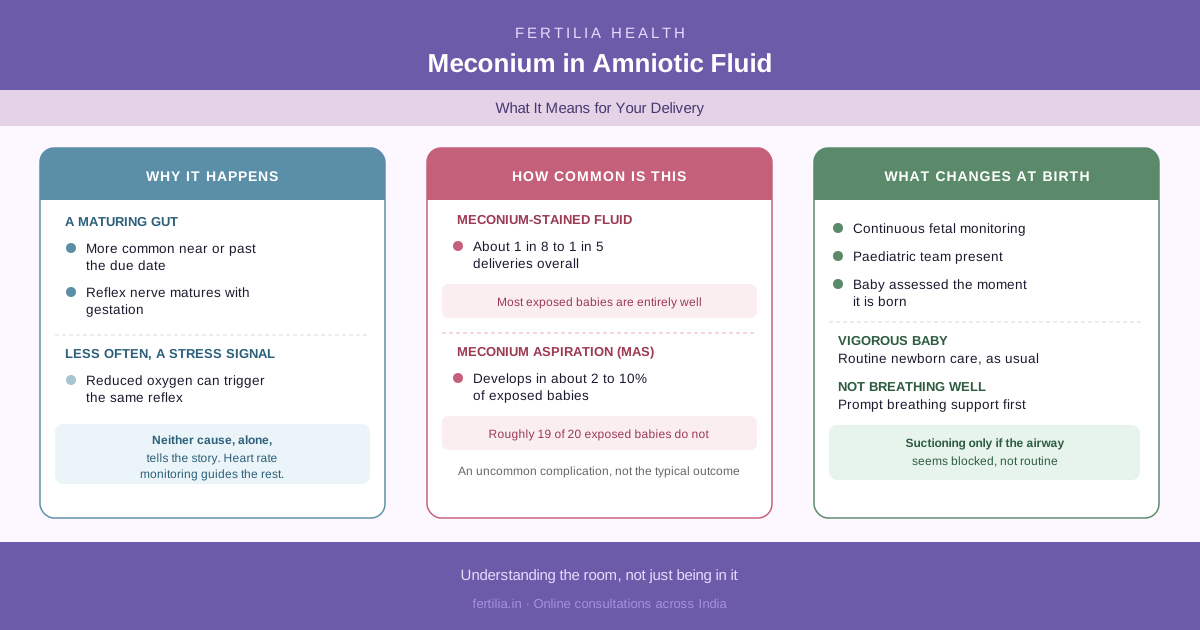
The gut simply matures with gestation. A baby’s bowel becomes capable of passing meconium as pregnancy advances, and the vagus nerve, part of what controls that reflex, matures further as the baby approaches and passes full term. This is why meconium-stained fluid becomes more common the further along a pregnancy goes, and it is the most frequent reason it appears.
Less commonly, it can be a response to a stressful moment for the baby, such as reduced oxygen during labour, which can trigger a vagal reflex that relaxes the anal sphincter and increases bowel movement. This is why your medical team pays closer attention once meconium appears, not because it always means something is wrong, but because it is one of several signals they use together, alongside the baby’s heart rate pattern, to judge how the baby is coping with labour.
Neither explanation on its own tells your doctor which one applies to you. That is exactly why closer monitoring, rather than alarm, is the right response, and it is what actually happens in a well-run delivery room.
How Common Is This, and What Does It Usually Mean
Meconium-stained fluid is not rare. It complicates roughly 1 in 8 to 1 in 5 deliveries overall, and it becomes noticeably more common the later a pregnancy runs, appearing in a substantially higher share of pregnancies that go past their due date. If you are being induced or delivering at 40, 41, or 42 weeks, your obstetrician mentioning the possibility of meconium is a statement about gestational age, not a prediction about your baby.
The most important thing to hold onto is this: the majority of babies born through meconium-stained fluid are entirely well. Passing meconium before birth does not, by itself, mean the baby has been harmed or is short of oxygen. It is one piece of information your delivery team factors in alongside everything else they are already watching, principally your baby’s heart rate pattern on the monitor.
What actually predicts a more watchful delivery is a combination of factors: how thick the meconium is (thin and lightly stained fluid is treated differently from thick, undiluted meconium, sometimes described as looking like “pea soup”), whether the baby’s heart rate pattern on the monitor shows any signs of distress, and how the baby looks and behaves in the first moments after birth. None of these are things you need to assess yourself. They are exactly what your obstetric and paediatric team are trained to watch for.
If you are approaching your due date or already past it and want to talk through what to expect at delivery, message me on WhatsApp and we can talk it through over a video consultation, whatever week you are in right now.
What Changes in Delivery-Room Management
When meconium is noticed, whether because your waters break at home and you notice the colour, or because it is seen when your membranes rupture in hospital, a few practical things change. None of them are things to be frightened by; they are the reason meconium-stained deliveries are, on the whole, safely managed.
Continuous fetal monitoring becomes the standard, if it was not already. Your baby’s heart rate is tracked closely through the rest of labour, because the heart rate pattern, not the meconium alone, is what tells the team whether the baby is coping well.
A paediatrician or neonatal team is present at the delivery itself, ready to assess the baby immediately after birth. This is standard practice for any meconium-stained delivery in a properly equipped hospital, and it is precisely why you may notice more people in the room than you expected. Their presence is a precaution built into how these deliveries are handled everywhere, not a signal specific to your baby.
The baby is assessed the moment it is born, mainly by how it looks: is it breathing well, is it moving with good muscle tone, is the heart rate strong. A baby who is crying, breathing, and moving normally right at birth (described clinically as “vigorous”) is dried, warmed, and given routine newborn care, exactly as any other baby would be, meconium or not.
If a baby is not breathing well, has poor tone, or a slow heart rate at birth (described as “non-vigorous”), the priority is getting that baby breathing, promptly. Current neonatal resuscitation guidance (Aziz K et al., Circulation, 2020, PMID 33081528) has deliberately moved away from routinely suctioning a non-vigorous baby’s airway before doing anything else. Suctioning is now reserved for the specific situation where the airway seems blocked and the baby is not responding to the usual breathing support. This changed because the evidence, including a large multicentre randomised trial of intrapartum suctioning (Vain NE et al., The Lancet, 2004, PMID 15313360), did not show that routine suctioning prevented complications, while delaying it delayed the far more important step: helping the baby breathe. If your delivery involves this scenario, your team is following an established, evidence-based sequence, not improvising.
A note on cord clamping and skin-to-skin, since this is something many women ask about specifically: when meconium is present but the baby is vigorous and breathing well, delayed cord clamping and immediate skin-to-skin contact still proceed as normal in most units. It is only when a baby needs breathing support that the neonatal team will take the baby to a warmer for assessment first.
Meconium Aspiration Syndrome: What It Is, Honestly
This is the complication that makes “meconium” a frightening word to search, so it deserves a direct, honest answer rather than either dismissal or alarm.
Meconium aspiration syndrome (MAS) happens when a baby breathes meconium-stained fluid into the lungs, either before or during birth, and it causes breathing difficulty after birth. It can range from mild, needing only extra oxygen or brief monitoring, to more serious, needing NICU support.
Here is the number that matters most for context: among babies exposed to meconium-stained fluid, only about 2 to 10 percent develop MAS, commonly cited around 5 percent. That means the large majority of meconium-exposed babies, roughly 19 out of 20, do not develop it at all. MAS is a recognised, real complication. It is not the typical outcome of meconium-stained fluid.
Babies at somewhat higher risk of MAS include those with thick meconium rather than light staining, babies who show signs of fetal distress during labour, babies born non-vigorous, and babies born past their due date. Even within these higher-risk situations, most babies still do well, particularly with the monitoring and immediate newborn assessment described above.
When MAS does occur, it is treated actively and effectively in a hospital setting equipped for it. Depending on severity, treatment can include supplemental oxygen, close respiratory monitoring, antibiotics if infection is a concern alongside it, and in more significant cases, admission to a NICU for breathing support. This is exactly why the presence of a paediatric team at a meconium-stained delivery matters: if support is needed, it is available immediately, not after a delay.
If your delivery involved meconium and you are still processing what happened, or if you are pregnant now and this is on your mind, you do not have to carry that alone. Message Dr. Suganya Venkat’s team on WhatsApp to talk it through, online, whenever suits you.
What This Means for You, Practically
A few things are worth carrying forward from all of this, especially if you are still pregnant and reading ahead:
- Meconium-stained fluid is common, especially near or past your due date. It is a routine finding your team is trained to manage, not a rare emergency.
- The colour of your fluid is worth noting and reporting, particularly if your water breaks at home. If you notice green, brown, or dark-tinged fluid, or a strong odour, tell your hospital and go in as advised, so continuous monitoring and the right delivery-room preparation can begin. Our post on the early signs labour is starting and our guide to water breaking early both cover what to watch for and when to head in.
- Being induced or going past your due date makes meconium more likely, not more dangerous by itself. If your doctor discusses induction with you as you approach or pass 40 weeks, our post on induction of labour: methods, reasons, and what to expect explains that conversation in full.
- Most babies born through meconium-stained fluid go home healthy, on the usual newborn timeline. For what those first days actually look like, our guide to newborn care in the first 30 days is a good next read.
- If your pregnancy has other risk factors, your care team may already be watching more closely for this. Our post on what high-risk pregnancy means and how care works covers how that closer monitoring is structured.
Frequently Asked Questions
What does meconium in the amniotic fluid mean?
It means the baby has passed its first stool before birth, into the surrounding amniotic fluid, rather than after birth as usually happens. The fluid takes on a green, brown, or yellow tinge instead of its normal clear or pale colour. It is a common finding, especially near or after the due date, and most babies born through it are entirely well.
Is meconium-stained fluid dangerous for the baby?
Not usually. Most babies exposed to meconium-stained fluid have no complications at all. It does prompt closer monitoring, a paediatric team at delivery, and careful assessment of the baby right after birth, because in a small number of cases it can be associated with meconium aspiration syndrome. But the majority of exposed babies, roughly 90 to 98 percent, do not develop it.
What is meconium aspiration syndrome?
It is breathing difficulty in a newborn caused by meconium-stained fluid entering the lungs before or during birth. It occurs in an estimated 2 to 10 percent of babies exposed to meconium-stained fluid, and severity ranges from mild, needing brief oxygen support, to more significant cases needing NICU care. It is treated actively and, in most cases, resolves well.
Does the doctor suction the baby’s airway if there is meconium?
Current neonatal resuscitation guidance has moved away from routinely suctioning every baby exposed to meconium. If a baby is vigorous, breathing, and has good tone at birth, no suctioning is needed at all. If a baby is not breathing well, the priority is starting breathing support promptly; suctioning is reserved for cases where the airway appears blocked and initial breathing support has not worked.
Can meconium-stained fluid be prevented?
Not directly, since it is often simply a sign of a maturing gut near or after full term rather than a problem to prevent. What matters is recognising it when it happens (noting fluid colour if your water breaks) and having your delivery managed in a facility equipped for continuous monitoring and immediate newborn assessment.
Does meconium mean I will need a C-section?
Not on its own. Meconium-stained fluid alone is not an indication for caesarean delivery. The decision about mode of delivery continues to be based on your baby’s heart rate pattern, your labour progress, and the usual factors your obstetrician already considers, meconium is simply one more piece of information factored into that ongoing assessment.
Is thick meconium worse than light staining?
Thick, undiluted meconium is generally treated with somewhat closer attention than thin, lightly stained fluid, since it is associated with a modestly higher chance of meconium aspiration syndrome. Even so, most babies born through thick meconium-stained fluid also do well with the monitoring and immediate assessment described above.
Meconium-stained fluid is one of those moments in labour that can look more alarming from inside the room than it usually is in outcome. Dr. Suganya Venkat and the team at Fertilia have supported women through this exact moment, and through the anxious weeks of a pregnancy running past its due date, many times over 15 years of practice. If you want to talk through your own pregnancy, your due date, or what happened at a previous delivery, WhatsApp us and we will go through it together, over a video consultation, wherever you are.
Dr. Suganya Venkat, OB-GYN (DNB, GKNM Hospital, Coimbatore), consults online via video call across India.