A woman came to me last year with a folder of reports: AMH, thyroid, an HSG, and a semen analysis for her husband, all normal. She had read online that low vitamin D might explain an eighteen-month gap between “trying” and “conceiving,” and she wanted to know if that was true, or if she was chasing something that did not matter.
What I usually tell her sits between the two extremes women read online: vitamin D does not fix fertility on its own, but it is not irrelevant either. I am Dr. Suganya Venkat, an OB-GYN at Fertilia, and this post walks through what the evidence on vitamin D and fertility shows, where the biology is solid, where the outcome data is genuinely uncertain, and what a reasonable, unhurried plan looks like if your levels turn out to be low.
What this post covers
- Why vitamin D receptors matter in the ovary, uterus, and even sperm
- What the fertility and IVF outcome studies found, and their limits
- The PCOS-and-obesity confounding problem, explained plainly
- Male fertility: vitamin D’s role beyond the female partner
- What to test, what the numbers mean, and correction that is common in India
- A plan that does not overpromise
Vitamin D receptors are present through the reproductive system
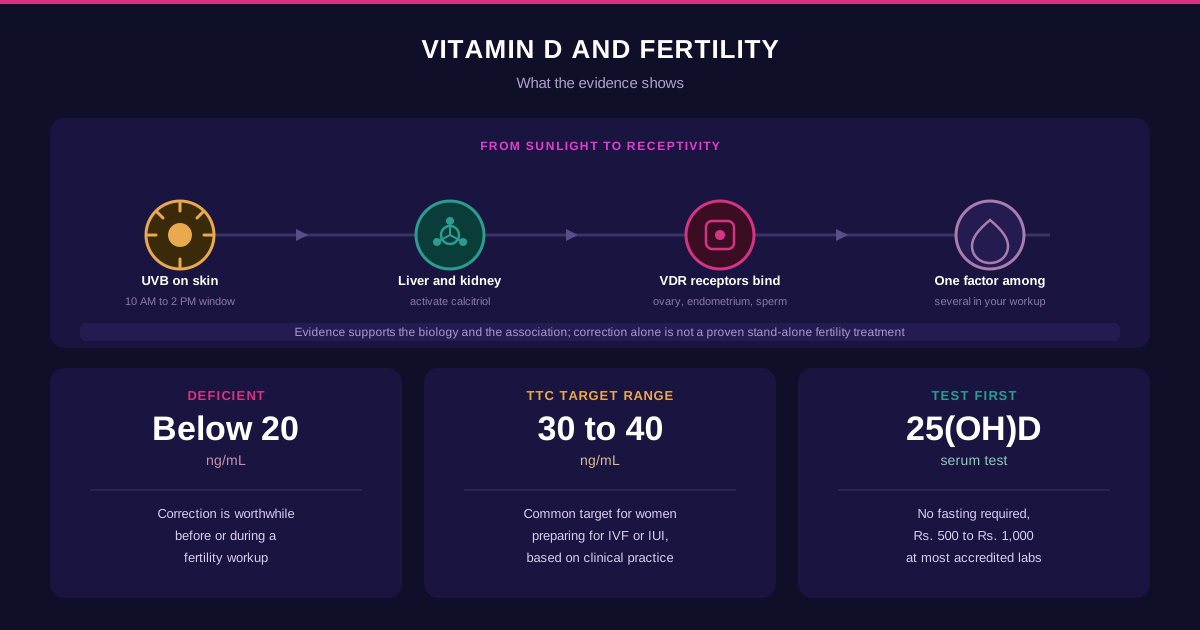
Vitamin D behaves less like a vitamin and more like a hormone. Once your skin makes it or you take it as a supplement, your liver and kidneys convert it into its active form, calcitriol, which then binds to vitamin D receptors (VDR) found across the body. The reproductive system carries more of these receptors than most people realise.
Agic and colleagues documented VDR and the enzymes that activate and break down vitamin D in both the human endometrium and the ovary, confirming that reproductive tissue does not just receive circulating vitamin D passively, it processes it locally (Agic et al., Reproductive Sciences, 2007). In the ovary specifically, a systematic review by Irani and Merhi found that vitamin D signalling in granulosa cells (the cells that nurse each developing follicle) influences AMH sensitivity, FSH response, and progesterone production (Irani & Merhi, Fertility and Sterility, 2014). None of this proves that raising your vitamin D level improves your odds of conceiving. It does establish that the biological pathway is real and specific, not a stretch.
The uterine side matters as much as the ovarian side. Endometrial receptivity, the short window in which the uterine lining is ready to accept an embryo, depends on coordinated signalling that VDR is thought to participate in. This is why vitamin D is discussed not only in the context of egg quality but also implantation, both of which sit downstream of the same receptor biology.
What the outcome studies found
Biology explaining a plausible mechanism is different from a study showing that correcting a deficiency changes your odds. Here is where the picture gets more complicated, and it is worth walking through carefully rather than reducing it to a single number.
The most robust synthesis to date is a systematic review and meta-analysis by Chu and colleagues, pooling 11 cohort studies and roughly 2,700 women undergoing assisted reproductive treatment, including IVF, ICSI, and frozen embryo transfer (Chu et al., Human Reproduction, 2018). Women with sufficient vitamin D status had statistically higher odds of clinical pregnancy and live birth compared with women who were deficient. That sounds like a clear result, and in one sense it is. But every one of those 11 studies was observational: women were not randomly assigned to correct their vitamin D or not, they simply had their levels measured and their treatment outcomes tracked. Observational data of this kind can show an association without proving that the vitamin D itself caused the better outcome.
An earlier systematic review by Lerchbaum and Obermayer-Pietsch reached a similar conclusion: higher vitamin D levels correlated with better fertilisation and pregnancy rates in some IVF cohorts, but the authors were explicit that the relationship was associative, not established as causal (Lerchbaum & Obermayer-Pietsch, European Journal of Endocrinology, 2012).
Why does this distinction matter to you as a patient, and not just as an academic footnote? Because a woman who is vitamin D deficient is, on average, also more likely to be indoors more, have a higher BMI, or have PCOS, and each of those factors independently affects fertility and IVF response. Vitamin D deficiency and lower fertility can travel together without vitamin D being the reason for the lower fertility. This is the same correlation-causation caution I apply to every “X causes Y” health headline, and vitamin D deserves the same scrutiny, not less because the story is appealing.
The PCOS and obesity confounding, explained plainly
If you have PCOS, this section applies to you directly. Wehr and colleagues found that women with PCOS had a high prevalence of vitamin D deficiency, and that lower 25-hydroxyvitamin D levels correlated with worse insulin resistance in this group (Wehr et al., European Journal of Endocrinology, 2009). This is a real and clinically useful finding: it tells us that checking vitamin D is worthwhile as part of a broader PCOS management plan, alongside the other PCOS drivers we already screen for.
What it does not tell us is that low vitamin D is a distinct, separable cause of PCOS-related infertility that you can fix on its own. PCOS itself independently reduces vitamin D through mechanisms involving adipose tissue (fat tissue sequesters vitamin D, making it less bioavailable) and reduced outdoor activity that sometimes accompanies the condition. So when a woman with PCOS has both lower fertility and lower vitamin D, untangling how much of that lower fertility is “caused by” the vitamin D deficiency versus caused by the PCOS itself, which also happens to lower vitamin D, is genuinely difficult from the available data. The same logic applies to obesity, which independently lowers circulating 25(OH)D because vitamin D is fat-soluble and gets diluted into a larger fat mass.
This is not a reason to ignore your vitamin D level if you have PCOS. It is a reason not to expect vitamin D correction alone to resolve a fertility picture that has several contributing drivers.
Vitamin D and male fertility
Most conversations about vitamin D and fertility focus entirely on the female partner, but the receptor biology is just as present on the other side. Blomberg Jensen and colleagues demonstrated that VDR and the enzymes that activate vitamin D are expressed throughout the human male reproductive tract, including in mature spermatozoa (Blomberg Jensen et al., Human Reproduction, 2010). In a follow-up study, the same group found that serum vitamin D levels were positively associated with sperm motility, and that active vitamin D increased intracellular calcium and triggered the acrosome reaction (the process a sperm needs to complete before it can fertilise an egg) in laboratory conditions (Blomberg Jensen et al., Human Reproduction, 2011).
If a couple’s evaluation has not turned up an explanation on the female side, it is reasonable to ask whether the male partner’s vitamin D has been checked alongside a semen analysis, particularly if motility is borderline. For the full picture of what moves the needle on sperm health, our evidence-based guide to increasing sperm count covers this alongside the other factors worth addressing together.
Chat with Dr. Suganya on WhatsApp →
What to test and what the numbers mean
The test is a simple blood draw: serum 25-hydroxyvitamin D, sometimes written as 25(OH)D. It does not require fasting and can be added to any routine panel.
| 25(OH)D level | Category | What it means for fertility planning |
|---|---|---|
| Below 20 ng/mL | Deficient | Correction is worthwhile before or during a fertility workup |
| 20 to 29 ng/mL | Insufficient | Most fertility specialists suggest correcting into the sufficient range |
| 30 to 40 ng/mL | Sufficient | The range most fertility clinics aim for in women preparing for IVF or IUI |
| Above 40 ng/mL | High-normal | No added benefit to pushing further without a specific reason |
You will notice fertility-specific targets sit slightly higher than the general population’s “sufficient” threshold of 20 ng/mL. This is common clinical practice rather than a formally established fertility-specific guideline: since the outcome studies above found associations at higher vitamin D levels, many fertility specialists in India and internationally aim for the upper end of the normal range (30 to 40 ng/mL) for women actively trying to conceive or preparing for treatment, even though no randomised trial has proven that this specific target improves live birth rates over simply reaching 20 ng/mL.
Why deficiency is so common among Indian women trying to conceive
India gets abundant sunlight year-round, yet vitamin D deficiency remains widespread. Ritu and Gupta’s national review found deficiency and insufficiency affecting a majority of the urban Indian population studied, attributing it to a combination of factors: darker skin pigmentation requiring longer UVB exposure to generate the same amount of vitamin D, indoor-heavy work and commuting patterns, covering clothing, and a largely vegetarian diet that provides little dietary vitamin D (Ritu & Gupta, Nutrients, 2014, PMID 24566435). None of these factors are unique to women trying to conceive, but they mean that if you are in this position, a low result is common rather than unusual, and not a sign that something else is wrong.
Correction: what is commonly done in India
If your levels come back deficient or insufficient, correction under medical supervision is straightforward. A frequently used regimen in Indian clinical practice for confirmed deficiency is 60,000 IU of oral cholecalciferol once weekly for 8 to 12 weeks, followed by a maintenance dose and a repeat 25(OH)D test to confirm the correction held. This is common practice rather than a single fixed national protocol, and the exact dose and duration should be set by whoever is managing your fertility care, especially if you are already pregnant or on fertility medications, since dosing changes in those situations.
What correction reliably does: brings your level into the range most fertility specialists consider appropriate, supports the bone and immune benefits vitamin D provides regardless of fertility, and removes one variable from your workup so your care team can focus on the factors driving your specific situation. What it does not reliably do, based on the evidence above: guarantee a pregnancy, replace a full fertility evaluation, or work faster than the 8 to 12 week window most correction protocols need.
If you are also working on the wider picture, our guide on improving egg quality through diet, supplements, and lifestyle places vitamin D correction alongside the other changes with genuine evidence behind them, and preparing your body for IUI or IVF covers the full pre-treatment checklist, of which vitamin D is one part, not the centrepiece.
A plan that does not overpromise
Here is what I recommend to women in Fertilia’s fertility program who ask about this:
- Test before you supplement. A serum 25(OH)D test costs approximately Rs. 500 to Rs. 1,000 at most accredited labs and removes the guesswork.
- Correct a confirmed deficiency, don’t chase a number for its own sake. If you are already above 30 ng/mL, there is no evidence that pushing higher adds benefit.
- Treat it as one piece, not the plan. Vitamin D sits alongside AMH, thyroid function, ferritin, and (for the male partner) a semen analysis in a complete picture. Correcting vitamin D in isolation while ignoring the rest of the workup is unlikely to be the difference-maker on its own.
- Give correction time to work. Most protocols need 8 to 12 weeks before a recheck. This is not a same-cycle fix.
- If you have PCOS, correcting vitamin D belongs inside your broader management plan, not as a substitute for addressing insulin resistance directly.
Frequently Asked Questions
Does vitamin D help you get pregnant?
The evidence shows an association between adequate vitamin D and better assisted reproduction outcomes (Chu et al., 2018), but the underlying studies are observational, meaning they cannot prove vitamin D correction causes the improvement rather than simply travelling alongside it. Correcting a confirmed deficiency is a reasonable, low-risk step with other proven benefits (bone health, immune function), but it should not be presented, or relied upon, as a stand-alone fertility treatment.
What vitamin D level is considered good for fertility?
Most fertility specialists aim for 30 to 40 ng/mL for women actively trying to conceive or preparing for IVF or IUI, slightly higher than the general population’s 20 ng/mL “sufficient” threshold. This is common clinical practice based on the levels seen in the better-outcome groups in observational studies, not a level proven by a randomised trial to independently raise live birth rates.
Can low vitamin D cause infertility on its own?
There is no strong evidence that vitamin D deficiency alone causes infertility. What the data shows is an association between deficiency and somewhat lower odds of pregnancy in assisted reproduction, and this association is complicated by the fact that PCOS and higher BMI both independently lower vitamin D levels and independently affect fertility. Vitamin D deficiency is best understood as one contributing factor to check and correct, not a standalone diagnosis explaining a fertility struggle.
Does vitamin D affect male fertility too?
Yes. Vitamin D receptors are present throughout the male reproductive tract and in mature sperm, and vitamin D signalling has been shown to influence sperm motility and the acrosome reaction in laboratory studies (Blomberg Jensen et al., 2010, 2011). If a couple’s fertility evaluation has not identified a clear cause, checking the male partner’s vitamin D alongside a semen analysis is worth discussing.
How long does vitamin D correction take before it might help fertility?
Most correction protocols run 8 to 12 weeks with weekly high-dose cholecalciferol, followed by a repeat blood test to confirm the level has normalised. This timeline lines up reasonably well with the 90-day window over which fertility-related lifestyle and supplement changes are typically evaluated, since eggs take roughly three months to mature through their final growth phase.
I have PCOS. Should I prioritise vitamin D over other treatments?
No. Vitamin D deficiency is common in PCOS and worth correcting, but it works alongside addressing insulin resistance, which is one of the central PCOS drivers, not instead of it. Treating vitamin D in isolation while leaving insulin resistance unaddressed is unlikely to move your fertility picture meaningfully.
Is it safe to just start taking a high-dose vitamin D supplement without testing?
It is not the ideal approach. Vitamin D is fat-soluble, meaning excess amounts are stored rather than excreted, and doses well above what your body needs (sustained intake above 10,000 IU per day over months) can lead to toxicity. Testing first tells you whether you need correction at all, and at what dose, rather than guessing.
If you are trying to conceive and want your vitamin D level reviewed alongside the rest of your fertility picture, whether that means a first workup or getting ready for IVF or IUI, Dr. Suganya Venkat and the team at Fertilia can walk through your reports over a video consultation and help you understand what is worth prioritising.