Most of the conversations I have about periods involve too much blood, not too little. Heavy, painful, clot-filled periods are the ones that send women to a clinic. Light periods often go unexamined for years, with women quietly relieved that they do not have to deal with the inconvenience.
But a scanty period is not always a non-event. In some cases it is a signal worth paying attention to, particularly if you are trying to conceive or are noticing the pattern alongside other symptoms.
This post explains what counts as a light or scanty period, the range of causes (most are not alarming), and the specific situations where it deserves medical attention.
What counts as a scanty or very light period?
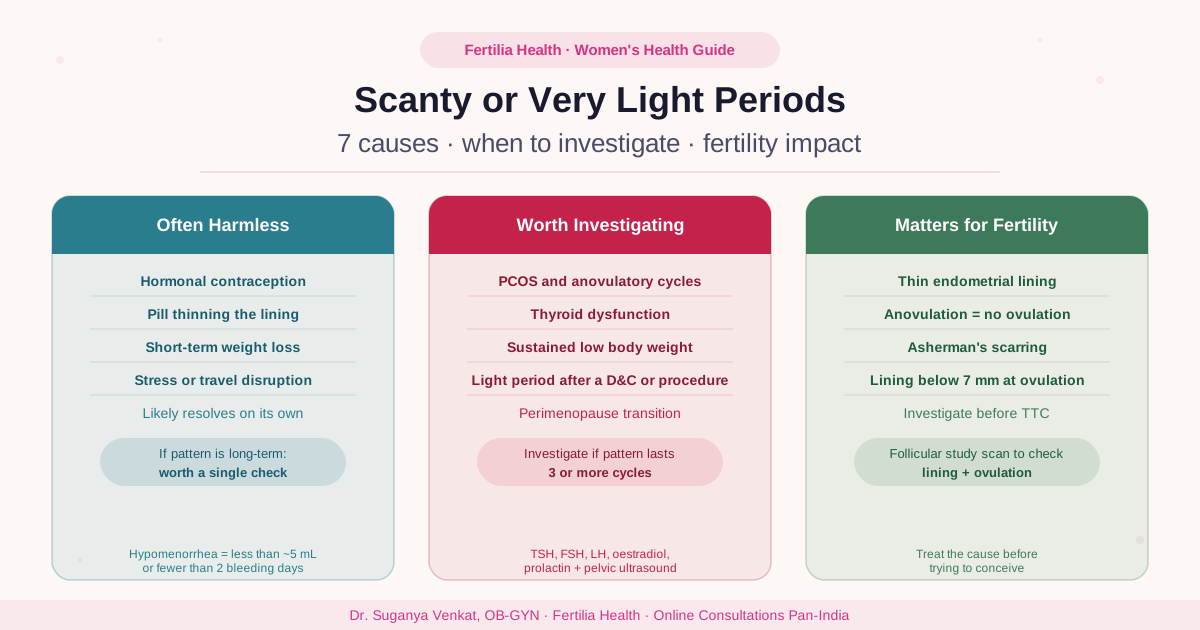
The clinical term is hypomenorrhea. It refers to period blood loss that is significantly less than your own normal baseline, or less than approximately 5 mL per cycle across all days.
In practice, most women describe it this way: the period lasts only a day or two, the pad or cup barely fills, there is almost no cramping, and by the time day two arrives the bleeding has stopped or reduced to spotting.
A note on the normal range: healthy period blood loss spans a wide range, roughly 35 to 80 mL per cycle (Hallberg et al., Acta Obstet Gynecol Scand, 1966). What matters clinically is not the absolute volume but whether your own flow has changed, and by how much.
If your periods have always been short and light, and nothing else is changing, that may simply be your baseline. If they used to be moderate and have recently become significantly lighter, that shift is the signal worth exploring.
Seven causes of scanty periods
1. Hormonal contraception
This is the most common cause, and the most straightforward.
Pills, patches, the hormonal IUD (Mirena), and the implant all thin the endometrial lining as part of how they work. When the lining is thinner, there is less tissue to shed, so the period becomes lighter or disappears entirely. This is expected and not harmful.
If you started a hormonal method and noticed lighter periods shortly after, this is the likely explanation. You do not need to do anything, and fertility is not affected long-term after stopping the method.
2. PCOS and anovulatory cycles
In PCOS, the ovaries often do not release an egg in a given cycle. Without ovulation, progesterone is not produced in the second half of the cycle. Without adequate progesterone, the endometrial lining does not build and shed the way it would in an ovulatory cycle.
The result can be either very light, irregular periods or periods that are delayed by weeks and then arrive all at once. Some months you may bleed lightly. Other months the period may not come at all.
If your light periods arrive unpredictably, skipping some months entirely, PCOS-related anovulation is worth discussing with your doctor.
3. Low body weight and restrictive eating
The hypothalamus controls the hormonal cascade that drives ovulation, and it is sensitive to energy availability. When body weight drops below a certain threshold, or when caloric intake is severely restricted, the hypothalamus quiets its hormone output to conserve resources.
This can suppress ovulation and significantly reduce period flow. Women who are underweight, who eat very little, or who exercise intensively often notice scanty or absent periods.
The mechanism is sometimes called hypothalamic amenorrhea at its more severe end. Gentle, sustained weight restoration typically reverses it over several months.
4. Thyroid dysfunction
Both an underactive thyroid (hypothyroidism) and, less commonly, an overactive thyroid (hyperthyroidism) can alter menstrual patterns. Hypothyroidism in particular has been linked to lighter periods and cycle irregularity, likely through its effects on sex hormone binding globulin and overall reproductive hormone balance (Krassas et al., Clin Endocrinol, 1999; PMID 10468932).
This is one reason thyroid function is checked early when a woman reports a change in her menstrual pattern.
For more on this, read our guide on Short Menstrual Cycles. If your thyroid and fertility picture has not been evaluated, and you are also noticing fatigue, hair thinning, or feeling cold more than usual, a TSH test is a logical starting point.
5. Thin endometrial lining
The endometrium, the inner lining of the uterus, grows during the first half of the cycle in response to oestrogen and is shed during the period. When this lining does not thicken adequately, there is less to shed, and the period is proportionally lighter.
A thin lining can result from long-term hormonal contraception, low oestrogen (as in perimenopause or hypothalamic suppression), or previous uterine procedures. The clinical threshold for concern in a fertility context is an endometrial thickness below 7 mm at the time of ovulation.
If you are trying to conceive and periods have become scanty, a baseline ultrasound to assess endometrial thickness is one of the early steps worth taking.
6. Asherman’s syndrome (intrauterine adhesions)
This is less common, but important to know about.
Asherman’s syndrome refers to scar tissue (adhesions) that forms inside the uterine cavity, often after a procedure such as a dilatation and curettage (D&C) for a miscarriage, an endometrial polyp removal, or a manual vacuum aspiration. The scarring can partially block the uterine cavity and reduce the surface area of endometrium available to shed.
The hallmark presentation is a period that was previously normal and then becomes very light or stops entirely, often after one of the procedures above. Cyclical pelvic pain with minimal bleeding, or pelvic discomfort around the time a period is expected but nothing arriving, can also be features.
Asherman’s syndrome is diagnosed by hysteroscopy and can be treated. The fertility implications depend on the extent of scarring. More on Asherman’s syndrome, its diagnosis, and fertility outcomes is covered here.
7. Perimenopause
From the mid-to-late thirties, and more commonly in the forties, oestrogen production begins to fluctuate. Cycles become less predictable. Some months the period is heavier; other months it is shorter and lighter. Anovulatory cycles (months without ovulation) become more frequent.
If you are in your forties and your periods have become unpredictably light alongside other changes (sleep disruption, mood shifts, irregular intervals), perimenopause is the likely context.
This does not mean conception is impossible in perimenopause, but it does mean the fertility picture is different. If you are trying to conceive in this stage, an assessment that includes AMH and antral follicle count gives a clearer picture of where ovarian reserve stands.
If you have noticed a change in your period and are unsure which of these fits your situation, I am happy to help you work through it. Message me on WhatsApp for a ₹399 video call and we can go through your cycle history together.
When does a light period affect fertility?
Not every scanty period is a fertility problem. The cause matters enormously.
When it does not affect fertility:
- Hormonal contraception-related light periods are not a fertility signal. They reverse when the method is stopped.
- Stress-related or travel-related light cycles that return to normal within a cycle or two.
- Mild weight changes that self-correct.
When it may affect fertility and warrants investigation:
- Light periods alongside irregular cycles, suggesting anovulation.
- A period that suddenly became light after a uterine procedure (Asherman’s risk).
- Light periods with an ultrasound showing a consistently thin endometrial lining at the time of ovulation.
- Light periods in the context of low oestrogen: low body weight, excessive exercise, or an FSH level coming back elevated.
- Scanty periods over several months without an identified cause.
A thin endometrium at ovulation can affect implantation. A fertilised egg needs adequate endometrial thickness and receptivity to implant successfully. When the lining is consistently below 7 mm at ovulation, investigating and addressing the cause is worth doing before trying to conceive, not after. What a thin endometrium means for conception is covered in more detail here.
Similarly, if anovulatory cycles are driving the light flow, ovulation induction with monitoring is often a more direct path than waiting and watching. Tracking whether you are actually ovulating with a mid-luteal progesterone test is one of the simplest first steps.
What to look for between cycles
If you are monitoring your own pattern, here are the things worth noting:
- Duration: Is the bleeding lasting less than two days?
- Volume: Are you using far fewer pads or tampons than you used to?
- History: Did this change follow a procedure, a medication, or a significant weight change?
- Accompanying symptoms: Fatigue, hair thinning, feeling cold (thyroid), or irregular intervals and acne (PCOS drivers), or cyclical pain without much bleeding (Asherman’s)?
- Cycle pattern: Is ovulation still happening? An ovulation predictor kit or a mid-cycle tracking ultrasound (follicular study) can answer this.
A cycle or two of lighter flow is not usually a reason to act immediately. A pattern over three or more months, or a sudden change after a procedure, warrants a proper look.
What your gynaecologist will check
When you see a doctor about scanty periods, the standard workup typically includes:
- A thyroid panel (TSH, and sometimes free T4)
- Hormonal profile in the early follicular phase: FSH, LH, oestradiol, prolactin
- Ultrasound to assess endometrial thickness and ovarian morphology (PCOS pattern or follicle count)
- Progesterone around day 21 (to confirm whether ovulation occurred)
If Asherman’s syndrome is suspected based on the history, a saline infusion sonography (SIS) or hysteroscopy will be recommended for a direct look inside the uterine cavity.
These investigations cover the most common causes and can usually identify the driver within one to two cycles of testing.
A note on the Indian context
Very light periods are often dismissed in clinical consultations as a non-problem, particularly compared with the attention given to heavy periods. Indian women are less likely to report them because there is a cultural tendency to see a lighter, less inconvenient period as a good thing.
It can be. Sometimes it is simply a constitutional pattern or a response to hormonal contraception.
But in the fertility context, and particularly when a woman has been trying to conceive without success, scanty periods deserve the same systematic evaluation as any other cycle irregularity.
If your period has changed and you are not sure why, investigating what is behind it is a practical next step. A pattern over three or more months, or a sudden change after a uterine procedure, gives your doctor enough to work with.
Start with a ₹399 video consultation if you would like to go through your cycle history and work out what investigations make sense for your situation.
Frequently asked questions
What is the Tamil term for scanty or light periods? Periods in Tamil are called maadhavidaai (மாதவிடாய்). Scanty or very light periods may be described in Tamil as kuraindha maadhavidaai (குறைந்த மாதவிடாய்), where “kuraindha” means reduced or insufficient. In Hindi, the same pattern is often called halka period or kam bleeding wala period. These are the terms women search for locally, and the medical term is hypomenorrhea (hypo = less, menorrhea = menstrual flow).
Is a very light period normal if I am on the pill? Yes, very commonly. Combined oral contraceptive pills thin the endometrial lining, which reduces period blood volume significantly. Many women on the pill bleed for only one to two days with very light flow. This is an expected effect of the method and is not harmful. Fertility is not affected once you stop the pill. Related: irregular periods guide.
Can a light period mean I am pregnant? Implantation bleeding is sometimes mistaken for a very light period. It typically occurs around the time a period is expected, is lighter and shorter than a normal period, and does not involve clots or cramping. If you are in a conception cycle and bleeding is unusually light, a pregnancy test on the day of expected period or two days after is the simplest way to check.
My periods became very light after a D&C for a miscarriage. Should I be worried? A significant reduction in period flow after a D&C is worth discussing with your doctor, particularly if you are planning another pregnancy. Intrauterine adhesions (Asherman’s syndrome) can form after uterine procedures and reduce the endometrial lining surface. This does not always happen, and not every light period after a D&C means adhesions, but the history makes it worth evaluating with a saline sonography or hysteroscopy. More detail here.
How light is too light if I am trying to conceive? There is no single volume threshold, but the clinical concern relates to the endometrial lining at the time of ovulation. A consistently thin lining (below 7 mm on a follicular study scan) alongside scanty periods suggests a lining that may not be receptive enough for implantation. If your periods have become lighter and conception is not happening, a baseline ultrasound in the early follicular phase and a follicular study scan near ovulation give useful information.
Can PCOS cause very light periods? Yes. In PCOS, anovulatory cycles are common. Without ovulation, progesterone is not produced after mid-cycle, so the endometrial lining does not build as it normally would. The period that follows is often lighter, shorter, or delayed compared with an ovulatory cycle. Some months may have no period at all. Managing the anovulation, rather than focusing on the flow volume alone, is the relevant clinical step. PCOS and periods explained.
Does thyroid disease cause scanty periods? Both hypothyroidism and hyperthyroidism can alter the menstrual cycle. Hypothyroidism (underactive thyroid) is more likely to cause lighter, irregular, or infrequent periods. A TSH blood test, which can be done at any time in the cycle, is the starting point. If thyroid levels are outside range and you are also trying to conceive, optimising thyroid function is a priority before conception. Thyroid and fertility: what to know.