Brown discharge before your period. You notice it in the bathroom and your first instinct is to search online. Within a few minutes you have scrolled past everything from “completely normal” to something that made your stomach drop.
I receive messages like this from women across India regularly. Here is what I tell them: in most cases, brown discharge before a period is old blood making its way out, and that is entirely normal. Blood that leaves the uterus slowly has time to oxidise, turning dark brown instead of the bright red you expect on day one. That is basic physiology, not a warning sign.
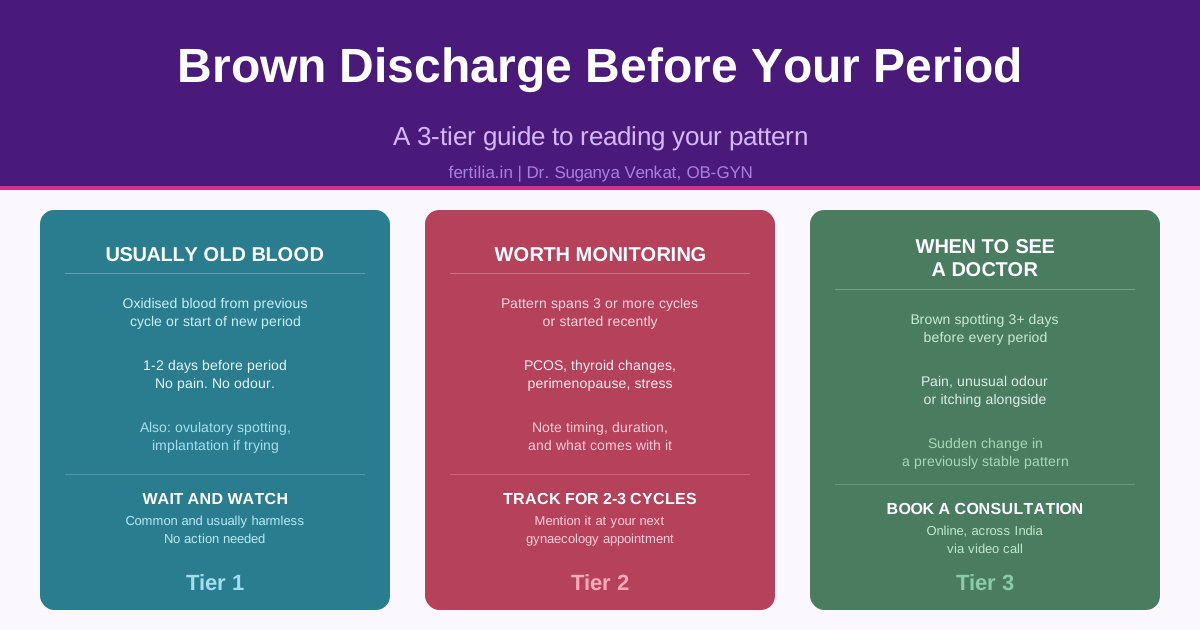
That said, “most cases” is not all cases. So this guide walks you through the three-tier framework I use to help women read this pattern calmly: what is almost certainly benign, what is worth keeping an eye on, and what genuinely warrants an appointment.
What this guide covers
We will go through what brown colour means, the three common patterns of pre-period brown discharge, a practical set of questions to read your own situation, and the implantation question for women who are trying to conceive.
Why discharge turns brown before a period
The colour comes down to how quickly blood moves.
During a period, blood exits relatively quickly and stays bright red. When blood exits slowly (whether from light spotting, remnant blood from the previous cycle, or early endometrial shedding) it has time to oxidise. Oxidised blood is brown, sometimes dark, sometimes closer to rust, depending on how long it has been sitting. This is the same process that turns a cut brown as it dries.
The shade of brown does not change the clinical picture significantly. Whether it is light tan, deep brown, or almost black, the mechanism is the same: oxidised blood leaving slowly. What matters clinically is the timing, the duration, and what comes alongside it.
If what you are seeing before your period is white or creamy rather than brown, that is a different thing entirely: leukorrhea, the normal discharge driven by your cycle hormones. We cover it in white discharge before your period.
For more on this, read our guide on Scanty or Very Light Periods.
Tier 1: Almost certainly benign
These are the patterns that, in most women, require no investigation at all.
Old blood from the previous cycle
The most common cause by far. A small amount of blood from your last period can sit in the uterus or upper vaginal canal and make its way out over the following days or at the start of your next cycle. If it is predictable, consistent, and comes without pain, odour, or other symptoms, it is your body clearing itself between cycles. Nothing more.
For more on this, read our guide on Short Menstrual Cycles.
The very start of a new period
Many women see brown spotting in the day or two before their flow turns red. This is the uterine lining beginning to shed: the lightest, oldest layer comes first, and it has already oxidised by the time it reaches outside. This is a normal part of the cycle’s opening and is not a sign of a hormone problem or lining issue.
Ovulatory spotting
Around ovulation, a brief dip in oestrogen can cause a small amount of spotting. This appears around days 12 to 16 of a typical 28-day cycle, is often pink or brown, and lasts a day or two at most. For women who are tracking their fertile window, mid-cycle spotting alongside a change in cervical mucus is actually a useful signal.
Implantation bleeding (if you are trying to conceive)
If you have been trying to conceive, brown spotting that arrives 6 to 12 days after ovulation is often called implantation bleeding. It is lighter and shorter than a period, does not progress into full flow, and is often pink or light brown. Bleeding in early pregnancy is genuinely common: about a quarter of women report some bleeding during the first trimester (Hasan R et al., Ann Epidemiol, 2010, PMID 20538195). What is less certain is the implantation label itself. When researchers used daily hormone samples to identify the actual day of implantation, bleeding rarely fell on that day (Harville EW et al., Human Reproduction, 2003, PMID 12923154). So spotting at this stage is worth mentioning to your doctor, but it is not a reliable way to tell whether implantation has happened.
The key distinction: implantation spotting is brief (typically 1 to 3 days), does not fill a pad, and comes at the right timing window. For a detailed breakdown of how to tell implantation spotting from the start of a period, including the colour, flow, and cramping differences, read our guide on implantation bleeding vs period.
Tier 2: Worth monitoring over a few cycles
These situations do not need urgent attention, but they are patterns worth noting and mentioning to your gynaecologist at your next visit.
PCOS and irregular endometrial shedding
PCOS (PMOS, the updated name following the 2026 international renaming) commonly causes anovulatory cycles, cycles where ovulation does not happen. Without ovulation, progesterone does not rise as it should, and the lining does not shed cleanly on a schedule. Instead, it may shed intermittently, producing brown spotting before what eventually becomes a period, or light brown discharge in place of a proper flow.
If you have known or suspected PCOS and you are noticing this pattern consistently, bring it up with your gynaecologist. It is useful information when managing your cycle and hormones. For more on how PCOS affects your periods, read our guide on PCOS: Symptoms, Root Causes and Treatment.
Thyroid changes
Both an underactive (hypothyroid) and an overactive (hyperthyroid) thyroid can affect menstrual regularity. Women with hypothyroidism tend to have heavier or irregular periods; those with hyperthyroidism may have lighter or infrequent ones. Brown spotting before a period can be part of this irregular pattern. If you notice other thyroid symptoms alongside spotting (persistent fatigue, unexplained weight changes, hair thinning, sensitivity to cold or heat), ask your doctor to check your TSH alongside your menstrual complaint.
Perimenopause (women in their early to mid 40s)
As ovarian reserve shifts and oestrogen levels fluctuate, cycles become less predictable. Pre-period brown spotting is common in perimenopause as the uterine lining responds differently to changing hormone levels. If you are 40 or older and noticing a new pattern in your cycle, including spotting that was not there before, mention it to your gynaecologist. This is not alarming; it is a natural transition that benefits from monitoring.
For more on how cycles change in the years leading up to menopause, read our guide on irregular periods.
Stress or significant disruption
Intense stress, sudden weight change, illness, or travel across time zones affects the hypothalamus and disrupts the hormonal cascade that drives your cycle. Pre-period spotting can be a side effect of this disruption. If this happened once around a stressful event, it is almost certainly transient. If it persists across three or more consecutive cycles, treat it as a pattern worth investigating.
For more on why a late or missed period sometimes follows stress, read Why Is My Period Late?
If you have been seeing this pattern and you are not sure what to make of it, a short conversation with a gynaecologist often provides clarity faster than weeks of self-monitoring. Dr. Suganya Venkat consults online, across India, via video call and phone.
Send a message on WhatsApp and she will get back to you personally.
Tier 3: Patterns that warrant an appointment
These are the situations where booking a consultation is the right call, not because something is necessarily serious, but because these patterns need proper evaluation.
Brown discharge lasting more than 3 days before every period, cycle after cycle
Occasional pre-period spotting is common. Brown spotting that starts 4 or more days before your flow, and does this consistently month after month, is worth investigating. In some women this reflects endometriosis, which can cause pre-menstrual brown discharge as endometrial-like tissue outside the uterus sheds in response to hormonal shifts. In others it points to fibroids or endometrial polyps that are causing irregular or prolonged lining shedding.
The clinical framework doctors use to work through abnormal uterine bleeding is the PALM-COEIN classification (Munro MG et al., Int J Gynaecol Obstet, 2011, PMID 21345435). This separates structural causes (Polyps, Adenomyosis, Leiomyoma, Malignancy) from functional ones (Coagulopathy, Ovulatory dysfunction, Endometrial causes, Iatrogenic, Not classified). Your gynaecologist will be thinking through this framework when you describe your pattern. You do not need to know the classification; you need to describe your pattern clearly.
For more on this, read our guide on Endometrial Cancer.
Brown discharge with an unusual odour or itching
Brown discharge that smells different from usual, or comes with itching or vaginal irritation, is more likely an infection than a menstrual variation. Bacterial vaginosis, for example, can produce dark or brown discharge with a distinct fishy odour. This is very treatable, but it needs a proper diagnosis. Do not self-treat with an antifungal: bacterial vaginosis does not respond to antifungal treatment.
For more on this, read our guide on Vaginal Discharge.
Brown discharge with pelvic pain outside your period window
Mild cramping just as a period begins is normal. Brown spotting accompanied by pelvic pain that occurs outside your expected period window, or pain that is persistent rather than just the usual first-day cramps, warrants evaluation. Endometriosis, pelvic inflammatory disease, and ovarian cysts can all present with a combination of pre-period discharge and pelvic pain.
A sudden change in a previously stable pattern
If your cycle has been regular for years and you suddenly develop pre-period brown spotting, or if existing spotting worsens in duration or amount, that change is worth mentioning to your gynaecologist. The body giving a different signal than usual is a reason to check in, not a reason to panic.
For more on mid-cycle and between-period spotting (as opposed to the pre-period pattern this guide covers), see our full guide on spotting between periods.
What to tell your doctor
If you decide to see a gynaecologist, the most useful thing you can bring is a simple log: the day your cycle starts, the day the brown discharge begins, how many days it lasts, whether it has any odour, and whether it comes with pain. Three months of this data gives your doctor enough to see a pattern and decide what investigation, if any, is needed.
Depending on your pattern, your doctor may arrange a pelvic examination, a transvaginal ultrasound to look at the lining and ovaries, or blood tests checking thyroid function and hormones. Most workups start with an ultrasound, which is non-invasive, quick, and gives a clear picture of the uterine lining and any structural causes.
Three questions to read your own pattern
Rather than working through a long list of conditions, these three questions help most women decide what to do next.
Is the timing predictable? If you see brown discharge the same 1 to 2 days before every period, in roughly the same amount, it is almost certainly old blood and does not need investigation. Predictable and stable is reassuring.
Does it come with anything else? Pain, odour, unusual colour (green, grey, yellow), itching, or discharge that is thick alongside the brown are the signals that shift this from “wait and watch” to “see a doctor soon.”
Has anything changed recently? If this is new after years of a regular cycle, or if it coincides with a change in contraception, a period of significant stress, or other cycle changes, that context helps your doctor narrow down the cause quickly.
Practical takeaways
- Brown colour means oxidised blood, not fresh bleeding. On its own it is almost always benign.
- One to two days of brown spotting before your period is a common, normal variation.
- If you are trying to conceive and this appears 6 to 12 days after ovulation, take a pregnancy test. It may be implantation.
- Consistent brown spotting lasting more than 3 days before every period, or spotting that comes with pain or odour, is worth an appointment.
- Track your pattern for 2 to 3 cycles before deciding what to do: a one-off is usually nothing; a pattern tells you something.
Frequently asked questions
Is brown discharge before my period normal?
Yes, in most cases. Brown discharge 1 to 2 days before a period is old blood from the previous cycle or the very start of your new period’s lightest layer. As long as it is brief, odourless, and not accompanied by pain, it is a normal variation. Consistent spotting lasting more than 3 days before every period is worth discussing with a gynaecologist.
Can brown discharge before my period mean I am pregnant?
It can, if you are trying to conceive and the timing fits. Implantation spotting typically appears 6 to 12 days after ovulation, is lighter and shorter than a period, and lasts 1 to 3 days. If you think this might be implantation, wait 12 to 14 days after ovulation and take a pregnancy test. A test taken too early, before the embryo has produced enough hCG, may give a false negative result.
For more on this, read our guide on Missed Period, Negative Pregnancy Test.
I had brown discharge instead of a period. Should I worry?
Not necessarily, but it is worth paying attention to. Brown discharge in place of your expected flow could be an unusually light period where the blood oxidised before exiting, a sign of an anovulatory cycle (one where ovulation did not happen), or early pregnancy. If a pregnancy test is negative and this has happened more than once, mention it to your gynaecologist. For more, see our guide on why a period comes late or doesn’t come.
How long before my period is brown discharge considered normal?
One to two days before your period is very common and generally harmless. If the brown discharge starts 3 or more days before your flow, or if this pattern has continued across several cycles, it is worth mentioning at your next gynaecology appointment. It is not an emergency, but it is information your doctor should have.
Can brown discharge before my period be related to PCOS?
Yes. PCOS can cause anovulatory cycles, where ovulation does not occur and the lining does not shed cleanly. This can lead to irregular or prolonged brown spotting before what eventually becomes a period. If you have known or suspected PCOS and you are seeing this pattern consistently, bring it up with your doctor. It is useful information when managing your hormones and cycle.
Period se pehle brown discharge kya hota hai?
Period se pehle brown discharge zyaadatar purana khoon hota hai jo uterus se dheere dheere nikalta hai. Jab khoon dheere nikalta hai, toh hawa mein oxidise hokar brown rang ka ho jaata hai. Zyaadatar yeh bilkul normal hota hai, khaaskar jab yeh sirf 1 se 2 din pehle aata ho aur koi dard ya badbu ke saath nahi aata. Agar yeh 3 din se zyaada rahe ya har cycle mein aata ho, toh apni gynaecologist se zaroor baat karein.
What is the Tamil term for pre-period brown discharge?
In Tamil, the period is called “maadhavidaay” (மாதவிடாய்) and vaginal discharge is “vellaipaduthal” (வெள்ளைப்படுதல்), also heard as “vellaipaadu” or “vettai”. Pre-period brown spotting is usually searched as “maadhavidaaikku mun vellaipaduthal” (discharge before the period). If you are searching for this in Tamil and found this guide, the reassurance is the same: 1 to 2 days of brown spotting before your period is common and usually harmless. Consistent or painful spotting should be discussed with a gynaecologist.
If you have been noticing brown discharge before your period and you want a clear answer on whether your pattern needs attention, Dr. Suganya Venkat consults across India online via video call and phone.
Message Dr. Suganya on WhatsApp for a ₹399 consultation. No waiting room, no commute.