A woman came to me recently. She was 37, her cycles were regular, her thyroid was fine, she had had one pregnancy years ago that ended in an early loss. Her AMH came back at 1.2 ng/mL. Her husband’s semen analysis was normal. Three weeks after her first appointment at a fertility chain, she had been told she needed IVF and should not delay.
She wanted to know whether that was true.
This is one of the most common questions I hear from women in their mid to late 30s. Not “what is my AMH” or “how do I track ovulation” but this specific, anxious question: do I actually need IVF, or can I still try naturally?
The answer is not the same for every woman at 35 or 37 or 39. It depends on five factors, not one. Age is one of them. It is not the only one.
This post lays out what the data says, what the five factors are, when IVF is genuinely the right next step, and when natural conception is still a reasonable first path.
What the Numbers Say About Natural Conception After 35
The fertility statistics you see online tend to come from one of two places: either very old research done on French church records in the 1700s, or modern IVF success tables. Neither tells you much about what happens when a healthy couple tries naturally today.
More useful is data from studies on actual couples trying to conceive in the modern era.
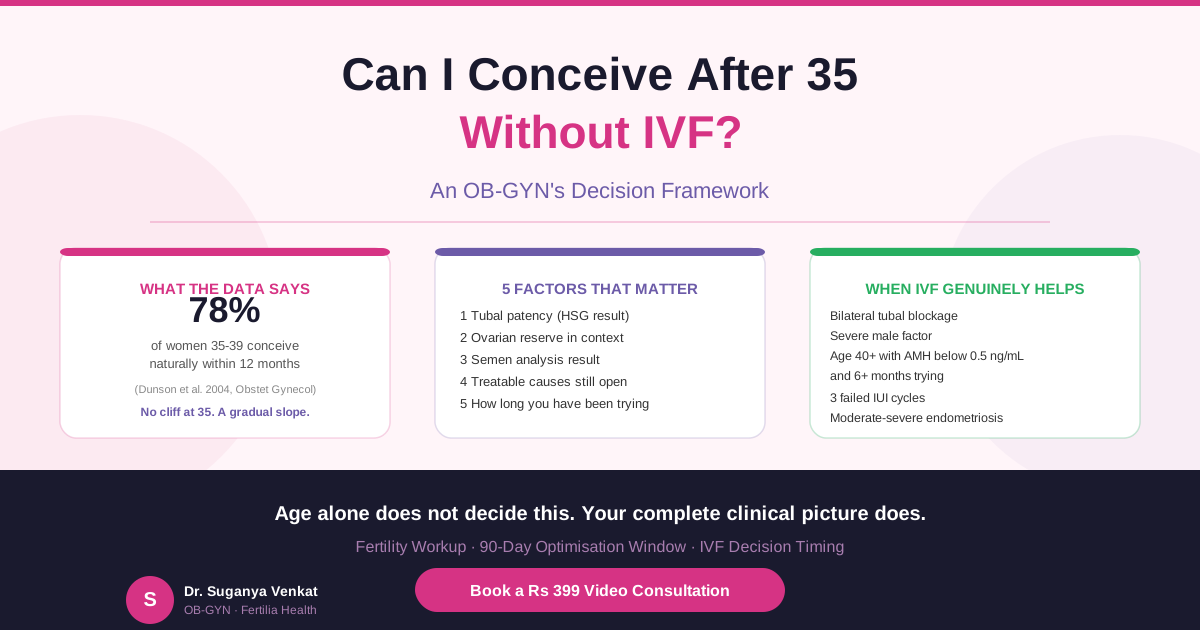
Dunson et al. (2004, Obstet Gynecol 103:51-56, PMID 14704244) followed 782 couples trying naturally and found that over a 12-month period:
- About 18% of women aged 35 to 39 had not conceived within 12 cycles, which is to say roughly 82% did conceive.
- For comparison, that figure was around 8% not conceiving at ages 19 to 26, and 13 to 14% at ages 27 to 34.
- The study recruited women up to age 40, so it does not give a figure for the early forties. Anyone quoting one from this paper is quoting something that is not in it.
For context: women aged 19 to 26 in the same dataset had a 12-month conception probability of around 92%.
The decline is real. It is also gradual. There is no biological cliff at 35, or at 38, or at 40. The change happens as a continuous slope. What the data shows is a meaningful difference between the early 30s and the early 40s, but not an urgent emergency at any single age.
The same data also shows that most women 35-39 who are trying naturally, with no major structural finding, will conceive within 12 to 18 months. The IVF argument at 37 with a regular cycle and normal semen analysis is not always backed by what the numbers actually say.
For more on this, read our guide on Can I Conceive with Endometriosis Without IVF?. For a fuller breakdown of fertility statistics by age and what they mean, the existing fertility after 35 guide covers the epidemiology in detail. What this post adds is the clinical decision layer: given your specific numbers and history, which path makes sense.
The 5 Factors That Determine Your Path
Age is a factor. It is not the only factor. What an OB-GYN is actually weighing when deciding between natural conception, IUI, and IVF is the combination of five things.
1. Tubal Patency
If both fallopian tubes are blocked, natural conception cannot happen. The egg and sperm cannot meet without a patent tube. In this case, IVF is not a recommendation based on age. It is the only biological path.
An HSG or diagnostic laparoscopy can clarify tubal status. If your workup has not included an HSG, that information gap matters before making a decision about IVF.
If one tube is open, natural conception remains possible. A blocked single tube reduces the probability but does not eliminate it. The guide on conceiving with one blocked tube covers this specifically.
2. Ovarian Reserve in Context
AMH and antral follicle count tell you how many eggs remain in your reserve. They do not tell you whether those eggs will fertilise, develop, or implant. As Steiner et al. (2017, JAMA, PMID 29049585) showed in a well-designed study, among women aged 30-44 with no known fertility issues, a low AMH did not predict a lower probability of natural conception compared to women with a normal AMH.
This is important. AMH below 1.0 ng/mL does not by itself mean IVF is necessary. What AMH tells you is how many eggs you are likely to produce if you were to do IVF (and therefore, how many cycles you might have available before reserve declines further). That matters for planning. It does not mean natural conception is off the table.
What changes the calculation is AMH very low (below 0.3 ng/mL), combined with age above 38, combined with months of trying without success. That combination shifts the calculus toward IVF because the window for natural conception is genuinely narrower.
3. Semen Analysis
Male factor accounts for 40 to 50% of infertility cases, according to the WHO 2021 estimates. An untreated male factor means that even if everything else is optimal for the woman, the conception probability per cycle is significantly lower.
If the semen analysis shows very low total motile sperm count (below about 5 million), IUI becomes less effective and IVF with ICSI moves to the front of the conversation. If semen parameters are borderline but not severely low, IUI is often a reasonable middle step before committing to IVF. If the analysis is normal, male factor is not driving the picture.
4. Treatable Root Causes Still Unaddressed
Before IVF, it is worth asking whether any correctable problem has been found and treated. Common ones in women 35-40:
- Thyroid function outside the fertility-optimum range (TSH above 2.5 mIU/L for TTC)
- Subclinical Vitamin D deficiency (shown in Lerchbaum and Obermayer-Pietsch 2012, EJENDO, PMID 22275473 to be associated with lower IVF success; also relevant for natural conception quality)
- Luteal phase deficiency from progesterone production issues
- Endometrial lining concerns (PCOS, anovulation, or thin lining from a structural issue)
- Mild PCOS with anovulatory cycles making it impossible to conceive without ovulation induction
Each of these is correctable before escalating to IVF. Escalating without addressing them means potentially doing IVF when the actual problem was something simpler.
5. How Long You Have Been Trying
Time matters partly because of biology and partly because of planning. The standard definition of infertility is 12 months of regular unprotected intercourse without conception, reduced to 6 months for women 35 and over. After that threshold, investigation and intervention are warranted.
What I see fairly often, though, is women being recommended IVF after 3 to 4 months of trying at age 37, when the workup is incomplete and no treatable cause has been addressed. That is early to commit to a procedure costing Rs 1.5 to 3.5 lakhs per cycle when the cause has not been established.
If you are 37 with a 4-month history of trying, a normal HSG, a TSH of 2.1, an AMH of 1.4, and a normal semen analysis, the data does not support going straight to IVF. What it supports is optimising the conditions over 90 days and reassessing.
When IVF Is Genuinely the Right Answer
There is a short honest list of situations where IVF is not just an option but the clinically appropriate next step, regardless of what natural approaches you have tried.
Bilateral tubal blockage. No tube, no natural conception. IVF is the path.
Severe male factor. Total motile sperm count consistently below 1 to 2 million, or other severe parameters (zero sperm in the ejaculate). IVF with ICSI is the appropriate treatment.
Age 40 and above with AMH below 0.5 ng/mL, and more than 6 months of trying. The window for natural conception is genuinely narrow. IVF with your own eggs gives you a real chance in a compressed timeframe; waiting risks running out of the window.
Three failed IUI cycles. After three well-timed IUI cycles with no success, escalating to IVF is evidence-based. Continuing with more IUI beyond that point has diminishing returns.
Moderate to severe endometriosis with structural involvement. Endometriosis that affects the tubes or ovaries significantly changes the conception environment in ways that lifestyle optimisation cannot address. Surgical assessment and, often, IVF is appropriate.
Previous IVF with evidence of poor fertilisation or repeated embryo failure. In this case, you are not choosing between natural and IVF; you are inside an IVF process and trying to understand why it has not worked.
When Natural Conception Is Still a Reasonable First Step
If you are 35 to 38, with patent tubes, a semen analysis in the normal range, and a cycle that ovulates (even if not perfectly), and if you have been trying for less than 6 to 8 months, natural conception is not a route to rule out.
The same applies if:
- Your workup is incomplete (no HSG, no semen analysis, no Day-3 hormone panel)
- Correctable causes have been identified but not yet treated
- You have been trying for 6 months or less at 35 to 37, with nothing abnormal yet found
- AMH is low but not extremely low, without other compounding factors
In these situations, what a 90-day optimisation phase addresses is egg quality, the hormonal environment, ovulation regularity, and the uterine lining. These are not guarantees. They are conditions that can genuinely improve the probability of natural conception or improve the outcome if IVF is eventually pursued.
The steps in a 90-day optimisation phase are evidence-based and include cycle regularity, thyroid and Vitamin D correction where indicated, CoQ10 ubiquinol for mitochondrial support in egg quality (Showell 2020 Cochrane, PMID 32851663), and dietary changes that reduce inflammation and support hormonal balance. Ragi, rajma, palak, dahi, amla, haldi, and methi are a practical Indian plate for this phase.
If You Do Need IVF Eventually, Optimisation Still Matters
One thing worth understanding: if you do eventually go to IVF, the same factors that support natural conception also improve IVF outcomes. Egg quality, thyroid function, Vitamin D status, and the hormonal environment at the time of stimulation all affect IVF cycle outcomes.
This means the 90-day phase is not wasted time if IVF ends up being the path. It is preparation. The conversation with your treating doctor about IVF timing can continue in parallel with that preparation, not instead of it.
If you are 37 and starting to think about this, the workup and a short optimisation window are genuinely compatible with a well-timed IVF decision 3 to 4 months later if that is what the clinical picture calls for.
Talking to Your Doctor About This
The goal is not to argue with your doctor. The goal is to understand what specific finding is driving the IVF recommendation, and whether natural conception or a simpler intervention has been reasonably excluded first.
Questions that help:
- Is the IVF recommendation based on a specific finding (tubal blockage, severe male factor, failed IUI) or primarily on age?
- Has the full workup been completed, including HSG and semen analysis?
- Are there any correctable causes that have not yet been treated?
- What would a 90-day optimisation window involve, and is that reasonable given my specific picture?
A good fertility doctor will be able to answer these specifically. If the answer is “your AMH is 1.1 and you’re 37, so you should start IVF next cycle,” that is worth a second opinion before committing.
Book a ₹399 video consultation with Dr. Suganya to review your workup and decide what the right next step actually is for your specific numbers.
FAQ
Is it normal to conceive naturally at 37 or 38?
Yes. Research from Dunson et al. (2004) shows that roughly 82% of women aged 35-39 conceive within 12 cycles of trying, assuming no major structural finding. Being 37 or 38 does not make natural conception unusual. It becomes less common as you approach 40 and move through your early 40s, but it is not rare in the late 30s.
My AMH is low. Does that mean I need IVF?
Not by itself. A landmark 2017 JAMA study (Steiner et al.) found that among women aged 30-44 without known fertility problems, a low AMH did not predict a lower probability of natural conception. AMH tells you about ovarian reserve, not egg quality or fertilisation potential. What matters for the IVF decision is AMH in combination with age, how long you have been trying, what your workup has shown, and whether there are treatable causes still unaddressed. See the full guide on low AMH and natural conception for more.
I’m 40. Is IVF the only option?
No, but the calculus changes significantly at 40, especially if AMH is below 0.5 ng/mL and you have been trying for 6 or more months without success. At 40, the egg quality decline is steeper and the window for natural conception is genuinely narrower. A clear workup, followed by a short but targeted optimisation phase and a frank conversation with your doctor about IVF timing, is a reasonable approach. IVF is often indicated earlier at 40 than at 37, but it is still worth knowing what is specifically driving the recommendation.
What does a 90-day optimisation phase involve?
It depends on your workup findings. Generally it includes correcting thyroid and Vitamin D levels where needed, supporting egg quality with CoQ10 ubiquinol and a nutrient-dense diet (leafy greens, legumes like rajma and chana, Indian millets, dahi, amla), regulating the cycle if anovulatory, and addressing any lifestyle factors affecting reproductive function (sleep, stress, insulin regulation in PCOS). It is not a substitute for medical care. It runs alongside investigation and, where needed, alongside preparation for IVF.
Does the workup need to happen before deciding on IVF?
Yes, ideally. A complete fertility workup includes an HSG (to check tubal patency), a semen analysis (male factor accounts for 40-50% of infertility), a Day-3 hormone panel (FSH, LH, estradiol), AMH, thyroid function, and an antral follicle count on ultrasound. If an IVF recommendation comes before these are all done, ask what specific finding is driving it. The honest fertility workup guide explains what each test tells you.
Can irregular cycles affect natural conception after 35?
Yes. If you are not ovulating regularly, the number of conception opportunities per year is reduced, and the timeline matters more when you are 35 or older. Irregular cycles, particularly in PCOS, need ovulation induction as part of the treatment plan. This can be done with medication rather than IVF in most cases where tubes are open and sperm parameters are reasonable. See the guide on PCOS and pregnancy for the full pathway.
I’ve had one miscarriage and I’m 36. Does that change the picture?
One miscarriage at 36 does not change the fundamental fertility picture. Miscarriage risk does increase with age (approximately 20-25% at 35-40 vs 10-15% at 25-30, per ACOG estimates), but one loss at 36 is not an indication for IVF by itself. If you have had two or more losses, investigation is warranted. See the recurrent miscarriage guide for what tests to get after two losses.
The decision about IVF is not one size fits all, and it is not primarily determined by age. Five factors together tell the clinical story. If you are 35 to 39 with regular cycles, a complete workup showing nothing definitive, and correctable causes still being addressed, natural conception is a reasonable first path. If you are 40 with low reserve and 6 months of trying behind you, the conversation shifts.
Knowing where your specific picture falls in that range is what an honest, complete fertility assessment gives you.
Talk to Dr. Suganya about your specific numbers in a ₹399 video consultation. She can review your workup, identify what is still needed, and help you understand what the right next step actually is. If a structured, supervised attempt is the right path for your picture, that is what the 90-day Fertility program is built to support.