Every fertility journey is different. Some journeys bring the joy of a positive pregnancy test. Some bring the happiness of a long-awaited period. Some bring a natural conception after years of trying. And some journeys take unexpected turns.
At Fertilia, we believe it is important to talk about all of it, not just the celebrations. Alongside the beautiful milestones we celebrate, we have also witnessed difficult moments (setbacks, uncertainties and pregnancy losses) in some of the journeys we have been a part of. Miscarriage is more common than many people realise, with estimates suggesting that around 15 to 30% of pregnancies may end in miscarriage, depending on how pregnancy and pregnancy loss are defined. Yet despite how common it can be, it is still surrounded by silence, stigma and, often, an enormous amount of self-blame.
A woman may start questioning herself and replaying everything she did, wondering, “Was it because I climbed the stairs? Did I eat something wrong? Did I walk too fast? Was it because I travelled or rode my scooty? Did I sleep late? Did I do something that caused this?” Slowly, the loss can turn into self-blame, overthinking, anxiety and a feeling that her own body has failed her. But these are moments that need compassion, understanding and the right support, not guilt.
And after a loss, a woman is often left with so many unanswered questions: “Will I be able to conceive again? If I do conceive, will it happen again? What should I do differently this time? What should I change in my body, my diet or my lifestyle?” The uncertainty can make even everyday decisions feel overwhelming. Every food, every activity, every late night, every journey can suddenly become something she questions, wondering whether she could have done something differently.
This is where we at Fertilia have walked alongside these women. Not just through the celebrations, but through these uncertain and heartbreaking chapters too, supporting them through their questions and fears, helping them understand what is within their control, and helping them find their way forward, one step at a time.
Because fertility care is not only about celebrating a positive pregnancy test. It is also about being there when the journey becomes uncertain, when fear takes over, and when a woman doesn’t know what step to take next.
We cannot control every outcome, and we cannot promise that every journey will be easy. But we can choose to walk alongside women through every phase of it: the hope, the waiting, the uncertainty, the setbacks, the healing and the courage to begin again. Because when we look at the whole journey, we also see something else. Progress. Resilience. And hope.
Sowmya and Naveen: Progress Beyond the IVF Outcome
When Sowmya and Naveen joined Fertilia, they were preparing for IVF while managing several health challenges. Sowmya had long-standing PCOS, irregular cycles and significant weight gain, while Naveen was managing diabetes and other metabolic concerns.
Instead of rushing into treatment, they first focused on building a healthier foundation. With consistent nutrition, movement and lifestyle changes, Sowmya went from 118 kg to 99 kg, while Naveen went from 109 kg to 94 kg. Along the way, they also developed healthier routines and made meaningful changes to their lifestyle.
They then moved forward with their first IVF journey. Although it did not bring the outcome they had hoped for, Sowmya understandably went through a difficult emotional phase. She felt low, had to process the disappointment and, like many women going through a setback, had moments where it became difficult to think about what to do next.
Recovery: where she is today. Slowly, she began finding her way back. Instead of allowing the setback to make her stop, Sowmya started reconnecting with herself, her routines and the progress she had already made. She got back into her routine, began focusing on her health again and has been making good progress with her weight loss and overall lifestyle changes.
With continued support and guidance at Fertilia, she is slowly finding her rhythm again and figuring out her next steps. Their journey reminds us that a setback does not erase the progress that came before it. Sometimes, the journey takes an unexpected turn, and recovery means finding your way back, rebuilding your confidence and continuing forward.
Why Do Miscarriages Happen?
This is one of the most important questions women ask after a pregnancy loss: “Why did this happen to me?” And unfortunately, there isn’t always one clear answer.
In early pregnancy, chromosomal abnormalities in the developing embryo are a major cause of miscarriage. These can occur randomly during the formation of the egg or sperm or during the early stages of cell division, and they can happen even when both parents are otherwise healthy. The risk of chromosomal abnormalities and miscarriage also increases with maternal age.
Other factors can also contribute, including certain uterine or cervical problems, hormonal or endocrine conditions, poorly controlled diabetes, infections, autoimmune conditions and other medical factors. In some cases, more than one factor may be involved, and in many cases, even after evaluation, the exact reason for a particular miscarriage cannot be identified.
And this is something we particularly want women to understand: a miscarriage is not usually caused by something as simple as climbing stairs, taking a normal walk, travelling, riding a two-wheeler, sleeping late on one occasion, or eating one particular food. The WHO notes that the difficulty in identifying a precise cause can leave women feeling that they caused the loss, adding unnecessary guilt to an already painful experience (WHO, Why we need to talk about losing a baby, who.int).
So when a woman finds herself asking, “What did I do wrong?”, the most honest answer is often: you may not have done anything wrong. Understanding this does not take away the pain of the loss, but it can help take away some of the blame. And when there have been repeated pregnancy losses, that is different: it warrants a proper medical evaluation to look for potentially treatable causes rather than assuming that the woman simply needs to “try harder” or change her lifestyle. For what those investigations look like, see our guide on tests to consider after two or more losses.
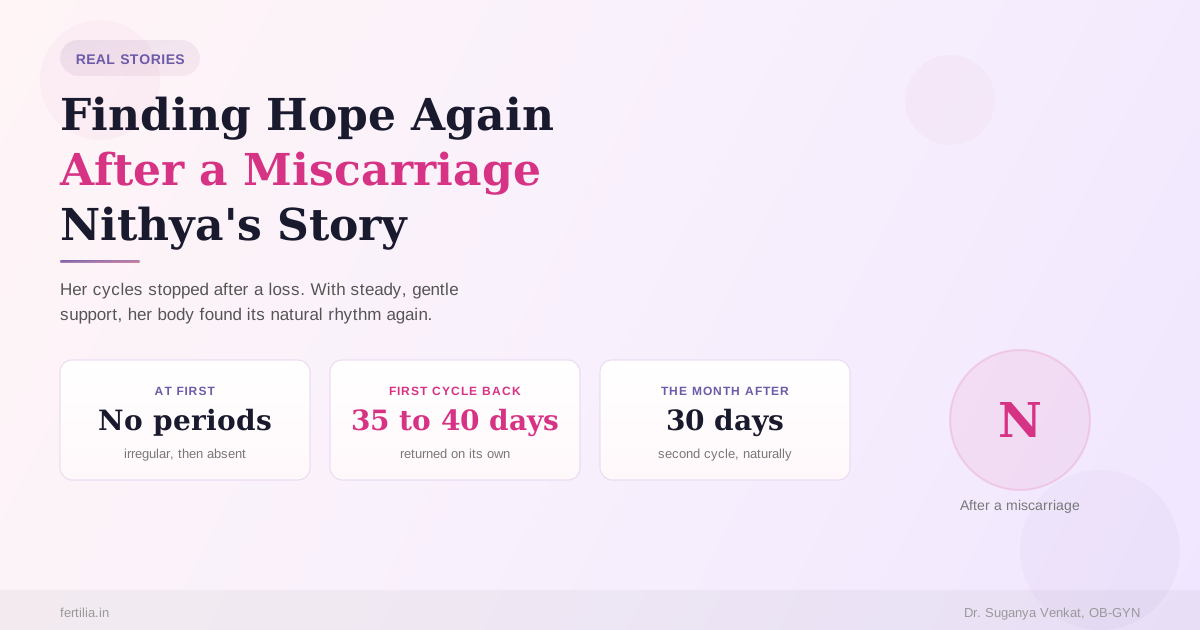
Deepika: From Waiting Years for a Period to Natural Conception
Deepika, 30, had been living with PCOS for nearly 7 to 8 years. For around five years, she rarely experienced a natural period without medication. Her cycles were unpredictable, and she was unsure even of when she was ovulating.
After joining Fertilia, something she had been waiting years to experience finally happened: Deepika got her period naturally. And then came another beautiful milestone: she conceived naturally. Although the pregnancy sadly did not progress and a heartbeat was not detected, her journey had already shown remarkable progress, from years of waiting for a natural period to experiencing a natural cycle and then a natural conception.
The loss was painful, but it did not erase how far she had come. Sometimes, hope begins with one small change that once felt impossible.
Recovery. With time, Deepika began to understand her body better and realised that sometimes the body needs time, patience and a sense of calm to find its rhythm again. Instead of allowing the setback to define her journey, she slowly began rebuilding her routine and giving herself the space she needed. She shared that she had started feeling grateful even for the small things in life and was learning to look at things differently rather than allowing every setback to pull her down. Her journey is not about pretending that the loss wasn’t painful. It is about learning to move through the pain without losing hope, reconnecting with herself and finding a little more clarity about what comes next.
What Can and Cannot Be Controlled?
After a miscarriage, it is very natural to look back and search for a reason. “Did I do something wrong? Could I have prevented this?” But this is where it is important to separate what we can influence from what we simply cannot control.
Many early miscarriages happen because of chromosomal abnormalities in the developing pregnancy, often arising randomly during the formation of the embryo. In many cases, there is nothing the woman could have done to prevent it. Even after medical evaluation, the exact cause of an individual miscarriage may remain unknown.
At the same time, there are things that are within our control: managing existing health conditions, taking prescribed medications appropriately, attending medical appointments, following recommended nutritional and lifestyle guidance, avoiding smoking and alcohol, and preparing the body as well as possible for a future pregnancy. These steps can support overall reproductive health, but they cannot guarantee that a miscarriage will not happen.
And then there are the everyday things women often blame themselves for. Climbing stairs, normal walking, routine physical activity or simply going about everyday life are not things a woman should automatically blame herself for after a miscarriage. For uncomplicated pregnancies, concerns that regular physical activity causes miscarriage have not been substantiated, and appropriate exercise is considered safe (ACOG, Physical Activity and Exercise During Pregnancy and the Postpartum Period, Committee Opinion No. 804, 2020, acog.org).
So perhaps the most important distinction is this:
- We can control the care we give our body.
- We can control the health conditions we work on.
- We can control the support we seek.
- But we cannot control every outcome of a pregnancy.
Understanding that difference can help take away some of the unnecessary guilt that women carry after a loss. Taking care of yourself is within your control. Blaming yourself for an outcome you could not control is not.
💬 Carrying questions or guilt after a loss? You don’t have to sort through them alone. Talk to Dr. Suganya Venkat on WhatsApp for an online consultation, available pan-India.
Gayathri: From Vaginismus and IUI Attempts to Natural Conception
Gayathri joined Fertilia after facing the challenges of vaginismus and multiple IUI attempts. With personalised nutrition, correction of nutritional deficiencies, thyroid optimisation, physical activity and guidance around her fertile window, she worked towards building a stronger foundation.
Within a month of joining, she conceived naturally. After everything she had been through, that positive pregnancy test was a beautiful moment of hope. Unfortunately, she later experienced mild bleeding and the pregnancy ended in a miscarriage. The loss was heartbreaking, but it did not erase the progress she had made. Sometimes, progress is not about how the story ends, but about how far we have come.
Recovery. Today, Gayathri has slowly found her confidence again. She has chosen to move forward with strength and a renewed sense of hope, rather than allowing the loss to define her journey. What makes her story even more meaningful is the way she now wants to encourage other women who are going through vaginismus and similar struggles. Having experienced the fear, uncertainty and challenges herself, she wants other women to know that they are not alone and that there can be a way forward with the right support, patience and care.
Miscarriage and Self-Blame: The Importance of Partner Support
After a miscarriage, a woman may be carrying much more than grief. She may be questioning her body, replaying everything that happened and wondering whether she could have prevented the loss. This is where the support of a partner can make a meaningful difference.
A partner does not need to have the perfect words or find an immediate solution. Sometimes, simply listening without trying to minimise the loss is what she needs most. Saying “I’m here with you,” “You don’t have to go through this alone,” or simply allowing her to talk about what she is feeling can be more comforting than trying to explain why it happened.
It is also important to recognise that partners may grieve differently. One person may want to talk constantly, while the other may become quiet or focus on practical things. Neither response necessarily means that one person is hurting less. Each parent can experience grief differently, and talking with a partner or another trusted person can be an important source of support (ACOG, Early Pregnancy Loss, Practice Bulletin No. 200, 2018; patient FAQ, acog.org).
For the woman, one of the most important forms of support can be helping her step away from self-blame. If she starts saying, “Maybe I shouldn’t have climbed those stairs,” “Maybe I shouldn’t have travelled,” or “Maybe it was something I ate,” the response shouldn’t be to investigate every action she took. Instead, she needs reassurance that she does not have to carry the loss as something she caused.
Partners can also support her in more practical ways: accompanying her to medical appointments, helping her remember questions for the doctor, taking care of meals or household responsibilities, and giving her the space to rest and grieve. Emotional support and appropriate follow-up after pregnancy loss, including counselling or support groups when needed, are also recommended (ACOG, Early Pregnancy Loss, patient FAQ, acog.org). The partner’s emotions matter too. This is a loss for both people, and supporting each other means creating space for both to process it without comparing whose pain is greater.
Most importantly, she should not feel that she has to become “strong” immediately. Grief does not follow a fixed timeline. What she needs from her partner is patience, presence and reassurance, especially during the days when the fear of trying again becomes overwhelming. For more on processing this together, read our guide on coping with grief after pregnancy loss.
Rekha: A Journey of Hope Through Every Setback
Rekha joined Fertilia after five years of marriage, multiple investigations, two unsuccessful IUI attempts and being advised to consider IVF. With PCOS, high AMH and unexplained infertility, her journey had already involved years of uncertainty and waiting.
With personalised nutrition and lifestyle changes, she worked on improving her health and fertility. Eventually, she conceived naturally. Sadly, her hCG levels did not rise as expected, and she had to undergo a D&C. She later went through another IUI and conceived, but sadly that pregnancy was also unsuccessful. Then, unexpectedly, she conceived naturally once again. This time, the gestational sac was not seen, and she experienced another pregnancy loss.
Her journey has had many unexpected turns, but through each one, she has continued moving forward. Sometimes, resilience is simply choosing to hope again.
Recovery. Rekha’s journey has had more than its share of disappointments, but she has never allowed those setbacks to completely stop her. She has continued to take the guidance given to her and, slowly, has started finding her way back to her routine. Rather than trying to change everything at once, she is focusing on the small things she can do consistently: staying mindful of her diet, getting back to her walking routine and making small improvements to her everyday lifestyle. There are still ups and downs, but what stands out is her willingness to keep showing up for herself. Her story reminds us that resilience doesn’t always look like being strong every day. Sometimes, it simply means getting back to your routine after a difficult day and choosing to continue.
When Can You Try Again After a Miscarriage?
One of the questions women often have after a miscarriage is, “When can I try again?” And there isn’t one fixed waiting period that applies to everyone. Fertility can return surprisingly quickly after an early miscarriage: ovulation may occur as early as around two weeks after the loss, even before the next period.
For an uncomplicated early miscarriage, the decision about when to try again is usually based on physical recovery, emotional readiness and medical circumstances, rather than simply waiting for a specific number of months. It is important that the miscarriage has been appropriately managed and that there are no ongoing complications such as significant bleeding or infection. If a woman has undergone a procedure such as a D&C, had a later pregnancy loss, or has experienced recurrent losses, her doctor may recommend an individualised plan before trying again.
There is also an important emotional side to this. Being physically ready does not necessarily mean being emotionally ready. One woman may feel ready to try again relatively soon, while another may need more time to process the loss. Both are completely valid.
Reassuringly, most women who experience an early pregnancy loss go on to have a healthy pregnancy, and planning a future pregnancy is a good opportunity to review any existing health conditions, medications and nutritional status with your healthcare provider (ACOG, Early Pregnancy Loss, patient FAQ, acog.org). For a fuller answer, see our guide on how soon you can conceive after a miscarriage.
Progress Is Not Always a Straight Line
These stories are not about celebrating loss. They are about recognising the progress that existed alongside the pain:
- A returning period after years of waiting.
- A healthier body after years of struggle.
- A natural conception after repeated treatments.
- The courage to try again after disappointment.
- The strength to keep moving forward when the journey takes an unexpected turn.
Sometimes, we become so focused on the destination that we forget to notice how far we have already come. Every one of these moments matters. We cannot promise that every fertility journey will be easy, and we will never minimise the pain of a pregnancy loss. But we can remind every woman of this: a difficult chapter does not erase the progress you have made. Your journey may take an unexpected turn. You may need to pause, heal, regroup and begin again. But you are not back at the beginning. There is always hope, and sometimes the next step is where a new chapter begins.
What Support Does a Woman Need After a Miscarriage?
After a miscarriage, physical recovery may happen relatively quickly, but emotional recovery can take much longer. A woman may experience sadness, anxiety, anger, guilt, fear or even feel emotionally numb, and there is no single “right” way to grieve.
What she often needs first is space to grieve without being rushed to “move on.” Instead of saying things like “Everything happens for a reason” or “At least you can try again,” sometimes the most supportive thing is simply acknowledging the loss, listening and allowing her to express what she is feeling. Empathy, sensitivity and giving women space to talk are specifically highlighted as important after pregnancy loss (WHO, Why we need to talk about losing a baby, who.int).
She also needs reassurance without false promises. Many women immediately start blaming themselves or questioning whether something they ate, did or failed to do caused the miscarriage. In most cases, miscarriage is not caused by something the woman did or did not do. Helping her understand this can be an important part of reducing unnecessary guilt.
There is also a need for appropriate medical follow-up. Depending on how the miscarriage was managed, a woman may need review with her obstetrician, review of any relevant investigations, and guidance about physical recovery and future pregnancy planning. If she is experiencing persistent anxiety, depression, difficulty functioning or overwhelming grief, professional mental-health support can also be extremely valuable.
And perhaps most importantly, she needs support when she begins thinking about the future. The next pregnancy can bring hope, but it can also bring fear: “What if it happens again?” That fear is real, and getting pregnant again does not automatically erase the grief from the previous loss. Having appropriate medical guidance, emotional support and someone who can walk alongside her through the uncertainty can make that next chapter feel less overwhelming.
This is the kind of care Dr. Suganya Venkat, an OB-GYN with over 15 years of experience, and the Fertilia team try to offer women through every phase of their journey, over online consultations available pan-India. We listen, understand where a woman is emotionally and physically, and provide individualised guidance based on what she is going through at that particular stage. Whether it is getting back to a healthy routine, improving nutrition, becoming consistent with movement, or simply helping her regain confidence after a difficult phase, we walk alongside her. Our goal is not to tell every woman that her journey will be easy. It is to make sure that when the journey becomes difficult, she has the right support, guidance and care to find her way forward. To understand the medical side more fully, see our detailed guide on miscarriage causes, signs and recovery, or explore the 90-day fertility program.
FAQ {#faq}
Why do most miscarriages happen?
In early pregnancy, the most common cause is a chromosomal abnormality in the developing embryo. These usually occur randomly and can happen even when both parents are healthy. The risk rises with maternal age. Uterine or cervical problems, hormonal or endocrine conditions, poorly controlled diabetes, infections and autoimmune conditions can also contribute, and in many cases the exact cause is never identified.
Can climbing stairs, walking or riding a scooty cause a miscarriage?
For an otherwise uncomplicated pregnancy, everyday activities like climbing stairs, normal walking, routine work or riding a two-wheeler are not established causes of miscarriage. Concerns that regular physical activity causes miscarriage have not been substantiated for women with uncomplicated pregnancies (ACOG, Committee Opinion No. 804, 2020, acog.org).
Is a miscarriage my fault?
Usually not. In most cases a miscarriage is not caused by something a woman did or did not do. The most common early cause is a random chromosomal abnormality that no one could have prevented. Self-blame is common but rarely reflects what actually happened.
When can I try again after a miscarriage?
There is no single waiting period for everyone. For an uncomplicated early loss, the timing is usually guided by physical recovery, emotional readiness and your doctor’s advice rather than a fixed number of months. Fertility can return quickly, sometimes with ovulation around two weeks after the loss. After a D&C, a later loss or recurrent losses, your doctor may suggest an individualised plan.
How can a partner help after a miscarriage?
Often the most valuable support is simply being present: listening without minimising the loss, avoiding blame, and offering practical help such as coming to appointments or taking on household tasks. Partners may grieve differently, and that is normal. Talking together, or with another trusted person, can be an important source of support.
When should repeated miscarriages be investigated?
Recurrent pregnancy losses are treated differently from a single early loss. They warrant a proper medical evaluation to look for potentially treatable causes, rather than assuming a woman simply needs to change her lifestyle or “try harder.”
💬 If you or someone you love is going through this, you don’t have to navigate it alone. Talk to Dr. Suganya Venkat on WhatsApp for a compassionate, online consultation, available pan-India.
A free guide to keep. Our Miscarriage Support Guide is available as a free download, a companion covering physical recovery, emotional healing and when to try again.