After a second loss, most women I see want a straight answer to one question: which test will tell me why. Not a list of everything a lab can run, and not a reassurance that “it’s probably nothing.” An answer.
Some tests in a recurrent pregnancy loss workup find a cause often, some find one rarely, and one has just moved from an afterthought to the recommended first step. I’m Dr. Suganya Venkat, an OB-GYN with fifteen years of experience, and this guide ranks the tests by what they actually find, not by how many are ordered together as a routine panel.
What This Post Covers
- What actually counts as recurrent pregnancy loss now, and when testing starts
- The test that has moved to the front of the queue, and why
- Which of the remaining tests find a cause often, and which rarely do
- What a normal result across the board really means
- A realistic sequence and cost picture for India
What Counts as Recurrent Pregnancy Loss, and When Testing Starts
The American Society for Reproductive Medicine (ASRM) published a new committee opinion on recurrent pregnancy loss in April 2026, replacing the version from 2012 (ASRM Practice Committee, Fertility and Sterility, 2026, PMID 42062119). Two changes in it matter directly to you.
First, the losses no longer need to be confirmed on ultrasound to count. A pregnancy confirmed only by a positive urine or blood test, one that ends before anything is visible on a scan, now counts toward the definition, because the evidence shows it carries a similar impact on future risk as a loss confirmed by ultrasound. Second, the losses do not need to be consecutive. Two pregnancy losses, in any order, with or without a successful pregnancy in between, is enough to define recurrent pregnancy loss (RPL) and start an evaluation.
What has not changed is the threshold itself. Two losses, not three, is when a workup is appropriate. Waiting for a third loss before investigating is now clearly outdated guidance, and if a doctor tells you to wait, it is entirely reasonable to ask for a referral or a second opinion.
The Test That Now Comes First
For years, the standard advice after two losses was a broad panel run all at once: antiphospholipid antibodies, parental karyotype (a blood test on each partner’s own chromosomes), a uterine cavity check, and a thyroid and metabolic screen. Our own detailed walkthrough of that four-part workup covers each of those tests, what they cost in India, and what a positive result means for treatment.
What has changed is the order. ASRM’s 2026 opinion now recommends genetic testing of the miscarriage tissue itself, not the parents’ blood, as the first step whenever it is feasible, ahead of most of the rest of the panel. This is a different test from parental karyotype, and the distinction is easy to miss because both involve chromosomes.
Parental karyotype looks at your and your partner’s own chromosomes, drawn from a blood sample. It checks whether either of you carries a balanced structural rearrangement, something you were born with and that causes no symptoms in you, but that can produce an unbalanced embryo.
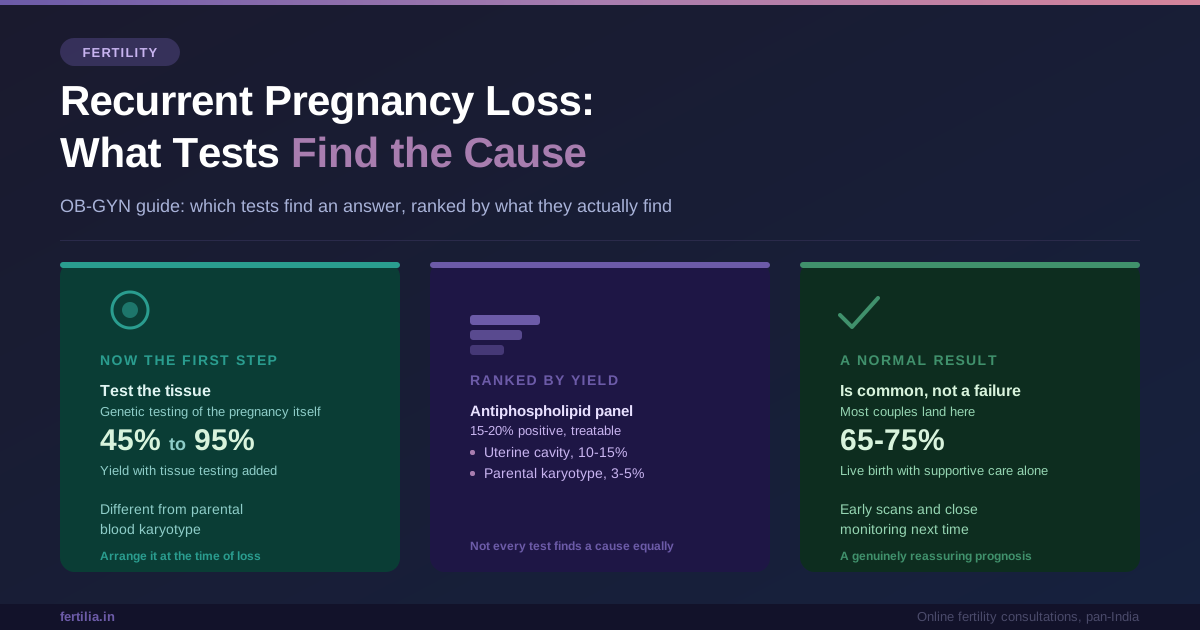
Genetic testing of products of conception (POC testing) looks at the pregnancy tissue itself, collected at the time of a miscarriage. It checks whether that specific pregnancy was chromosomally normal (euploid) or abnormal (aneuploid). ASRM’s rationale is straightforward: chromosomal abnormality, arising fresh in that pregnancy rather than inherited from a parent, is the single most common identifiable cause of early miscarriage, present in roughly half of miscarriages tested in women under 35 and around three-quarters of those in women over 40 (ASRM Practice Committee, Fertility and Sterility, 2026, PMID 42062119). A single-centre study of 100 women with RPL found that a standard evaluation alone identified a probable cause in 45% of patients, but adding chromosomal microarray testing of the miscarriage tissue raised that to 95% (Popescu F et al., Hum Reprod, 2018, PMID 29538673). It is one study from one clinic, not a population-wide guarantee, but it is the clearest demonstration to date of how much a single added test can change the yield of the whole workup.
There is a practical, and genuinely reassuring, reason this matters beyond the number itself. A confirmed chromosomally abnormal loss is, in ASRM’s own words, associated with reduced guilt and self-blame, because it usually points to a sporadic event in that embryo rather than leaving the cause open to whatever explanation feels most personal. Usually, not always: some abnormalities arise from a balanced structural rearrangement carried by a parent, and age-related aneuploidy can carry an ongoing recurrence risk, so the specific abnormality found is what decides whether parental karyotype is still needed. A normal (euploid) result on the tissue points in the opposite direction: that particular loss is less likely to have been a one-off chromosomal accident, and in women whose losses keep testing chromosomally normal, the rest of the workup (antiphospholipid antibodies, uterine assessment, thyroid) carries more of the explanatory weight. A result from one pregnancy cannot account for the others, though, so it does not replace the standard evaluation. After two losses, the antiphospholipid panel, uterine assessment and thyroid testing remain appropriate whichever way a tissue result comes back.
The catch is timing. This tissue can only be tested if it is collected at the time of the loss, before it is discarded. If you are currently pregnant after a prior loss, or if you have had a loss recently, it is worth asking your gynaecologist in advance whether the tissue can be sent for genetic testing rather than assuming this can be arranged after the fact. In India, SNP-based microarray testing of products of conception is available through labs including Metropolis and DNA Labs India, with published Chennai pricing in the range of roughly ₹17,500 to ₹18,500 for the tissue test alone (verified via the labs’ own published Chennai pricing pages, checked 2026-09-18), plus separate consultation and any parental testing if the result indicates it. The tissue needs to be collected fresh, without formalin, and transported quickly, so this is arranged with the operating gynaecologist, not after discharge.
Message Dr. Suganya on WhatsApp to discuss testing options after a loss
The Rest of the Panel, Ranked by What They Find
Once the miscarriage-tissue result is in (or if it was not available), the remaining tests are not equally likely to explain what happened. Here is how they rank, based on the frequency with which each finds an actionable result in women with RPL.
| Test | How often it finds something | Does a positive result change what you do |
|---|---|---|
| Antiphospholipid antibody panel | About 15-20% of women with RPL | Yes, an effective treatment (aspirin plus heparin) exists |
| Uterine cavity assessment | About 10-15% of women with RPL | Yes, a septum or polyp can often be corrected |
| Parental karyotype (both partners) | About 3-5% of couples with RPL | Yes, changes conception planning and, sometimes, the case for IVF with PGT-SR |
| Thyroid function (TSH, anti-TPO) | Varies; overt thyroid disease is uncommon, while anti-TPO antibodies with normal thyroid function are more frequent | Depends on actual thyroid function. Overt hypothyroidism is treated. For a mildly raised TSH or isolated anti-TPO antibodies with normal function, trials have not shown that routine levothyroxine improves live birth, so treatment is individualised against current guideline thresholds |
| Fasting glucose and HbA1c | Uncommon as a sole finding but worth checking | Yes, if abnormal |
| Inherited thrombophilia panel | Not recommended for routine testing | No, a large randomised trial found no live-birth benefit from aspirin plus heparin over placebo in recurrent miscarriage (Kaandorp SP et al., N Engl J Med, 2010, PMID 20335572) |
| Natural killer cell / immune panels | Not recommended for routine testing | No, insufficient evidence to guide treatment |
The antiphospholipid panel sits at the top of this list for a reason beyond how often it is positive: it is one of the few results in this entire workup where a positive finding leads to a specific, well-studied treatment that measurably improves the odds of the next pregnancy. A structural finding in the uterine cavity is a close second, because a septum or a polyp is sometimes correctable surgically. The evidence is weaker than many people assume: randomised data has not shown that routine septum resection improves live birth, and evidence for polypectomy specifically in recurrent pregnancy loss is limited, so whether to operate is an individual decision made with your gynaecologist rather than an automatic next step.
The full mechanics of each of these tests, including exact costs and turnaround times in India, are covered in our existing four-part RPL workup guide. This post’s focus is which of them are worth prioritising, and that answer starts with the two at the top of the table.
One test that belongs in this conversation but is not part of the standard female-side panel is semen quality. Sperm DNA fragmentation has been associated with early pregnancy loss in some studies, although the assays and thresholds are not standardised and it is not established that testing improves live birth outcomes. A standard semen analysis is reasonable if it has not been done recently; DFI testing is considered selectively, usually when the female-side workup keeps coming back normal.
Why Two Losses Is Enough, Not a Compromise
A common concern women raise is whether testing after only two losses is premature, whether a third loss should confirm the pattern first. The data does not support waiting.
A retrospective study of 1,020 women with RPL compared those with exactly two losses to those with three or more, and found no meaningful difference in how often each of the standard diagnostic tests came back abnormal between the two groups (Jaslow CR et al., Fertil Steril, 2010, PMID 19338986). In plain terms, a third loss does not make the underlying cause more findable. It only adds another loss to grieve while waiting for an answer that was already available.
There is a separate, older finding worth knowing if a chromosomal cause is identified on tissue testing. A Japanese study of over 1,300 women with recurrent miscarriage found that the proportion of losses with an abnormal embryonic karyotype decreases, and the proportion with a normal karyotype increases, as the number of prior losses rises, and that a prior normal-karyotype loss actually predicted a higher chance of a subsequent loss than a prior abnormal-karyotype one did (Ogasawara M et al., Fertil Steril, 2000, PMID 10685533). This is part of why ASRM’s 2026 opinion treats a euploid (chromosomally normal) miscarriage as the signal to look more closely elsewhere, not as a reassuring dead end.
What a Normal Result Across the Board Means
This is the outcome most couples land on, and it is worth saying plainly: a fully normal workup does not mean the testing failed. It means the identifiable causes we currently know how to test for are not present in your case.
Under the older standard workup alone, roughly half of RPL cases came back with no identifiable cause (Rai R and Regan L, Lancet, 2006, PMID 16905025). That figure predates the shift toward routine miscarriage-tissue testing, and the emerging data suggests that adding it narrows, though does not close, that unexplained group; the 95% combined-yield figure above comes from one 100-patient study and should be read as encouraging, not as a population-wide guarantee that has replaced the older number.
Whatever the exact proportion turns out to be for you, an unexplained result carries a genuinely reassuring prognosis. The same Rai and Regan follow-up reported live birth rates of 65-75% in subsequent pregnancies among couples with unexplained RPL who were followed with supportive care alone; no additional treatment, just early scans to confirm viability and a doctor available to answer questions as the pregnancy progresses. That range is an average across a study population rather than a personal forecast, and an individual couple’s odds shift with maternal age, the number of previous losses and how late in pregnancy they occurred. At Fertilia, this is the plan I build with women whose workup comes back clear: closer monitoring in early pregnancy, not a shrug and a “try again.”
What Happens Next, Practically
Most of this workup runs in parallel and finishes within a single menstrual cycle. Blood tests (antiphospholipid panel, karyotype, thyroid, glucose) take one to two weeks. A uterine cavity assessment adds a week or two if needed. Miscarriage-tissue testing, if arranged at the time of a loss, adds its own turnaround separately, and does not delay the rest of the workup.
The blood tests do not require you to pause trying to conceive while results come back. A uterine cavity assessment is different: HSG, saline-infusion sonography and hysteroscopy are scheduled in the first half of the cycle, after a period and before ovulation, so that pregnancy has been excluded, and your gynaecologist may ask you to avoid conception in the cycle the procedure is planned. Separately, one blood result needs a repeat sample: if the antiphospholipid panel is positive, the diagnosis needs confirmation on a second sample at least 12 weeks later before it is treated as confirmed, and it is worth having that treatment plan (aspirin plus heparin) ready before your next positive pregnancy test, not after.
Message Dr. Suganya Venkat on WhatsApp for a ₹399 Online Consultation
Frequently Asked Questions
Does testing the miscarriage tissue replace the rest of the workup? No. It is now the recommended first step because it has the highest single-test yield, but it does not test for antiphospholipid antibodies, uterine shape, or thyroid function. Think of it as reordering the sequence, not shrinking the list. A normal tissue result is actually the signal to look more carefully at the rest of the panel, not to stop.
What if the miscarriage tissue wasn’t tested and it’s too late now? Then the workup proceeds with the remaining tests: antiphospholipid panel, uterine cavity assessment, parental karyotype, and thyroid and metabolic screening, in the order of likely yield described above. Missing the tissue test on a past loss does not close off testing on a future one, and it is worth asking in advance if there is a next loss.
Which single test is most likely to change my treatment plan? The antiphospholipid antibody panel. It has a meaningful positive rate in RPL and a well-established, effective treatment (low-dose aspirin plus heparin) when confirmed. A uterine structural finding is a close second, since a septum or polyp is often correctable.
I’ve had two losses. Do I really need to test now, or should I wait for a third? Test now. A study comparing women with exactly two losses to those with three or more found no meaningful difference in how often the standard tests found an explanation between the two groups. Waiting for a third loss does not improve the odds of finding a cause; it only adds time and another loss.
Do both partners need testing? Parental karyotype is done on both partners, because a balanced chromosomal rearrangement can originate from either side. The antiphospholipid panel, thyroid tests, and glucose tests are done on the woman. A semen analysis is standard for the male partner. DNA fragmentation testing is a selective add-on rather than a routine repeat: the assays and cut-offs are not yet standardised and it is not established that testing improves live birth outcomes, so it is considered case by case, usually when the female-side workup is normal.
Is a normal result actually good news, or is it just “no answer”? It is genuinely good news for what happens next, even though it does not name a cause. Couples with an unexplained RPL workup often go on to have a successful next pregnancy, with older follow-up data reporting live birth rates broadly in the 65-75% range. That is a group average rather than a personal prediction: individual odds shift with maternal age, the number of previous losses and how late they occurred, and the supportive care itself (early scans, close monitoring, no additional intervention) is not what produces the figure. That is a reassuring prognosis on its own terms.
Recurrent pregnancy loss ka test kab karana chahiye? Do bar pregnancy loss ho jaane ke baad hi testing shuru ho sakti hai, teesri baar ka intezaar karne ki zaroorat nahi hai. Sabse pehle miscarriage tissue ka genetic test kiya jaata hai (agar sample available ho), uske baad antiphospholipid antibody panel, uterine cavity check, aur thyroid screening.
Two losses is enough to ask for answers, and the answers a workup finds are not evenly distributed across every test in the panel. Testing the pregnancy tissue itself, when it is possible to arrange, now comes first. After that, the antiphospholipid panel and a uterine cavity check carry most of the remaining explanatory weight, and a fully normal result across the board is common, not a sign that something was missed.
Message Dr. Suganya Venkat on WhatsApp to talk through your specific history and which tests make sense to prioritise first. Her Fertility program supports couples through this investigation with a full-picture plan, alongside the complete fertility workup guide for the broader hormonal and ovarian-reserve picture.
Consultation is online, pan-India, via video call or phone.