When a girl’s first period arrives, it often comes with a mix of surprise, questions, and a lot of searching online for what is normal. For the parent in the room, the anxiety can be just as acute. And for the young girl herself, the experience is entirely new, with no point of reference.
This guide is written for both: the parent trying to understand what their daughter is going through, and the teenage girl who wants to know what to expect in the months and years ahead. The short answer is that most of what happens in the first year or two after the first period is well within the range of normal. The longer answer is what follows.
What menarche means and when it usually happens
Menarche, pronounced “men-ar-kee,” is the medical term for a girl’s very first menstrual period. It marks the beginning of reproductive life, and it is one of the clearest outward signals that puberty has entered its final stage.
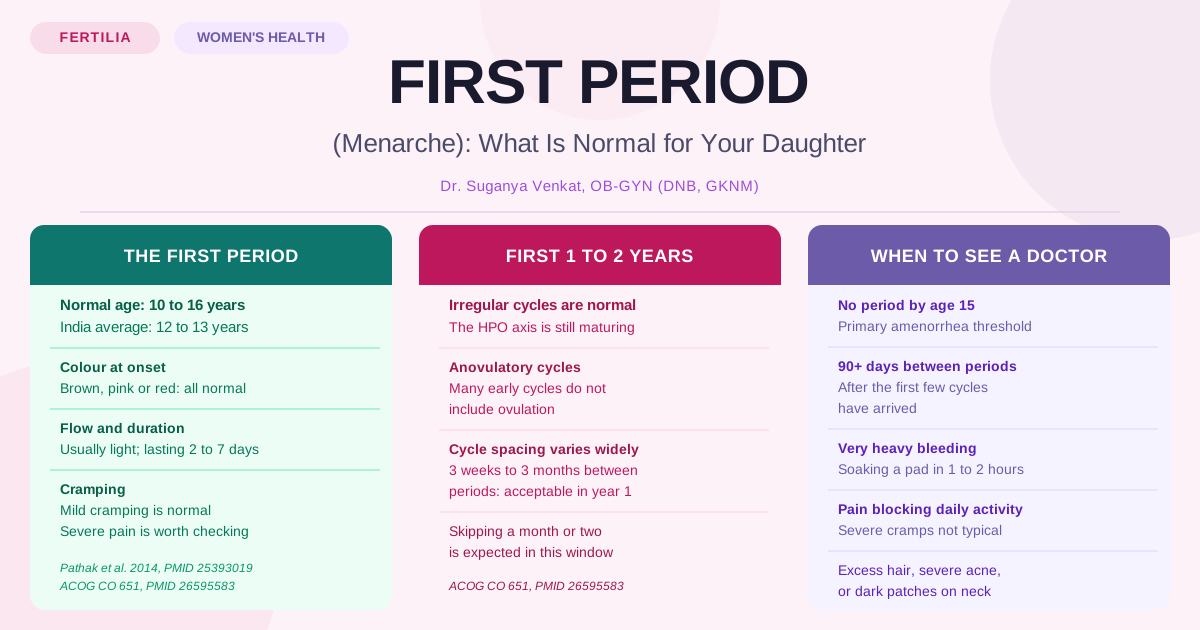
The age at which menarche occurs varies widely between individuals. Globally, the normal range is considered to be 10 to 16 years. In India, a large national analysis of the Indian Human Development Survey found a mean age at menarche of 13.76 years among ever-married women aged 15 to 49 surveyed in 2005, with regional and socioeconomic variation (Pathak PK et al., PLoS One, 2014, PMID 25369507). Girls from urban areas and higher socioeconomic backgrounds tend to have slightly earlier menarche than those from rural settings, a pattern seen across many countries.
Before menarche arrives, there are usually physical signs that have been developing for one to three years. Breast development (called thelarche) typically begins between ages 8 and 13 and is usually the first sign of puberty. Pubic and underarm hair follow, along with a growth spurt. The first period tends to arrive about two to three years after the initial breast development. So if your daughter’s body has been changing for a while, the first period is not a surprise, even if its exact timing is.
If no period has arrived by age 15, or by three years after breast development began, that is worth discussing with a gynaecologist. This is called primary amenorrhea, and it usually has a benign explanation, but it does warrant a proper evaluation.
What the first period looks like
This is one of the most common questions I hear, and it is entirely reasonable. The first period often looks different from what people expect from a period.
The colour is often brown or dark, not bright red. This surprises many girls and parents. Brown or dark blood is older blood that has taken longer to travel out of the uterus. It is completely normal, particularly at the very start and end of each period. As flow picks up, the colour usually shifts to red, and then returns to brown or pink as the period tapers off.
The flow is usually light. The first few periods are often spotty or very light. Some girls initially wonder whether what they saw was really a period at all. A flow that requires only a thin pad or a panty liner is normal in the early months.
The duration varies. Most girls bleed for two to seven days during their first period (ACOG Committee Opinion No. 651, Obstetrics & Gynecology, 2015, PMID 26595586), and the first one may sit at the shorter end of that range.
Some cramping is normal. Mild cramping on the first day or two of a period is one of the most common period symptoms and is caused by the uterine muscle contracting to shed its lining. Mild to moderate cramping that responds to a warm compress or standard pain relief is within the normal range. Cramping so severe that your daughter cannot attend school or carry out daily activities is not something to simply wait out. That level of pain is worth investigating, and period pain with that intensity has specific causes that can be diagnosed and treated.
Why irregular cycles are normal in the first two years
This is the most important thing to understand, and it is the most frequently misunderstood.
When the first period arrives, the hormonal system that controls a regular adult cycle is not yet fully operational. The hypothalamic-pituitary-ovarian (HPO) axis, which is the three-way signalling loop between the brain, the pituitary gland, and the ovaries, is still in the process of maturing. Getting this system to run in a coordinated, rhythmic way takes time, typically one to two years after menarche.
During this window, the brain is sending signals to the ovaries, the ovaries are responding, but the feedback loop is not yet calibrated. This means that many of these early cycles do not involve ovulation at all. They are called anovulatory cycles, and they are a normal part of early adolescent development. The ACOG committee opinion on adolescent menstruation states that immaturity of the hypothalamic-pituitary-ovarian axis in the early years after menarche often results in anovulation, and that cycles may be somewhat long (ACOG Committee Opinion No. 651, Obstetrics & Gynecology, 2015, PMID 26595586).
What this looks like in practice:
A cycle might arrive after 25 days one month, then after 45 days the next. Your daughter might have two periods close together, then skip a month entirely. The gap between periods may be anywhere from three weeks to three months and still fall within what clinicians consider developmentally acceptable in this early window.
This is one of the most frequent sources of worry I hear from parents, and it is one of the areas where I find myself offering the most reassurance. A teenage girl whose periods started a year ago and are arriving unpredictably is not, by that fact alone, unwell. Her cycle is simply finding its rhythm.
The international PCOS guideline defines irregular menstrual cycles as normal in the first year after menarche, as part of the pubertal transition, and asks that in an adolescent with irregular cycles the value and timing of assessing for PCOS be discussed with her, given the diagnostic challenges at this life stage (Teede HJ et al., Human Reproduction, 2018, PMID 30052961). The irregularity that would be significant in an adult is expected and temporary in an early adolescent. For more on how teenage PCOS is actually diagnosed when there is reason to suspect it, the companion post on PCOS in teenagers covers this in detail.
If you have questions about whether your daughter’s cycle pattern needs evaluation, Dr. Suganya Venkat consults with women and families across India via video call. You can reach her on WhatsApp at wa.me/919940270499 to describe your daughter’s cycle history and ask what, if anything, the next step should be.
Period products: what Indian families should know
Choosing the right product for the first period is a practical question that parents and daughters often navigate together.
Pads are the most common starting point and the most widely available option in India. Brands like Whisper, Stayfree, Carefree, and Sofy are available at most pharmacies and supermarkets. For the first period, a regular-absorbency pad without wings is usually comfortable and easy to manage. As your daughter gets more familiar with her flow, she can move to whatever thickness and format works for her.
Menstrual cups and cloth pads are becoming more widely used in India and are entirely safe options. The Sirona and Everteen cups are among the better-known Indian brands. Cups have a learning curve, and most girls are better served by a pad or tampon first, transitioning to a cup once they are comfortable with the idea of internal products.
Tampons can be used from the very first period. There is no medical reason to wait. The tampon does not affect the hymen in any clinically significant way, and it does not need to be “introduced slowly.” If your daughter prefers to start with a pad while she learns what her body is doing, that is entirely reasonable, but there is no health reason she cannot use a tampon from the start if she wants to.
Hygiene basics are simple: change a pad every four to six hours (or more frequently on heavy days), change a tampon every four to eight hours. Wash the vulvar area gently with water at each change. There is no need for special washes, deodorant sprays, or products marketed as “intimate hygiene.” These often disturb the natural vaginal environment and are not needed.
When to see a doctor
The first two years give a great deal of leeway. But there are specific situations where a medical evaluation is appropriate, regardless of how recently the first period arrived.
No period by age 15. If a girl has reached 15 without a first period, a gynaecology evaluation is warranted. This is the clinical threshold for primary amenorrhea. It is often entirely benign, but the cause should be identified.
No period for 90 or more days after the initial cycle has started. Missing one or two periods in the first year or two is common. Going three months without a period, once cycles have started, is the threshold at which an evaluation is helpful, especially to rule out pregnancy in older teenagers, low body weight as a cause, and thyroid dysfunction. Our guide on irregular periods in teenagers goes into this in more detail.
Very heavy bleeding. Heavy bleeding is defined as soaking through a thick pad or tampon in one to two hours, consistently, over several hours. Heavy periods have identifiable causes and should be evaluated rather than simply managed with more products.
Severe pain. As mentioned earlier, cramping that prevents school attendance or normal activity is worth investigating. Conditions like endometriosis can begin in adolescence, and earlier evaluation leads to earlier support.
Signs that may point to a hormonal issue. Excess hair growth on the face, chest, or abdomen, severe acne that does not respond to skin care, darkening of the skin at the neck or underarms (called acanthosis nigricans), or significant unexplained weight gain alongside irregular periods are signs that warrant a review. These may indicate PCOS or another hormonal condition. The PCOS symptoms guide explains what to look for and what the diagnostic process involves.
A note on the contraceptive pill for regulating periods
This is worth addressing directly, because many teenage girls in India are given an oral contraceptive pill after their first year of irregular cycles, with the explanation that it will “regulate” the period.
The pill does not regulate the menstrual cycle. It replaces the cycle entirely with a pharmaceutical withdrawal bleed, which looks like a period but is a different physiological event. When the pill is stopped, the cycle returns to exactly where it was before, because the underlying cause has not been addressed.
In the first one to two years after menarche, where irregular cycles are developmentally expected, starting a teenager on the pill to “fix” irregularity may not be the right approach. The cycle often becomes regular on its own within this window. If there is a genuine clinical reason for the pill, such as very painful periods with a suspected cause, or another medical need, that is a different conversation. But as a default response to early irregular cycles, it is worth asking your gynaecologist why the pill is being recommended and what alternatives exist before starting.
Your daughter’s gynaecologist is best placed to make this decision for her specific situation. This note is not a reason to refuse the pill if it has been recommended. It is a prompt to have the conversation.
What to say to your daughter
A parent’s response to the first period sets the tone for how a young girl will understand and relate to her body for years to come.
A few things that help:
Start by normalising it. “This is something that every woman goes through. It means your body is doing exactly what it should.”
Keep the information practical. Show her how to use a pad, how to count the first day of her period, and who to come to if she has questions.
Tell her what to expect in the first year. “Your period might be irregular for a while. That is normal. It does not mean anything is wrong.”
Give her the language to tell a trusted adult if something feels wrong. Severe pain, very heavy bleeding, or anything that worries her is worth mentioning. She should feel that this is a body function worth paying attention to, not something to be managed in silence.
The Period Health Guide has a downloadable resource covering the full picture of menstrual health: the normal cycle, what to track, and what warrants a conversation with a doctor. It is a useful reference to read through with your daughter when the first period arrives.
For specific questions about your daughter’s cycle pattern, pain levels, or any concerns that have come up since her periods began, Dr. Suganya Venkat is available for online consultations across India via video call. Message her on WhatsApp at wa.me/919940270499 with a brief description of what you are noticing and she will help you understand what, if anything, should be done next.
What menarche is called in other languages
Menarche is a term used across medical settings in India, but the everyday language varies by community.
In Hindi, the first period is commonly referred to as pahli mahavari (पहली माहवारी) or pehla period. The verb “period aana” or “mahavari shuru hona” (माहवारी शुरू होना) means the period has started.
In Tamil, the first period is referred to as muthal maadhavidaai. The cultural tradition around the first period is sometimes called manjal neerattu vizha, a coming-of-age ceremony that is still observed in many Tamil families.
These terms are useful to know, particularly when an adolescent girl or her parent is searching for information in their own language. The biology is the same; the words around it vary.
Frequently asked questions
At what age is the first period normal in India? The normal age range for menarche in India is approximately 10 to 16 years. A national analysis of the Indian Human Development Survey found a mean age at menarche of 13.76 years, with wide variation between states (Pathak PK et al., PLoS One, 2014, PMID 25369507). If your daughter has not had a period by age 15, a gynaecology evaluation is recommended. A period arriving as early as 10 is within the normal range, provided other puberty signs (breast development, pubic hair) have been progressing.
Why is the first period brown or dark instead of red? Brown or dark blood is simply older blood. It has taken longer to travel from the uterus to the outside, so it has had more time to oxidise. Brown discharge at the start or end of a period, or a first period that is entirely brown or dark pink, is completely normal. As flow increases, the colour usually becomes brighter red. If discharge is brown between periods, or if it has an unusual smell, that is worth checking with a doctor.
Is it normal to skip periods in the first year after menarche? Yes, skipping one or two periods in the first year is within the normal range. The HPO axis is still maturing, and many early cycles are anovulatory. Going three months or more without a period (after the first cycle has arrived) is the threshold at which an evaluation is helpful, to rule out pregnancy, low body weight, thyroid dysfunction, or other causes of secondary amenorrhea.
Should a teenage girl be put on the pill to regulate her period? The oral contraceptive pill suppresses the natural cycle and replaces it with a withdrawal bleed. It does not regulate the underlying cycle. In the first two years after menarche, irregular cycles are developmentally expected and often resolve on their own. The pill is a valid option for specific clinical reasons (very painful periods, acne, endometriosis), but it is worth asking your gynaecologist what specific benefit is being aimed for and whether it is the right choice for your daughter’s situation.
Can irregular periods after the first period mean PCOS? Irregular cycles in the first two years after menarche are common and are not sufficient on their own to diagnose PCOS. The international PCOS guideline treats irregular cycles in the first year after menarche as a normal part of the pubertal transition, and asks that the value and timing of assessing an adolescent for PCOS be discussed with her, given the diagnostic challenges at this life stage (Teede HJ et al., Human Reproduction, 2018, PMID 30052961). After two years post-menarche, if cycles remain irregular alongside other features such as excess hair growth, severe acne, or signs of insulin resistance, a PCOS evaluation is appropriate. The teen PCOS guide explains the diagnosis process in detail.
When should I take my daughter to see a gynaecologist about her periods? A gynaecology visit is worth arranging if: no period has arrived by age 15; periods stopped for three months or more after starting; flow is heavy enough to soak through a pad in one to two hours consistently; pain is severe enough to prevent daily activities; or there are signs of a hormonal issue such as excess hair growth, darkening at the neck, or severe acne. Routine well-woman care can also begin in adolescence if there are ongoing questions about her cycle, even when nothing is clearly wrong.
What is pahli mahavari in terms of menstrual health? “Pahli mahavari” (पहली माहवारी) is the Hindi phrase for “first period” or menarche. The physiology is the same as described in this guide: a normal first period can be brown or dark, light in flow, and irregular for the first one to two years. Teenage girls searching in Hindi for information about their first period can find the same evidence-based guidance here, without the information being any different based on the language used to search for it.