A woman finds out she is pregnant and the first feeling is not joy, it is dread. Not dread about being a mother, dread about the birth itself: the pain, the loss of control, the idea of her body being examined and handled by strangers in a room she cannot leave. Some women carry this fear quietly through nine months, telling no one, hoping it will pass on its own. Some avoid pregnancy for years because of it. Some ask for a caesarean not because of a medical indication, but because the thought of labour itself feels unsurvivable.
This has a name: tokophobia, an intense, often overwhelming fear of childbirth. I am a psychiatrist, and I see this fear more often than most people expect, sometimes in a woman’s first pregnancy, sometimes years later after a birth that left more than physical marks.
This post covers what tokophobia is, how it goes beyond ordinary third-trimester nerves, and what genuinely helps, based on evidence rather than reassurance alone.
What this post covers:
- What tokophobia is, and how common it actually is
- Primary tokophobia versus secondary tokophobia (after a difficult previous birth)
- How it differs from normal pregnancy anxiety
- What the evidence shows actually reduces the fear
- How birth-preference planning works alongside your obstetrician, not against them
- The partner’s role in this
What Tokophobia Is
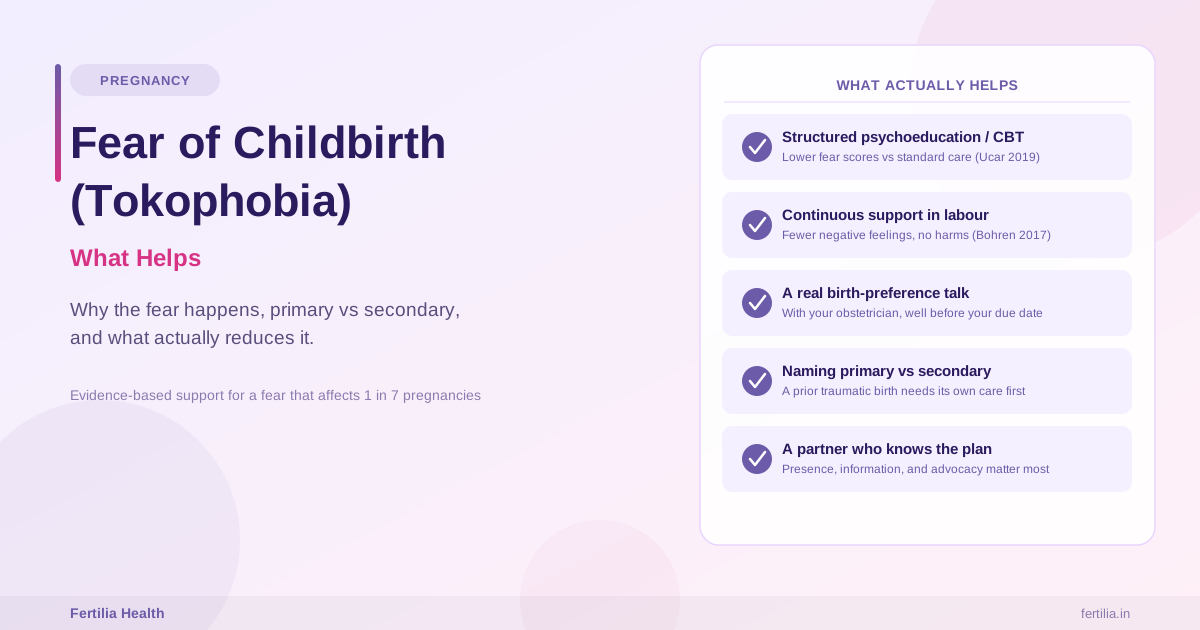
Tokophobia was first described clinically in a case series of 26 women whose fear of childbirth was severe enough to affect their pregnancy decisions, sometimes leading them to avoid pregnancy altogether or request delivery by caesarean with no medical reason for it (Hofberg and Brockington, 2000, British Journal of Psychiatry, PMID 10789333). It is not a rare curiosity. A systematic review pooling data from close to 854,000 pregnant women worldwide estimated that around 14% experience fear of childbirth severe enough to meet clinical criteria, roughly one in seven (O’Connell et al., 2017, Acta Obstetricia et Gynecologica Scandinavica, PMID 28369672).
That number matters because it tells you something important: if this fear has taken hold of you, you are not the exception in the room. You are one of a large group of women who simply do not talk about it, because admitting you are terrified of giving birth feels, to many women, like admitting you are a bad mother before you have even become one. You are not. Wanting a baby and being afraid of the birth are two entirely separate things, and holding both at once is common, not contradictory.
Two Different Starting Points: Primary and Secondary Tokophobia
Tokophobia does not arrive the same way for every woman, and the distinction matters for what helps.
Primary tokophobia develops before any personal experience of childbirth. It often begins early, sometimes in adolescence, shaped by a frightening story heard from a relative, a traumatic birth witnessed or described in vivid detail, or a general horror at the idea of losing control of one’s body in front of others. Some women with primary tokophobia have never been pregnant and avoid it specifically because of this fear.
Secondary tokophobia develops after a birth the woman experienced as traumatic, whether or not it was medically complicated. This is the pattern I see most often in women who already have one child and are terrified of a second pregnancy. A birth can feel traumatic even without an obstetric emergency: feeling unheard, feeling like decisions were made about her body without her, severe unmanaged pain, or a delivery that moved faster and with less warning than she was prepared for, can all leave the same mark as a genuine emergency does. Some women with secondary tokophobia go on to develop symptoms consistent with post-traumatic stress: intrusive memories of the birth, avoidance of anything that reminds them of it, and a persistent sense of dread about repeating it (Hofberg and Brockington, 2000, PMID 10789333).
Knowing which of these fits you changes the starting point of treatment. Primary tokophobia usually responds well to structured psychoeducation and graded exposure to information. Secondary tokophobia, when it carries traumatic-stress features, often needs the previous birth itself processed first, before birth-preference planning for the next one can do its job.
How This Differs From Normal Pregnancy Nerves
Almost every pregnant woman feels some anxiety about labour, especially the first time. That is a normal, proportionate response to something genuinely unfamiliar and significant. Tokophobia is different in degree, not just in kind.
A few signs suggest the fear has moved past ordinary nervousness:
- The fear is present from very early in pregnancy, or even before conception, rather than building gradually as delivery approaches
- Thinking about labour brings on physical panic symptoms: racing heart, breathlessness, a strong urge to escape the thought entirely
- The fear affects daily functioning: disrupted sleep, difficulty concentrating at work, avoiding pregnancy-related appointments or conversations
- You have delayed or avoided pregnancy specifically because of this fear, or requested a caesarean primarily to avoid labour rather than for a medical reason
- The fear does not ease with reassurance or information the way ordinary nerves usually do; if anything, more information about labour makes it worse
If several of these sound familiar, this is worth naming to your obstetrician and, if needed, a mental health professional, early in pregnancy rather than close to your due date. There is more that can be done with time on your side.
What the Evidence Shows Helps
The reassuring part of tokophobia is that it responds to structured intervention. This is not a fear you are expected to simply push through.
Structured psychoeducation and CBT-based programmes. A controlled study of a cognitive-behavioural educational programme for fear of childbirth found that women who went through the programme had substantially lower fear scores after the intervention than women who received standard care, using a validated fear-of-childbirth measure (Uçar and Gölbaşı, 2019, Journal of Psychosomatic Obstetrics & Gynaecology, PMID 29583056). The programme did not try to talk women out of their fear. It walked them through what actually happens at each stage of labour, in a structured, paced way, which is often what primary tokophobia in particular responds well to.
Continuous labour support. A Cochrane review of 26 randomised trials involving nearly 16,000 women found that continuous one-to-one support during labour, someone staying with the woman throughout rather than checking in periodically, was associated with fewer negative feelings about the birth experience, along with a higher chance of spontaneous vaginal birth and less need for pain medication, with no identified harms (Bohren et al., 2017, Cochrane Database of Systematic Reviews, PMID 28681500). This is one of the more consistent findings in this evidence base: not being left alone during labour changes how the experience feels and is remembered, independent of how the birth actually proceeds.
Processing a previous traumatic birth, when secondary tokophobia is present. For women whose fear is rooted in a specific prior birth, addressing that memory directly, rather than only planning for the next delivery, is usually necessary. This is trauma-focused work, the kind a psychiatrist or trained perinatal mental health professional does, and it is a legitimate, evidence-informed part of preparing for a second pregnancy, not an optional extra.
None of this requires you to simply be braver about labour. It requires structure, support, and, where relevant, processing what happened before.
💬 If you are pregnant and dreading the birth itself, that is worth talking through now, not closer to your due date. You can message Dr. Suganya’s team at Fertilia on WhatsApp, describe what you are afraid of, and we will talk about what support and planning can look like for you specifically. Message us on WhatsApp
Birth-Preference Planning: Working With Your Obstetrician, Not Around Her
A written birth plan, discussed in advance with your obstetrician, is one of the most practical tools for tokophobia, and it works precisely because it is collaborative rather than a wish list handed over at the last minute.
A useful birth-preference conversation with your obstetrician covers:
- What you are most afraid of, specifically, not just “labour” in general
- What pain relief options are available to you and at what point you can ask for them
- Who will be with you, and whether continuous support is possible given your hospital’s setup
- What will and will not be explained to you as it happens, since not knowing what comes next is often a large part of the fear itself
- What happens if the plan needs to change, so an unplanned deviation does not feel like a loss of control on top of everything else
This is not about extracting a guarantee of a particular delivery mode. Birth is not always predictable, and no responsible clinician can promise a specific outcome. What this conversation can do is make sure your fears are known in advance, so your care team can plan around them rather than discovering them mid-labour. Your gynaecologist wants this conversation as much as you do; a woman whose fears are already on record is easier to support well than one whose fear surfaces for the first time on the delivery table.
If a caesarean is being considered specifically because of tokophobia rather than a medical indication, that is a conversation to have honestly with your obstetrician, weighing the evidence-based support options above against a caesarean’s own risks and recovery. Both a vaginal delivery with the right support and a planned caesarean are legitimate paths depending on your specific situation. Neither should be decided by fear alone, in either direction.
The Partner’s Role
A supportive partner changes this in a real, specific way, not just emotionally. Partners who attend antenatal appointments, understand the fear rather than dismissing it as “normal nerves,” and know in advance what has been agreed with the obstetrician, become an active part of the continuous-support pattern the Cochrane evidence points to. Practically, this means:
- Coming to at least one appointment where the birth plan is discussed, so the partner hears it directly rather than secondhand
- Learning, specifically, what the woman is afraid of, rather than assuming it is generic nervousness
- Agreeing in advance what “stop and reassess” looks like during labour, so the partner can advocate clearly if the woman is too overwhelmed to
- Simply staying, physically present and attentive, through as much of labour as the hospital setup allows
A partner does not need to fix the fear. Presence, information, and advocacy are the three things the evidence shows matter most, and all three are within a partner’s reach.
When to Seek Professional Support
Tokophobia that includes panic symptoms, sleep disruption, or avoidance of pregnancy-related care is worth bringing to a mental health professional, ideally early in pregnancy. This is especially true for secondary tokophobia with features of a previous birth intruding as memories or nightmares. This fear is treatable, and treatment works better with more time before delivery, not less.
If your fear is tangled up with a fear of the pelvic exam itself, or with intimacy more broadly, our post on fear of pelvic exams and how to make a visit easier covers that specific, related pattern. If what you are noticing feels more like general anxiety that has intensified during pregnancy rather than a fear centred specifically on birth, our guide to anxiety in women is a useful starting point. And if you are further along and want to understand exactly what happens at each point in labour, which for many women with primary tokophobia is itself a large part of the treatment, our guide to the stages of labour and our overview of pain relief options during labour walk through it step by step.
At Fertilia, Dr. Suganya Venkat has supported women through fifteen years of pregnancies where fear, not just physiology, needed a plan, and that planning starts the moment a woman names what she is actually afraid of.
Frequently Asked Questions
1. Is it normal to be terrified of giving birth?
Some anxiety about labour is common and expected, especially in a first pregnancy. Tokophobia is different: it is a fear intense enough to disrupt daily functioning, delay pregnancy decisions, or bring on panic symptoms at the thought of delivery. A pooled analysis of nearly 854,000 pregnant women worldwide estimated around 14% experience fear of childbirth at this severity, so if this describes you, you are far from alone.
2. What is the difference between primary and secondary tokophobia?
Primary tokophobia develops before any personal experience of childbirth, often shaped early by frightening stories or a general fear of losing bodily control. Secondary tokophobia develops after a birth the woman experienced as traumatic, whether or not it involved a medical complication, and can carry features of post-traumatic stress, like intrusive memories or nightmares of the birth.
3. Can tokophobia be treated during pregnancy?
Yes. Structured psychoeducation and CBT-based programmes have been shown in controlled studies to significantly reduce fear-of-childbirth scores compared to standard care. Earlier is better: starting this work in early or mid-pregnancy gives more time for it to help before delivery.
4. Should I ask for a caesarean because I am scared of labour?
That is a conversation to have honestly with your obstetrician rather than a decision to make from fear alone. A planned caesarean can be a reasonable choice in some situations, but it carries its own risks and recovery, and evidence-based support during labour, like continuous one-to-one support, meaningfully changes how vaginal birth is experienced and remembered. Your obstetrician can walk you through both paths with your specific fears in view.
5. Does a birth plan actually help with tokophobia?
Yes, when it is a genuine conversation with your obstetrician rather than a document handed over at the last minute. Naming your specific fears, agreeing on pain relief and support in advance, and understanding what happens if the plan changes all give your care team the information they need to support you well, and reduce the number of unknowns that fear tends to fill in with worst-case assumptions.
6. My last birth was traumatic and I am terrified of a second pregnancy. What helps?
This is secondary tokophobia, and it usually needs the previous birth itself addressed, not only planning for the next one. A psychiatrist or trained perinatal mental health professional can help process what happened, and that work is a legitimate, evidence-informed part of preparing for another pregnancy rather than something separate from your obstetric care.
7. What can my partner actually do to help?
More than most partners realise. Attending appointments where the birth plan is discussed, understanding your specific fears rather than assuming general nervousness, agreeing in advance on how to advocate for you during labour, and simply staying present throughout, are the concrete actions the evidence points to as genuinely helpful, not just emotionally supportive.
Taking the First Step
Tokophobia is treatable, and the earlier it is named, the more time there is to work with it before your due date. You do not need to justify the fear or prove it is severe enough to matter. If it is affecting how you feel about your pregnancy, it is worth a conversation.
If you would like to talk through what support could look like for you specifically, message Dr. Suganya’s team on WhatsApp. You can describe exactly what worries you, in your own words, and we will take it from there.