The first question most women ask when they hear “endometrial cancer” is whether they should be scared. The more useful answer is: you should be informed, and you should get checked when something is not right.
Abnormal bleeding is common. The vast majority of cases turn out to be benign: a hormonal shift, a polyp, fibroid-related bleeding, or the typical irregularity that comes with perimenopause. But endometrial cancer, which grows in the lining of the uterus, is the gynaecological cancer most likely to announce itself early through bleeding. That early warning is why most cases are caught at a stage when treatment works very well.
This guide covers what endometrial cancer is, the warning signs that need evaluation, who is at higher risk, and what you can do.
What this post covers:
- What endometrial cancer is and its two main types
- Warning signs that warrant evaluation
- Who is at higher risk, including the PCOS connection
- How doctors diagnose it
- Practical steps to take
What Is Endometrial Cancer?
The endometrium is the inner lining of the uterus. Each month, it thickens under the influence of oestrogen, then sheds during your period. When cells in this lining grow without control, the result is endometrial cancer, sometimes called uterine cancer.
Globally, endometrial cancer accounts for approximately 417,000 new cases per year and is the most common gynaecological cancer in high-income countries (Sung H et al., Global Cancer Statistics 2020, CA Cancer J Clin 2021, PMID 33538338). In India, cervical cancer still ranks higher by total incidence, but endometrial cancer rates are rising alongside urbanisation, obesity, and an ageing population.
Clinicians have long distinguished two main types, first described by Bokhman in 1983 (Gynecol Oncol 1983;15(1):10-17, PMID 6822361):
- Type I: Endometrioid, well-differentiated, oestrogen-driven. Accounts for around 75-80% of cases. Slower-growing, better prognosis, and closely linked to the risk factors discussed below.
- Type II: Includes serous and clear-cell carcinoma. Less common, not driven by oestrogen, and more aggressive. Less connected to the hormonal risk factors this post focuses on.
The practical implication is that most endometrial cancer cases fall into the Type I category, and most Type I cases are preventable or detectable early because of a clear connection to oestrogen imbalance.
Warning Signs to Know
Abnormal bleeding is the most important warning sign of endometrial cancer. It is also the reason most cases are caught early.
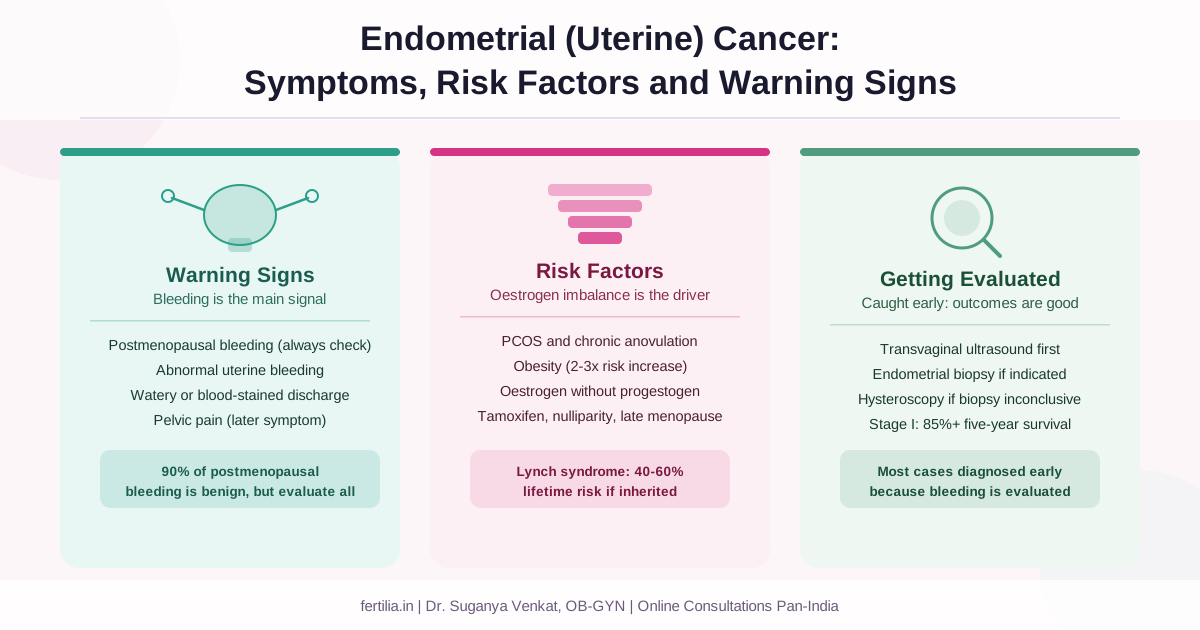
Postmenopausal bleeding. If you have not had a period for 12 months or more and you notice any bleeding, even a very small amount of spotting, this needs evaluation. Around 90% of women with postmenopausal bleeding have a benign cause: atrophic changes, polyps, or hormonal fluctuations. But because endometrial cancer is in the remaining group, every case of postmenopausal bleeding needs an ultrasound and, if indicated, a biopsy. Do not wait to see whether the bleeding stops.
Abnormal uterine bleeding before menopause. Periods that are getting progressively heavier, bleeding between periods that is persistent over several cycles, or cycles that become very unpredictable over months are worth discussing with your gynaecologist. These symptoms are usually caused by fibroids, polyps, or PCOS, but an endometrial assessment may be appropriate depending on your risk profile and history.
Watery or blood-stained vaginal discharge. This can appear before frank bleeding in some women. If it persists or is unusual for you, it deserves attention.
Pelvic pain or pressure. This is typically a later symptom. Most women with early-stage endometrial cancer have no pain at all, which is why bleeding is so valuable as an early signal.
The key point is this: early-stage endometrial cancer is often silent except for bleeding. When bleeding is evaluated promptly, the cancer is often found at Stage I, confined to the uterus, where treatment outcomes are very good.
If you have questions about postmenopausal bleeding specifically, the team at Menolia has a detailed guide at Post-Menopausal Bleeding: Causes and When to See a Doctor.
Who Is at Higher Risk?
Endometrial cancer is driven primarily by an imbalance between oestrogen and progesterone. When oestrogen acts on the endometrial lining without the counterbalancing effect of progesterone, cells can proliferate abnormally. Over years, this leads to endometrial hyperplasia (abnormal thickening), and in some cases to cancer.
PCOS (Polycystic Ovary Syndrome or PMOS). In PCOS, ovulation is irregular or absent. Without ovulation, no progesterone is produced in the second half of the cycle. Oestrogen continues to stimulate the endometrial lining month after month without opposition. Multiple systematic reviews have documented an approximately 2- to 3-fold elevated endometrial cancer risk in women with PCOS compared to those without it (Chittenden BG et al., Reprod Biomed Online 2009). The risk is real, but it is also manageable, and it is one of the genuine long-term reasons that treating PCOS actively matters.
Obesity. Fat tissue contains an enzyme called aromatase that converts androgens into oestrogen. Women with higher body weight have persistently elevated circulating oestrogen levels, independent of ovarian function. Obesity is one of the most consistent and well-documented risk factors for endometrial cancer across population studies (Kaaks R et al., Cancer Epidemiol Biomarkers Prev 2002, PMID 12496040). The risk rises progressively with BMI.
Oestrogen-only hormone therapy without progestogen. Women who still have an intact uterus and take oestrogen therapy without a progestogen are at increased risk because the endometrium is stimulated without opposition. Combined hormone therapy (oestrogen with a progestogen) is prescribed precisely to counteract this. If you are on any hormone therapy and unsure of your regimen, check with your doctor.
Tamoxifen. This medication, used in breast cancer treatment, has weak oestrogenic effects on the uterine lining. Women taking tamoxifen long-term have a modestly elevated endometrial cancer risk. Gynaecological surveillance is included in standard breast cancer follow-up for this reason.
Nulliparity (no pregnancies). Pregnancy brings sustained progesterone exposure, which is protective for the endometrium. Women who have never been pregnant have a slightly higher baseline risk.
Late menopause (after age 55). A longer reproductive span means more cumulative years of oestrogen exposure.
Insulin resistance and diabetes. Elevated insulin drives oestrogen production and creates an oestrogen-dominant environment in the endometrium. This is one of the reasons the PCOS risk overlaps with the obesity and insulin resistance risk.
Lynch syndrome (hereditary non-polyposis colorectal cancer). This inherited condition significantly elevates the risk of several cancers, including colorectal and endometrial. Women with Lynch syndrome face a 40-60% lifetime risk of endometrial cancer, compared to approximately 3% in the general population. If you have a strong family history of colorectal, endometrial, or ovarian cancer diagnosed before age 50, it is worth asking your doctor about genetic counselling.
Age. The majority of cases are diagnosed after 50. It does occur in younger women, particularly those with untreated PCOS, obesity, or a genetic predisposition, but it is much less common before menopause.
The PCOS Connection in Detail
This is worth a dedicated section because it comes up frequently in consultations and is sometimes communicated in ways that cause unnecessary alarm.
In PCOS, the core problem for endometrial health is chronic anovulation. When ovulation does not occur, there is no corpus luteum, and without a corpus luteum, no progesterone is produced in the luteal phase. Oestrogen acts on the endometrium through the entire cycle without any opposition. Month after month, year after year, this can cause the endometrial lining to thicken progressively, a process called endometrial hyperplasia.
Not all hyperplasia carries the same risk. Hyperplasia without atypia (no abnormal cell changes) carries a low risk of cancer progression and often resolves with progestogen therapy. Hyperplasia with atypia carries a higher risk and requires more active management. A biopsy is the only way to distinguish between them.
What this means in practice:
If your periods come very infrequently (fewer than 4 times a year or less), an endometrial assessment is appropriate. Your doctor may recommend a transvaginal ultrasound to check endometrial thickness, and in some cases a biopsy.
Regularising your cycle protects your endometrium. Whether through lifestyle changes, weight management, or hormonal medication, bringing ovulation back means producing progesterone, which opposes oestrogen and keeps the lining healthy. This is one of the concrete long-term benefits of treating PCOS, beyond fertility.
PCOS does not make endometrial cancer inevitable. The elevated risk is real but it is manageable. Women who actively treat their PCOS, maintain a reasonable weight, and report abnormal bleeding promptly are in a much better position than those who let years go by with very infrequent cycles and no gynaecological review.
For more on how PCOS affects your cycle and what managing it involves, see PCOS: Symptoms, Root Causes and Treatment and PCOS and Missing Periods: Why They Stop and How to Restore Your Cycle.
If you have irregular periods, significant anovulation, or any of the risk factors above and would like to understand what this means for your long-term gynaecological health, a conversation with a gynaecologist is the right starting point.
WhatsApp me directly: wa.me/919940200330
How Doctors Evaluate Suspected Endometrial Cancer
If you report postmenopausal bleeding or persistent abnormal uterine bleeding, the evaluation follows a clear sequence.
Transvaginal ultrasound (TVS). This is the first step. The scan measures endometrial thickness. After menopause, an endometrial thickness greater than 4mm warrants further evaluation. Before menopause, the interpretation depends on where you are in your cycle. An ultrasound alone is not sufficient to diagnose cancer, but it guides the next step.
For more on understanding endometrial thickness on a scan report, see Endometrial Thickness: Trilaminar Pattern and Normal Ranges.
Endometrial biopsy. If the ultrasound raises concern, or if bleeding persists despite a normal scan, a small tissue sample is taken from the endometrial lining, usually in an outpatient setting using a thin instrument called a pipelle. The sample is sent to a laboratory for histology. This is the definitive diagnostic step.
Hysteroscopy. If the biopsy result is inconclusive, or if a focal abnormality (such as a polyp) needs to be visualised directly, a thin camera is passed through the cervix into the uterus. Targeted biopsies can be taken under direct view.
Staging. If endometrial cancer is confirmed, the FIGO staging system (Stage I to IV) determines how far it has spread. The majority of endometrial cancers are diagnosed at Stage I, meaning the cancer is still confined to the uterus. Stage I disease has a five-year survival rate above 85%, which reflects the benefit of early detection through bleeding evaluation.
What You Can Do
If you have any of the risk factors above, or if something does not feel right with your cycle, these are the steps worth taking.
Report abnormal bleeding promptly. This is the single most important step. Postmenopausal bleeding is never a symptom to observe and wait on. Any amount of bleeding after 12 months without a period should be evaluated by a gynaecologist.
Address heavy or very irregular periods. If your periods are very heavy, coming far apart, or both, this is worth investigating and treating, not only for quality of life but for endometrial protection. See Heavy Periods After 35: Fibroids, Adenomyosis or PCOS? and Heavy Periods: Causes and Every Treatment Option for more.
Treat PCOS actively. Regularising cycles, addressing insulin resistance, and maintaining a healthy weight all reduce the risk of prolonged unopposed oestrogen exposure. If you go more than three months without a period, an endometrial assessment and progestogen withdrawal or therapy is often appropriate.
Maintain a healthy weight. Obesity is a strong, independent, modifiable risk factor. Weight management as part of PCOS care carries broad hormonal and gynaecological benefits.
Understand your hormone therapy. If you are taking any oestrogen-containing medication and still have a uterus, confirm with your doctor that it includes a progestogen.
Ask about Lynch syndrome if you have a close family member with colorectal, endometrial, or ovarian cancer diagnosed before age 50.
Keep up regular gynaecological reviews. For women who have had a long history of PCOS with very infrequent cycles, the perimenopause transition is a good time to have a baseline endometrial assessment.
Other relevant reading: Cervical Cancer Screening: Pap, HPV and When to Get Tested and the Period Health Resource.
If you would like to discuss your risk profile, your history of irregular periods, or what your scan results mean, I am available for an online consultation.
WhatsApp me to book: wa.me/919940200330
Frequently Asked Questions
Does every woman with PCOS get endometrial cancer? No. The risk is elevated relative to women without PCOS, because of chronic anovulation and the resulting unopposed oestrogen exposure, but most women with PCOS do not develop endometrial cancer. Actively managing PCOS, regularising cycles, maintaining a healthy weight, and reporting abnormal bleeding promptly are the steps that manage the risk.
I had spotting once after menopause. Does that mean cancer? Not necessarily. Around 90% of postmenopausal bleeding has a benign cause: atrophic changes, a polyp, or hormonal fluctuations. But because endometrial cancer is in the remaining group, every case needs to be evaluated with an ultrasound and, if indicated, a biopsy. Do not wait to see whether the spotting stops on its own.
What does an endometrial biopsy feel like? It is done in an outpatient setting without anaesthesia. Most women experience a few seconds of cramping when the thin instrument is passed through the cervix and when the sample is taken. The procedure is usually over within a minute or two. Taking ibuprofen about an hour before the appointment helps with discomfort.
My ultrasound showed a thickened endometrium. Does that mean I have cancer? A thick endometrium on ultrasound is a finding that needs follow-up, not a diagnosis. After menopause, a thickness greater than 4mm on scan prompts a biopsy. Before menopause, the significance depends on where you are in your cycle and your clinical history. Many causes of endometrial thickening are benign and treatable: hyperplasia without atypia, polyps, or hormonal effects.
I am in my 30s with PCOS and irregular periods. Should I worry? Endometrial cancer in your 30s with PCOS is uncommon. The concern is cumulative, building over years if cycles remain very infrequent. The practical focus now is managing your PCOS, regularising periods so your endometrium sheds regularly, and attending annual gynaecological reviews. If you go more than three or four months without a period, let your doctor know.
What is the difference between endometrial cancer and endometriosis? They are entirely different conditions. Endometriosis is a condition in which endometrial-like tissue grows outside the uterus, on the ovaries, tubes, or pelvic lining, and causes pain, heavy periods, and fertility difficulties. Endometrial cancer grows inside the uterus from the lining itself. Having endometriosis does not increase your risk of endometrial cancer. See Endometriosis and Fertility for more on that condition.
Can the risk of endometrial cancer be reduced? Yes, through several modifiable factors: regularising cycles in PCOS so the endometrium sheds regularly and is not exposed to unopposed oestrogen for prolonged periods; maintaining a healthy weight; using combined hormone therapy (oestrogen with progestogen) rather than oestrogen alone when you have an intact uterus; and reporting any abnormal bleeding promptly so it can be evaluated and, if needed, treated early.
Dr. Suganya Venkat, OB-GYN, consults online for women across India on PCOS, fertility, irregular periods, and general gynaecological health. Appointments by WhatsApp: wa.me/919940200330