Every feed hurts, your baby seems to slide off the breast no matter how you reposition, and someone (a relative, a nurse, an Instagram reel) has just told you it might be tongue tie. Now you’re staring at your sleeping baby’s mouth, trying to decide if what you’re seeing under the tongue is normal or a problem, and whether a small surgery is something you should be arranging this week.
I’m Dr. Suganya Venkat, an OB-GYN with more than 15 years of clinical experience, and at Fertilia this is one of the questions I get asked most often in the first fortnight after delivery, usually from a mother whose nipples are already sore and who has run out of patience for another vague answer. Tongue tie is a real, well-recognised condition. It is also one of the more debated topics in newborn care right now, with frenotomy rates rising faster in the last decade than the evidence behind them has. This guide walks through what tongue tie actually is, the specific signs worth paying attention to, how it’s assessed, and an honest look at when a frenotomy genuinely helps versus when a mild tie is better watched than cut.
In this post:
- What tongue tie (ankyloglossia) is and how common it is
- Baby-side and mother-side signs worth noticing
- How it’s assessed by a clinician
- The honest picture on frenotomy: what helps, what’s overused
- When a mild tie can be managed without treatment
- Practical steps if you suspect it
- Answers to the most common questions
What Tongue Tie Is
Tongue tie, medically called ankyloglossia, means the thin band of tissue under the tongue (the lingual frenulum) is shorter, tighter, or more restrictive than usual, limiting how far the tongue can move: up toward the roof of the mouth, forward past the lower gum, or side to side. Every baby has a lingual frenulum. Tongue tie describes the cases where that band restricts movement enough to matter functionally, not simply cases where a frenulum is visible, which is true of every baby’s mouth.
That distinction, visible versus functionally restrictive, is the single most important thing to hold onto through the rest of this guide, because it’s exactly where the debate about over-diagnosis lives.
Reported prevalence varies by how strictly it’s defined and who’s doing the assessing. A 2025 cross-sectional study examining 501 newborns in Portugal before hospital discharge, using a structured frenulum-function assessment, found ankyloglossia in 13.8% of the babies examined (Dias JM et al., Journal of Pediatrics: Clinical Practice, 2025, PMID 41438911). Other cohorts using different diagnostic criteria have reported figures anywhere from under 5% to well above that, which is a sign of how much the number depends on the assessment tool used, not just on how many babies genuinely have a restrictive tie.
The Signs Worth Noticing
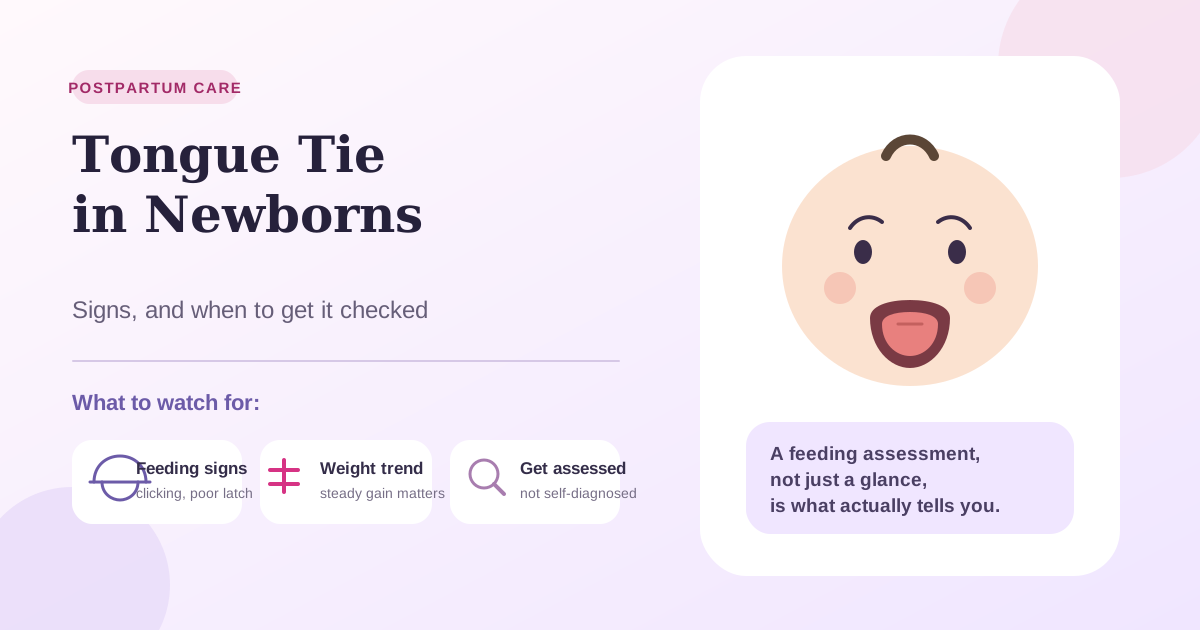
Tongue tie shows up in two places: how your baby feeds, and how you feel while feeding them. Neither one alone is proof, but the combination is worth an assessment.
Signs in your baby:
- Difficulty maintaining a latch, or repeatedly sliding off the breast
- Clicking sounds during feeds, which usually means the seal is breaking and reforming
- Long feeds that still leave your baby seeming unsettled or hungry afterward
- Slow or flat weight gain despite frequent feeding
- A tongue that looks heart-shaped at the tip when your baby cries, or one that can’t extend past the lower gum
Signs in you:
- Nipple pain that persists despite a latch that looks correct from the outside
- Cracked, misshapen, or compressed nipples after feeds
- A sense that your baby is “chewing” rather than drawing milk with suction
The same Portuguese study found this pattern directly: babies diagnosed with ankyloglossia were not significantly more likely to be off exclusive breastfeeding during the hospital stay, but their mothers had a significantly higher rate of nipple pain (prevalence ratio 1.51, 95% CI 1.11 to 2.06) (Dias JM et al., PMID 41438911). In plain terms, a tongue tie is more reliably a mother’s pain problem in the very early days than it is a weight-gain problem, at least in that window. If you’ve already read our guide on cracked nipples, tongue tie is one of the contributors listed there precisely because a baby cannot compensate for restricted tongue movement by “trying harder,” and the friction shows up on you.
None of these signs on its own means your baby has a tongue tie that needs treatment. Clicking happens in plenty of feeds for reasons that have nothing to do with the frenulum, and nipple pain in the first two weeks is common even with an unrestricted tongue while you and your baby are both learning. What the signs above are for is deciding whether a proper feeding assessment is worth arranging, not deciding the diagnosis yourself.
How It’s Assessed
A tongue tie is not diagnosed by a photo sent to a relative or by comparing your baby’s mouth to a picture online. It needs a clinician, usually a paediatrician, lactation professional, or ENT, to examine both the anatomy (how the frenulum looks and attaches) and the function (how far the tongue actually moves, and how the baby feeds in real time).
Several structured tools exist for this. A 2026 systematic review and meta-analysis for the American Academy of Pediatric Dentistry compared the available diagnostic tools and found that the Bristol Tongue Assessment Tool (also called TABBY) had high discriminative accuracy across more than 2,000 clinical cases and correlated strongly with the older Hazelbaker Assessment Tool for Lingual Frenulum Function (correlation 0.89) (Dhar V et al., Pediatric Dentistry, 2026, PMID 42050817). The same review, though, rated the overall evidence linking a restrictive frenulum to feeding difficulties as very low certainty, with a wide, statistically inconclusive pooled estimate: exactly the kind of finding that should make any single scoring number feel less absolute than it sounds when a clinic hands you a printout with a score on it.
What this means in practice: an assessment using a validated tool is a genuine improvement over a quick visual look, but the tool itself is still an aid to clinical judgement, not a verdict that stands on its own. A thorough assessment looks at your baby’s whole feeding picture, weight trend, and your comfort, not the frenulum in isolation.
If your baby is feeding poorly, not gaining weight, passing fewer wet nappies than usual, unusually sleepy or hard to wake, or looking more yellow, she needs to be examined in person by a paediatrician without delay, and urgently if any of those signs are marked. Newborn feeding difficulty cannot be assessed over a screen. If the main problem is nipple pain that isn’t easing, message Dr. Suganya on WhatsApp and we can talk through what you’re seeing and help you arrange the right in-person feeding assessment, over a video consultation.
The Honest Picture on Frenotomy
A frenotomy (sometimes called a tongue-tie release or “clipping”) is a brief procedure where the restrictive band of tissue is cut, usually in a clinic visit with minimal or no anaesthesia for a simple anterior tie. It is quick, and serious complications are uncommon. But quick and low-risk is not the same question as necessary, and this is where the evidence asks for real caution.
Frenotomy rates have risen sharply almost everywhere they’ve been tracked. A nationwide cohort study using Denmark’s universal health register followed every infant born between 2014 and 2024, more than 656,000 babies, and found the annual rate of frenotomy rose from 5.3 per 100 infants in 2015 to 12.1 per 100 infants in 2024, more than doubling in a decade, with the large majority of procedures performed in private practice (Sonne H et al., JAMA Otolaryngology-Head & Neck Surgery, 2026, PMID 41854600). The same study found wide geographic variation, with some municipalities performing the procedure on under 5% of infants and others on more than 36%, a range that reflects differences in local practice more than differences in babies. Its authors were direct about what this means: given the limited evidence on how effective frenotomy actually is, the rising rate calls for closer evaluation of when the procedure is clinically appropriate, not an assumption that more is better.
A separate mixed-methods study from a tertiary hospital in Hyderabad, closer to home, followed 476 mother-baby pairs and compared exclusive breastfeeding and weight gain at 6 months between babies with and without ankyloglossia, none of whom were treated with frenotomy in the study. It found no significant difference in exclusive breastfeeding rates (78.6% versus 81.4%) or in weight gain velocity between the two groups, and mothers who stopped breastfeeding early rarely cited nipple pain or tongue tie itself as the reason (Raol N et al., Pediatrics, 2026, PMID 41380726). Its authors concluded that ankyloglossia alone doesn’t appear to determine whether breastfeeding succeeds, and that a mother’s other concerns, particularly worry about milk supply, mattered more.
Set against that, a 2026 meta-analysis specifically on frenotomy for infants with documented feeding difficulties did find real benefit on some measures: maternal nipple pain showed short-term reductions after the procedure, though whether that benefit lasts remains uncertain, and mothers reported an improved sense of the feeding experience. But the same review rated the overall evidence as very low certainty and was explicit that frenotomy is supported “for documented functional impairment in carefully selected cases where conservative management has failed,” alongside multidisciplinary evaluation, not as a routine response to a visible frenulum (Dhar V et al., Pediatric Dentistry, 2026, PMID 42050812).
A broader 2025 systematic review looking at the entire published literature on tongue tie found the number of studies has grown exponentially since 2017, without a matching rise in study quality: randomised controlled trials made up under 3% of the 462 studies reviewed, and most lacked objective outcomes like breastfeeding duration or growth data (Thornton AR et al., Otolaryngology-Head and Neck Surgery, 2025, PMID 40366002). In plain terms, a great deal has been written about tongue tie, and comparatively little of it can tell us, with confidence, exactly who benefits from cutting the frenulum and who doesn’t.
None of this means frenotomy is the wrong choice for your baby. For a baby with a clearly restrictive tie, a properly done feeding assessment, and persistent pain or feeding trouble that hasn’t responded to positioning and latch correction, it can genuinely help, and the pain-reduction evidence above is real. It means the decision deserves the same weight as any other minor procedure: a clear functional reason, not a reflex response to a frenulum someone noticed.
When a Mild Tie Can Be Managed Without Treatment
Many ties, especially mild ones where the tongue can still extend reasonably and lift toward the palate, cause little or no functional problem and are often managed without surgery at all. In these cases, correcting positioning and latch, working with a lactation professional on technique, and simply giving your baby time to grow (the mouth and frenulum both change shape in the first months) resolve the feeding difficulty on their own for a meaningful number of babies.
This is exactly why a feeding assessment, not a glance under the tongue, is the right first step. If latch correction and positioning support genuinely don’t move the needle after a real trial, that’s the point at which a frenotomy becomes a reasonable next conversation, not the first one.
Practical Steps If You Suspect It
- Start with latch and positioning. Our breastfeeding positions guide covers holds that can make a shallow latch deeper, which resolves a meaningful share of “possible tongue tie” pain on its own.
- Get a proper feeding assessment, not just a look at the frenulum, from a lactation professional or paediatrician who will watch an actual feed.
- Track weight, not just pain. A baby who is feeding 8 or more times in 24 hours and gaining weight as expected is a reassuring sign, even alongside nipple pain.
- If nipple pain persists despite correct positioning, that combination (not clicking sounds alone) is the strongest signal worth acting on.
- Ask what would change if the tie were released. A clinician recommending frenotomy should be able to describe the specific functional problem it’s expected to fix, not just point to the appearance of the frenulum.
- Get a second opinion if something feels rushed. Given the rate variation documented in the Danish data above, a second assessment before a procedure is a reasonable, sensible request, not an overreaction.
Frequently Asked Questions
How do I know if my baby has tongue tie?
Look at the combination of signs, not any single one: a clicking sound while feeding, a tongue that looks heart-shaped when your baby cries, persistent nipple pain despite a latch that looks correct, and slow weight gain. A definite answer needs an in-person assessment of both the anatomy and how your baby actually feeds, not a visual comparison to a photo.
Is tongue tie always a problem?
No. Many babies have a visible frenulum that causes no feeding difficulty at all, and with growth and good feeding support many mild ties stop causing feeding problems, though there is no reliable way to predict which babies will improve on their own. If symptoms persist, ask for a reassessment rather than waiting it out. Tongue tie becomes clinically relevant when it functionally restricts feeding, not simply when it’s visible.
Does my baby need surgery for tongue tie?
Not automatically. A frenotomy is one option, and the evidence supporting it is strongest for babies with a documented functional problem and persistent difficulty after latch correction has genuinely been tried. For milder ties, positioning support and time are often enough.
What happens during a frenotomy?
For a simple anterior tie, it’s usually a brief clinic procedure: the thin band under the tongue is cut, often with minimal or no anaesthesia, and feeding can typically resume within minutes. Serious complications are uncommon, though bleeding and the need for a repeat procedure do occur in a small proportion of cases.
Why are tongue tie diagnoses and frenotomies increasing so much?
Rates have risen sharply in multiple countries over the past decade, and researchers studying this trend have flagged that the rise in procedures hasn’t been matched by an equivalent rise in strong evidence about who actually benefits. This doesn’t mean every recent diagnosis is wrong, but it’s a reasonable reason to want a thorough functional assessment before agreeing to a procedure.
Can tongue tie cause nipple pain even if my baby is gaining weight well?
Yes, and this is one of the more consistent findings in the research: ankyloglossia is more reliably linked to maternal nipple pain than to poor weight gain, especially in the early weeks. Good weight gain doesn’t rule out that a tongue tie is contributing to your pain.
Should I wait, or get it checked now?
If you’re in persistent pain, or your baby is showing clicking, poor weight gain, or real difficulty maintaining a latch despite correct positioning, arrange a feeding assessment now rather than waiting it out. If the signs are mild and your baby is feeding and gaining well, watching and supporting positioning first is a reasonable approach; ask your paediatrician or lactation professional to help you decide which situation you’re in.
If you’re not sure which of these applies to you and your baby, or the pain isn’t improving despite trying the positioning changes above, message Dr. Suganya Venkat on WhatsApp and we’ll work through it together, over a video consultation, alongside a proper feeding assessment.
Fertilia’s Postpartum Recovery program includes lactation support with Dr. Manjari alongside medical oversight, and our free breastfeeding guide covers latch and positioning fundamentals that resolve a large share of early feeding pain on their own. If nipple pain is the main issue you’re dealing with right now, our cracked nipples guide and our guide on increasing breast milk supply cover the related pieces of this picture. For the wider first month, our newborn care guide walks through what else is worth watching in your baby’s first 30 days.
Sources checked
- Dias JM et al. Prevalence of Ankyloglossia in Portuguese Newborns and Its Effect on Exclusive Breastfeeding and Maternal Nipple Pain During Postpartum Hospitalization. Journal of Pediatrics: Clinical Practice. 2025. PMID 41438911.
- Sonne H et al. Temporal Trends and Geographic Variation in Frenotomy Procedures Among Infants. JAMA Otolaryngology-Head & Neck Surgery. 2026. PMID 41854600.
- Raol N et al. Ankyloglossia, Breastfeeding, and Infant Weight Gain: A Mixed-Methods Study. Pediatrics. 2026. PMID 41380726.
- Dhar V et al. Diagnostic Assessment of Ankyloglossia and Association With Infant Feeding Challenges: A Systematic Review and Meta-Analysis, Part 1. Pediatric Dentistry. 2026. PMID 42050817.
- Dhar V et al. Frenotomy for Ankyloglossia Associated With Feeding Challenges in Infants: Effectiveness, Technique, and Safety, Part 2. Pediatric Dentistry. 2026. PMID 42050812.
- Thornton AR et al. Systematic Review of Tongue Tie Publications: Exponential Rise in Publications Without Exponential Increase in Evidence. Otolaryngology-Head and Neck Surgery. 2025. PMID 40366002.
This article provides general education and cannot examine your baby or assess a feed online. A lactation professional, paediatrician, or ENT should assess a suspected tongue tie in person before any procedure is planned.