It tends to catch women off guard the first time it happens. You finished your last period maybe two and a half weeks ago, and here it is again. The calculation seems off. Surely this cannot be right.
Sometimes it is completely fine. Some women simply have shorter cycles, and their bodies have always worked that way. But when a previously regular cycle begins arriving noticeably earlier, or when every cycle is consistently below a certain threshold, it is worth understanding why.
This post walks through what a short cycle means clinically, the most common causes, how to figure out which one applies to you, and what it means if you are trying to conceive.
What counts as a short menstrual cycle?
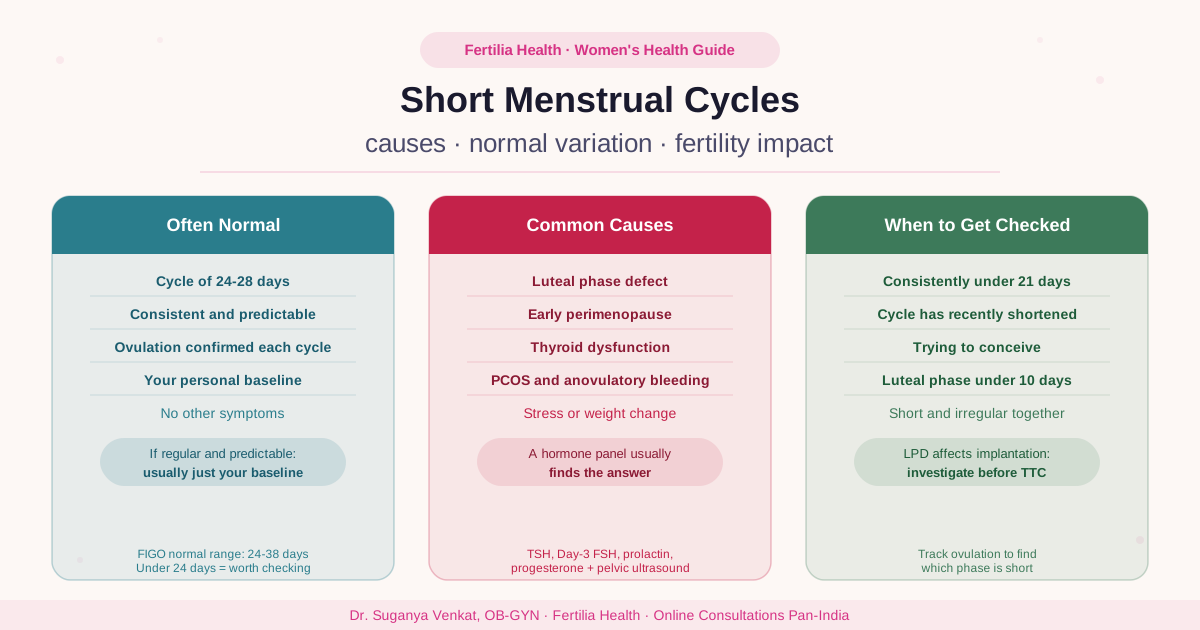
The updated FIGO (International Federation of Gynaecology and Obstetrics) classification defines the normal menstrual cycle as 24 to 38 days from the first day of one period to the first day of the next. Cycles shorter than 24 days fall into the “frequent” category, which is also called polymenorrhoea (Munro et al., Int J Gynaecol Obstet, 2011, PMID 21345435).
Many women and older references still use the threshold of 21 days as the lower boundary of normal. In practice, a cycle of 21 days is now considered short by current clinical criteria, and consistently cycling at 18 to 20 days is always worth investigating.
Why cycles shorten: a two-phase explanation
Your menstrual cycle has two distinct halves, and which phase shortens tells you a great deal about what is happening.
The follicular phase runs from day one of your period to ovulation. This is the variable part. Depending on how quickly a follicle matures and releases an egg, it can last anywhere from 7 to 21 days across different women and different cycles. Ovulation happens when a follicle is ready; the brain signals it; the egg is released. When this phase shortens, ovulation happens earlier, and the whole cycle compresses.
The luteal phase runs from ovulation to the first day of your next period. This phase is much more fixed. In most women it lasts between 12 and 16 days (Lenton et al., Br J Obstet Gynaecol, 1984, PMID 6743609). It is controlled by the corpus luteum, the structure that remains on the ovary after the egg is released. The corpus luteum produces progesterone for a set lifespan before it breaks down, progesterone falls, and the lining sheds.
When cycles shorten, the follicular phase is almost always the part that has changed. Rarely, the luteal phase shortens, and that is clinically significant in a different way, particularly for women trying to conceive.
Common causes of short menstrual cycles
1. Natural baseline variation
Before assuming something is wrong, it helps to ask: has my cycle always been short, or is this new?
Some women naturally cycle every 22 to 25 days throughout their reproductive years. Their follicular phases are on the quicker end of normal. If ovulation is occurring and the luteal phase is adequate, a consistently short but regular cycle does not indicate a problem.
For more on this, read our guide on Menstrual Cycle 101. What matters clinically is change. If your cycle has reliably been 26 to 28 days for years and has recently moved to 20 to 22 days, that shift is worth investigating. If it has always been 23 days, that is likely just how your body works.
2. Early perimenopause (even in your late 30s)
One of the earliest and least-discussed signs of the perimenopausal transition is a shortening of the menstrual cycle. As the ovarian reserve starts to decline, FSH (follicle-stimulating hormone) rises. Follicles respond to the higher FSH signal by maturing faster, which means ovulation occurs earlier in the cycle. The net effect is a shorter follicular phase and a cycle that arrives sooner.
The STRAW+10 criteria describe this early-perimenopausal pattern: cycles that are still regular but noticeably shorter than before, often by 6 or more days, before the erratic, longer cycles of later perimenopause begin (Harlow et al., Menopause, 2012, PMID 22343510). Menolia’s guide to how periods change through perimenopause covers what comes next in that transition.
This change can begin in women as young as 37 or 38. If you are in your late 30s or early 40s and your cycle has quietly shortened over the past year without an obvious reason, a Day-3 FSH, AMH, and estradiol check is a good starting point.
3. Luteal phase defect
This is a distinct situation from a shortened follicular phase, and it matters particularly for women trying to conceive. Here, it is the luteal phase itself that is abnormally short, under 10 days from ovulation to the first day of bleeding.
The luteal phase depends on progesterone from the corpus luteum. When the corpus luteum does not sustain adequate progesterone for long enough, the endometrium breaks down earlier than it should. The period arrives early. The cycle looks short, but the underlying problem is insufficient progesterone support in the second half of the cycle.
A luteal phase defect can occur on its own, or alongside thyroid dysfunction, high prolactin, or significant stress. It is clinically relevant to fertility because the window between ovulation and the next period may not be long enough for an embryo to implant.
For the full detail on identifying and supporting luteal phase defect, the post on luteal phase defect: signs, tests, and how to support it covers this in depth.
4. Thyroid dysfunction
Both an underactive thyroid (hypothyroidism) and an overactive thyroid (hyperthyroidism) can alter menstrual cycle length and flow. Thyroid hormones influence sex hormone-binding globulin, LH, and FSH, all of which affect when ovulation happens.
In hyperthyroidism, periods often become lighter and more frequent, which can result in a shortened cycle. In hypothyroidism, cycles more often become heavier and irregular, but shorter cycles are also possible. Both directions of thyroid dysfunction can disrupt the cycle.
Thyroid issues are among the most commonly missed causes of menstrual changes in Indian women, where subclinical thyroid dysfunction is particularly prevalent. A TSH test, ideally alongside T3 and T4, should be part of the workup any time cycles change without an obvious explanation (Krassas, Clin Endocrinol, 1999, PMID 10468928).
The fuller connection between thyroid function and reproductive health is covered in the post on thyroid and fertility in Indian women.
5. PCOS and anovulatory bleeding
PCOS is most commonly associated with infrequent periods. But not always. In some women with PCOS, the hormonal pattern produces erratic and sometimes frequent bleeding rather than long gaps between periods. This often is not a true short cycle in the ovulatory sense, but anovulatory breakthrough bleeding: the lining builds up and sheds unpredictably, sometimes at short intervals.
The distinction matters because the clinical approach differs. True polymenorrhoea in a woman who is ovulating needs different management from anovulatory irregular bleeding in a woman with PCOS. Tracking when bleeding arrives and whether there is a predictable pattern across several months, alongside ovulation testing, helps clarify which is happening.
The post on PCOS and periods: why they go missing and how to get them back explains the PCOS hormonal picture in detail.
6. Stress and significant weight change
The hypothalamus, the brain region that drives the hormonal cascade governing your cycle, is sensitive to physical and psychological stress. When the body is under sustained stress, or experiences rapid weight loss, or is under-fuelled over time, the GnRH (gonadotropin-releasing hormone) pulse pattern can change. This most often delays ovulation and lengthens cycles. But in some women, the disruption accelerates follicular maturation instead, producing a shorter cycle.
If your cycle shortened after a period of significant stress, a major dietary change, or notable weight loss, that connection is worth considering. The cycle often normalises once the stressor reduces or lifestyle support is in place.
If you are trying to conceive and your cycles are consistently short, a call with the Fertilia team will help put the picture together. A short cycle can mean an earlier ovulation window or a compressed luteal phase, and knowing where your cycle sits helps you time things accurately. Message Dr. Suganya on WhatsApp for a Rs. 399 video call and we will go through your cycle history together.
How to find out which phase is shortened
Because the follicular and luteal phases are clinically different and require different responses, it helps to know which one is affected in your case.
The most practical approach is to track ovulation for two to three cycles.
LH strips (urine ovulation predictor kits) detect the LH surge that occurs 24 to 36 hours before ovulation. For a short cycle, begin testing from around day 8. When you see the positive surge, note the date. Count from that day to the first day of your next period. That count is your luteal phase length. If it is consistently 10 days or fewer, a luteal phase defect is likely. If it is 12 to 16 days, the luteal phase is adequate and the short cycle is coming from a quick follicular phase instead.
Basal body temperature (BBT) tracking shows a sustained temperature rise after ovulation. Counting from the temperature shift to the next period gives the same information about luteal length.
A mid-luteal progesterone test, timed to approximately 7 days after confirmed ovulation, checks whether the corpus luteum is producing adequate progesterone. For a woman with a 22-day cycle who ovulates on day 9 or 10, the mid-luteal test would be around day 16 or 17, not the standard day 21. The test needs to be timed to your cycle, not to a fixed calendar day.
For more on how to interpret this test and what the numbers mean, see the post on Day-21 progesterone: did you ovulate this cycle?
Ovulation symptoms can also provide useful information while you are tracking. The post on ovulation symptoms and signs of ovulating covers what to look for.
Blood tests worth considering
If cycles are consistently shorter than 21 days, or have recently shortened by 5 or more days from your previous pattern, a baseline hormone panel is worth getting:
- Day-3 FSH and estradiol: A rising FSH level can signal declining ovarian reserve and early perimenopause. A high estradiol on day 3 can also suppress FSH, making it look falsely normal, so both are checked together.
- AMH: A useful indicator of ovarian reserve, though less relevant to cycle timing directly.
- TSH: To rule out thyroid dysfunction.
- Prolactin: Elevated prolactin can shorten cycles and disrupt luteal function.
The post on Day-3 FSH, LH, and estradiol: what the baseline test shows explains what the numbers mean and how to read them.
When short cycles matter most for fertility
A short cycle is not automatically a fertility concern. Many women with 22 to 24 day cycles conceive without difficulty. The situations where it becomes clinically relevant are:
Luteal phase under 10 days: If the luteal phase is too short, the embryo does not have long enough to implant before progesterone drops and the lining sheds. This is the version of a short cycle that directly affects conception, and it is the one most worth investigating and addressing before trying to conceive. Progesterone support in the luteal phase is the usual approach, guided by your doctor.
Perimenopause with reduced ovarian reserve: A shortened cycle in the late 30s or early 40s associated with rising FSH or declining AMH indicates the ovarian reserve is decreasing. This does not make conception impossible, but it does mean the fertile window is smaller and timing matters more.
Short cycles with no confirmed ovulation: If cycles are short and ovulation is not occurring consistently, the cycle is not producing a viable egg each time. In this case, the short interval is a downstream effect of the underlying issue, not the core problem. Confirming ovulation by LH strip or blood test is the first step.
The broader context of menstrual irregularity, including what counts as irregular and what the workup involves, is covered in the post on irregular periods: causes and natural solutions.
A note on Indian naming and search terms
Short menstrual cycles are described in several ways across India’s languages. In Hindi, you might search for “period jaldi aana” (period coming early), “chota mahina aana” (short cycle arriving), or “period har 18-20 din mein aana” (period every 18-20 days). In Tamil, the pattern is sometimes called “adikamaai varum maadhavidaai” or “kurai naatkal maadhavidaai” (short-days period). The medical term polymenorrhoea (sometimes spelled polymenorrhea) refers specifically to cycles consistently shorter than 24 days.
Whatever language you search in, the clinical picture and the investigations are the same.
If your cycle is consistently shorter than 21 days, has recently shortened, or you are trying to conceive and are not sure what the pattern means, a consultation with Dr. Suganya can help. She consults online across India, and the Rs. 399 video call covers a full review of your cycle, any test results you have, and a clear plan for what to investigate or address. Start the conversation on WhatsApp
Frequently asked questions
Is a 21-day cycle normal?
By current FIGO criteria, a 21-day cycle falls below the normal range of 24 to 38 days and would be classified as a frequent or short cycle. Many older references defined the lower boundary as 21 days, so you may see that number cited elsewhere. In clinical practice, a 21-day cycle that has always been your baseline and is regular and predictable is less concerning than one that has recently shortened from 28 days. Consistently cycling at 21 days or under is worth a hormone check and a conversation with your doctor, particularly if you are trying to conceive.
Can I get pregnant with a short cycle?
Yes. Many women with cycles in the 22 to 25 day range conceive without difficulty. Ovulation simply happens earlier in the cycle, and the fertile window falls a few days sooner. The situation that most directly affects conception is a short luteal phase under 10 days, where implantation time is reduced. Tracking ovulation for two to three cycles will clarify whether this applies to you.
How do I know if I have a luteal phase defect?
Track ovulation using LH strips or basal body temperature, then count the days from confirmed ovulation to the first day of your next period. If this is consistently 10 days or fewer across multiple cycles, a luteal phase defect is likely. A mid-luteal progesterone test, timed to 7 days after ovulation, can support the diagnosis by showing whether progesterone is at adequate levels. See the post on luteal phase defect for the full detail.
My cycle used to be 28 days and is now 20-22 days. What has changed?
A shortening of 6 or more days, particularly in the late 30s or early 40s, is one of the earliest signs of the perimenopausal transition. Rising FSH causes follicles to mature faster, moving ovulation earlier. Other possibilities include a thyroid change, a shift in stress levels, or a significant weight change. A hormone panel including Day-3 FSH, AMH, TSH, and prolactin is the best starting point.
Can stress cause my period to come early?
Yes, in some cases. Stress affects the hypothalamic-pituitary-ovarian axis, which controls the timing of ovulation. For most women, stress delays ovulation and lengthens the cycle. For some, it accelerates follicular maturation instead, producing a shorter cycle. If your cycles shortened after a period of sustained stress, illness, travel, or dietary restriction, the connection is plausible. The cycle often returns to its previous pattern when the stressor resolves.
My period comes every 18-19 days. When should I see a doctor?
A cycle that is consistently 18 to 19 days is shorter than the normal range and should be investigated. At that interval, the follicular phase is very compressed, and the luteal phase may also be short depending on when ovulation occurs. A workup including FSH, TSH, prolactin, AMH, and ovulation tracking will usually identify the cause. A ₹399 consultation with Dr. Suganya is a good starting point, and she can advise whether further tests are needed.
What tests do doctors run for short menstrual cycles?
The standard initial panel is: Day-3 FSH and estradiol (to assess the follicular start of the cycle and ovarian reserve signalling), TSH (thyroid), prolactin, and AMH (ovarian reserve context). Ovulation tracking via LH strips or basal body temperature adds functional information about which phase is shortened. A mid-luteal progesterone level, timed to 7 days after confirmed ovulation, completes the picture of luteal phase function.