You have just delivered your baby, and in the middle of the relief and exhaustion, someone on your care team says the placenta has not come away yet. It is a strange moment to have to process, right after everything else your body has just been through, and the word “retained” makes it sound more alarming than it usually is.
I’m Dr. Suganya Venkat, an OB-GYN, and over more than 15 years of practice I have sat with many women right after this exact moment, watching their care team work through it calmly while they wondered whether to be frightened. Retained placenta is one of the more common third-stage complications managed in a delivery room. It is well understood, it is actively watched for at every birth, and in the overwhelming majority of cases it is resolved the same day, in hospital, without lasting effect on your health or your ability to have another baby. This guide walks through why it happens, what treatment looks like, and what it does and does not mean for your recovery and your future pregnancies.
In this post:
- What counts as a retained placenta, and why the timing matters
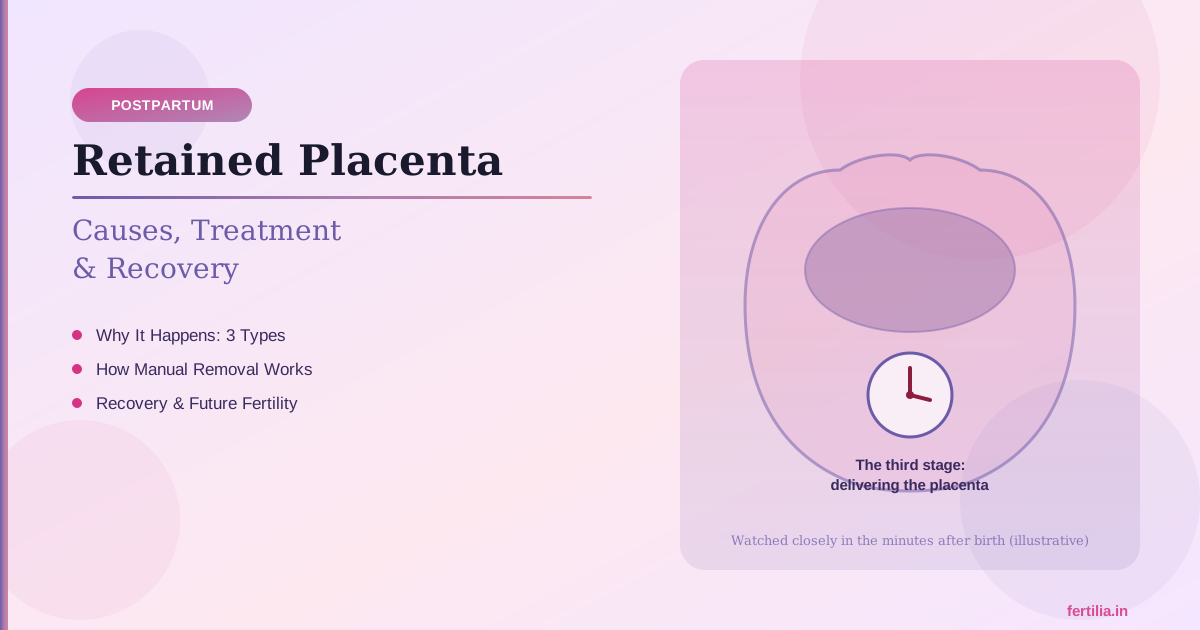
- The three underlying reasons it happens
- How common it is, and who is more likely to experience it
- What treatment looks like: from cord traction to manual removal
- Recovery, and what it means for your future pregnancies
- Answers to the questions women ask most
What Retained Placenta Means
After your baby is born, your uterus is meant to continue contracting, which separates the placenta from the uterine wall and delivers it, usually within a matter of minutes. A retained placenta is when all or part of the placenta has not been delivered within the expected window after your baby’s birth (Coviello EM et al., American Journal of Obstetrics and Gynecology, 2015, PMID 26226556).
There is some variation in exactly where that window is drawn. Many hospitals flag it at 30 minutes after delivery, and clinical reviews describe manual removal as generally being carried out somewhere between 30 and 60 minutes postpartum, since a placenta that is going to separate on its own most often does so within that time (Weeks AD, Best Practice & Research Clinical Obstetrics and Gynaecology, 2008, PMID 18793876). If you are not actively bleeding, your care team may reasonably watch for a little longer before intervening. If you are bleeding, they act sooner. Either way, this is a decision your obstetric team is actively making in the room, not a fixed stopwatch running against you.
It helps to separate this from retained products of conception, a related but different situation where a small fragment of placental tissue is discovered to have been left behind after what looked like a complete delivery, sometimes not identified until days or weeks later through ongoing bleeding or a scan. What this guide covers is the more immediate scenario: the placenta, or part of it, has not delivered in the expected window right after birth.
Why It Happens: Three Underlying Reasons
Retained placenta is not one single problem with one single cause. Clinical reviews describe three recognised types, and understanding which one is happening is what shapes how it is treated (Weeks AD, PMID 18793876; Akol AD, Weeks AD, Acta Obstetricia et Gynecologica Scandinavica, 2016, PMID 26765548):
Placenta adherens. The placenta has separated from the uterine wall, or is in the process of separating, but the uterus itself is not contracting firmly enough to push it out. This is closely related to uterine atony, the same underlying issue behind most cases of heavy bleeding after delivery, which we cover in detail in our guide to postpartum haemorrhage.
Trapped placenta. The placenta has fully separated and is essentially ready to come away, but it becomes caught behind a cervix that has already started to close. This can happen when the third stage moves quickly after a rapid delivery, or the cord is handled in a way that closes off the space it needs to pass through.
Partial placenta accreta. A small area of the placenta has attached more deeply into the uterine wall than normal, so that area will not separate even while the rest of the placenta has. This is a smaller-scale version of the same abnormal attachment we cover in our guide to placenta accreta spectrum, and a prior C-section is a shared risk factor for both.
All three types are managed with manual removal if they do not resolve on their own, though the specific medical options tried first can differ slightly depending on which type your team suspects.
How Common It Is, and Who Is More Likely to Experience It
Retained placenta complicates roughly 1 to 3% of vaginal deliveries in well-resourced hospital settings, based on a large US cohort of over 91,000 deliveries (Coviello EM et al., PMID 26226556). A systematic review pooling 35 studies found reported rates ranging more widely, from 0.5% to 4.8%, reflecting differences in how studies define and record it (Favilli A et al., BMC Pregnancy and Childbirth, 2021, PMID 33789611).
Several factors are consistently linked to a higher likelihood:
- A previous retained placenta. This is one of the strongest known predictors. One large cohort found that among women who had experienced retained placenta once, 9.3% had it again at their very next delivery (Rottenstreich M et al., Journal of Maternal-Fetal & Neonatal Medicine, 2021, PMID 31718354). A separate hospital-based study found an even higher pattern: 25.3% of women with a prior retained placenta experienced it again at a subsequent vaginal delivery, compared with 5.3% of women with no such history (Nikolajsen S et al., Acta Obstetricia et Gynecologica Scandinavica, 2013, PMID 22882191).
- A previous C-section or previous dilation and curettage (D&C). Both leave the possibility of some scarring in the uterine lining, which is part of why they are linked to retained placenta as well as to placenta accreta spectrum (Favilli A et al., PMID 33789611).
- Labour induction, which was independently associated with a higher chance of recurrence in the cohort above (Rottenstreich M et al., PMID 31718354).
- Maternal age of 30 or older, and delivery well before term, which were both linked to a higher likelihood in the large US cohort (Coviello EM et al., PMID 26226556).
- A history of stillbirth in a prior pregnancy was also strongly associated with retained placenta in that same cohort, though the reason for the link is not fully understood.
None of these factors mean retained placenta will definitely happen. They are simply what your care team keeps in mind, and part of why active management of the third stage, which we explain in our postpartum haemorrhage guide, is standard practice at almost every hospital delivery today, regardless of your individual risk.
If you have questions about your own delivery history or risk factors before your next birth, message Dr. Suganya on WhatsApp and we can talk it through over a video consultation.
What Treatment Looks Like
Here is the sequence your care team typically works through, and why each step comes before the next:
Step 1: Gentle, controlled cord traction. If the placenta has separated but not fully delivered, your obstetrician applies gentle, sustained traction on the umbilical cord while supporting the uterus with the other hand, encouraging the placenta out. This alone resolves many cases, particularly where the placenta has already separated and simply needs help completing the journey.
Step 2: Additional oxytocin. If a uterotonic medication was already given as part of routine active management and the placenta still has not delivered, your team may give an additional dose, since a better-contracted uterus is more likely to expel it. In some settings, oxytocin injected directly into the umbilical vein is used specifically for this purpose, and has been shown to reduce the need to proceed to manual removal by around 20% (Weeks AD, PMID 18793876).
Step 3: Manual removal of the placenta. If the steps above do not work within the expected window, or if you are bleeding significantly, your obstetrician performs manual removal: with adequate pain relief, usually a spinal or general anaesthetic, a gloved hand is passed into the uterus to gently separate the placenta from the uterine wall and remove it directly. This is done in an operating theatre or a fully equipped delivery room, with the same readiness (blood availability, monitoring, a full surgical team on standby) as any other obstetric procedure. It sounds more dramatic described in words than it typically is in practice: for the large majority of women, it is a single, controlled procedure, over within minutes, after which the bleeding that retained placenta was causing settles because the uterus can finally contract fully.
Antibiotics after manual removal. Manual removal does raise the chance of infection compared with a placenta that delivers on its own, since it involves a hand entering the uterine cavity, and many hospitals give a dose of antibiotics as a precaution. It is worth knowing that the evidence on how much this actually reduces infection is limited: an updated Cochrane review found the evidence supporting routine prophylactic antibiotics for this purpose is very uncertain (Kongwattanakul K et al., Cochrane Database of Systematic Reviews, 2024, PMID 39474979). Many hospitals use antibiotics as standard practice regardless, given the biologically plausible risk, and that is a reasonable, common approach for your care team to take.
Rarely, surgery beyond manual removal. In a small number of cases, usually where accreta is more extensive than expected or bleeding cannot be controlled by the steps above, further surgical intervention is needed. This is uncommon, and your surgical team plans for this possibility as a matter of routine readiness rather than an expected outcome.
Recovery and What It Means for Future Pregnancies
For most women, recovery after treated retained placenta looks very similar to recovery after any vaginal delivery, once the immediate treatment is complete. Your care team will watch you a little more closely in the hours after manual removal, for bleeding and for early signs of infection such as fever, since these are the two specific things the procedure carries a slightly higher chance of.
A single episode of retained placenta does not generally affect your ability to have another baby. This is the question I hear most often once the immediate treatment is behind a woman, and it is genuinely reassuring: manual removal, done properly, does not damage the uterus in a way that changes future fertility for the majority of women. What it does mean is that your obstetrician will note it in your history, since, as covered above, it does raise the chance of it happening again in a future delivery. That is a planning detail for your next birth, not a diagnosis that changes the picture of your fertility today.
If you have had retained placenta more than once, or if it was caused by a partial accreta rather than atony or a trapped placenta, raise it specifically with your obstetrician before your next pregnancy. Naming it early is what lets your care team watch for it again and plan your next delivery around it from the start.
Practical Takeaways
- Retained placenta is actively watched for at every hospital delivery. It is not something that catches your care team off guard.
- If you are not bleeding, a short period of watchful waiting beyond 30 minutes is a normal, reasonable clinical decision, not a sign that something has gone wrong.
- Manual removal, when needed, is a controlled procedure done with proper pain relief, not an emergency scramble.
- A previous retained placenta is the strongest predictor of it happening again, so mention it at your very first antenatal visit in any future pregnancy.
- One episode, properly treated, does not generally change your future fertility. Most women who have had a retained placenta go on to have straightforward pregnancies afterward, with a little extra planning built into the next delivery.
Our Postpartum Recovery program supports women through the full six weeks after any kind of delivery, including working through exactly what happened at your birth so you go into your recovery with clear answers rather than lingering questions. The Postpartum Care Guide is a useful printable summary of the wider recovery timeline if you want the fuller picture.
If something about your own delivery still feels unresolved, or you want to talk through what a retained placenta diagnosis means for your specific history, message Dr. Suganya Venkat on WhatsApp. Bring your questions, however small they feel, and we will work through them together on a video consultation.
Frequently Asked Questions
What is a retained placenta? A retained placenta is when all or part of the placenta has not delivered within the expected window after your baby is born, typically judged from around 30 minutes onward depending on whether there is bleeding. It happens for one of three reasons: the uterus is not contracting firmly enough to expel an already-separating placenta, the placenta has separated but is trapped behind a closing cervix, or a small area of the placenta has attached too deeply to separate on its own.
How common is retained placenta? It complicates approximately 1 to 3% of vaginal deliveries in well-resourced settings, with reported rates across different studies ranging from 0.5% to 4.8% (Coviello EM et al., PMID 26226556; Favilli A et al., PMID 33789611).
What are the symptoms of a retained placenta? The main sign is that the placenta simply has not delivered within the time your care team expects, which they are actively monitoring for in the minutes right after your baby is born. It is often, though not always, accompanied by heavier than expected bleeding, since the uterus cannot fully contract and close off the placental site while part of the placenta remains attached.
How is a retained placenta treated? Treatment usually starts with gentle controlled cord traction and, if needed, additional uterotonic medication. If the placenta still has not delivered, or if bleeding is significant, manual removal is performed with adequate pain relief, most often a spinal or general anaesthetic. This resolves the large majority of cases.
Does manual removal of the placenta hurt? The procedure itself is done under anaesthesia, so you should not feel pain during it. Some cramping and tenderness afterward, similar to strong period pain, is common in the following day or two as the uterus continues to contract and heal.
Will a retained placenta affect my ability to have another baby? For most women, no. A single episode, properly treated, does not generally affect future fertility. What it does mean is a higher chance of it happening again at a future delivery, which is why it is worth mentioning to your obstetrician at your very first antenatal visit next time, so your care team can plan for it.
Can a retained placenta be prevented? Active management of the third stage of labour, giving a uterotonic medication right after birth and using controlled cord traction to help deliver the placenta, is standard practice at nearly every hospital delivery today and reduces the overall chance of complications including retained placenta and heavy bleeding. It cannot be prevented entirely, since some cases, particularly partial accreta, relate to how the placenta attached earlier in pregnancy rather than anything that happens during labour.
Is retained placenta an emergency? It requires prompt hospital attention and is treated the same day it occurs, since delivery has already happened in a hospital setting when it is identified. It is a well-understood, well-managed situation rather than an unpredictable crisis, and the overwhelming majority of cases are fully resolved without lasting complications for either your health or your future pregnancies.
Dr. Suganya Venkat is an OB-GYN with a DNB from GKNM Hospital, Coimbatore, an MD Pathology from CMC Vellore, and 5 Gold Medals in MBBS from SRMC. She has 15+ years of clinical experience in obstetrics and women’s health.