Your doctor has prescribed Utrogestan suppositories to be inserted vaginally at night. Or Duphaston tablets twice a day. Or Proluton Depot injections, weekly, at the clinic. You have the prescription in your hand and a reasonable question in your mind: what is this for, and does it matter?
Progesterone is prescribed in pregnancy for several distinct clinical reasons, and those reasons are not interchangeable. The scenario that led to your prescription shapes which formulation you need, when you start, and when you stop.
If you want to understand what a progesterone blood test result means in terms of normal ranges by trimester, that is a separate question, covered in the guide to progesterone levels in pregnancy. This post is specifically about treatment: the clinical situations in which supplementation is prescribed.
What Progesterone Does in Early Pregnancy
In the first weeks after conception, progesterone is produced by the corpus luteum, the small structure that forms in your ovary after the egg is released. The corpus luteum is a temporary gland. Its job is to keep progesterone high enough to maintain the uterine lining and support the embryo while it implants and begins to grow.
This arrangement is designed to be temporary. Around 8 to 10 weeks of pregnancy, the placenta takes over progesterone production. This transition, called the luteo-placental shift, is a normal developmental step. Once the placenta is the primary source, the corpus luteum is no longer the critical factor. In most pregnancies, this shift happens without any intervention.
But there are clinical situations where the corpus luteum has been disrupted, where its function is inadequate, or where progesterone supplementation serves a separate purpose later in pregnancy.
When Progesterone Is Prescribed
1. Luteal Support After IVF or IUI
This is the most common reason for progesterone supplementation in pregnancy, and the evidence behind it is unambiguous.
During an IVF cycle, eggs are collected from the ovaries through a needle aspiration procedure. The follicle that contained each egg would normally go on to form a corpus luteum after natural ovulation. After aspiration, it does form a corpus luteum, but the aspiration removes some of the cells that would have made it, and, more importantly, the very high oestrogen and progesterone levels produced by a stimulated cycle switch off the pituitary’s LH signal that a corpus luteum depends on. The GnRH agonist or antagonist used to control the cycle suppresses that signal further. The resulting corpus luteum does not produce adequate progesterone to support a fresh embryo transfer, so the uterine lining does not receive the hormonal support it needs in the days after transfer.
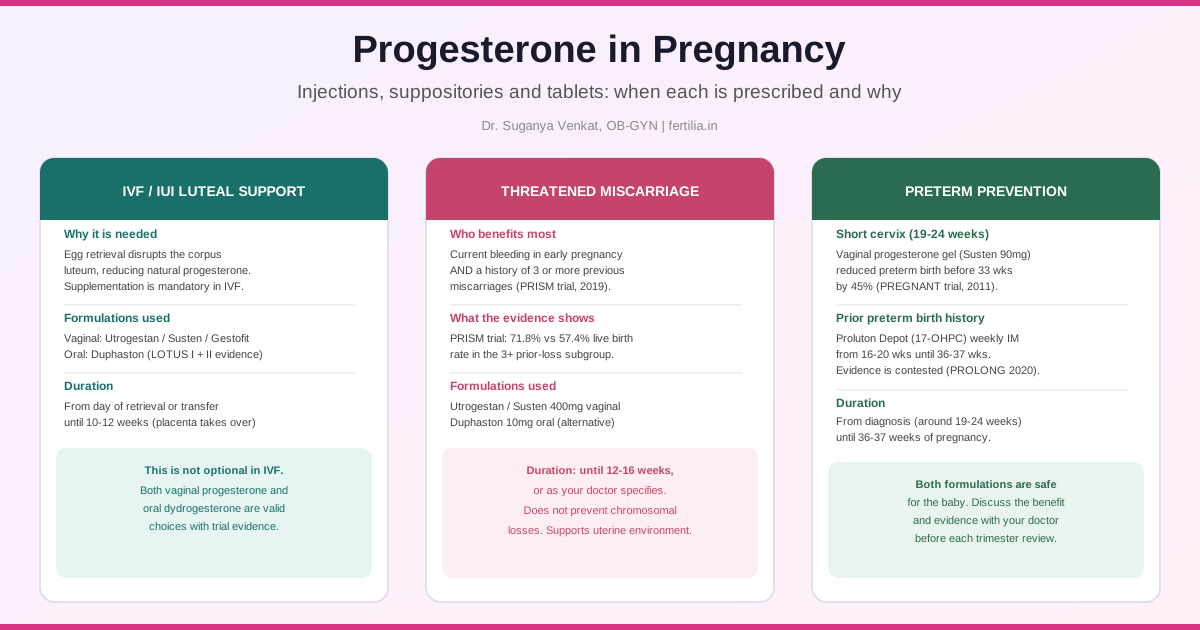
For this reason, progesterone supplementation is a standard, non-negotiable part of a fresh IVF transfer and of a programmed (hormone-replacement) frozen embryo transfer, where there is no corpus luteum at all. It begins on the day of egg retrieval or embryo transfer and continues until the 10 to 12 week scan confirms a healthy, growing placenta has taken over. The exception is a natural-cycle frozen transfer, where your own corpus luteum is intact and protocols differ between clinics; if you were not prescribed progesterone for one of those, it is not an oversight. For IUI cycles with ovarian stimulation, many centres prescribe luteal support on the same reasoning, but practice varies and the evidence for benefit in IUI is weaker than for IVF.
For women in this situation: you need this medication. The uncertainty is about which formulation (covered below), not about whether to take it.
2. Threatened Miscarriage (Bleeding in Early Pregnancy)
Vaginal bleeding in early pregnancy, classified as threatened miscarriage, is more common than many women realise. Around 20 to 25% of all pregnancies involve some bleeding in the first trimester, and the majority continue without complication. Whether progesterone helps in this situation depends on who you are, and the evidence is specific enough to be worth reading carefully.
The largest randomised trial on this question is the PRISM trial (Coomarasamy et al., 2019, New England Journal of Medicine, PMID 31067371). It randomised 4,153 women with bleeding in early pregnancy, regardless of miscarriage history, to vaginal progesterone 400 mg twice daily or placebo, continued to 16 weeks. In the trial as a whole, the difference in live births was small and not statistically significant (75% versus 72%). The benefit appeared in a pre-specified subgroup: among women with three or more previous miscarriages, live births rose from 57% with placebo to 72% with progesterone, a statistically significant difference. That is a subgroup result, not the trial’s primary finding, and it is the reason the guidance is targeted rather than universal.
Bleeding in early pregnancy needs to be assessed, not just treated. Heavy bleeding that soaks a pad an hour, severe or one-sided lower abdominal pain, pain felt at the tip of the shoulder, fever, or feeling faint or dizzy are reasons for same-day review at a hospital, not a WhatsApp message, because an ectopic pregnancy can present exactly this way. Progesterone is prescribed only once a scan has confirmed where the pregnancy is.
The clinical interpretation in practice: current bleeding plus a history of recurrent loss is the combination where the PRISM data supports progesterone use. A single prior miscarriage with no current bleeding is a different clinical situation, and the evidence for supplementation there is less clear.
If you are on progesterone for this reason and your bleeding has settled, ask your doctor at the next visit when they plan to review the prescription. It is a reasonable question with a specific answer.
For more on what miscarriage involves and what the recovery looks like, see Miscarriage: Causes, Signs & What Happens Next.
3. Recurrent Pregnancy Loss (Three or More Losses) Without Bleeding
For women with a history of three or more unexplained consecutive miscarriages who are not currently bleeding, progesterone is sometimes prescribed as a precaution from the moment a positive test is confirmed.
The PROMISE trial (Coomarasamy et al., 2015, New England Journal of Medicine, PMID 26605928) tested vaginal progesterone against placebo in exactly this group. The live birth rate was 65.8% in the progesterone group and 63.3% in the placebo group, a difference that did not reach statistical significance.
In clinical practice, many doctors still prescribe progesterone in this setting. The rationale is that the treatment is low-risk, some women do respond, and the confidence intervals in the PROMISE trial did not rule out a modest benefit. Your doctor will weigh your individual history. What matters most, before or alongside progesterone, is understanding whether your losses had an identifiable cause. Chromosomal analysis of the pregnancy tissue, thrombophilia testing, and antiphospholipid antibody screening, among other investigations, may be more consequential than the supplement itself. For the full investigation pathway after recurrent loss, see Recurrent Miscarriage: What Tests to Get After 2 Losses.
4. Short Cervix and Preterm Birth Prevention
Vaginal progesterone has a well-established role in reducing the risk of preterm birth for women found to have a short cervix on a second-trimester ultrasound scan.
The PREGNANT trial (Hassan et al., 2011, Ultrasound in Obstetrics and Gynecology, PMID 21472815) showed that vaginal progesterone gel (90 mg daily) in women with a cervical length of 10 to 20 mm between 19 and 24 weeks of pregnancy reduced preterm birth before 33 weeks by 45%, from 16.1% to 8.9%. This finding has been replicated in multiple meta-analyses. For what a short cervix measurement means on your scan report, see Short Cervix in Pregnancy: What Cervical Length Means.
A separate indication involves weekly progesterone injections (17-alpha-hydroxyprogesterone caproate, abbreviated 17-OHPC) for women who have had a prior spontaneous preterm birth before 37 weeks. The Meis trial (Meis PJ et al., New England Journal of Medicine, 2003, PMID 12802023) showed that 250 mg weekly injections from 16 to 20 weeks reduced preterm birth before 37 weeks from 54.9% to 36.3%. In India, this is available as Proluton Depot (Bayer/Schering). A subsequent large trial, PROLONG (Blackwell et al., 2020, PMID 31652479), did not replicate these results, and the US FDA withdrew approval for this indication in 2023. Your obstetrician will weigh this evidence against your specific history when recommending whether Proluton is appropriate for your pregnancy.
WhatsApp Dr. Suganya for an online consultation, pan-India. She can review your clinical situation and explain which formulation and duration applies to your case.
Which Formulation, and Why?
The route and formulation of progesterone follow from the clinical reason for prescribing it.
Vaginal Micronized Progesterone (Utrogestan, Susten, Gestofit)
Micronized progesterone means the hormone has been broken into very fine particles to improve absorption. When taken vaginally, it achieves high local concentrations directly in the uterus, a property called the uterine first-pass effect. The same dose produces a much larger local uterine effect when inserted vaginally than when swallowed. This is why the vaginal route is the standard of care for uterine support in IVF and for threatened miscarriage, where local uterine action is the goal.
Available brands in India:
- Utrogestan (100 mg, 200 mg capsules for vaginal use): the original micronized progesterone brand
- Susten (Sun Pharma; 200 mg, 400 mg capsules; also as Susten 8% vaginal gel, 90 mg per applicator, for the short-cervix preterm-prevention indication)
- Gestofit (Alembic; 200 mg, 400 mg capsules)
Several other Indian brands carry the same salt, natural micronized progesterone 200 mg, under names such as Progestone, Progess and Prognex; the salt line on the strip is what matters, not the brand (brand and strength details checked against online pharmacy listings, September 2026).
These are inserted vaginally, typically at bedtime. A white waxy discharge from the undissolved capsule coating is expected and is not a sign of infection.
Dose depends on the clinical indication. IVF luteal support commonly uses 400 mg per day, given as 200 mg twice daily or 400 mg once at night. The short-cervix preterm-prevention indication uses the Susten gel at 90 mg daily.
Oral Dydrogesterone (Duphaston)
Dydrogesterone is a synthetic progestogen that binds the same receptors as natural progesterone. It is not identical to progesterone, but it has a well-documented safety profile and clear clinical trial evidence. Duphaston (Abbott) 10 mg tablets, taken two or three times daily, is one of the most widely prescribed medications in early pregnancy across India.
For IVF luteal support, the LOTUS I and LOTUS II trials (Tournaye et al., 2017, PMID 28333318; Griesinger et al., 2018, PMID 30304457) compared oral dydrogesterone 30 mg daily against vaginal micronized progesterone and found noninferior ongoing pregnancy and live birth rates. This means either formulation is a valid choice for IVF luteal support.
For threatened miscarriage, the Cochrane review of progestogens (Wahabi et al., 2018, Cochrane Database of Systematic Reviews, PMID 30081430) pooled seven trials of 696 women and found that treatment probably reduces the risk of miscarriage compared with placebo or no treatment (risk ratio 0.64, 95% CI 0.47 to 0.87), with oral progestogen, which in these trials was mostly dydrogesterone, showing a similar effect. The review graded the evidence as moderate quality at best, because most of the trials were small and at high risk of bias, so this is supportive evidence rather than a settled answer, and it does not overturn the PRISM finding that the clearest benefit is in women with recurrent loss.
The practical advantage of dydrogesterone: it is an oral tablet, not a vaginal suppository. For women who find vaginal insertion difficult, uncomfortable, or culturally distressing, Duphaston provides an equally effective alternative backed by solid evidence.
Progesterone Injections (Proluton Depot / 17-OHPC)
Weekly intramuscular injections of 17-alpha-hydroxyprogesterone caproate are used specifically for the prevention of recurrent preterm birth in women with a prior preterm birth. This formulation is not used for early pregnancy loss prevention or IVF luteal support.
The injections begin between 16 and 20 weeks of pregnancy and continue weekly until 36 to 37 weeks. Proluton Depot (250 mg per mL) is the available brand in India. The injection site can be tender, and some women develop localised skin reactions. As noted above, the evidence for this formulation is contested after the PROLONG trial, and the discussion with your obstetrician should include a clear account of what is known and what is uncertain.
How Long Do You Take Progesterone?
Duration depends on the indication.
| Indication | Typical Duration |
|---|---|
| IVF / IUI luteal support | Day of retrieval or transfer until 10-12 weeks |
| Threatened miscarriage with prior loss | Until bleeding settles, typically to 12-16 weeks |
| Recurrent pregnancy loss (preventive) | From positive test until 12-16 weeks |
| Short cervix, preterm prevention | From diagnosis (around 19-24 weeks) until 36-37 weeks |
| 17-OHPC for prior preterm birth | From 16-20 weeks until 36-37 weeks |
The most common question is whether stopping at 12 weeks risks a drop in progesterone. For early-pregnancy indications, stopping around 10 to 12 weeks is standard because by that point the placenta has taken over as the primary source. Stopping does not cause a sudden fall in progesterone levels. The placenta compensates. Your doctor will set the stopping date. Do not adjust the schedule without that guidance.
Is Progesterone Safe for the Baby?
This is the question most women want answered before they feel comfortable taking the medication.
For micronized progesterone (the natural hormone in Utrogestan, Susten, Gestofit): the available data, including safety outcomes from the 4,153-woman PRISM trial, where adverse events did not differ between the progesterone and placebo groups, have not shown an increased risk of birth defects. Progesterone is a hormone the pregnant body produces in large amounts, rising through pregnancy to levels far above what supplementation adds. Using natural progesterone does not introduce a molecule the uterine environment is not already exposed to.
For dydrogesterone (Duphaston): the molecule is structurally close to natural progesterone and does not carry the androgenic or glucocorticoid activity found in some older synthetic progestogens. Duphaston has been in clinical use for more than 50 years. Its safety in the first trimester has been actively debated since 2024, and you deserve the honest version rather than a one-line reassurance. A systematic review and meta-analysis of six randomised trials and two observational studies, covering 5,070 pregnancies, found no increase in congenital anomalies with first-trimester dydrogesterone (risk ratio 0.92, 95% CI 0.55 to 1.55; Katalinic et al., 2024, Human Reproduction Open, PMID 38344249), although the authors rated the certainty as low and the paper’s editorial support was funded by the manufacturer. Separately, an analysis of the WHO’s global pharmacovigilance database reported more birth-defect reports, mainly hypospadias and heart defects, in dydrogesterone-exposed pregnancies than expected, particularly when compared with progesterone (Henry et al., 2025, Human Reproduction Open, PMID 39807112); that kind of analysis can detect a signal but cannot establish cause, and it is subject to reporting bias. What this means in practice: the randomised evidence is reassuring, a safety question has been raised and is being studied, and if you are given a choice between the two for a first-trimester indication, that is a fair thing to discuss with your doctor. It should not be confused with older progestogens, such as norethisterone, which had a different receptor profile and are not used in pregnancy.
For 17-OHPC injections (Proluton Depot): the available data do not indicate fetal harm. The uncertainty around this formulation relates to its efficacy, not its safety.
A note on what to avoid: some older injectable progestogens and high-dose synthetic progestins are not recommended in pregnancy. If you have been given a prescription for a progesterone-related medication and the brand name is unfamiliar, check with your prescribing doctor what category it falls into.
For guidance on what to expect across the first trimester alongside any progesterone supplementation, the first trimester guide covers the full picture of symptoms, tests, and development week by week.
WhatsApp Dr. Suganya: she consults online across India and can review your prescription, clarify which formulation applies to your situation, and explain when it is appropriate to stop.
Frequently Asked Questions
Can I take Utrogestan orally instead of inserting it vaginally?
Utrogestan is licensed for both oral and vaginal use, but the oral route is far less effective for uterine support. When swallowed, micronized progesterone is largely metabolised on the first pass through the liver, producing much lower uterine concentrations than vaginal insertion of the same dose. If you find vaginal insertion difficult, speak to your doctor about switching to oral dydrogesterone (Duphaston), which is a different molecule with its own clinical trial evidence and is taken as a tablet.
My doctor prescribed Duphaston, but I keep reading about Utrogestan. Are they equivalent?
They are not the same molecule, but they act through the same hormone receptors and have comparable clinical trial evidence for IVF luteal support (the LOTUS trials) and for threatened miscarriage. Your doctor’s choice will reflect their clinical experience and your specific situation. Both are valid options supported by published research. The main practical difference is the route: Duphaston is oral, Utrogestan is vaginal.
I am 11 weeks pregnant and my doctor says I can stop Utrogestan this week. Is it safe to stop now?
Stopping at 10 to 12 weeks is standard practice and is safe, because by this point the placenta is producing enough progesterone to maintain the pregnancy without the corpus luteum. Stopping does not cause your progesterone levels to fall. Follow your doctor’s specific guidance on the stopping date. If you feel concerned, you can ask for a progesterone blood test around the time of stopping for reassurance, though this is not routinely necessary.
I am on Proluton injections weekly. They are uncomfortable and I am not sure they are helping. Should I stop?
Do not stop without consulting your obstetrician. The reason for prescribing 17-OHPC (Proluton) in your specific case should be documented and discussed with you. Given the PROLONG trial result, some centres have moved away from routine 17-OHPC injections for prior preterm birth in favour of vaginal progesterone when a short cervix is found on scan. Your doctor may have a specific clinical reason for continuing, or they may be open to reviewing the decision. Ask for the conversation.
Pregnancy mein progesterone injection kab lena chahiye? (When should a progesterone injection be given in pregnancy?)
Progesterone injections (Proluton Depot) are typically started between 16 and 20 weeks of pregnancy, specifically for women who have had a previous spontaneous preterm birth before 37 weeks. They are given weekly until 36 to 37 weeks. They are not used for early pregnancy support or IVF luteal supplementation, where vaginal or oral progesterone is preferred. If your doctor has recommended Proluton, the reason will be a prior preterm birth in your history.
Can progesterone injections or suppositories prevent a miscarriage from happening?
Progesterone supplementation cannot prevent a miscarriage caused by a chromosomal abnormality in the embryo, which accounts for the majority of early pregnancy losses. What it can do, in specific subgroups (particularly women with three or more prior losses who are bleeding in early pregnancy), is improve the chance of a live birth, as the PRISM trial demonstrated. The supplement supports the uterine environment. It does not override other biological factors. If you have had repeated losses, a thorough investigation of possible causes is as important as any medication.
What is the difference between Susten gel and Susten capsules?
Susten gel (90 mg vaginal bioadhesive gel) is specifically formulated for the preterm prevention indication in women with a short cervix. Susten capsules (200 mg or 400 mg) are used for IVF luteal support and early pregnancy support. The doses and delivery systems are different. Make sure you are using the version your doctor prescribed for your specific indication, and confirm the dose with the prescription.
For the complete investigation pathway if you have had two or more miscarriages, see Recurrent Miscarriage: What Tests to Get After 2 Losses. To understand the luteal phase more broadly and its role in early pregnancy, the luteal phase defect guide covers what a short or inadequate luteal phase means and how it relates to progesterone support. For the full pregnancy resource guide, visit our pregnancy guide.