The report says “AMH low” or “diminished ovarian reserve”, and someone in the room uses the word “urgent”. You go home and search, and within ten minutes you have read the phrase “running out of eggs” more times than you can count. It is a frightening way to receive a number that, on its own, says less than it seems to.
I’m Dr. Suganya Venkat, an OB-GYN with more than fifteen years in practice, and a low ovarian reserve result is one of the most common reasons women book a video consultation with me at Fertilia. Most of them arrive with one question: “Can I still have a baby, and what do I do now?” This post is my answer, laid out the way I would go through it with you.
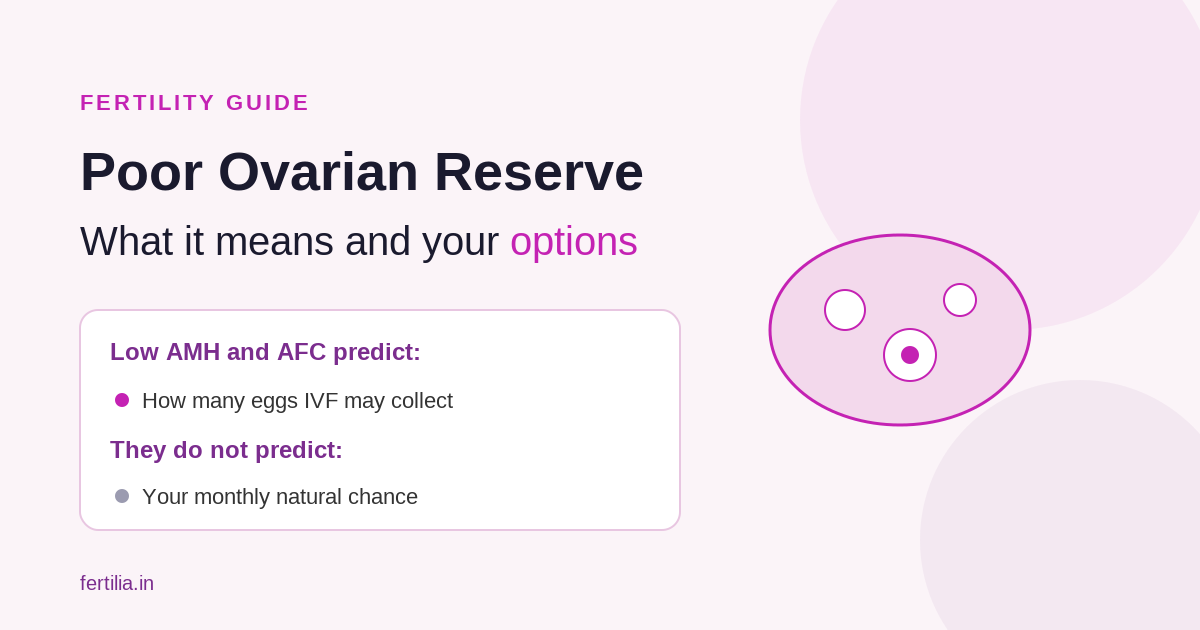
The short answer. Poor ovarian reserve means fewer eggs remain in the ovaries than expected for your age. It predicts how many eggs IVF medicines are likely to collect. It does not, by itself, predict whether you will conceive naturally in the next few months, and it does not measure egg quality. What you do next depends far more on your age, how long you have been trying, and what else your tests show.
What This Post Covers
- What “poor ovarian reserve” means, and how it is measured
- What the result predicts, and what it does not
- Why your age changes the meaning of the same number
- The options, from trying naturally to donor eggs
- What helps alongside medical care, and what to skip
- Questions to take to your next appointment
What “Poor Ovarian Reserve” Means
You are born with all the eggs you will ever have. Each month a group of them starts to grow, one usually leads, and the rest fade away. Over the years the pool gets smaller. “Ovarian reserve” is simply a measure of how large that remaining pool is.
When doctors say reserve is “poor”, “low” or “diminished”, they mean the pool is smaller than expected for your age. It is a finding on tests, not a disease, and it does not mean menopause is close in most women.
Two tests do most of the work:
- AMH (anti-Müllerian hormone). A blood test that can be done on any day of the cycle. Small growing follicles make AMH, so a lower level suggests fewer of them. We have a full guide to AMH ranges by age for Indian women.
- AFC (antral follicle count). A transvaginal scan early in the cycle that counts the small follicles in both ovaries. Our guide on how to read your antral follicle count explains the report.
Day 2 or 3 FSH is sometimes added, but it varies a lot from month to month. If you want to know which test to ask for first, see which ovarian reserve tests to ask for.
One lab value is a snapshot. AMH can read lower while you are on the pill, after ovarian surgery, and different labs use different kits. Before any big decision, I like to see AMH and AFC together, ideally from a reliable lab, rather than a single number.
What the Result Predicts, and What It Does Not
This is the part most women are never told clearly.
What it predicts well: the egg count in IVF. Reserve tests are good at estimating how many eggs will grow when the ovaries are stimulated with injections. A woman with a low AMH and AFC will usually collect fewer eggs in an IVF cycle. That is useful, because it helps your IVF team choose the dose and plan ahead.
What it predicts poorly: natural conception. In a well-known study, Steiner and colleagues followed 750 women aged 30 to 44 with no history of infertility who were trying to conceive naturally (Steiner AZ et al., JAMA, 2017, PMID 29049585). Women with a low AMH (below 0.7 ng/mL) had a predicted 65% chance of conceiving within six cycles, compared with 62% for women with normal values, a difference that was not statistically significant. The authors concluded that these tests should not be used to judge natural fertility in women like those in the study.
The reason is simple: you only need one good egg a month to conceive naturally. A smaller pool still releases an egg each cycle in most women who have regular periods.
What it does not measure at all: egg quality. Whether an egg has the right number of chromosomes is linked mainly to age, not to AMH. That is why age keeps coming back into every decision below.
💜 Just got a low AMH or AFC result? Message Dr. Suganya’s team on WhatsApp to book a ₹399 video consultation. She goes through your reports, cycle history and age with you, and works alongside your gynaecologist or IVF team, from anywhere in India.
Why Your Age Changes the Meaning
Picture two women with the same AMH of 0.8 ng/mL.
- At 30, she has fewer eggs than most women her age, but the eggs she has are, on average, young eggs. If her periods are regular and her tubes and her partner’s semen are healthy, trying naturally for a while is often reasonable.
- At 42, the same number sits alongside the age-related fall in egg quality. Time spent trying matters more, and the conversation about IVF or donor eggs usually comes sooner.
So when someone asks me “Is my AMH good or bad?”, my first question back is always “How old are you, and how long have you been trying?”
When Low Reserve Is Part of a Bigger Picture
For most women, a low reserve is just how their ovaries are, often from family pattern or simply age. Sometimes there is a cause worth knowing about:
- Previous ovarian surgery, for example removal of an endometrioma (chocolate cyst)
- Endometriosis itself
- Chemotherapy or pelvic radiation
- Smoking
- Some genetic conditions, such as a fragile X premutation, which your doctor may test for if reserve is low at a young age or there is a family history of early menopause
If your periods have become irregular or stopped before 40, that is a separate conversation with your gynaecologist about premature ovarian insufficiency, which is managed differently and is beyond the scope of this post.
Your Options, Laid Out
There is no single “treatment” for poor ovarian reserve, because no medicine reliably adds eggs back to the pool. What we can do is make the best use of the time and the eggs you have. Here are the paths, roughly from least to most intervention.
1. Trying naturally, with good timing
If you are younger than about 35, have regular cycles, open tubes and a normal semen analysis, the Steiner findings support trying naturally for a defined period. Track ovulation (our ovulation tracking guide helps), aim for intercourse every one to two days in the fertile window, and agree a review point with your doctor, often six months, sooner if you are older.
2. Ovulation induction or IUI
If ovulation is irregular, or there is a mild sperm factor, tablets to support ovulation with or without IUI may be offered. With a low reserve, response to these medicines can be smaller, so it helps to have a clear limit on how many cycles you will try before moving on.
3. IVF with a plan built for low reserve
IVF is often the most efficient route when reserve is low, especially above 35, because it lets the team see every egg and embryo. With a low reserve, expect fewer eggs per cycle. Doctors usually use the term “poor responder” only after a stimulated cycle has collected few eggs. The widely used Bologna criteria from the European Society of Human Reproduction and Embryology (ESHRE) define a poor response using at least two of three features: older age or another risk factor, a previous poor response, and an abnormal reserve test (Ferraretti AP et al., Human Reproduction, 2011, PMID 21505041). The later POSEIDON grouping sorts women by age and reserve to guide planning (Poseidon Group, Alviggi C et al., Fertility and Sterility, 2016, PMID 26921622).
What your IVF team may adjust includes the stimulation dose, the protocol, and sometimes collecting and freezing eggs or embryos over more than one cycle before transfer. If you have already had a cycle with few eggs, our post on poor ovarian response in IVF goes into those next steps in detail.
About DHEA. DHEA is a hormone supplement often suggested to women with low reserve before IVF. A Cochrane review of trials in poor responders found higher live birth or ongoing pregnancy rates with DHEA, but the effect was smaller and no longer statistically significant when trials at high risk of bias were removed, and the review found too little evidence on safety (Nagels HE et al., Cochrane Database of Systematic Reviews, 2015, PMID 26608695). It is a prescription decision for your IVF specialist, not something to start on your own.
4. Donor eggs
For some women, particularly in their 40s or after several cycles with very few eggs, donor eggs give the highest chance of pregnancy, because the success rate then follows the donor’s age. It is a big emotional step, and it is never the first thing to say to someone the day she hears her result. When it is the right conversation, our guide to donor egg IVF in India covers the legal framework and process.
5. Freezing eggs if you are not ready yet
If you are not trying to conceive now and have learned your reserve is low, egg freezing is worth discussing sooner rather than later. See our egg freezing guide.
What Helps Alongside Medical Care
No food or supplement has been shown to rebuild the egg pool. What you can influence is the general health of the eggs growing in the months before ovulation or retrieval, and your body’s readiness for pregnancy:
- Stop smoking, including second-hand smoke where you can.
- Check vitamin D and thyroid, and treat genuine deficiency or thyroid problems with your doctor.
- Eat regular, balanced meals: dal, eggs or paneer for protein, ragi and millets, vegetables, a handful of nuts, and curd. Nothing exotic is needed.
- Keep weight and blood sugar in a healthy range, and move most days.
- Protect sleep, and get support for stress. A diagnosis like this is heavy, and it is fine to say so.
Our guide to improving egg quality and the post on whether AMH can be raised naturally go through the evidence in detail, including which popular remedies have none.
Practical Takeaways
- Confirm the result. AMH and AFC together, from a reliable lab, before big decisions.
- Read it with your age. The same number means different things at 30 and at 42.
- Check the rest of the picture. Tubes, semen analysis, thyroid and ovulation all matter.
- Set a time limit for each step, and agree it with your doctor in advance.
- Ask about IVF planning early if you are over 35 or have been trying for a year.
- Look after your health in the meantime, without paying for “AMH-boosting” packages.
Frequently Asked Questions
Can I get pregnant naturally with poor ovarian reserve?
Yes, many women do. Reserve tests predict how many eggs IVF will collect, not your monthly chance of natural conception. A US study of women aged 30 to 44 found no significant difference in natural conception over six cycles between women with low and normal AMH (Steiner AZ et al., JAMA, 2017, PMID 29049585). Age, regular ovulation, open tubes and healthy sperm matter more.
What is the treatment for low ovarian reserve?
There is no medicine that reliably increases the number of eggs. Treatment means choosing the right path for your situation: timed natural attempts, ovulation induction or IUI, IVF with a plan suited to low reserve, or donor eggs. The choice depends on your age, how long you have been trying, and your other test results.
Does low AMH mean early menopause?
Not usually. Most women with a low AMH still have regular periods for years. If your periods become irregular or stop before 40, see your gynaecologist, as that needs a separate assessment.
Can diet or supplements increase my ovarian reserve?
No diet or supplement has been shown to add eggs back. A healthy diet, correcting vitamin D deficiency, stopping smoking and good sleep support overall health and pregnancy readiness. DHEA is sometimes prescribed before IVF, but the evidence is mixed and it should only be taken under your IVF specialist’s guidance.
Is IVF successful with poor ovarian reserve?
IVF can work, though fewer eggs are usually collected per cycle, so more than one cycle may be needed. Success depends strongly on age, because age drives egg quality. Your IVF team can explain your expected numbers based on your AMH, AFC and age.
What AMH level counts as poor ovarian reserve?
There is no single cut-off that applies to everyone, as labs and kits differ and the meaning changes with age. Doctors read AMH alongside the antral follicle count and your age rather than labelling one number as “poor”.
When should I consider donor eggs?
Usually after a detailed discussion, often for women in their 40s or after IVF cycles that collected very few eggs. It is a personal decision with no deadline attached, and you can take time with it.
Talk It Through With a Doctor
A low reserve result is information, and you have time to understand it before deciding anything. If you would like someone to go through your AMH, scan, age and history with you and map out the next step, message Dr. Suganya’s team on WhatsApp for a ₹399 video consultation, from anywhere in India. We work alongside your gynaecologist or IVF team, and women who want structured support can join Fertilia’s Fertility program. You can also download our free Guide to Getting Pregnant.