A woman in her early 40s comes to me with a pattern she has tracked over several months. For about ten days before her period, she becomes irritable, tearful, anxious, and exhausted. Then her period arrives and, usually within a day or two, she feels like herself again. She has had something like this since her 30s, but recently it has become more disruptive. Some months the symptoms are manageable; other months they derail her completely. Her cycles, which were always predictable, have now become slightly irregular.
Her question is reasonable: is this PMDD getting worse, or is something new beginning?
This is one of the most common confusions I see in women between the ages of 35 and 45, and it matters because the two conditions, premenstrual dysphoric disorder and early perimenopause, share a significant symptom cluster. Treating one when you have the other leads to months of unnecessary frustration. Getting the distinction right makes a real practical difference.
What PMDD looks like as a clinical pattern
PMDD is a condition rooted in the luteal phase of the menstrual cycle. The luteal phase is the second half of the cycle, the period between ovulation and the start of the next period, which typically lasts 10 to 14 days. In PMDD, symptoms emerge during this window and resolve within a few days of the period beginning.
The DSM-5 (American Psychiatric Association, 2013) sets the diagnostic bar for PMDD at five or more symptoms in most cycles over the preceding year, with at least one of those symptoms being a core mood symptom: marked irritability or anger, depressed mood, anxiety or tension, or emotional sensitivity. Physical symptoms such as bloating, breast tenderness, fatigue, and sleep changes can also count, but the mood dimension is what distinguishes PMDD from ordinary PMS.
For more on this, read our guide on Chasteberry (Vitex) for PMS & PMDD. The defining feature of PMDD is its timing. The symptoms are not present throughout the month. They follow the cycle like a tide. There is a reliable window in which the woman changes, and then a reliable clearing. If you look at a two-month symptom diary and the pattern shows symptoms clustered in the ten days before bleeding and gone by day 2 of the period, that timing is consistent with PMDD.
For more on this, read our guide on PMDD or Depression? Why Timing Tells Them Apart. PMDD is typically present throughout a woman’s reproductive years, though the severity can vary with stress, life events, sleep quality, and, importantly, with hormonal changes during the perimenopause transition.
What early perimenopause looks like
Perimenopause is the transition phase that leads up to menopause, defined as 12 consecutive months without a period. The STRAW+10 staging system (Harlow et al., Climacteric, 2012), the international framework that defines reproductive ageing, describes early perimenopause as the point when cycles become persistently more variable (cycle length changing by 7 or more days from your usual pattern). Late perimenopause begins when gaps between periods reach 60 days or more.
In India, the average age at menopause is 46 to 48 years (Palacios S et al., Climacteric 2010, PMID 20690868) (Ahuja M, J Midlife Health 2016, PMID 27721640), which is somewhat earlier than the global average of 51. This means perimenopause for many Indian women begins in the early to mid-40s, and in some cases the late 30s.
The hormonal picture during perimenopause is one of increasing erraticism. Oestrogen levels do not simply fall; they fluctuate widely, sometimes spiking before dropping. This fluctuation is what produces many perimenopausal symptoms: hot flashes, night sweats, disrupted sleep, mood changes, and cycle irregularities. Unlike PMDD, these symptoms are not neatly confined to the luteal phase. They can appear at any point in the cycle, or even across multiple consecutive weeks.
The overlap zone
Here is what makes the distinction genuinely difficult: both conditions produce mood instability, irritability, anxiety, sleep disruption, fatigue, and reduced tolerance for stress. In women over 35, PMDD and early perimenopause can coexist. The hormonal turbulence of perimenopause can make pre-existing PMDD substantially worse. Research from the SWAN (Study of Women’s Health Across the Nation) has documented that the menopausal transition is associated with an increased risk of depressive symptoms, particularly in women who had prior episodes of premenstrual mood symptoms.
For more on this, read our guide on Premenstrual Anxiety. In other words, if you had mild PMDD in your 30s and you are now 40 with a noticeably worse premenstrual phase, it is entirely possible that perimenopause is amplifying what was already there. It is also possible that perimenopause is producing new symptoms that pattern themselves around the cycle in ways that look like PMDD but are driven by a different mechanism.
A third possibility: you may have classic perimenopausal symptoms that are not cycle-bound at all, but because you are still cycling (even irregularly), the symptoms feel like they arrive and leave with the period when in fact they are more continuous than you realise.
How to tell them apart in practice
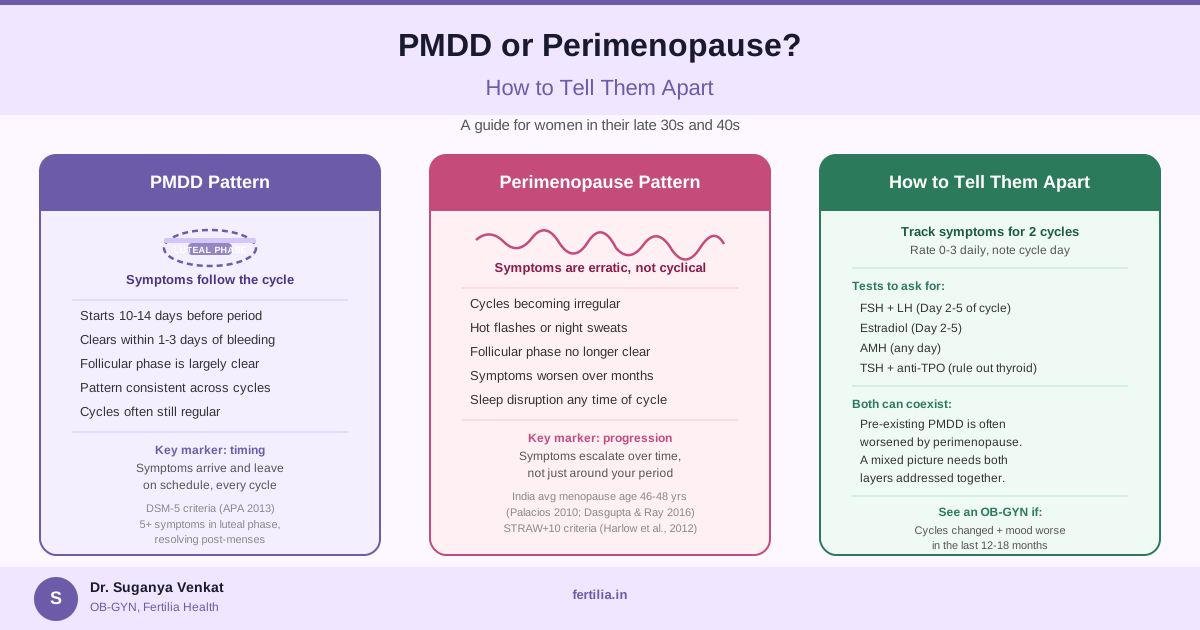
The most useful tool is a symptom diary kept over at least two complete cycles. You track your symptoms daily on a simple 0 to 3 scale, note where you are in your cycle (day 1 being the first day of bleeding), and note any physical markers like hot flashes, night sweats, or changes in sleep.
When you review two or three months of data, look for these patterns:
A PMDD pattern looks like: Symptoms that reliably start 10 to 14 days before the period, worsen in the week before bleeding, and clear within 1 to 3 days of the period starting. The follicular phase (the first half of the cycle after bleeding ends) is largely symptom-free.
A perimenopause pattern looks like: Symptoms that do not follow a clean luteal-phase arc. Hot flashes or night sweats at any point in the cycle. A follicular phase that is no longer the reliable clear window it used to be. Worsening cycle irregularity alongside the mood symptoms.
A mixed picture: When PMDD and perimenopause coexist, you will often see a baseline of symptoms that is present even in the “good” part of the cycle, with a clear worsening still visible in the premenstrual window. The floor has risen even if the ceiling has stayed the same.
If you are in your late 30s or 40s and are unsure which picture fits, a single consultation with an OB-GYN can help you map your symptom diary against your hormonal picture.
Start a consultation with Dr. Suganya via WhatsApp (Rs 399 video call, available pan-India.)
The tests that add information
A blood test cannot diagnose PMDD, because PMDD is defined by the pattern and timing of symptoms, not by a specific hormone level. But blood tests are genuinely useful when perimenopause is a possibility.
The standard panel to consider if you are over 38 with worsening premenstrual symptoms and cycle irregularity:
FSH and LH (drawn on Day 2 to 5 of your cycle): FSH rising above 10 IU/L, and particularly above 20 IU/L on repeated testing, points toward declining ovarian reserve and possible perimenopausal transition. A single elevated FSH reading in perimenopause can be misleading because levels fluctuate, so two tests about 4 to 6 weeks apart are more reliable.
Estradiol (Day 2 to 5): Low oestradiol combined with elevated FSH strengthens the case for perimenopause. Fluctuating oestradiol without a consistent pattern is also common in early perimenopause.
AMH (Anti-Müllerian Hormone): AMH falls steadily as ovarian reserve declines and can indicate where you are in the transition. Unlike FSH, AMH can be drawn on any day of the cycle. A low AMH for your age suggests the perimenopause transition has begun.
TSH and anti-TPO: Thyroid dysfunction, which is common in Indian women, produces fatigue, mood changes, and cycle irregularity that mimic both PMDD and perimenopause. Ruling out thyroid disease is a standard first step.
These tests do not replace the symptom diary, but they help frame it. A woman in her early 40s with elevated FSH, declining AMH, and a symptom diary showing mood symptoms that extend through her follicular phase is not dealing with classic PMDD; perimenopause is the more likely driver.
Treatment implications: why getting this right matters
PMDD and perimenopause have overlapping but distinct treatment pathways, and conflating them leads to under-treatment or the wrong treatment.
For PMDD (with a clear luteal-phase pattern and no perimenopausal indicators): the evidence-based options are calcium supplementation (Thys-Jacobs 1998), luteal-phase or continuous SSRIs (Pearlstein, 2005, PMID 16307962), the drospirenone-containing OCP, and CBT. The full treatment guide is in the PMDD treatment post.
For perimenopause-driven mood symptoms: the hormonal instability is the root. Treating only the mood symptoms without addressing the oestrogen fluctuation often gives partial results. This is where HRT, when indicated, can be genuinely helpful, as stabilising oestrogen levels smooths the perimenopausal symptom curve. Lifestyle measures for perimenopause overlap considerably with PMDD management: aerobic exercise, sleep prioritisation, and reducing alcohol.
For a mixed picture (PMDD amplified by perimenopause): this is the most common scenario in the 38 to 45 age group. The approach needs to address both layers, and it is worth seeing an OB-GYN rather than treating one component in isolation.
One important note: it is not unusual for a woman in this age range to also be dealing with anxiety or depression that is not cycle-driven at all. The worsening of premenstrual symptoms can sometimes be the visible edge of a broader mental health picture. If your symptoms are severely affecting your work or relationships, an assessment with a psychiatrist alongside your OB-GYN review is appropriate, not as a replacement but as a complement.
India context
Indian women navigate this transition with an additional layer of complexity. The average age of perimenopause onset in India is several years earlier than in Western populations, meaning the overlap zone between PMDD and early perimenopause arrives earlier here, sometimes in the late 30s rather than the mid-40s.
There is also a cultural framing: in many households, worsening premenstrual mood symptoms are attributed to stress, character, or the demands of domestic and professional life rather than to a hormonal pattern with a medical name. Women are often told to manage better, rather than being offered a clinical framework that explains what is actually happening. This delay in seeking care means many women spend years dealing with untreated PMDD or unrecognised perimenopause when effective options are available.
If your premenstrual symptoms have changed in the last one to two years, particularly if your cycles have also changed, that shift is worth understanding rather than simply adapting to.
When to see an OB-GYN
You do not need to have a definitive answer before seeing a doctor. If any of the following apply, a review with an OB-GYN is the right step:
- Your cycles have become shorter, longer, or more irregular in the last 12 to 18 months.
- Premenstrual symptoms that used to be manageable are now disrupting work, relationships, or sleep.
- You are experiencing new symptoms such as hot flashes, night sweats, or vaginal dryness alongside the mood symptoms.
- You are over 38 and have not had a hormone panel recently.
- You have been told you have PMDD but standard treatments are not helping as expected.
If perimenopause is contributing, that is a condition Menolia, our dedicated menopause care programme, addresses alongside the Fertilia team. You can read more about what perimenopause feels like, and how the transition is managed, at menolia.in.
Talk to Dr. Suganya about your cycle and symptoms (Rs 399 video call, pan-India)
Related reading
- PMS or PMDD? A Psychiatrist’s Guide for India: the full psychiatric framework for PMDD, by Dr. Sandhiya Loganathan
- PMDD Treatment in India: What Actually Works: the full evidence-based treatment guide
- Mood Swings Before Your Period: Why It Happens: for women at the earlier, less severe end of the spectrum
Frequently asked questions
Can PMDD start in your 40s for the first time, or does it always begin earlier?
PMDD technically requires 12 months of a consistent pattern, but new-onset severe premenstrual symptoms in the early 40s should prompt a check for perimenopause rather than a PMDD diagnosis, because the underlying driver is often hormonal transition rather than the lifelong pattern PMDD usually represents. That said, PMDD can emerge or worsen significantly at any point in reproductive life when hormonal conditions shift.
My periods are still regular but my premenstrual symptoms have worsened a lot in the last year. Is that perimenopause?
Regular cycles do not rule out early perimenopause. The STRAW+10 framework defines early perimenopause by subtle cycle variability, but FSH can be rising and oestrogen fluctuating even before cycles become irregular. A hormone panel alongside your symptom diary will give a clearer picture than cycle regularity alone.
Can I have both PMDD and perimenopause at the same time?
Yes, and this is actually common in the 38 to 48 age range. Pre-existing PMDD can be amplified by the hormonal turbulence of perimenopause, producing a pattern that looks like severe PMDD but has perimenopause as a contributing driver. Treating only one layer often gives incomplete results.
What tests should I ask my doctor for?
Start with FSH, LH, and estradiol drawn on Day 2 to 5 of your cycle. Add AMH (any day), TSH, anti-TPO, and a Vitamin D and B12 panel. Keep a symptom diary for 2 cycles and bring it to your appointment.
My doctor says it is just stress. What should I tell them?
A 2-cycle symptom diary is the most useful evidence you can bring. If you can show that your symptoms cluster reliably in the 10 to 14 days before your period and clear within 2 days of bleeding, that documents a cycle-linked pattern that warrants clinical evaluation rather than a stress attribution. If you cannot get that clarity from your current care, a second opinion is reasonable.
At what age does perimenopause usually begin in Indian women?
Studies including Palacios (2010, Climacteric) and the Indian Menopause Society’s pan-India survey (Ahuja M, J Midlife Health 2016, PMID 27721640) report the average age of natural menopause in Indian women as 46 to 48 years. Perimenopause typically begins 4 to 8 years before menopause, placing the start of the transition in the early to mid-40s for most Indian women, and in the late 30s for some.
Will HRT help with my premenstrual symptoms if perimenopause is the cause?
If perimenopause is driving or amplifying your premenstrual symptoms, stabilising oestrogen levels through HRT can significantly reduce symptom severity. This is something to discuss with an OB-GYN who can review your hormone panel and symptom pattern together, because HRT is not appropriate for all women or all clinical pictures.