A woman came to see me last year, eight months after her right fallopian tube had been removed following an ectopic pregnancy. Her surgery had gone well, her recovery had been straightforward, and her cycles had returned within six weeks. She was ready to try for a baby again. But she had a question she had been holding onto since the day she left the hospital: “Do I still have a real chance?”
She did. She conceived naturally nine months later.
I share this because the question of what one ovary or one fallopian tube actually means for natural conception is one that deserves a clear, clinical answer. Many women receive either vague reassurance (“You have another one, you should be fine”) or an immediate IVF referral with no discussion of natural options. Neither response serves women well.
This post covers:
- How one fallopian tube functions after the other has been removed, and what the research shows
- How one ovary affects your hormones, ovarian reserve, and monthly cycle
- What happens when the remaining tube and ovary are on opposite sides
- A practical framework for deciding whether to try naturally or to move forward with IVF sooner
- The ectopic pregnancy risk conversation every woman with one tube needs to have
One Fallopian Tube: What the Evidence Shows
The most common reason a woman ends up with one fallopian tube is an ectopic pregnancy that required surgical removal of the affected tube (salpingectomy). Other reasons include surgery to remove a severely damaged tube due to pelvic inflammatory disease, hydrosalpinx (a fluid-filled tube that can reduce fertility even when open), or a previous gynaecological operation.
Regardless of the reason, the clinical picture tends to be similar: one tube is gone, the other is present, and the question is whether that one tube is enough.
The short answer is: for most women, yes. The longer answer involves understanding a biological phenomenon that not all clinicians explain clearly.
How the remaining tube can capture eggs from either ovary
Most women assume their fallopian tube is a fixed pipe, directly connected to the ovary on the same side. This is not quite how it works.
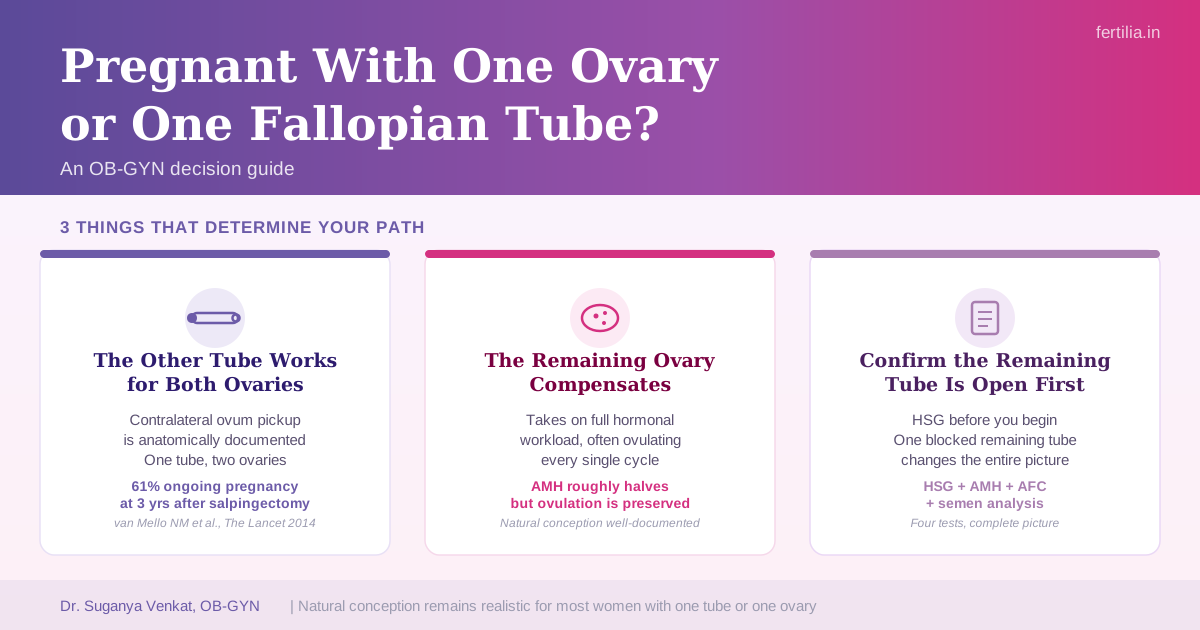
At the open end of each tube, there are finger-like projections called fimbriae. When an egg is released at ovulation, it enters the peritoneal space (the abdominal cavity) briefly before being swept up by these fimbriae. The tube does not attach to the ovary; it sweeps the egg from a small pool of peritoneal fluid. And because the egg floats in that fluid for a brief window, the tube on the opposite side can, and does, capture it. This is called contralateral ovum pickup, or transperitoneal migration of the oocyte, and it is a well-documented anatomical reality.
This means that in months when the ovary on the tubeless side ovulates, your remaining tube still has a meaningful opportunity to capture that egg. It is somewhat less efficient than same-side capture. It is not zero.
What the landmark clinical trial found
The most robust evidence on conception after salpingectomy comes from the ESEP study, a multicentre randomised controlled trial published in The Lancet in 2014 (Mol F et al., Lancet 383:1483-9, PMID 24499812). The study randomised women with a tubal ectopic pregnancy to either salpingotomy (tube-sparing surgery, where the ectopic is removed but the tube is kept) or salpingectomy (full removal of the affected tube).
After three years of follow-up, the cumulative ongoing pregnancy rate was 60.7 percent in the salpingotomy group and 56.2 percent in the salpingectomy group, a difference that was not statistically significant (fecundity rate ratio 1.06, 95% CI 0.81 to 1.38).
Let that land for a moment. Removing one fallopian tube entirely did not meaningfully reduce a woman’s chance of achieving an ongoing pregnancy compared to women who retained both tubes (with one operated on). This is not a guarantee for any individual woman, because age, ovarian reserve, the health of the remaining tube, and several other variables all play a role. But as a population-level finding from a well-designed trial, it tells us that one healthy tube is a genuine and functional reproductive asset.
One Ovary: What Happens to Your Fertility
Women who have had one ovary removed often receive even less detailed information than women who have lost a tube. The explanation is typically brief: “Your other ovary will take over.”
This is broadly true, but it deserves more than a sentence.
Why one ovary gets removed
Common reasons include:
- A large ovarian cyst (dermoid cyst, endometrioma, serous cystadenoma) too large to drain without removing the ovary
- Ovarian torsion where blood supply was cut off before the ovary could be saved
- A pelvic abscess involving the ovary
- A borderline or malignant ovarian tumour
In some cases, one ovary is removed alongside a fallopian tube during ectopic surgery, or as part of a hysterectomy.
What happens to your hormones and ovarian reserve
Ovarian reserve, measured by AMH (anti-Mullerian hormone) and antral follicle count (AFC), does roughly halve after one ovary is removed. This is expected: you have lost approximately half your follicle pool.
Two important things follow. First, the pituitary gland produces more FSH (follicle-stimulating hormone) to compensate, and the remaining ovary responds by developing follicles and typically ovulating every single cycle rather than alternating. Second, AMH levels tend to stabilise at the lower level rather than continuing to fall, because the remaining ovary is now carrying the full workload.
What this means practically: your monthly ovulation is preserved. Your cycle length usually normalises. Natural conception remains well within reach for most women, particularly those under 35.
Your AMH after oophorectomy is more relevant as a baseline for planning IVF response (if that ever becomes necessary) than as a gatekeeper for natural conception. Many women with AMH in the lower-normal range after unilateral oophorectomy conceive naturally without difficulty. Our detailed guide on AMH and AFC testing explains what these numbers mean and how to interpret your report.
If you have one tube, one ovary, or both, and you are wondering whether natural conception is still realistic for your specific situation, this is exactly the conversation I have with women in my online consultations. A single session is enough to look at your test results and give you a clear next step.
WhatsApp me for a ₹399 video consultation
When the Tube and Ovary Are on Opposite Sides
This is the scenario that gets the least clear guidance, and it deserves its own section.
Suppose your right fallopian tube was removed after an ectopic pregnancy. Then, a few years later, your left ovary was removed for a large dermoid cyst. You now have your right ovary and your left tube, on opposite sides.
In every ovulation cycle, the egg released by your right ovary must travel across the peritoneal space to be captured by your left tube. Contralateral pickup is not a backup option in this situation; it is the only route.
It happens. There are documented natural pregnancies in exactly this anatomical setup, and they are not medical anomalies. But the efficiency is lower, and the typical “try for twelve months before investigating” advice does not apply here. Given the anatomical challenge, I would recommend a fertility workup, including AMH, AFC on the remaining ovary, confirmation that the remaining tube is open, and a partner semen analysis, before the first month of trying.
If the remaining tube has any evidence of scarring, narrowing, or hydrosalpinx, the path toward IVF becomes much more direct. This is not about being pessimistic; it is about being accurate with your timeline.
A Framework for Deciding Your Next Step
Here is how I approach this with patients.
Step 1: Confirm the remaining tube is open
Before anything else, you need to know whether your one tube is functional. An HSG (hysterosalpingography) or sonosalpingography will answer this. There is no clinical justification for waiting twelve months trying naturally if the remaining tube is also blocked or damaged. This is the single most important test you can do before you start.
Our guide on blocked fallopian tubes covers what to look for on an HSG report and how to assess whether a reported blockage is real.
Step 2: Check ovarian reserve
An AMH blood test plus an AFC ultrasound gives you a picture of what the remaining ovary can do. If you have one ovary, AFC is particularly useful because it counts the actual follicles visible in that one ovary this cycle.
Step 3: Rule out a male factor
One tube or one ovary combined with a normal sperm picture is a very different situation from the same anatomy with borderline sperm parameters. A semen analysis is quick, inexpensive, and changes the decision tree significantly. Many couples find out during this workup that a male factor was contributing, which they had not previously investigated.
Step 4: Apply the timeline
If you are under 35, both of the above checks are reassuring, and you are in the standard “same-side tube and ovary” situation: a trial of natural conception for six to nine months is appropriate before the next decision point.
If you are 35 or older: three to six months before the next review, not twelve.
If you have the opposite-side scenario, or if the remaining tube shows any damage, or if your AMH is significantly low for your age: do not wait. A fertility consultation is a conversation, not a commitment to IVF. It gives you accurate information faster.
The secondary infertility population (women who have already had one baby and are now finding conception more difficult the second time) often has one or more of these anatomical changes at play. Our post on secondary infertility causes and tests covers the full workup for this group.
The Ectopic Risk Conversation
This section applies specifically to women with one fallopian tube.
After losing one tube to an ectopic pregnancy, the risk of a second ectopic in the remaining tube is meaningfully elevated compared to the general population. The remaining tube may have underlying vulnerability (whether from PID history, endometriosis, or anatomical factors) that contributed to the first ectopic. The second tube is now the only route, and it is carrying more load.
When you conceive with one tube, an early transvaginal scan (TVS) at five to six weeks of pregnancy is not optional. It is clinical standard of care, and you should request it proactively rather than waiting for a standard eight-week appointment.
An ectopic pregnancy identified at five weeks, before significant tube distension, can often be managed with a single injection of methotrexate. An ectopic identified at seven or eight weeks because the appointment was delayed is more likely to require emergency surgery, and there is a real risk to the remaining tube.
Know the warning signs and go to an emergency department without waiting if you experience: one-sided lower abdominal pain, shoulder-tip pain (which can indicate internal bleeding), brown spotting alongside a positive pregnancy test, or a positive test without the expected symptoms. Our detailed guide on ectopic pregnancy signs and what to expect explains the full clinical picture.
Practical Steps If You Have One Tube or One Ovary
- Get the remaining tube checked (HSG or sonosalpingography) before you begin trying. This is the single most important piece of information.
- Test ovarian reserve (AMH + AFC) to understand what the remaining ovary is producing. Do this early in a cycle (cycle day 2 to 5 for AMH, same window for AFC by ultrasound).
- Include a semen analysis in the initial workup. This is not optional, and it changes treatment decisions.
- Apply age-adjusted timelines. Under 35 with reassuring tests: six to nine months naturally. Over 35, or opposite-side anatomy, or any tube or ovarian abnormality: fewer months before the next step.
- Book an early scan at five to six weeks when you do get a positive pregnancy test. Do not wait for the standard eight-week scan.
- Do not assume IVF is inevitable. The evidence on one tube is reassuring, and many women with one ovary conceive without difficulty. The workup tells you whether you are in the reassuring group.
FAQ: One Ovary and One Fallopian Tube
Can I get pregnant naturally with just one ovary?
Yes. After one ovary is removed, the remaining ovary typically compensates by developing follicles and ovulating every cycle. Monthly conception potential is preserved. Many women with one ovary conceive naturally without any fertility treatment. The key factors that matter are age, the AMH and AFC of the remaining ovary, whether both fallopian tubes are open, and your partner’s sperm health.
Does it matter which side I ovulate from if I only have one tube?
Somewhat. When ovulation occurs on the same side as your remaining tube, the egg has the shortest route to be captured. When ovulation occurs on the opposite side, the tube has to capture it via contralateral pickup (transperitoneal migration). This is less efficient but is a real anatomical process. Women with one tube on one side and one ovary on the other have conceived naturally, though the monthly probability is lower and evaluation should happen earlier.
How long should I try naturally before seeing a doctor?
If you are under 35, your remaining tube is confirmed open, your ovarian reserve tests are reassuring, and your partner’s semen analysis is normal: six to nine months is a reasonable natural trial. If you are 35 or older, or if the tube and ovary are on opposite sides, three to six months is the appropriate review point. If any test is abnormal, go sooner.
Will IVF work if I have only one ovary?
Yes. IVF response is typically lower (fewer eggs retrieved in one cycle) when you have one ovary, because the total follicle pool is smaller. However, IVF can and does succeed with one ovary, including for women with lower AMH. The protocol is adjusted to stimulate the remaining ovary appropriately. The clinician handling your IVF cycle will plan around your AFC and AMH at the time of treatment.
What is contralateral ovum pickup, and is it a real mechanism?
Contralateral ovum pickup (also called transperitoneal ovum migration) is the process by which a fallopian tube captures an egg released by the ovary on the opposite side. The tube’s fimbriae (finger-like projections) sweep the egg from the peritoneal fluid. This is anatomically documented and clinically real, not theoretical. It is the mechanism that allows women with one tube to conceive in months when the ovary on the tubeless side ovulates.
What tests should I do before trying to conceive with one tube or one ovary?
The four key tests are: (1) HSG or sonosalpingography to confirm the remaining tube is open, (2) AMH blood test for ovarian reserve, (3) AFC (antral follicle count) ultrasound, typically on cycle day 2 to 5, and (4) your partner’s semen analysis. These four together give a complete picture and allow you to make an informed decision about whether to try naturally, how long to try, and when to move to assisted reproduction.
Is my risk of ectopic pregnancy higher with one tube?
Yes. With one tube, the risk of a second ectopic is elevated compared to the general population. The remaining tube is the only route for the embryo to travel to the uterus, and if it has any underlying damage or vulnerability, ectopic implantation can recur. This is why an early transvaginal scan at five to six weeks is essential with any pregnancy after salpingectomy, not at eight weeks.
If you would like to go through your test results with me and understand what they mean for your specific situation, I hold online consultations and I see women from across India for exactly this kind of review.
WhatsApp me to book a ₹399 video consultation
Dr. Suganya Venkat is a DNB OB-GYN (GKNM Hospital, Coimbatore) with 15 years of clinical experience in fertility and reproductive health. She consults online, pan-India, via video call.