“My breasts hurt so much I cannot sleep on my side. Is this normal?” It is one of the most common messages I receive from women in the first weeks of pregnancy. For many, sore breasts are the very first clue that they are pregnant, sometimes even before the period is missed. For others, the pain feels so much stronger than usual period tenderness that it starts to worry them.
I’m Dr. Suganya Venkat, an OB-GYN with more than fifteen years of practice, and I can reassure you of one thing at the start: breast pain in early pregnancy is usually a sign that your body is doing exactly what it should. This post explains why it happens, how it typically feels, when it tends to ease, what you can do to feel more comfortable, and the few situations where a check is worth it.
If you are still piecing together whether you are pregnant at all, our guide to early pregnancy symptoms in the first weeks walks through the other early signs.
Why breasts hurt in early pregnancy
From the moment a pregnancy begins, your body starts preparing to feed a baby, months ahead of time. Rising levels of the pregnancy hormones, mainly oestrogen and progesterone, signal the milk ducts and milk-producing glands to grow. Blood flow to the breasts increases and the tissue holds more fluid.
All of this happens quickly, and the stretching of growing tissue is what you feel as soreness, heaviness or tingling. It is the same process that makes some women’s breasts tender before a period, only stronger and longer lasting, because the hormone levels in pregnancy keep climbing instead of falling.
What it usually feels like
Women describe it in many ways, and all of these are common:
- Tenderness or soreness, especially to touch, when hugging, or when lying on your front
- Heaviness or fullness, as if the breasts are swollen
- Tingling or prickling, particularly around the nipples
- Sensitive nipples, sometimes enough that a bra or blouse brushing against them is uncomfortable
- Aching under the arms, because breast tissue extends towards the armpit
You may also notice visible changes alongside the pain:
- The breasts grow, sometimes by a cup size or more over the pregnancy
- The areola (the darker skin around the nipple) becomes darker and wider
- Small bumps on the areola, called Montgomery’s tubercles, become more noticeable
- Blue veins show more clearly under the skin as blood flow increases
Both breasts are usually affected, though one may feel more sore than the other. That is normal too.
When it starts and when it eases
Breast tenderness often begins within a week or two of conception, which is around the time a period would be due. That is why many women notice it before a pregnancy test turns positive.
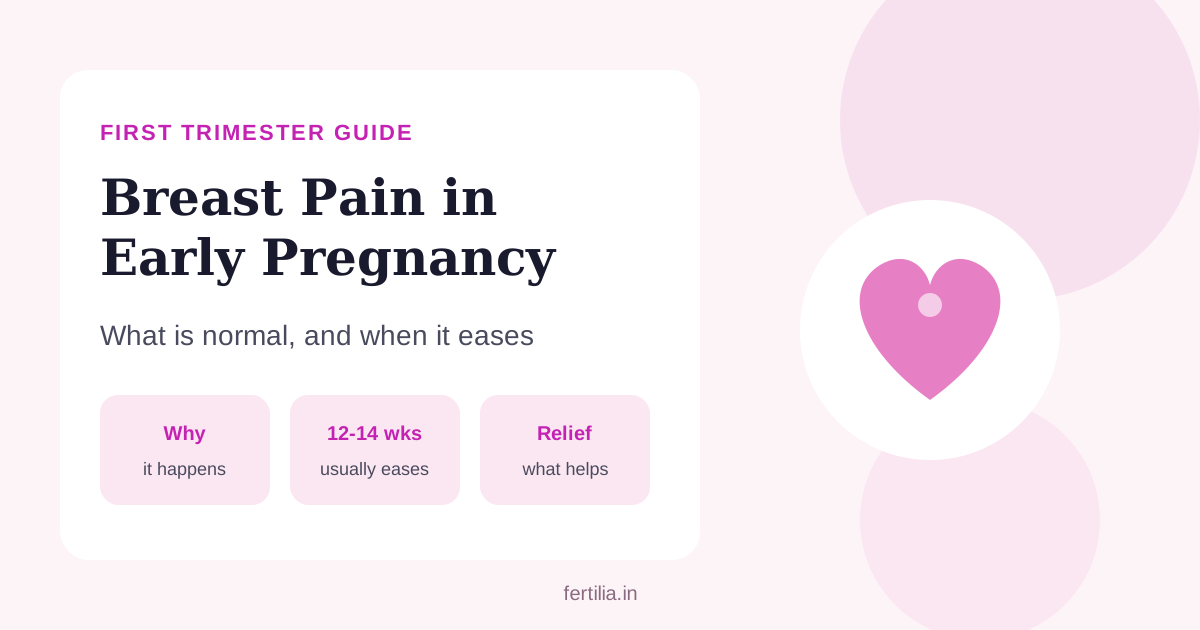
It is usually strongest in the first trimester. For most women it eases noticeably somewhere around the start of the second trimester, roughly 12 to 14 weeks, as the body settles into its new hormone levels. The breasts keep growing and changing through the pregnancy, so you may still feel occasional fullness or twinges later on, but the constant, sharp soreness of the early weeks usually fades.
Every pregnancy is different. Some women have barely any breast pain. Some have it in one pregnancy and not the next. The amount of tenderness does not tell you how healthy the pregnancy is.
If the breast pain suddenly goes away
This is a worry I hear often: “My breasts stopped hurting at 9 weeks. Has something gone wrong?”
In most cases, no. Symptoms in early pregnancy naturally come and go from day to day, and many women find breast soreness fades gradually towards the end of the first trimester. A change in breast tenderness on its own is not a reliable sign of a problem.
What matters more is what else is happening. If the change in breast pain comes with bleeding, cramping, or pain low in the abdomen, contact your doctor so they can check. If you feel well otherwise, a quieter day for your breasts is usually just a quieter day.
If you have bled or had a previous loss and are anxious, it is completely reasonable to ask for a check for peace of mind. Our guide to miscarriage signs and recovery explains which symptoms are worth a call to your doctor.
Not sure whether what you are feeling is normal? You can talk it through with Dr. Suganya Venkat over a video consultation, from anywhere in India. WhatsApp Dr. Suganya to book a ₹399 online consultation.
What helps with sore breasts in pregnancy
You cannot switch off the hormones, but you can make the weeks of soreness much easier.
Get the right bra
This makes the biggest difference for most women.
- Choose support without wires. A soft, well-fitting cotton bra or a maternity bra is usually far more comfortable than an underwired one in these weeks.
- Get measured again. Your size can change within weeks. A bra that fitted last month may now be pressing into growing tissue.
- Look for wide straps and a soft band, so the weight is spread rather than digging in at one point.
- Try a soft sleep bra or crop-style top at night if the breasts ache when you turn over.
Small daily comforts
- Warm or cool compresses. Some women find a warm shower soothing; others prefer a cool, clean cloth on the breasts for a few minutes. Use whichever feels better.
- Loose cotton clothing. A soft cotton nightie or kurti is gentler on sensitive nipples than tight synthetic fabric.
- Sleep on your side with support. A pillow in front of you to rest your upper arm on can take pressure off the breasts.
- Ask your partner to be gentle. It is fine to tell your partner that your breasts are sore right now and that hugs or touch need to be lighter for a while.
- Avoid harsh soaps on the nipples. Plain water is enough; the skin there is already sensitive.
About pain relief
Most women do not need medicine for pregnancy breast tenderness. If you feel you do, please ask your doctor before taking any painkiller, rather than reaching for whatever is at home. Some common painkillers are not advised in pregnancy, and your doctor can tell you what is suitable for you.
Leaking from the nipples
Some women notice a small amount of clear or yellowish fluid from the nipples, or dried crusts on the nipple, during pregnancy. This is colostrum, the early milk, and the breasts can start making it during pregnancy. It is not a problem and does not mean you will have less milk later.
There is no need to squeeze or express it. A soft breast pad in your bra can help if it marks your clothes.
When to get a check
Normal pregnancy breast pain affects both breasts in a general way and settles over time. Contact your doctor if you notice:
- A distinct lump that you can feel and that does not go away. Lumps in pregnancy are usually harmless, but any new lump deserves an examination and, if needed, an ultrasound, which is safe in pregnancy. Our guide to breast lumps and what is normal explains what doctors look for.
- Redness, heat and swelling in one area, especially with fever or feeling unwell
- Bloody discharge from the nipple
- Skin changes such as dimpling, puckering, or a nipple that has newly turned inwards
- Pain in just one spot that stays the same or worsens over a couple of weeks
None of these automatically means something serious. They are simply signs that are worth having examined rather than waiting out. Being pregnant does not mean breast concerns should be put on hold until after delivery.
If you have PCOS and have noticed breast pain before pregnancy as well, our post on whether PCOS can cause breast pain covers that separate question.
What this looks like in practice at Fertilia
At Fertilia, breast changes are one of the early-pregnancy topics we talk about with almost every woman in our pregnancy care program, usually in the first few weeks after a positive test. Dr. Suganya Venkat, who has cared for women through more than 1,000 pregnancies, finds that a short conversation about why the breasts hurt and when it usually eases is often all it takes to settle the worry. The practical part, getting a comfortable, unwired bra early, tends to bring the most relief.
Later in pregnancy, those same conversations shift towards preparing the breasts and the mind for feeding. You can read more about that support in our pregnancy care program.
Frequently Asked Questions
Is breast pain a sure sign of pregnancy?
No. Breast tenderness is a common early sign, but it also happens before periods, with some medicines, and with hormonal changes unrelated to pregnancy. A pregnancy test, ideally on or after the day your period is due, is the reliable way to know.
How early does breast pain start in pregnancy?
It can begin as early as one to two weeks after conception, around the time your period would be due. Some women notice it a few days before a missed period.
When does breast tenderness stop in pregnancy?
For most women it eases around 12 to 14 weeks, at the start of the second trimester. The breasts keep growing, so occasional fullness can continue, but the sharp early soreness usually fades. Many women searching “pregnancy me breast pain kab tak rehta hai” find this timeline reassuring.
How is pregnancy breast pain different from period breast pain?
They feel similar because the same hormones are involved. In pregnancy, the tenderness is often stronger, lasts beyond the expected date of your period, and may come with darkening of the areola and more visible veins.
My breast pain disappeared suddenly. Should I worry?
Usually not. Early pregnancy symptoms naturally vary and often fade towards the end of the first trimester. If the change comes with bleeding, cramping or lower abdominal pain, contact your doctor for a check.
Is it normal for only one breast to hurt in pregnancy?
It is common for one breast to feel more tender than the other. If the pain is in one specific spot, comes with a lump, redness or fever, or does not settle over a couple of weeks, get it examined.
Can I wear an underwired bra in early pregnancy?
You can if it is comfortable and fits well, but many women find a soft, wire-free or maternity bra much easier on sore, growing breasts. Get measured again as your size changes.
You do not have to wonder alone
Sore breasts in early pregnancy are usually your body preparing, well in advance, to nourish your baby. For most women the worst of it passes by the end of the first trimester, and a good bra and a few small comforts make the waiting easier.
If something does not feel right, or you would simply like someone to look at the whole picture with you, Dr. Suganya Venkat consults online across India over video call.
WhatsApp Dr. Suganya to book a ₹399 online consultation.