The 12 May 2026 rename of PCOS to PMOS has been widely reported. Most news articles cover the same three points: it happened, the old name was inaccurate, treatment does not change. All true. But the actual paper, published in The Lancet by Helena Teede and colleagues (DOI 10.1016/S0140-6736(26)00717-8), contains specifics that almost none of the patient-facing news pieces have surfaced.
I have read the full 11-page Health Policy paper, including the data tables and the implementation roadmap. This is my clinical take on the five things that should change in how OB-GYNs in India talk to women with PMOS, and what most articles have missed.
This is not a news piece, and it is written for two readers: the clinician, and the patient who wants the primary source rather than the headline. If you are looking for “what happened in May 2026 and what to do next”, read our PCOS to PMOS rename explainer or our PMOS vs PCOS comparison. This piece is for the reader who wants to know what the actual evidence says, and why the rename was the structural intervention the field needed.
Takeaway 1: Patients Led This Rename, Not Clinicians
The evidence for this is in Table 3.
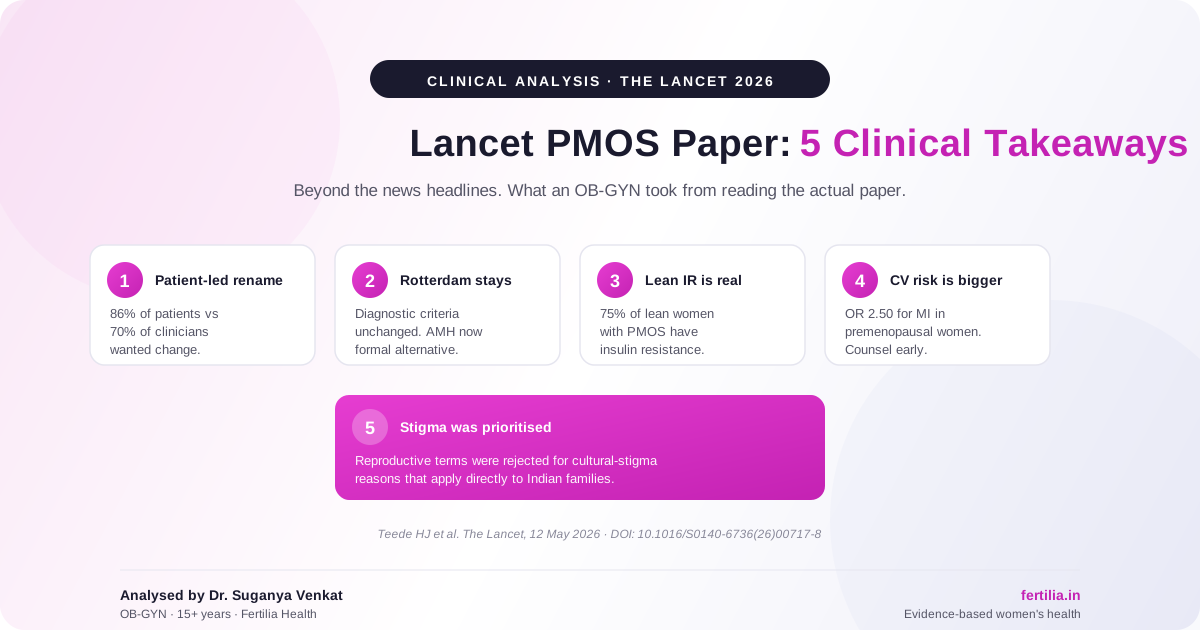
When Survey A asked whether the condition should be renamed using a new, accurate, symptom-based name, 86% of the 9,358 women with PCOS supported it. Only 70% of the 3,656 health professionals did. Patients wanted change more than doctors did. Sixteen percentage points more.
The priority rankings also diverged. Patients’ top priority was stigma avoidance (66%). Health professionals’ top priority was scientific accuracy (86%). This is not a small difference. It reflects two different lived experiences of the same condition.
The paper is open about this. From page 5:
“Patient support was strongest for stigma avoidance, and health professionals for accuracy.”
And in the free-text comments analysis (page 6):
“Prominent themes in the free text comments highlighted long-held patient frustrations over the need for a name that was accurate, enhanced understanding of broader features, and included a focus on recognition that this was a female condition.”
Medical nomenclature has historically been clinician-led. When the American Psychiatric Association renamed “manic depression” to “bipolar disorder” in DSM-III in 1980, patient input was minimal. When the 2012 Chapel Hill Consensus replaced “Wegener’s granulomatosis” with “granulomatosis with polyangiitis”, patient input was again limited. The PMOS rename inverts that pattern. It is, structurally, a patient-led correction of a clinician-defined name.
For the practising OB-GYN, this has a quiet but real implication: when a patient tells you the name made her feel misunderstood, that is now formally validated in The Lancet, drawn from a combined 14,360 survey responses across patients and health professionals (of which Survey A, quoted above, was one). It is not an individual complaint. It is a documented harm.
Takeaway 2: The Diagnostic Criteria Stay Identical, and AMH Is Now Formal
This is the most reassuring practical detail, and the one most patients want confirmed.
From page 8:
“Elevated AMH occurs with disordered folliculogenesis, and is now included in adult diagnostic criteria.”
The Rotterdam Criteria, established in 2003, continue to apply. A woman is diagnosed with PMOS (formerly PCOS) if she meets at least two of the following three:
- Signs of androgen excess, either clinical (acne, hirsutism, alopecia) or biochemical (elevated total or free testosterone)
- Irregular or absent menstrual cycles
- Polycystic ovarian morphology on ultrasound or elevated anti-Mullerian hormone (AMH) on blood test
The AMH-as-ultrasound-alternative is not new (it was emerging in the 2023 International Evidence-Based Guideline), but the Lancet paper formally endorses it. For Indian clinical practice this is significant: transvaginal ultrasound is culturally difficult for many unmarried women, and the 2023 guideline already preferred transabdominal scans in adolescents. AMH gives a non-invasive alternative that does not require any pelvic exam at all.
Practical implication: a woman who has been told she has PCOS at any point in the last 23 years, under any version of Rotterdam, has PMOS. No retesting is required. Her existing diagnosis stands. Her current treatment continues unchanged.
The ICD-10 code remains E28.2 (“Polycystic ovarian syndrome”) until the WHO updates the ICD, which the paper schedules for the 2028 International Guideline update (Stage 8 of the implementation plan, page 8).
Takeaway 3: The “Polyendocrine” Reframe Has Hard Numbers Behind It
The new name puts “polyendocrine” first for a reason. The paper backs this with a number that should change how Indian gynaecologists talk to lean women with PMOS.
From page 8:
“Insulin resistance and compensatory hyperinsulinaemia, present in 85% of affected individuals (75% of lean women [with BMI ≤25 kg/m²] with PMOS), amplify androgen secretion and disrupt steroidogenesis.”
Read that carefully. Eighty-five percent of all women with PMOS have insulin resistance. Seventy-five percent of LEAN women with PMOS have insulin resistance.
It is sourced from systematic reviews of euglycaemic-hyperinsulinaemic clamp studies (Cassar 2016, PMID 27907900) and Stepto’s 2013 lean-PCOS clamp study (PMID 23315059). The clamp is the gold standard for measuring insulin resistance.
For Indian clinical practice, this number lands hard. South Asian women have higher rates of central adiposity and insulin resistance at lower BMIs than Western populations. We have been undertreating lean PMOS for years on the assumption that “she does not look like she has it, so let’s just regulate cycles”. The Lancet data says 3 out of 4 lean women with PMOS have measurable insulin resistance, and they need the same metabolic attention as their overweight counterparts.
What this changes in clinical conversation:
- “You are not overweight, so you do not need metformin” stops being defensible as a default.
- The recommended metabolic screen (fasting glucose or HbA1c, an oral glucose tolerance test where indicated, plus lipids) is justified for nearly all women with PMOS, lean women included, not only those with elevated BMI. The 2023 guideline does not recommend routine insulin assays, because they are not standardised across labs; in my own practice I keep a lower threshold for a fasting insulin in lean women, but that is a clinical judgement, not a guideline mandate.
- Lifestyle and metabolic intervention is justified as first-line care for nearly all women with PMOS, not just the visibly metabolic ones.
- “Lean PMOS” stops being a separate category requiring a separate playbook. It is the majority condition.
Takeaway 4: The Cardiovascular Risk Numbers Are Larger Than Most Patients Are Told
I think this is the single most important takeaway for Indian women in their twenties and thirties.
From page 8, citing Tay et al. 2024 (PMID 39119982):
“Evidence from women who are predominantly premenopausal shows that the odds ratios of composite cardiovascular disease (1.68), myocardial infarction (2.50), and stroke (1.71) are increased in those with PMOS compared with those without PMOS.”
Premenopausal. Not “PMOS women after age 60”. Premenopausal. The very women who walk into a gynaecology consultation today.
Let me put those odds ratios in context:
- OR 1.68 for any cardiovascular disease. The odds of a cardiovascular event are 1.68 times higher in women with PMOS than in women without it, at the same age.
- OR 2.50 for myocardial infarction. The odds of a heart attack are 2.5 times higher.
- OR 1.71 for stroke. The odds of a stroke are 1.71 times higher.
One caution when reading these numbers: they are odds ratios, not risk ratios. An odds ratio overstates the relative rise in risk when the outcome is reasonably common, so “1.68 times the odds” is not the same as “68% more events”. What is not in doubt is the direction and the size of the signal: cardiovascular risk in PMOS is materially raised, and it is already measurable before menopause.
In Indian women, this needs to be triangulated with the Misra 2008 metabolic-risk data showing that South Asians develop cardiometabolic disease at lower BMIs and earlier ages than other ethnicities. The Indian PMOS patient is not at average global risk. She is at higher than average risk for cardiovascular outcomes, and we have been undercounselling on this for two decades.
This does not need to be communicated in a fear-inducing way. It is empowering, not frightening, when it is paired with the actionable intervention. What I now say to younger Indian women with PMOS:
“The same metabolic work we are doing for your cycles and your fertility is, separately, lowering your risk of having a heart attack in your forties. You are not exercising and eating well just to get pregnant. You are doing primary cardiovascular prevention, two decades early, while it actually works.”
This is the reframe the rename enables. PMOS is not a reproductive condition that incidentally causes metabolic disease. PMOS is a metabolic condition that incidentally affects reproduction. When the name puts “metabolic” in the middle, the management priorities reorder.
For the practical Indian clinical workflow, this means:
- Every PMOS workup should include a fasting lipid profile, HbA1c, and blood pressure measurement. Many do not.
- Risk discussion should explicitly include CV risk, framed as “what you can prevent now while it is preventable”.
- Women on long-term oral contraceptives for PMOS should have lipid and BP review at every prescription renewal, not just at year one.
- Cardiology referral should be considered in any PMOS patient over 40 with even one additional risk factor (smoking, family history of CAD, diabetes, BMI over 30).
Takeaway 5: Reproductive Terms Were Rejected for Cultural-Stigma Reasons That Apply to India
The most consequential decision in the paper, for Indian patients specifically, concerns the words that were considered and then rejected.
The workshop voting initially favoured “endocrine metabolic ovulatory syndrome” (EMOS). From page 6:
“Although accurately aligned to genetics, pathophysiology, and clinical features, the potential for the reproductive term to cause social stigmatisation and harm in some cultures or world regions was recognised. Alternative terms such as ovulatory were felt to be less stigmatising but did not encompass broader reproductive features.”
EMOS was eventually rejected for two reasons. One was the “emo” youth subculture overlap (page 6). The other was that “ovulatory” was perceived as having reproductive-stigma implications in some world regions.
What does that mean practically? It means the consensus committee, hearing from patient advocates from Africa, the Middle East, and South Asia, chose to not put a word like “ovulatory” or “reproductive” front and centre in the name, because in cultures where infertility carries social cost, that framing actively harms women.
For India, this is not abstract. The condition’s reproductive impact is real. But the label attached to the condition affects how a woman is treated by in-laws, by a marriage prospect, by employer health insurance, and by her own self-perception. The committee chose “ovarian” (a structural descriptor) over “ovulatory” (a functional descriptor with reproductive connotation) consciously, partly to protect the South Asian and Middle Eastern patient.
There is one limitation to flag here. The paper itself acknowledges, on page 9:
“Disproportionate representation across world regions and disciplines, with lower participation from middle-income and low-income countries, and from Asia, Africa, and South America.”
Indian patient representation in the surveys was, by the paper’s own admission, lower than ideal. We did have voices in the consortium (Dr Madhuri Patil from Bengaluru is a co-author), but the underlying surveys skewed Western and English-speaking. The good news is that, despite this, the paper states the regional analysis “did not identify major differences in the final terms or name preferences” (page 9). The global consensus held even where individual region n’s were small.
For Indian OB-GYNs, this is a quiet vindication of a long-held clinical instinct: words matter to outcomes in our cultural context. The rename committee agreed. That fact alone is worth communicating to patients who ask “did they think about us?”
What the Paper Does Not Change
For balance, here is what the paper explicitly does not change. None of these will surprise a practising clinician, but they are worth stating because patients will ask.
- Treatment. Metformin, combined oral contraceptives, anti-androgens, letrozole, GLP-1 agonists, lifestyle modification. All the same. The paper endorses the 2023 International Guideline protocols throughout.
- Pathophysiology models. Increased GnRH pulse frequency, elevated LH, insulin-driven androgen amplification, reduced SHBG, follicular arrest. All confirmed in the paper.
- Subtype frameworks. The paper does not endorse the “4 PCOS types” framework that circulates on social media. It refers to multiple endocrine pathways within one syndrome, consistent with the PCOS drivers framework we use clinically.
- Hereditary risk. Family clustering, polygenic origin with multiple identified loci. Unchanged.
- Pregnancy risk profile. Gestational diabetes, hypertensive disorders, miscarriage. Unchanged risk associations.
The Implementation Roadmap Is Real, and It Has Timing
Page 8 of the paper lays out eight implementation stages. Most rename papers stop at the rename and leave adoption to chance. This one does not.
| Stage | What Happens | Approximate Timeline |
|---|---|---|
| 1 | Publication and academic dissemination (this paper + commentaries) | May 2026 onward |
| 2 | Multilingual patient and clinician resources | 2026-2027 |
| 3 | Global communication, society toolkits, professional education | 2026-2028 |
| 4 | Integration into EHRs and SNOMED-CT | 2026-2028 |
| 5 | Policy alignment with funders, journals, regulators | 2026-2028 |
| 6 | WHO ICD update engagement | 2027-2028 |
| 7 | Managed 3-year transition with monitoring | 2026-2029 |
| 8 | Integration into the 2028 International Guideline (used in 195 countries) | 2028 |
For Indian clinicians, the most relevant of these is Stage 8. The 2023 Teede International Guideline is the document most Indian gynaecology programmes reference. The next update is scheduled for 2028, and that update will land PMOS as the canonical term in Indian undergraduate and postgraduate curricula. Until 2028, expect both terms in mixed use.
What I Will Be Telling My Patients Differently, Starting Now
This is the practical bottom line of the paper, from one OB-GYN’s reading.
- I will use both names in clinical conversation, with PCOS first for recognition and “now formally called PMOS” as the structural update. This matches the paper’s evolutionary rebranding recommendation (page 6).
- I will explicitly counsel cardiovascular risk at PMOS diagnosis, even in women in their twenties, framed as “what you can prevent now”. I have not been doing this consistently. The OR 2.50 for MI is high enough that the conversation is overdue.
- I will offer HOMA-IR or fasting insulin testing more readily in lean women with PMOS. The 75% lean-IR figure changes the threshold for testing.
- I will frame metabolic intervention as cardiovascular prevention, not just fertility prep. This rewires patient motivation in a way that improves long-term adherence.
- I will continue using PCOS in Tamil and conversational Hindi consultations for at least the next two years, because patients use those terms and translating “polyendocrine metabolic ovarian syndrome” into Tamil is genuinely difficult. The condition does not change with the language.
If any of the above is a conversation you have not had with your treating doctor, and you would like to have it with an OB-GYN who works alongside your local gynaecologist, that is the kind of consultation I run online across India. Start a WhatsApp conversation and tell me where you are on your journey.
If You Have PMOS: What to Ask For at Your Next Appointment
You do not need to act on the rename itself. But if the cardiovascular and metabolic findings above are new to you, these are reasonable things to raise with your own doctor, framed around what you can prevent now, not around fear:
- A fasting lipid profile, an HbA1c, and a blood pressure check as part of your PMOS review.
- If you take a combined oral contraceptive for PMOS, a lipid and blood pressure review at each renewal, not only in the first year.
- A conversation about metabolic and lifestyle steps as cardiovascular prevention, not only as fertility preparation.
Separately, and whether or not you have PMOS, everyone should know the symptoms that mean seek care immediately rather than at the next appointment: central chest pain or pressure, sudden breathlessness, or sudden one-sided weakness, facial droop, or difficulty speaking. Those are emergencies for anyone.
Frequently Asked Questions
What is the Lancet 2026 PMOS consensus paper?
It is the international consensus paper, published in The Lancet in May 2026 (Teede et al., DOI 10.1016/S0140-6736(26)00717-8), that officially renamed PCOS to PMOS (Polyendocrine Metabolic Ovarian Syndrome). It was developed by 56 organisations drawing on 14,360 survey responses (10,411 patients and 3,949 health professionals) and more than 90 clinicians in its consensus workshops, and its core point is that the name change reflects the condition’s multi-system endocrine and metabolic nature. Importantly, it did not change the Rotterdam diagnostic criteria or the treatment; only the name changed. The five clinically meaningful takeaways from the actual paper are unpacked above.
Where can I read the full Lancet 2026 PMOS paper?
The paper is open access under the CC BY 4.0 license. You can read the full text through its DOI, 10.1016/S0140-6736(26)00717-8, which resolves to it on thelancet.com. Its PubMed ID is 42119588.
Who wrote the paper?
The lead author is Professor Helena J Teede of the Monash Centre for Health Research and Implementation in Melbourne, Australia. She is the (unpaid) President of the International Society of Endocrinology and leads the international PCOS guidelines. The paper carries a large international author group, with a wider network listed in the appendix, spanning Australia, the UK, the Netherlands, Finland, the USA, and India (Dr Madhuri Patil, Bengaluru).
How is the new name an improvement over the old name?
The paper attributes three specific clinical harms to the old name: delayed diagnosis (the word “polycystic” routed women toward gynaecology when many had metabolic-dominant presentations), patient dissatisfaction (the name implied cysts that were not actually pathological cysts), and stigma (the cosmetic and reproductive framing). The new name addresses all three by leading with “polyendocrine” (signalling a multi-system endocrine condition), keeping “metabolic” (acknowledging the insulin-resistance core), and using “ovarian” as a structural rather than pathology-implying descriptor.
Did the paper change the diagnostic criteria for PMOS?
No. The Rotterdam Criteria (2 of 3: hyperandrogenism, ovulatory dysfunction, polycystic ovarian morphology or elevated AMH) remain the diagnostic standard. AMH is formally accepted as an alternative to ultrasound in adults. Adolescent diagnosis still requires both hyperandrogenism and irregular cycles, with ovarian morphology not used as a criterion before adulthood.
Will my existing PCOS diagnosis still be valid?
Yes. Any woman correctly diagnosed under any version of Rotterdam Criteria from 2003 onwards has PMOS under the new name. No retesting is required. No new prescription is needed. Insurance and hospital records will continue to show ICD-10 code E28.2 until the WHO ICD is formally updated, which the paper schedules for around 2028.
Why was the name “EMOS” rejected even though it ranked first initially?
EMOS (endocrine metabolic ovulatory syndrome) was the top-ranked candidate after Workshop A. It was rejected for two reasons, both documented on page 6 of the paper. First, “emo” overlapped with a youth subculture associated with melancholy and emotional expression, which the marketing analysis flagged as carrying inappropriate connotations for a medical condition. Second, the word “ovulatory” raised concerns about reproductive stigma in cultures where infertility carries social cost. The committee replaced “ovulatory” with “ovarian” and added “poly” to “endocrine” to retain similarity to the old PCOS acronym, producing PMOS.
Was Indian patient input represented in the consensus?
Yes, but underrepresented. The paper explicitly acknowledges, in the limitations section on page 9, that participation from Asia, Africa, and South America was lower than from high-income Western countries. India had representation at the authorship level (Dr Madhuri Patil from Bengaluru is a co-author), but the underlying surveys skewed English-speaking and Western. The paper notes that despite this limitation, regional analysis of the survey data did not show major differences in name preferences, so the chosen name appears to have global acceptability.
What should I do as a patient right now?
Continue your current treatment. Use whichever name your doctor uses (PCOS, PCOD, or PMOS), they all refer to the same condition. If you want personalised guidance, online consultation with an OB-GYN who consults across India is available at our PCOS program page. For background reading, our PMOS vs PCOS comparison piece answers the most common confusion questions.
The Bottom Line
The PMOS rename is not a cosmetic relabelling. It is a structural correction of three decades of clinically meaningful inaccuracy, decided by patients more than clinicians, with implementation already in motion across guidelines, EHRs, the WHO ICD, and 195 countries’ clinical education. The five takeaways above are what I think an Indian OB-GYN should pull from the paper and start doing differently next week.
Read next:
- PCOS Is Now PMOS: New Official Name Explained (May 2026): the news-framed backstory of the rename.
- PMOS vs PCOS: Same Condition, New Name in 2026: the patient-facing comparison that answers “are they the same”.
- PCOS Symptoms, Root Causes & Treatment: the evidence-based clinical hub.
- Insulin Resistance & PCOS: Signs, Diet & What to Do: the metabolic driver this paper foregrounds.
- Can PCOS Be Cured Naturally Without Medication?: what “reversal” actually means.
Want personalised guidance? Dr Suganya Venkat is an OB-GYN with 15+ years of experience and has supported over 1000 pregnancies. She consults online across India for ₹399. Start a WhatsApp conversation.