When heavy periods keep interrupting work, sleep or travel, you may want something more lasting than another month of managing around them. Being offered a device inside the womb can still feel like a big step. You can ask about pain, hormones and alternatives before deciding.
Mirena can reduce heavy menstrual bleeding and help some women avoid or postpone hysterectomy. It cannot replace surgery in every situation. The cause of the bleeding, the shape of the womb, your health history and whether you want a future pregnancy all matter.
I’m Dr. Suganya Venkat, an OB-GYN with 15+ years of experience. This guide explains the decision to discuss with your treating gynaecologist: whether an intrauterine system is suitable, what a fair trial involves, and when another treatment may serve you better. Fertilia offers online consultations; examinations, device procedures and surgery take place with a local clinician.
What Mirena is, and what it can do
Mirena is a small T-shaped intrauterine system (IUS) containing 52 mg of levonorgestrel, a progestogen. It releases the hormone gradually and thins the womb lining. There is then less lining to shed, which can make periods lighter. It also provides contraception while in use.
Its main action is within the uterus, but some hormone reaches the bloodstream. Hormonal side effects are therefore possible. Ovulation continues in many users, not necessarily every user or every cycle. These mechanisms and the measurable blood levels are described in Bayer’s Mirena prescribing information, sections 12.1-12.3.
Bleeding may become irregular or more frequent at first. For some women, periods eventually stop because the lining remains thin; blood is not building up inside. New or unexplained bleeding changes still deserve assessment, especially after a settled pattern.
How long does Mirena last in India?
Ask the inserting clinician to check the current Indian product insert for the indication being treated, and write down the review and replacement dates. We could not verify a current publicly accessible Indian Mirena prescribing document during this September 13, 2026 review, so we are not asserting an Indian licence duration here.
The US Mirena label permits up to eight years for contraception but five years for heavy menstrual bleeding. Those are US indications, not replacement instructions for India. A contraceptive duration also cannot automatically be used as the duration for treating bleeding.
Clinical sources and India pricing reviewed September 13, 2026; original publication date retained.
Who may benefit, and what needs checking first
NICE guideline NG88, recommendation 1.5.2, recommends considering an LNG-IUS as the first treatment for heavy menstrual bleeding when there is:
- No identified underlying pathology.
- A fibroid smaller than 3 cm that does not distort the uterine cavity.
- Suspected or diagnosed adenomyosis.
That is a recommendation for selected women, not a requirement that everyone try Mirena before surgery. A fibroid’s position and effect on the cavity matter as well as its size.
The assessment starts with your bleeding pattern, pain, medicines, pregnancy possibility and examination. NICE NG88, sections 1.2-1.3, recommends a full blood count for heavy menstrual bleeding. Ultrasound or hysteroscopy is chosen according to the history and examination; some women also need endometrial sampling. Persistent bleeding between periods, infrequent heavy bleeding with PCOS, or bleeding that has not responded to treatment may change the investigation plan. There is no single scan-and-blood-test package for everyone.
Mirena should not be inserted into an unexplained bleeding problem without appropriate assessment. Pregnancy, current pelvic infection, a cavity distorted in a way that prevents correct placement, and current breast cancer are important reasons not to use it. Past breast cancer and certain liver conditions also need specialist consideration; Bayer’s contraindications and the CDC medical eligibility guidance describe these restrictions.
Tell the clinician how bleeding affects ordinary days: flooding, disrupted sleep, avoiding travel, or feeling exhausted. Those details help set a treatment goal even when you cannot measure blood loss. Treatment should address the cause, not simply suppress a symptom without a plan.
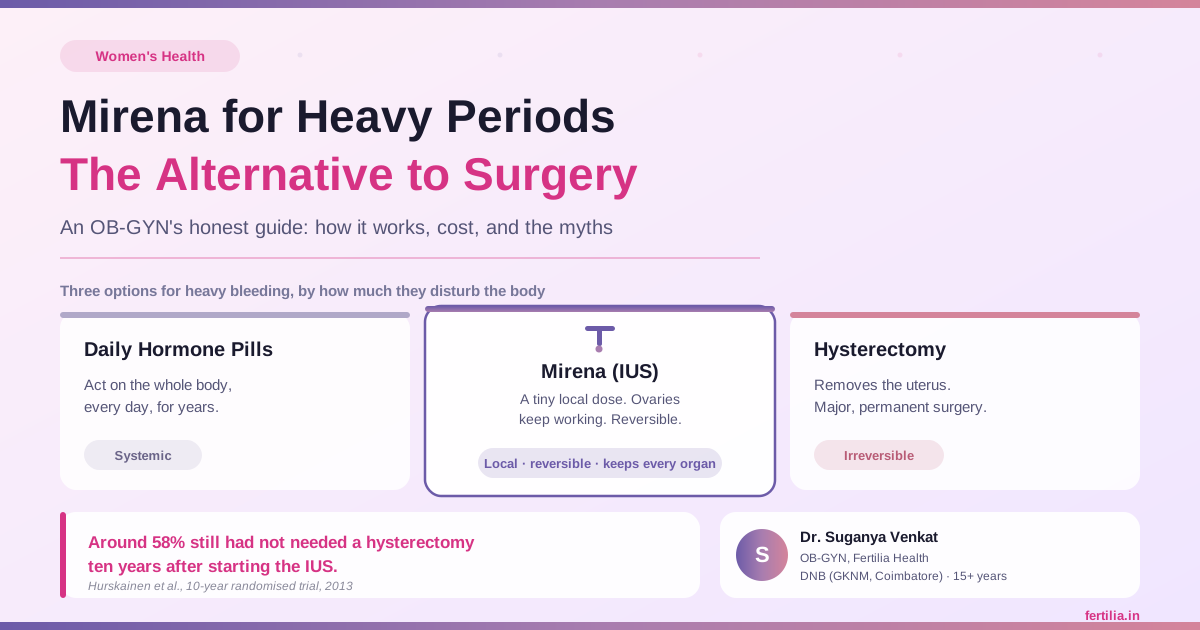
How does it compare with tablets and hysterectomy?
These are legitimate options with different trade-offs. Tablets are not inherently more harmful or “less natural” than a device, and surgery is not a failure of care.
| Option | What to weigh with your clinician |
|---|---|
| Tranexamic acid or an NSAID | Non-hormonal medicines used for bleeding or pain; suitability depends on medical history and other medicines. |
| Combined hormonal contraception or cyclical oral progestogens | Can help control bleeding without placing a device; the appropriate regimen depends on eligibility and pregnancy plans. |
| LNG-IUS such as Mirena | Reversible contraception and bleeding treatment, with an insertion procedure and an initial adjustment period. It may not control symptoms sufficiently. |
| Procedures or surgery | Treatment may target a polyp or fibroid, or involve ablation or hysterectomy. The cause, severity and future fertility wishes determine which options fit. |
These alternatives appear in NICE NG88, sections 1.4-1.5. Hysterectomy removes the womb and permanently ends the ability to carry a pregnancy. It can provide definitive relief from uterine bleeding, but involves operative risks and recovery. Removing the ovaries is a separate decision, not an automatic part of every hysterectomy.
When surgery remains appropriate
NICE NG88, recommendation 1.5.6, supports specialist referral when symptoms are severe, treatment has not worked, or a woman declines medication. An IUS may also be unsuitable because of the underlying cause. The next option can be a targeted procedure, ablation or hysterectomy, after discussing your goals and future fertility. You do not have to try every medicine or device before your preference is taken seriously.
What happened in the ten-year trial?
A Finnish randomised trial enrolled 236 women aged 35-49 with heavy menstrual bleeding. Of the 119 assigned to LNG-IUS treatment, 55 (46%) subsequently underwent hysterectomy during ten years of follow-up. The study reported no significant difference between the assigned groups in long-term quality-of-life outcomes, and lower overall costs for the LNG-IUS strategy despite later operations. See Heliövaara-Peippo and colleagues, American Journal of Obstetrics and Gynecology, 2013 (PMID 23999423).
This supports offering an LNG-IUS to suitable women who prefer it. It does not show that one device lasts ten years, guarantee that surgery will be avoided, or establish today’s Indian treatment costs. Some women needed surgery later; others did not. Your choice does not have to be justified by matching either outcome.
If you want help understanding the options already offered to you, WhatsApp Dr. Suganya for an online consultation. Bring any scan reports, blood counts and the treatment plan from your local gynaecologist.
Insertion, settling-in and side effects
Insertion is usually an outpatient procedure through the cervix, without an abdominal incision. Pain varies and can be significant. Ask in advance about available pain relief, including local anaesthetic options, and how to pause or stop if you need to. A painkiller beforehand does not reliably prevent insertion pain for everyone; CDC’s 2024 insertion guidance recommends an individualised plan and advises against routine misoprostol.
Spotting and irregular bleeding are common during the first few months. NICE NG88, recommendation 1.4.3, advises explaining that bleeding changes can last beyond six months and allowing at least six cycles to assess benefit. This is not an instruction to endure severe bleeding or pain for six months. Agree a review plan and seek help earlier if symptoms are difficult to manage.
Possible adverse effects include headaches, breast discomfort, acne, mood symptoms and ovarian cysts. Weight changes have been reported, but a change on the scales cannot automatically be attributed to the device. There is no reliable promise that any individual will have fewer mood or weight effects than with a pill. See Bayer’s adverse-effects information, section 6.
The device can be expelled or sit incorrectly. Rarely, it can perforate the uterine wall, sometimes recognised after insertion. It can therefore sit outside its intended position, including beyond the uterine wall. Insertion while breastfeeding or soon after childbirth needs specific risk counselling. These warnings are described in Bayer’s prescribing information, sections 5.5-5.6.
Get urgent local care for severe or worsening pelvic pain, fever with pelvic symptoms, a positive pregnancy test with an IUS in place, or heavy bleeding with faintness or breathlessness. If the threads change or cannot be felt when you have been taught to check them, use backup contraception and contact the inserting service; do not try to pull out the device. Do not wait for an online reply when urgent assessment is needed.
What about breast cancer?
Breast-cancer risk is one of the factors to discuss alongside bleeding relief. A Danish registry study found a higher breast-cancer rate among LNG-IUS users than nonusers of hormonal contraception. For the 0-5-year use interval, the estimated excess was 14 diagnoses per 10,000 users (95% confidence interval 6-23). That is an interval estimate, not an annual risk and not an India-specific prediction. The study was observational and cannot establish that the device caused the difference. See Mørch and colleagues, JAMA, 2024 (PMID 39412770; full study).
This belongs in a balanced discussion of bleeding relief, contraceptive needs and personal risk. Tell your clinician about any personal or family breast-cancer history. Do not stop or remove a device yourself because of a population-level statistic.
What it costs in India
Checked September 13, 2026: the NPPA Gazette notification S.O. 1575(E), March 25, 2026, English table page 40, row 365, sets a ceiling of ₹4,202.06 per 52 mg levonorgestrel-releasing IUD, excluding applicable GST, effective April 1, 2026 (page 50, note (a)).
This is a formulation-level device ceiling, not a verified Mirena-brand retail quote or an all-inclusive insertion package. Consultation, investigations when indicated, insertion, pain relief and later removal may be billed separately. Ask for an itemised estimate rather than assuming a national private-clinic total. We have not verified a current national hysterectomy price range, so no savings comparison is presented here.
The National List of Essential Medicines 2022, section 18.2.2, PDF page 66, includes a 52 mg levonorgestrel IUD at tertiary level. That does not guarantee local stock, free supply or the Mirena brand. Ask the hospital which device it offers and what its service charges are. Our Copper-T and Mirena price guide explains the distinction between the device price and procedure costs.
Questions to take to your appointment
- What is the likely cause of my bleeding, and which investigations do I need?
- Is the uterine cavity suitable for an IUS? Is it appropriate with my medical history?
- How will we manage insertion pain and early bleeding?
- What improvement would count as enough for me, and when will we review it?
- If I decline it or it does not help, which alternatives would you recommend?
If you also need contraception, our Mirena-versus-Copper-T decision guide covers that separate choice. Copper-T is not a treatment for heavy bleeding and can make periods heavier. If you prefer no uterine device, the contraception comparison covers pills, implants and other methods.
Frequently Asked Questions
Is Mirena painful to insert? Pain varies from mild cramping to significant discomfort. Discuss a pain-control plan before the appointment, including local anaesthetic where appropriate. You can ask for the procedure to pause or stop. It is not something you must simply tolerate.
Does Mirena stop periods completely? It may, but not for everyone. The lining becomes thin, so there is less to shed. Early spotting is common. A new change after a stable pattern, pregnancy symptoms or troublesome bleeding should be assessed rather than assumed to be normal.
Can I get pregnant after Mirena is removed? Fertility can return promptly; contraception is needed immediately if pregnancy is not wanted. Return of fertility is not a promise of conception, which also depends on age and other factors. A randomised comparison found no delay in fertility return after LNG-IUD removal versus a copper device: Andersson and colleagues, Contraception, 1992 (PMID 1493717).
Is Mirena better than a hysterectomy for heavy bleeding? Neither is best for everyone. An IUS is reversible and may be a suitable first treatment. Hysterectomy can be appropriate for severe symptoms, unsuccessful treatment or certain underlying conditions, after discussing alternatives and the permanent effect on fertility.
How much does Mirena cost in India? The September 2026 review found an NPPA ceiling of ₹4,202.06 excluding applicable GST for the 52 mg levonorgestrel-IUD formulation. This is the device alone, not an insertion package or guaranteed brand price. Ask the provider for a written itemised quote.
Do I have to keep it if the bleeding does not improve? No. Agree a review plan with the inserting clinician. Some early irregular bleeding is expected, but troublesome symptoms deserve help, and removal or another treatment can be discussed. Replacement timing must follow the applicable Indian product instructions for your indication.
You are welcome to message Dr. Suganya for a video consultation. Fertilia can help you understand your options alongside your local gynaecologist’s care; it does not provide device insertion, removal or emergency treatment online.