In the same week, two women in very different situations can arrive at the same question.
One has been trying naturally for just over a year. Her reports are broadly normal, her cycles a little irregular, and she keeps hearing “just relax, it will happen.” She wants to know if there is something she can actually do.
The other has an IVF cycle booked for the following month. Her clinic has done the workup and set the dates. She wants to walk in as prepared as possible, and the weeks between retrieval and transfer are on her mind.
Both are asking a version of the same thing: which kind of support do I need? One has read about “natural conception programs,” the other about “IVF support programs,” and the difference is not obvious. If you are standing at a similar crossroads, this post is for you.
For more on this, read our guide on OHSS After IVF.
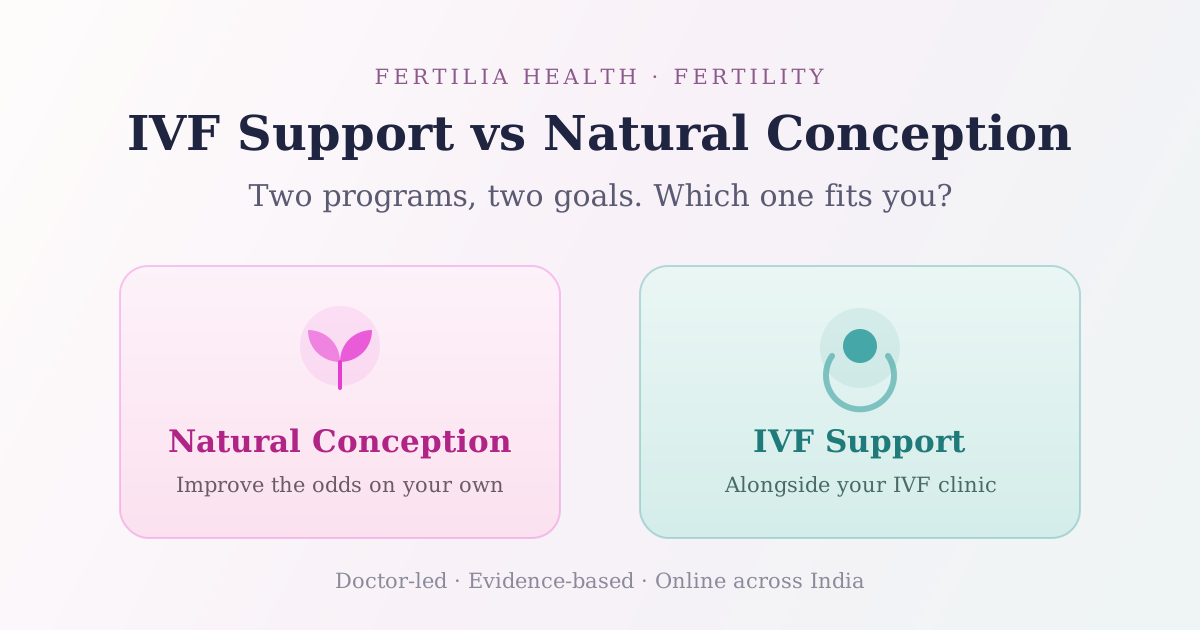
The two programs answer two different questions
The simplest way to tell them apart is by the question each one is built to answer.
A natural conception program asks: how do we improve the odds that pregnancy happens on its own, this cycle and the next few?
An IVF support program (the same logic applies to IUI) asks: how do we give this assisted cycle the best possible foundation to work, alongside the clinic running it?
Same destination. Different road, and a different starting point on the map. Neither is “better.” They are built for women in different situations.
What a natural conception program does
The goal here is to work on the factors you can actually influence, so your body has the best chance of conceiving without assisted treatment, or before it.
A good natural conception program works on:
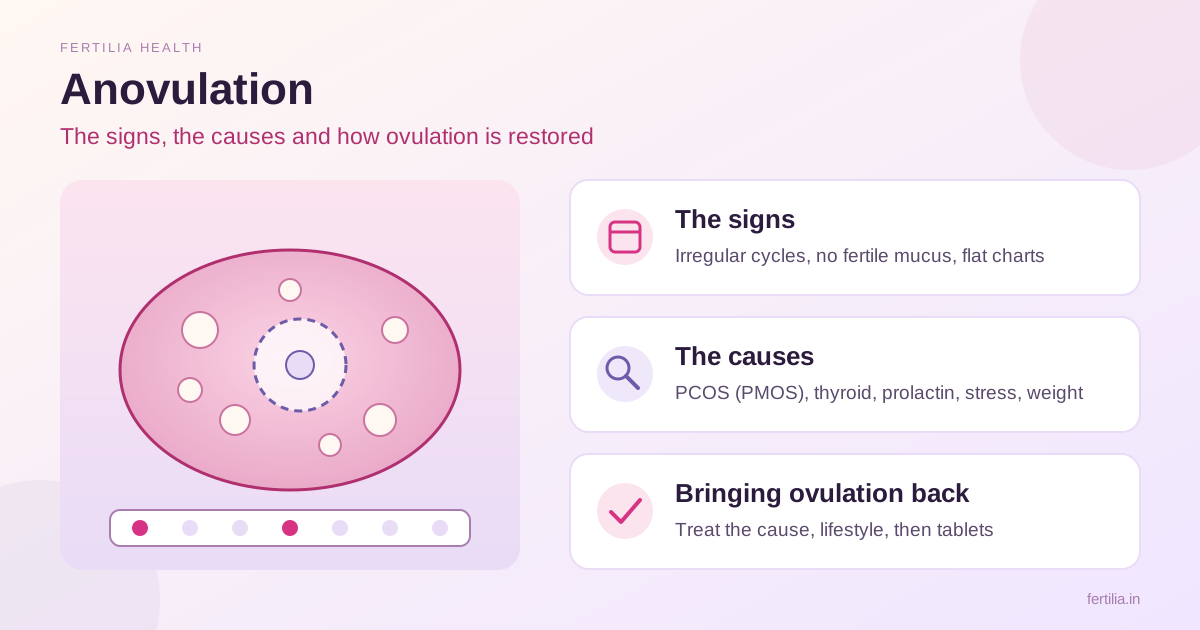
- Ovulation and cycle regularity, so there is a fertile window to aim for in the first place.
- Egg quality over the roughly 90-day window before an egg is released. The final stage of a follicle’s development takes about three months (Gougeon, 1986), which is why lifestyle changes are given time to work rather than judged in a single cycle.
- Insulin, thyroid and weight, because these quietly shape ovulation. In women with PCOS, even modest weight and lifestyle change can restore ovulation (Moran et al., 2011).
- Sleep and stress, which affect the hormonal signals that drive a cycle.
- The male partner’s sperm health, which is half of every conception and is often left out.
- Timing, so that all of the above is not wasted on the wrong days.
It helps to know the odds are often on your side. Around 80% of couples conceive within 12 months of trying, and a below-average AMH is not a closed door: one study found similar natural conception rates in women with low and normal AMH (Steiner et al., 2017).
This kind of program tends to fit you if you have been trying for six months or more, your cycles are irregular or you suspect a hormonal imbalance, you have been told “everything looks normal” but still are not conceiving, or you simply want to try the natural route properly before, or alongside, medical treatment. You can read our step-by-step guide on how to conceive naturally and, if AMH is on your mind, low AMH and natural conception.
What an IVF (or IUI) support program does
The goal here is different. Your clinic is running the medical cycle: the stimulation, the retrieval, the transfer. An IVF support program prepares your body for that cycle and supports you through it, working with your specialist, not around them.
Good IVF support is stage-specific, because each phase of a cycle needs something different:
- Before egg retrieval: the same roughly 90-day window is used to support egg quality through nutrition, sleep, and thyroid and insulin balance. This is the one window in which egg quality can meaningfully shift, so starting early matters. Our guide to improving egg quality covers the evidence.
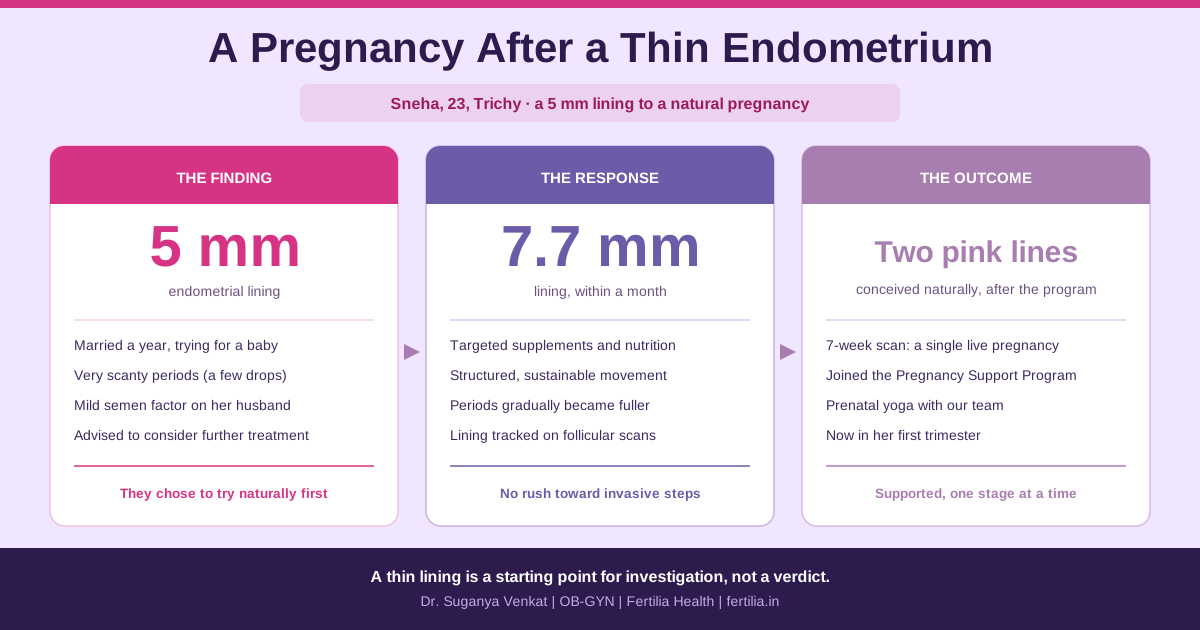
- Before embryo transfer: the focus moves to preparing a receptive uterine lining through nutrition, blood flow and an anti-inflammatory approach. If your lining has been flagged as thin, our post on thin endometrium explains what helps.
- Through the two-week wait: cycle-day check-ins and calm, steady support through what is often the hardest fortnight. Our two-week wait guide walks through what is normal.
- After a failed cycle: a recovery window to understand and gently address what is modifiable before the next attempt, without blame and without rush.
The most important line to understand: an IVF support program does not replace your IVF clinic, and it never overrides your medication or timing. Your specialist stays in charge of the cycle. The support layer handles the parts a busy clinic often does not have the bandwidth for: the daily questions, the diet, the sleep, the reassurance. IVF is a valuable, sometimes essential treatment, and this kind of program is built to make it work better, not to argue with it.
It tends to fit you if you are about to start your first cycle and want to walk in prepared, you are between retrieval and transfer, or you have had a cycle that did not work and want to understand what can be improved before the next one. If you would like the groundwork for either route, see our 90-day prep plan for IUI and IVF.
💜 Not sure which kind of support you need? Message Dr. Suganya’s team on WhatsApp and we will look at where you are in your journey and help you work out which fits your situation right now.
The difference in one view
| Natural conception program | IVF support program | |
|---|---|---|
| Core goal | Improve the odds of conceiving on your own | Give an assisted cycle its best foundation |
| Best time to start | Any time you are trying | Ideally 90 days before retrieval, but any stage helps |
| Works on | Ovulation, egg quality, cycle, insulin, thyroid, weight, sperm, timing | Egg-quality prep, lining receptivity, two-week-wait support, between-cycle recovery |
| Works with | You and your gynaecologist | You, your gynaecologist, and your IVF specialist |
| Best for | Trying under a year, irregular cycles, “all normal” but not conceiving | A planned or ongoing IVF/IUI cycle, or a failed cycle you want to build on |
Which one fits you right now
You do not need to diagnose yourself. But here is how I think about it in clinic, so you can get your bearings.
If you have not yet had a full fertility workup, there is no known blocker such as blocked tubes or a significant male-factor issue, you are broadly under 35, and you have been trying for under a year, then a natural conception approach first is usually a reasonable place to begin, with your doctor alongside you. Starting from a clear picture helps, so our fertility workup guide is a good first read.
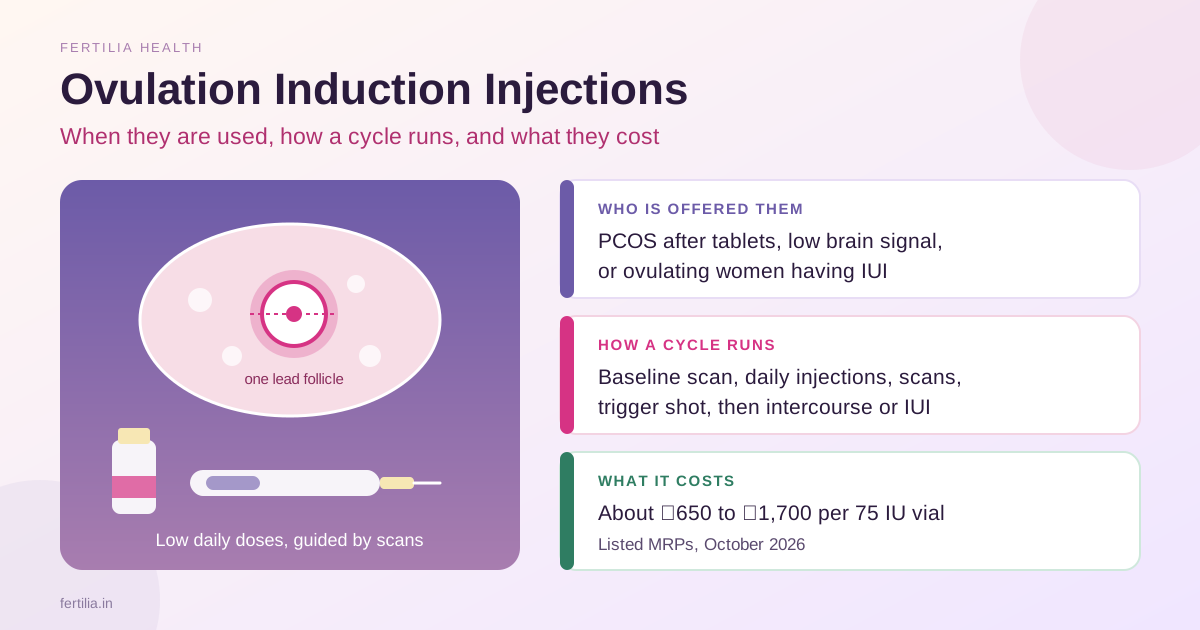
If there is already a known reason that makes natural conception unlikely, if age or ovarian reserve means time matters more, or if a cycle is already planned, then IVF or IUI support is the better fit. Whether an assisted cycle is the right next step at all is a separate question, and we cover it in Do You Need IVF? and IUI vs IVF.
Notice that none of this is about a deadline or a warning. It is about matching the support to where you actually are.
They are not either or
Here is the part that is easy to miss. The support you choose does not lock in your medical path. Choosing a natural conception program does not mean you have ruled out IVF, and choosing IVF support does not mean you have given up on your body.
In practice, many women begin with a natural conception plan and, if the picture changes or the trial has been fair, carry the same team and the same knowledge of their body into IVF support. The two programs are designed as siblings, not rivals. What stays constant is that someone knows your history, your labs, and your cycle, so nothing starts from scratch when the plan shifts.
What to look for in either kind of program
Whichever fits you, the things that make a fertility program worth your time are the same:
- It is doctor-led. Fertility touches medication, thyroid, insulin, and safety. That belongs with a qualified doctor, not a generic app or a coach working from a template.
- It is evidence-based. Look for guidance grounded in clinical evidence, not detoxes, unproven “cleanses,” or promises no one can keep.
- It coordinates with your existing doctors. A good program works alongside your gynaecologist or IVF specialist and never asks you to abandon them.
- It fits Indian life. Diet built around ragi, dal, dahi and the vegetables you actually eat, labs you can get in your city, and realistic guidance about cost. For real numbers, see our breakdowns of IVF cost in India and IUI cost in India.
- It is personalised. Your plan should be built around your history and your body, not handed to you off a shelf.
At Fertilia, this is exactly why we run two separate programs rather than one blurred offering. The Fertility program is built for natural conception, and the IVF Support program is built to run alongside your IVF clinic. Both are led by an OB-GYN, both are online across India and for Indian women abroad, and both come with daily WhatsApp support so you are never left guessing between appointments.
💜 Want help choosing the program that fits your situation? Message Dr. Suganya’s team on WhatsApp and we will talk through where you are and what would help most, with no pressure to sign up for anything.
Frequently Asked Questions
What is the main difference between an IVF support program and a natural conception program?
Their goals. A natural conception program works to improve the odds that pregnancy happens on its own, by optimising ovulation, egg quality, cycle regularity, insulin, thyroid, weight, sperm health and timing. An IVF support program prepares your body for and supports an assisted cycle (egg-quality prep before retrieval, a receptive lining before transfer, and steady support through the two-week wait), working alongside the clinic running your cycle.
Can I do a natural conception program if I am already planning IVF?
Often, yes, and the two overlap in the months beforehand. The 90-day egg-quality window, better sleep, and balanced insulin and thyroid all support both routes. If a cycle is already booked, the plan simply focuses on walking in prepared. If you have some time before deciding, natural conception support can run first, and shift to IVF support if the plan changes.
Does an IVF support program replace my IVF clinic?
No. Your IVF specialist stays fully in charge of the medical cycle, the medication and the timing. An IVF support program adds the layer around that cycle: nutrition, lining and egg-quality preparation, stress support, and day-to-day guidance. It is designed to work with your clinic, never to override it.
Which program should I choose if I have had a failed IVF cycle?
An IVF support program is usually the better fit. The window between cycles is used to gently understand what is modifiable, support egg quality and lining for the next attempt, and rebuild after a hard experience, all alongside your specialist. A failed cycle is information, not a verdict, and a lot can be done before the next one.
Is natural conception support only for women who want to avoid IVF?
No. It is for anyone who wants to give natural conception a proper, supported try, whether or not IVF is on the table. Choosing it does not close the door on assisted treatment. Many women use it as a first step and keep IVF as an option if it is needed later.
Can I switch from one program to the other?
Yes, and this is common. If a natural conception plan has had a fair trial and the picture points towards assisted treatment, the same team carries your history, labs and cycle knowledge into IVF support, so nothing starts over. The programs are built to hand off to each other smoothly.
How do I know which one is right for me?
The quickest way is a short conversation. Where you are in your journey, your age, your reports, and whether a cycle is already planned usually make the answer clear. You are welcome to message Dr. Suganya’s team on WhatsApp and we will help you find your footing, with no pressure either way.