When a fertility specialist suggests IUI, the first question most couples ask is not how the procedure works. It is: what are my actual chances?
The frustrating thing is that the numbers you find online vary enormously. Some clinics advertise 25% per cycle. Others quote 5%. Research papers land somewhere in the middle, with ranges wide enough to be nearly useless for any individual couple. And the number that matters for you specifically depends on factors that are almost never named alongside the headline figure.
This post breaks down what the evidence actually shows about IUI success rates in India, what those numbers mean in practice, and which factors genuinely shift the odds in your favour. The goal is not to make IUI sound better or worse than it is. The goal is to give you a clear picture before you commit to a treatment.
The Average Per-Cycle Success Rate
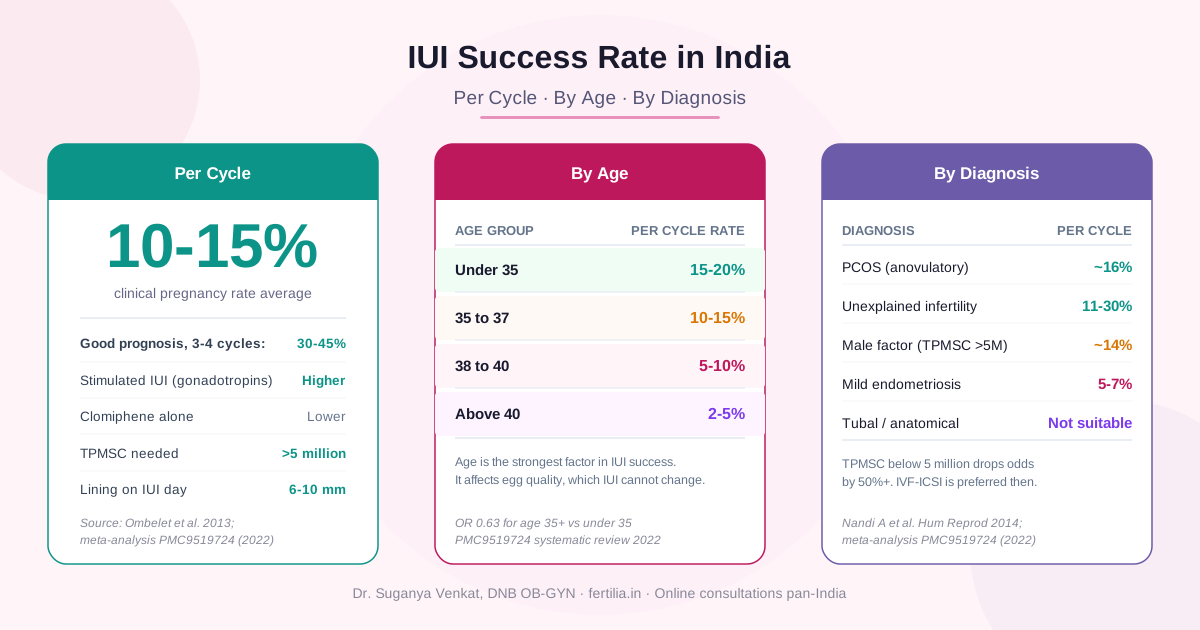
The most consistently reported per-cycle clinical pregnancy rate for stimulated IUI sits between 10% and 15% across published literature (Ombelet W et al., Facts Views Vis Obgyn, 2013; Nandi A et al., Hum Reprod, 2014). Individual studies range from 5% to 23% depending on patient selection, the stimulation protocol used, and how “success” is defined. Some studies report clinical pregnancy rate (gestational sac on ultrasound); others report live birth rate, which is lower.
A 2022 systematic review and meta-analysis (PMC9519724) that looked at prognostic factors for IUI success found that the cumulative clinical pregnancy rate across four cycles reached approximately 19 to 45% for good-prognosis couples. The lower end of that range applies to older women or those with challenging diagnoses; the higher end applies to younger women with unexplained infertility or well-treated PCOS.
What this means practically: a single IUI cycle is not a test of whether IUI can work for you. It is one attempt in what is typically a three- to four-cycle trial.
How Age Changes the Numbers
Female age is the single strongest prognostic factor in IUI. The same review found that women aged 35 or older had significantly lower per-cycle success compared to younger women (odds ratio 0.63 for age 35 and above).
The approximate per-cycle clinical pregnancy rates by age group, synthesised across published Indian and international data:
| Age Group | Per-Cycle Clinical Pregnancy Rate |
|---|---|
| Under 35 | 15 to 20% |
| 35 to 37 | 10 to 15% |
| 38 to 40 | 5 to 10% |
| 40 and above | 2 to 5% |
These are averages. Within each age bracket, a woman with good ovarian reserve, patent tubes, and a partner with reasonable sperm parameters will likely perform better than these ranges suggest. A woman at 32 with low AMH or significant endometriosis may not perform as well.
Age affects IUI success primarily through egg quality. As eggs age, the rate of chromosomal errors during fertilisation increases. IUI does not address this: it places better-prepared sperm closer to the egg, but the egg itself is unchanged. This is one of the reasons IVF with preimplantation genetic testing becomes more relevant as age rises, particularly above 38.
How Diagnosis Affects Your Odds
Not all diagnoses respond to IUI equally. The same 2022 meta-analysis reported per-cycle success rates by primary diagnosis:
| Diagnosis | Per-Cycle Clinical Pregnancy Rate |
|---|---|
| PCOS (anovulatory) | ~16% |
| Unexplained infertility | ~11 to 30% |
| Male factor only | ~14% |
| Mild endometriosis | ~6 to 7% |
| Tubal or anatomical factor | Very low (IUI not recommended) |
PCOS responds reasonably well to IUI when combined with ovulation induction, because the core problem is irregular ovulation, and the procedure addresses exactly that: a confirmed, timed ovulation with prepared sperm. If you have PCOS and are considering IUI, our step-by-step guide to conceiving with PCOS covers the preparation work that can support the IUI cycle.
Unexplained infertility has the widest range of reported success rates, which reflects how heterogeneous this diagnosis is. Some couples in this category conceive quickly on IUI; for others, the unexplained label may be masking factors the workup did not catch.
Male factor infertility is often a good candidate for IUI when the post-wash total progressively motile sperm count (TPMSC) is 5 million or above. Below 5 million, success rates drop sharply and IVF with ICSI becomes the more efficient route (odds ratio 0.38 to 0.47 for TPMSC below 5 million, same meta-analysis). Before starting IUI, it is worth reviewing a semen analysis report carefully with your fertility doctor to confirm the sperm count threshold is being met.
Endometriosis lowers IUI success even in mild stages. The inflammatory environment around the fallopian tubes and ovaries affects sperm function and embryo implantation in ways that IUI cannot correct. Moderate to severe endometriosis is generally considered an indication for IVF rather than IUI.
Tubal factor (blocked or damaged tubes) is a contraindication to IUI rather than an indication. The entire premise of IUI is that sperm, once placed into the uterus, travel up through patent tubes to meet the egg. If one or both tubes are blocked, the pathway does not exist.
Not sure whether IUI is the right starting point for your situation?
A ₹399 online consultation with Dr. Suganya covers your workup results, your diagnosis, and whether IUI, further investigation, or a different approach fits best for you.
WhatsApp Dr. SuganyaWhat Moves the Odds in Your Favour
Beyond age and diagnosis, these factors have consistent support in the evidence:
Post-wash TPMSC of at least 5 million. This is the single most cited sperm threshold in IUI literature. Below this number, the procedure becomes significantly less effective. The semen analysis borderline guide explains what to do if your parameters are close to this threshold.
Endometrial thickness between 6 and 10 mm, with a trilaminar pattern. The lining needs to be receptive on the day of insemination. Thickness below 6 mm on IUI day is associated with lower success rates; above 10 mm has variable evidence, but the pattern matters as much as the number.
Gonadotropin stimulation over clomiphene alone. Injectable gonadotropins tend to produce more mature follicles and better ovulation quality than oral clomiphene (Citadium) in most studies. The trade-off is a slightly higher risk of twins or triplets, which your fertility doctor will monitor carefully.
Timed insemination 36 hours after the HCG trigger. The timing of the HCG trigger and the subsequent insemination window matters. Too early or too late relative to ovulation reduces the chance of sperm meeting the egg at the right moment.
Absence of significant hormonal or anatomical problems. A TSH in the normal range, prolactin within reference limits, and a uterine cavity without polyps or fibroids that distort the cavity all contribute to the IUI having the best possible environment to work in. If you have not had a full fertility workup, the honest fertility workup guide covers what tests to run before starting.
Cumulative Success Across Multiple Cycles
One of the most useful pieces of information about IUI is the cumulative success rate across several cycles, not just the per-cycle number.
For couples with a good prognosis (woman under 35, patent tubes, post-wash sperm count above 5 million, unexplained infertility or well-treated PCOS), the cumulative clinical pregnancy rate reaches approximately:
- After 1 cycle: 10 to 20%
- After 2 cycles: 20 to 30%
- After 3 cycles: 30 to 40%
- After 4 cycles: 35 to 45%
The benefit of additional cycles diminishes significantly after the fourth attempt, particularly for women over 35. This is why most fertility specialists recommend a formal reassessment after three to four failed IUI cycles, rather than continuing indefinitely.
For lower-prognosis couples (age above 37, significant male factor, endometriosis), the cumulative rates are lower and the reassessment point often comes sooner.
What IUI Does Not Guarantee
IUI prepares the sperm and places it in a better position. It does not guarantee fertilisation, implantation, or a continuing pregnancy.
A common misunderstanding is that failed IUI means the sperm are not good enough, or that the woman has a problem. Neither is necessarily true. Fertilisation is a probabilistic event. Even in the most fertile couples, the per-cycle chance of conception through timed intercourse is around 20 to 25%. IUI gets that number to a similar range or slightly higher for the right candidates. It does not make conception certain.
It also does not replace the value of optimising the underlying fertility picture before starting. Weight, insulin resistance in PCOS, thyroid status, and lifestyle factors affect the quality of eggs, the receptivity of the lining, and sperm function. Addressing these before starting IUI, rather than expecting IUI to compensate for them, tends to give better results.
How IUI Costs and IVF Compare
For many couples in India, the decision between IUI and IVF comes down to a combination of diagnosis, age, and cost. IUI cycles in India typically run between Rs.5,000 and Rs.20,000 per cycle, depending on the stimulation protocol and the clinic. IVF costs between Rs.1.5 lakh and Rs.3.5 lakh per full cycle.
The IUI Cost India 2026 guide covers what is included in different pricing structures across cities. For IVF, the IVF cost guide breaks down what the advertised price often does not include.
The cost-per-pregnancy calculation sometimes favours IVF over multiple IUI cycles for older women or those with more complex diagnoses, even though the per-cycle IUI cost is lower. This is a calculation worth doing with your fertility doctor before committing to multiple IUI attempts. The do you need IVF decision guide covers the clinical thresholds where this shift is most relevant.
When to Review and Reassess
The following scenarios are generally accepted indications to review whether IUI is still the right path:
- Three to four completed IUI cycles with no pregnancy
- Age 38 or above with declining ovarian reserve
- TPMSC consistently below 5 million after washing
- Evidence of tubal damage found after the IUI cycles started
- New findings on repeat ultrasound (endometrial polyp, cavity distortion)
A reassessment does not mean IUI has failed you. It means the clinical picture is being updated with more information, and the next step is being chosen based on what is now known rather than what was assumed at the start.
Want to understand your IUI odds before starting, or review results after a failed cycle?
Dr. Suganya reviews your complete workup online, pan-India, at ₹399. She will tell you honestly whether IUI is the right starting point and what the numbers look like for your specific situation.
WhatsApp Dr. SuganyaFrequently Asked Questions
What is the average IUI success rate per cycle in India?
The per-cycle clinical pregnancy rate for stimulated IUI averages 10 to 15% in published studies. Rates range from 5% to 23% depending on age, diagnosis, sperm quality, and stimulation protocol. A single cycle gives roughly a 1-in-8 to 1-in-10 chance. This is why most specialists recommend planning for two to four cycles before assessing whether to continue.
Does IUI success rate decrease with age?
Yes, significantly. Women under 35 have per-cycle rates in the 15 to 20% range. Between 38 and 40, that drops to 5 to 10%. Above 40, IUI success rates are low enough that many fertility specialists recommend moving to IVF sooner, particularly if ovarian reserve is also declining. The age effect is primarily about egg quality, which IUI does not address.
What sperm count is needed for IUI to work?
The commonly cited threshold is a post-wash total progressively motile sperm count (TPMSC) of 5 million or above. Below this number, success rates fall sharply. Many studies show that a TPMSC below 5 million reduces the odds of success by more than 50%, and IVF with ICSI becomes the more appropriate option.
How many IUI cycles should I try before IVF?
Most fertility specialists recommend three to four IUI cycles before formal reassessment, adjusted for your age and diagnosis. For women above 37 or those with endometriosis or low ovarian reserve, the threshold is often lower: two to three cycles before a conversation about IVF. The cumulative benefit of additional IUI cycles beyond four is small for most couples.
Is IUI cheaper than IVF in India, accounting for success rates?
Per cycle, yes. IUI typically costs Rs.5,000 to Rs.20,000 per attempt. IVF costs Rs.1.5 lakh to Rs.3.5 lakh. However, three failed IUI cycles can cost Rs.30,000 to Rs.60,000 combined, while a single IVF cycle that succeeds at first attempt costs more but may result in a pregnancy sooner. For women over 35 or with a diagnosis that lowers IUI success rates, the cost-per-pregnancy calculation often favours starting IVF sooner.
Does PCOS affect IUI success rates?
PCOS can actually improve IUI outcomes when the procedure is combined with ovulation induction. Women with anovulatory PCOS show per-cycle success rates around 16% in some studies, which is at the higher end of the range. The key is confirming ovulation occurred and timing the insemination correctly. If PCOS is also associated with insulin resistance or elevated androgens, addressing those before starting IUI supports a better response.
Can I do IUI if I have one blocked tube?
It depends on which tube is blocked and whether the other is fully patent. If one tube is healthy and on the side where the dominant follicle is, IUI can still work. If both tubes show any obstruction, or if the open tube is on the opposite side from the growing follicle, success rates drop substantially. An HSG or laparoscopy is needed to confirm tubal status before starting IUI.