By the time a woman says the words “I am scared of sex” out loud, she has usually carried them alone for a long time. Sometimes for months before a wedding. Sometimes for years into a marriage, while everyone around her assumes things are fine and asks, with increasing frequency, when the good news is coming.
I am a psychiatrist, and a large part of my work at Fertilia is with women in exactly this position. So let me start with what I tell every one of them in the first session: fear of sex is common, it has a well-understood mechanism, and it responds to treatment. You are not broken, and you are not the only one.
This post is for the woman whose problem did not start with pain. It started with fear. The dread that builds through the evening, the racing heart, the mind that goes blank or floods with worst-case images at the thought of penetration. For some women the fear came first and the body followed. Understanding that order matters, because it changes where treatment begins.
What Fear of Sex Is Called, and What It Is
You may have searched for “erotophobia” or “genophobia” to find this page. Those words describe a persistent fear of sexual intimacy or intercourse, but neither is a formal diagnosis you will find on a prescription pad. In clinical practice, what matters is not the Greek label. It is the pattern underneath: fear, avoidance, and a body that has learned to brace.
Modern classification takes this fear seriously. The DSM-5 groups vaginismus and dyspareunia under one diagnosis, Genito-Pelvic Pain/Penetration Disorder (GPPPD), and one of its four diagnostic dimensions is “marked fear or anxiety about vulvovaginal or pelvic pain in anticipation of, during, or as a result of vaginal penetration.” Read that again: anticipation is in the diagnostic criteria. You do not need a history of painful attempts, or any attempts at all, for the fear itself to count as something worth treating.
This fear is also far from rare. In a nationally representative study of over 84,000 married Indian women, 12.6% reported pain during intercourse (Padmadas et al., 2006, Journal of Sexual Medicine, PMID 16409224), and behind a large share of those numbers sits anticipatory fear that nobody recorded. Research comparing women with vaginismus to controls found higher trait anxiety and a trend toward more diagnosed anxiety disorders in the vaginismus group (Watts and Nettle, 2010, Journal of Sexual Medicine, PMID 19549090). In other words, an anxious temperament can come first and set the stage. That is not a character flaw. It is a risk factor, the same way family history is a risk factor for diabetes, and it is one we know how to work with.
The Fear-Anxiety-Pain Cycle
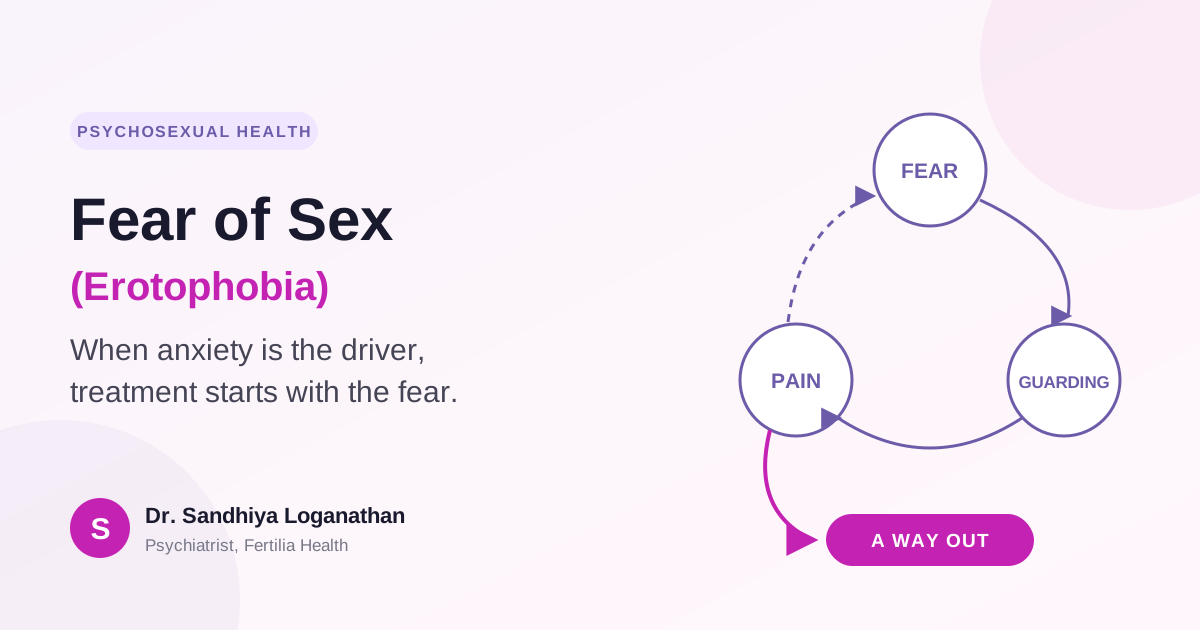
Here is the mechanism I draw on paper in almost every first consultation, because seeing it changes how women understand their own body.
- Anticipation. The thought of penetration triggers fear: of pain, of failure, of pregnancy, of being judged, sometimes of the act itself.
- The body responds to the fear. Anxiety is not just mental. It raises heart rate, tightens breathing, and contracts muscles, including the pelvic floor. The body braces exactly the way your shoulders rise before an injection.
- The attempt confirms the fear. A braced pelvic floor makes penetration painful or impossible. The mind records this as proof: “See, it does hurt. It does not work.”
- Avoidance follows. Avoiding sex brings immediate relief, and relief is a powerful teacher. The brain learns that avoidance is safety.
- The fear grows in the gap. Because every attempt is avoided, the brain never collects new evidence. The fear is never tested, so it is never updated.
This loop is described in the research literature as the fear-avoidance model of sexual pain (van Lankveld et al., 2010, Journal of Sexual Medicine, PMID 20092455). The crucial insight is that the cycle runs on prediction, not on damage. In most women I see, there is nothing structurally wrong. The body is doing a protection job extremely well, against a threat the mind has rehearsed a thousand times.
I want to say something about the Indian context here, gently. Many of the women I work with received no real information about sex before marriage. What filled that gap was a mix of overheard warnings, films, and first-night expectations they never chose. Add the pressure of a new marriage, in-laws waiting for pregnancy news, and no private space to even ask a question, and you have near-perfect conditions for this cycle to take hold. If this is your situation, the fear makes complete sense as a response to how you arrived here. It is still treatable.
Which Comes First: the Fear or the Spasm?
Vaginismus and fear of sex travel together, but the direction of causation differs from woman to woman, and a careful history is how a clinician tells which is leading.
Signs that anxiety is the primary driver:
- The fear extends beyond penetration. Kissing, undressing, being touched, sometimes even sharing a bed can trigger dread.
- Panic-type symptoms appear at the thought of sex: racing heart, breathlessness, nausea, a strong urge to escape.
- There is a wider anxious thread in your life: lifelong worry, health anxiety, panic attacks, or a diagnosed anxiety disorder.
- The fear has cousins: intense fear of pregnancy or childbirth, of blood, of injections, of loss of control.
- Gynaecologist visits are avoided entirely, not just internal examinations.
Signs the spasm is primary and the fear is downstream:
- Desire and comfort with intimacy are intact. The fear is specific to penetration and arrived after painful or failed attempts.
- The dread is narrowly about pain, not about sex itself.
- There is no broader anxiety pattern in the rest of your life.
Both directions end in the same visible problem, which is why they are so often confused. If your story sounds like the second list, the muscle-led path described in our guides to primary and secondary vaginismus and the vaginismus framework as a whole will likely be your starting point. If it sounds like the first list, keep reading, because treating the muscle without treating the fear leaves the engine of the problem running.
One important step belongs to both paths: a proper clinical assessment. Pain with penetration has several possible causes, and telling vaginismus apart from dyspareunia or from conditions like infection and vulvodynia is the gynaecologist’s job. The psychological work and the physical assessment belong in the same treatment plan, and each makes the other more effective.
💬 If reading this feels like reading your own story, that recognition is worth acting on. Message Dr. Suganya’s team at Fertilia on WhatsApp. Sessions with me are over video call, they begin with a conversation and nothing else, and you set the pace. Message us on WhatsApp
📘 Want the full picture in one place? Download Fertilia’s free 39-page Navigating Vaginismus: Information, Support, and Recovery. It covers the fear-pain cycle, the treatment paths, and what to expect at each step. Get the guide →
Prefer Instagram? Comment PAINLESS on any @fertilia.health post and we’ll DM you the guide directly.
What Treatment Looks Like When Anxiety Leads
The evidence here is encouraging, and I want you to see the numbers before the methods.
In a randomised controlled trial of therapist-aided exposure for women with lifelong vaginismus, 89% of the women in the treatment group (31 of 35) achieved intercourse, compared with 11% of the waiting-list group. Among the women who succeeded, around 90% did so within the first two weeks of treatment (ter Kuile et al., 2013, Journal of Consulting and Clinical Psychology). Two weeks, in many cases, after years of being stuck.
Here is what the work involves in practice.
Cognitive behavioural therapy (CBT). We map your specific predictions: “it will tear,” “I will panic and embarrass myself,” “something is wrong with my body.” Then we test them against evidence, gently and systematically. Most of these thoughts have never once been examined in daylight, and they lose much of their force when they are.
Graded exposure. This is the engine of the ter Kuile result. We build a ladder together, starting with steps that raise only mild anxiety, perhaps simply looking at diagrams, or touch nowhere near the pelvis, and climb only when the current step has become boring. Boredom is the goal. It is the feeling of your nervous system updating its threat prediction. The physical rungs of this ladder are the same ones used in the 12-week dilator protocol, and learning to release the pelvic floor with reverse Kegels runs alongside, so body and mind move together rather than in sequence.
Mindfulness-based approaches. Anxiety pulls attention into the future, into prediction and monitoring. Mindfulness training pulls it back to present sensation, which is where comfort is felt and where the brain gathers its new evidence. Mindfulness-based therapy has shown benefit in genito-pelvic pain conditions in randomised trials (Brotto et al., 2019, Journal of Sexual Medicine, PMID 31103481).
Medication, sometimes, and never as a reflex. Most women with fear of sex do not need medication. When a wider anxiety disorder or depression sits underneath, treating it (sometimes with an SSRI, alongside therapy) clears the ground so the exposure work can succeed. This is a decision we make together, with full information, and it is reviewed rather than permanent.
Your partner, if you have one. A short, structured conversation that replaces pressure with a clear agreement, including what will and will not happen while treatment is underway, changes the home environment from a source of dread into a place where the work can breathe. Many husbands are relieved to finally have a role: patience with a plan attached.
Who to See First, and How the Referral Works
Women often delay for months over this question, so let me make it simple. You can start from either door, and a good clinician will open the other one when it is needed.
Start with a gynaecologist if pain has been part of your story, or if you have never had an assessment. The physical examination, only when you are ready and always at your pace, rules out treatable physical contributors. Our guide to choosing a vaginismus-literate doctor in India explains what that consultation should feel like.
Start with a psychiatrist or psychologist if the fear is the loudest part: panic at the thought of sex, avoidance of all intimacy, a history of anxiety or trauma, or low mood that has settled in alongside. There is no examination in my consultations. We talk, we map the cycle, and we build the plan.
At Fertilia, these two doors lead into the same room. Dr. Suganya Venkat handles the gynaecological side, I handle the psychological side, and the plan is shared. Consultations are online, over video call from wherever you are, which for this particular condition is not a compromise. Many women find the first conversation easier from their own home, and it starts with a ₹399 consultation.
If your marriage has not been consummated and that word has been sitting heavily on you, our post on unconsummated marriage and what doctors see addresses that specific situation with the seriousness and the hope it deserves. And if the worry pulling you forward is fertility, conception with vaginismus is a question with better answers than most women expect.
Frequently Asked Questions
1. Is fear of sex normal?
It is common, which matters more than normal. Sexual pain affected 12.6% of married Indian women in the largest representative study we have, and anticipatory fear is woven through those numbers. If your fear is persistent, distressing, or shaping your relationship, it deserves treatment, and treatment works.
2. Is erotophobia a mental illness?
Erotophobia is a descriptive word, not a formal diagnosis. Depending on the pattern, a clinician might diagnose Genito-Pelvic Pain/Penetration Disorder, a specific phobia, or an anxiety disorder expressing itself in this area of life. The label guides the plan, and every one of those patterns is treatable.
3. Can anxiety alone cause vaginismus, without any painful experience?
Yes. Anxiety contracts the pelvic floor the same way it tightens shoulders and jaw. If penetration is attempted while the muscles are braced, it hurts or fails, and a spasm pattern is conditioned from that point forward. This is why the first attempt at sex can be painful even when nothing is physically wrong, something we cover in first-time sex pain: normal or vaginismus.
4. Will I need medication?
Often not. The first-line treatments are psychological: CBT, graded exposure, and mindfulness-based work, alongside the physical retraining. Medication enters the picture when a broader anxiety disorder or depression is underneath, and the decision is made with you, not for you.
5. I am getting married in a few months and I am terrified. What can I do now?
Start now rather than after the wedding. A few months is enough time to understand your own cycle of fear, begin breath and body work, and often begin the early exposure steps. Women who start before marriage carry a plan into it instead of a secret. A single consultation is a reasonable first step, and nothing about it commits you to more.
6. Will a psychiatrist examine me?
No. A psychosexual consultation is a conversation. We talk about your history, your fears, and your goals, and we agree on a plan. Any physical examination happens separately with a gynaecologist, only when you are ready, with your consent at every step, and going at your pace is a marker of a good doctor rather than a favour.
7. How long does treatment take?
Faster than the years the fear has usually taken, and faster than most women expect. In the exposure trial above, most women who succeeded did so within two weeks of starting treatment, and multimodal programmes report success in roughly 79% of cases overall (Maseroli et al., 2018, Journal of Sexual Medicine, PMID 30446469). A realistic frame is weeks to a few months of consistent, paced work.
Taking the First Step
The fear you are carrying was learned, in conditions you mostly did not choose. Anything learned can be relearned, and the trial evidence above shows that happening within weeks, not years.
Fertilia’s online Vaginismus Recovery Program brings the gynaecological and psychological sides of this work into one structured 12-week path, and when anxiety is the driver, the psychological side of that plan is mine.
The first message is a sentence. Everything after it goes at your pace.