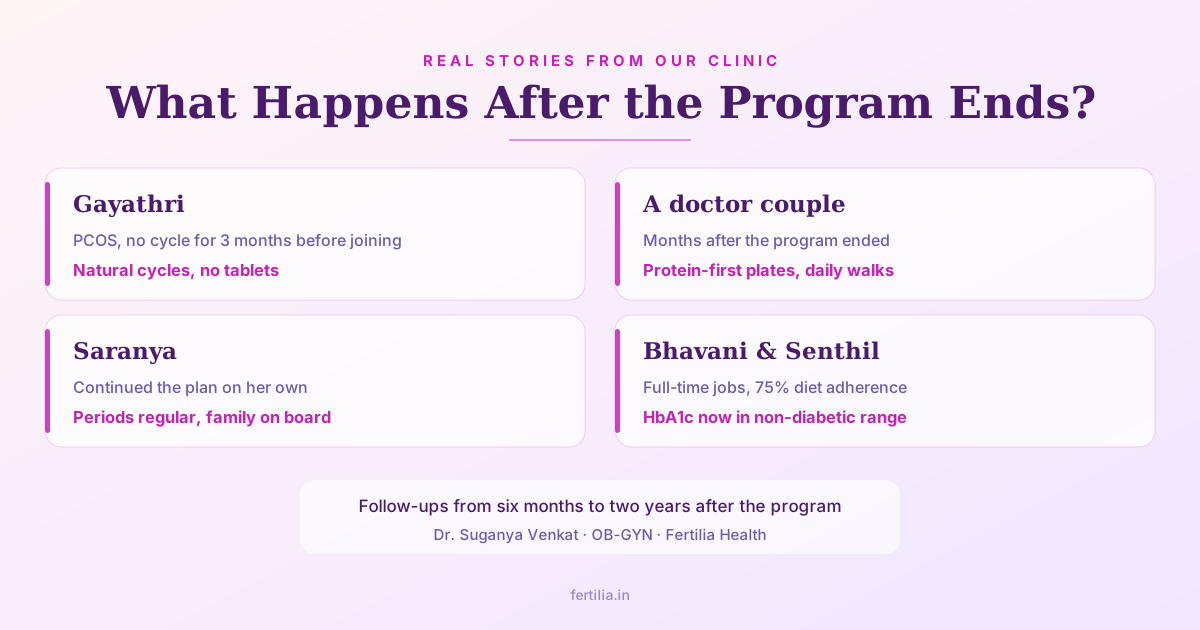
Names have been changed to protect privacy. Every message quoted here is verbatim from a real patient, with the original spelling preserved.
Somewhere around week ten of the 90-day program, many women ask the same quiet question.
“What happens when this ends? Will I manage on my own?”
It is a fair question. Most of them have been through programs before. A diet that worked until it stopped. An app that worked until the streak broke. Tablets that worked until the prescription ran out. They have learned to expect that results have an expiry date.
So recently, our team did something simple. We messaged our past patients, the women and couples whose programs ended six months, a year, even two years ago, and asked how they were doing. No script, no survey form. Just: how are you?
The replies came back over the next few days. What follows is a selection of them, the ones the patients were happy for us to share. They answer that week-ten question better than I ever could.
The plates tell the story
One reply came from a doctor couple. Their program ended months ago. He wrote:
“After the program we had made a significant change in our food style. we are including proteins in atleast two meals. last ten days ive reduced two Kgs and [my wife] had reduced one kgs. We are making a slow progress.”
A minute later:
“In addition, we are excersing in gym at morning and going for brisk walk at evening… everyday”
Then, without us asking, he sent photographs of their meals. Rice with fish curry and vegetables. Greens poriyal. Millet with broccoli. A side plate of cucumber.
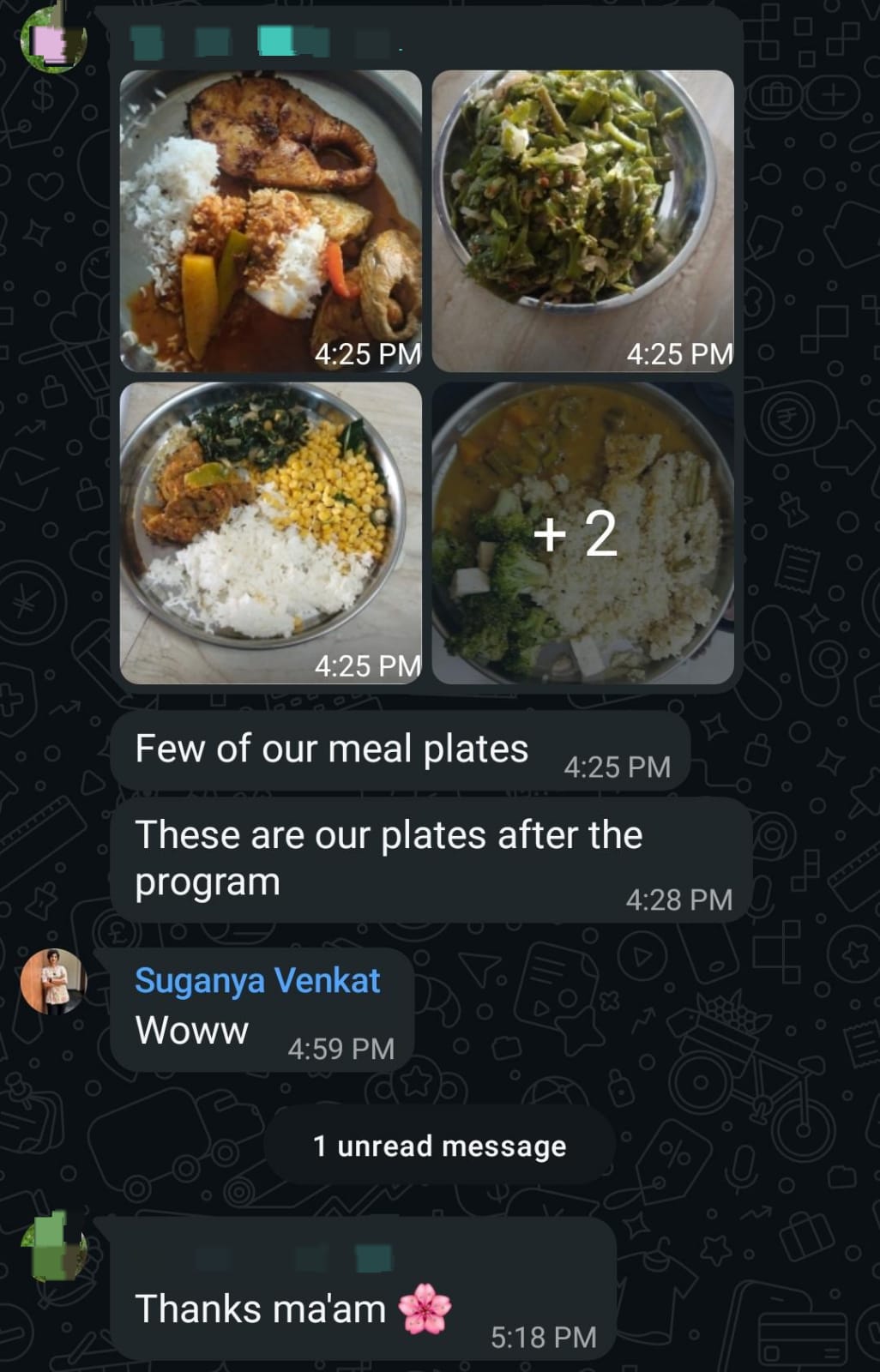
“These are our plates after the program,” he wrote.
Notice what is on those plates. Not imported superfoods. Not a salad bowl that has nothing to do with how a Tamil household eats. Rice, fish, greens, millets, dal. The same kitchen, the same cooking, rebalanced. That is the entire method. When the food plan lives inside the family’s normal kitchen, there is nothing to “go off” when the program ends.
And notice the pace he is proud of: two kilograms in ten days for him, one for her. “Slow progress,” he calls it, approvingly. That sentence would have sounded strange to him a year ago. It is what metabolic health sounds like when it has become a habit instead of a sprint.
Cycles that kept coming on their own
For the women who came to us with PCOS or irregular cycles, the question after the program is always the same: will my period keep coming without the program watching over me?
Gayathri had not had a cycle for three months before she joined. Her follow-up message:
“I’m following the diet mostly. Last month i got my cycle in 31 days, but this month i got it in 42 days, because i didn’t do the exercises regularly. But still I’m happy because before joining fertilia, I didn’t have my cycle for 3 months. But now, after our program, i got my cycles naturally without having any pills.”
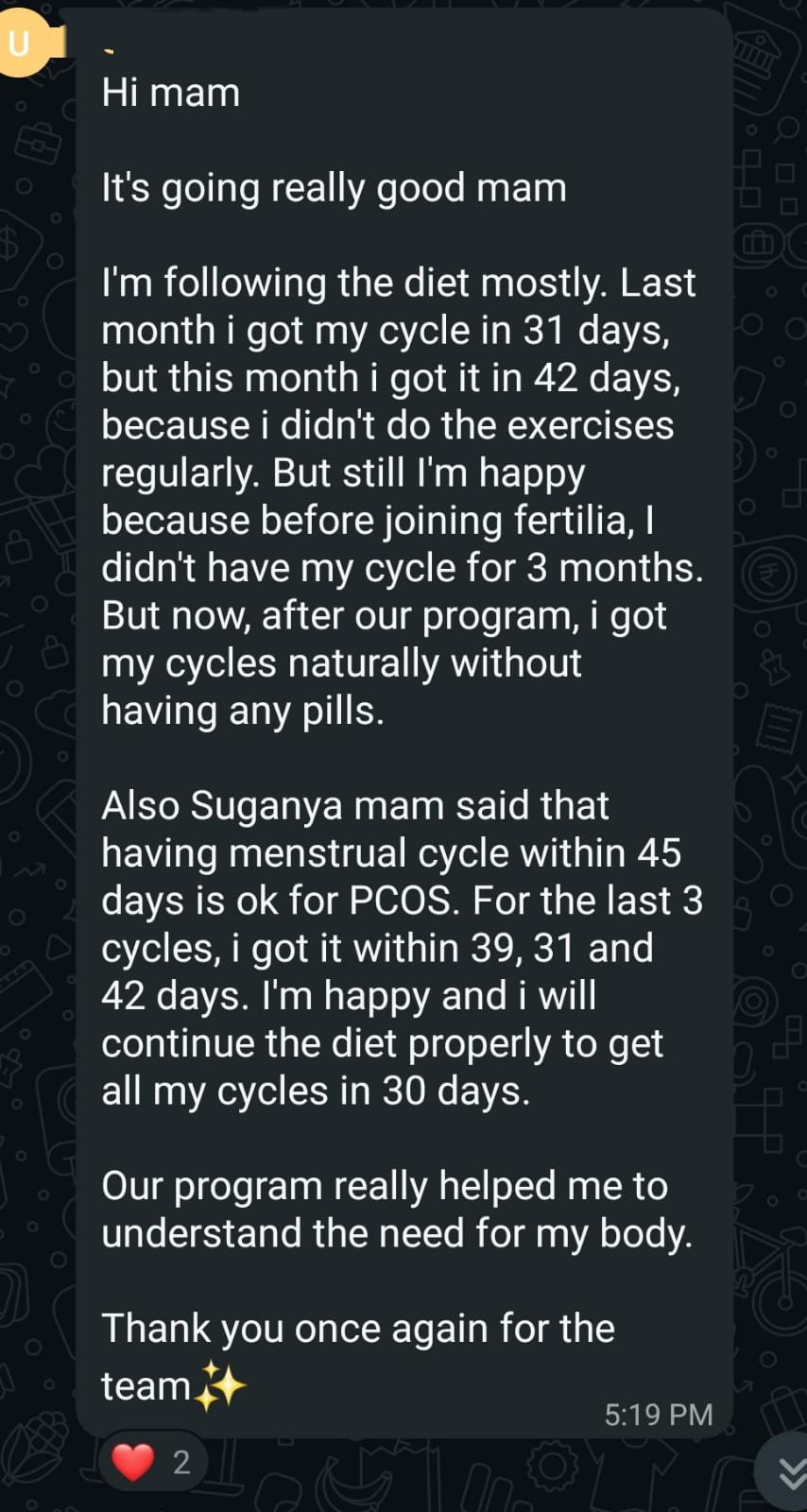
Read that message again, because something important is happening in it. She got a 42-day cycle, and instead of panicking, she diagnosed it herself: she had skipped her exercises. She knows her last three cycles were 39, 31 and 42 days. She knows that for a woman recovering from PCOS, a cycle arriving within 45 days is an acceptable stage on the way back to regularity, because we taught her that. And she has set her own next goal: all cycles within 30 days.
That is a woman who understands her body. No pills were involved in any of those three cycles.
Saranya’s reply was shorter:
“I have been following the same diet plan with exercise and walking even after the program ended . My periods are regularly now and as a family we are able to maintain a healthy lifestyle.”
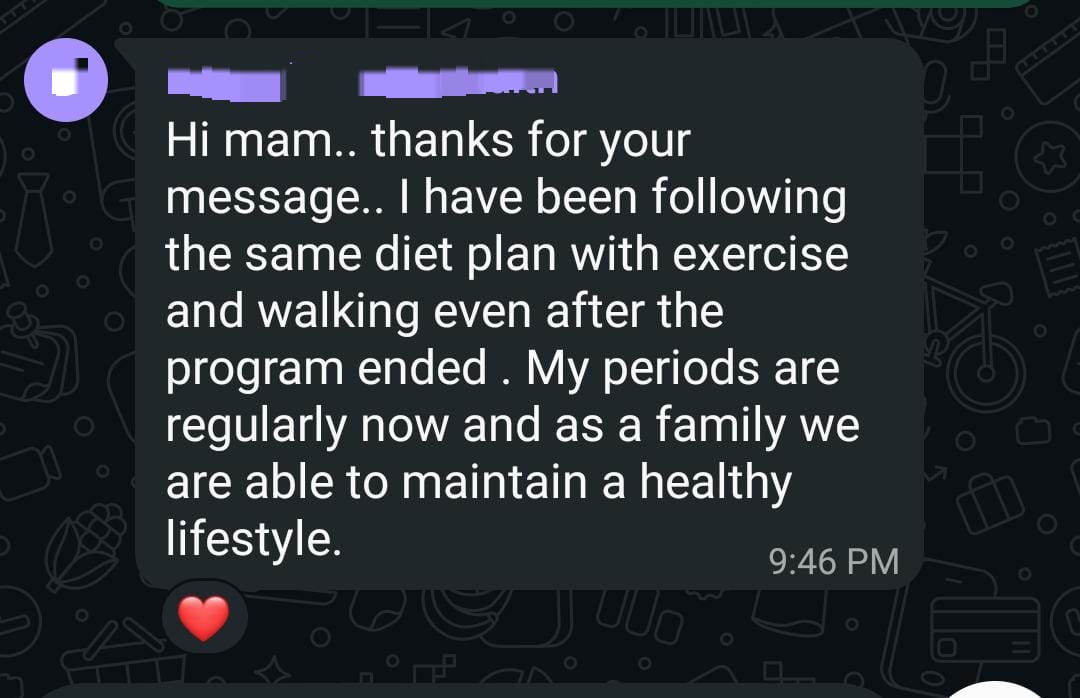
“As a family.” The habits did not stay locked inside one woman’s diet chart. They moved into the household.
Keerthana wrote about a change many women with painful periods will recognise:
“This program have helped me to cut down my quantity of carb and I’m focusing more on fibre and protien in every meal. These changes have been very helpful in improving my overall health. I could see the difference in the cramps before my periods during every cycle.”
If your cycles are still irregular and you want to understand why, start with our guide on why periods go missing in PCOS and how to get them back.
The couple who drifted, and what they did next
My favourite reply in this whole follow-up did not describe a perfect record. It described a relapse.
Revathi and her husband finished their program and, like most people, slowly slid back toward their old eating pattern. Here is what she wrote about it:
“We felt many changes in the initial week of the program got over like we again started our old eating pattern and we saw and felt the way our body responded and consciously we again started the diet.”
They drifted. Their bodies told them. They listened, and they corrected course, on their own, with no nutritionist chasing them.
“A big thanks to you all for making us understand the importance of balanced eating and how it affects our harmones and lifestyle.”
This is the outcome we are working toward in those 90 days: a kind of body literacy, the ability to feel what a week of poor eating does to your energy, your sleep, your skin, your cycle, and to know exactly what to do about it. A woman who has that skill is never starting from zero again.
Wondering what your body is trying to tell you? If your cycles, weight, or energy have been sending signals you cannot read, message Dr. Suganya on WhatsApp. She reads every message herself and will tell you what the right next step is.
Ups, downs, and 75 percent
Not every reply was a highlight reel, and I would not want it to be.
Mythili wrote:
“I’m doing well and have been able to follow many of the habits I learned during the program. It has definitely helped me become more mindful about my lifestyle and overall health. There are some ups and downs, but overall the program has made a positive difference for me.”
Ups and downs. That is what real life with sustained habits looks like, and a patient who can say so plainly is a patient whose habits will survive the downs.
Then there is Bhavani and Senthil, a couple whose follow-up I want to share exactly as it came, because their story is still in the middle.
Bhavani works a 10-to-7 office job, six days a week. She wrote that she and her husband have maintained their weight within one to two kilograms for three months while following “75%” of their diet. Her husband’s HbA1c has come down into the non-diabetic range, and a leg wound that had been slow to heal is improving. Her own periods have turned irregular again, and she is on a low-dose thyroid tablet.
They are also preparing for fertility treatment. At their fertility clinic, his semen quality was found to be affected, linked to his smoking, so the couple are using a three-to-six month recovery window before treatment, and they are using it well: the diet, the habits, the metabolic groundwork. Her closing lines:
“Situation persists same but we always suggest your diets to our friends and family members… Though it is tough for us to follow we are doing 75% diet”
I want to be clear about how we see this story. An HbA1c moving into the non-diabetic range is a major win for their future pregnancy and for his long-term health. A couple holding their weight steady through a six-day work week at 75 percent adherence is a win. And when their fertility clinic begins treatment, they will walk in with bodies that have been prepared for months. We work alongside their treatment team, and this preparation is exactly what gives the next step its best chance. Their bodies are getting ready.
If you are weighing up treatment yourself, our guide on whether you need IVF walks through that decision the way I would across the desk.
The quieter wins
Two more replies, because the program was never only about fertility.
Lakshmi is an older patient who came to us with leg pain and heaviness that had been limiting her daily life. Months later:
“i am able to manage with out the tablet . some days are i with out pain some days ofcourse i go through the pain . definitely much much better than before… the heaviness of the leg has drastically reduced so i feel much light than before.”
She has swapped the gym for a daily hour of physiotherapy exercises, identified on her own that her protein intake needs work, and is planning to restart her morning walks. Managing a body well is a skill she now owns.
And Abinaya, who is trying to conceive, replied in Tamil:
“ungaloda programme la follow pana tips enoda travel aitu dhan iruku… unga fertilia ku enoda pregnant news solanum nu enoda asai… positive thoughts seekiram adha nadathi vaikum nu namburen mam”
The tips from your program travel with me. My wish is to share my pregnancy news with Fertilia. I believe it will happen soon.
The habits are packed in her bag. We are waiting for her good news with her.
Why the program is built this way
None of these replies surprised us, and the reason is in how the 90 days are designed.
Crash diets produce fast results by creating a state your body cannot sustain. When the restriction ends, the weight returns, and often the symptoms with it. We do not use them. Ever. There are no 800-calorie weeks at Fertilia, no banned food groups, no “detoxes.”
Instead, the program corrects the metabolic ground underneath the symptoms: insulin resistance, inflammation, nutrient deficiencies, poor sleep, chronic stress. The tools are unglamorous and permanent. Balanced plates built from the patient’s own kitchen. Protein and fibre in every meal. Movement that fits the person’s actual day, whether that is a gym, a walking streak, or an hour of physiotherapy. Sleep. Stress care.
Because the tools are ordinary, they survive ordinary life. A 10-to-7 job. Travel. A joint family kitchen. A relapse and a restart. That is why a doctor couple is still photographing balanced plates months later, and why Gayathri’s cycles arrive without tablets: the thing we treated was never just the symptom. To understand the engine behind much of this, read our guide on insulin resistance in PCOS, or the piece on why weight was never the real story.
What they kept, in one list
Across ten follow-ups, the habits that survived were remarkably consistent:
- Protein and fibre in every meal, named by almost every patient in their own words
- Carbohydrate portions reduced, never eliminated. Rice and millets still on every plate
- Daily movement matched to the person: gym, brisk walks, physiotherapy, a walking streak
- A weekly cheat day, guilt-free, planned
- Self-monitoring: cycle lengths tracked, weight watched without obsession, plates photographed
- The family pulled in: spouses on the same plan, children eating the same food, friends asking for the diet
Not one patient mentioned a product, a supplement brand, or a rule they were afraid of breaking. That is what we mean when we say the program builds sustainable habits.
How Dr. Suganya works with you
Dr. Suganya Venkat is an OB-GYN with 15+ years of clinical experience. She holds a DNB in OB-GYN from GKNM Hospital, Coimbatore, an MD in Pathology from CMC Vellore, and an MBBS with 5 gold medals from SRMC. Her 90-day programs treat PCOS, fertility, pregnancy and postpartum health by correcting the metabolic root causes underneath the symptoms, with a team of nutritionists and wellness coaches guiding you daily.
She consults online, across India, via video call. And as the messages above show, the relationship does not end when the program does.
For more patient journeys from inside the program itself, read Stories from May at Fertilia.
Frequently Asked Questions
Are these follow-up messages real?
Yes. Every quote in this article is from a verified WhatsApp message sent by a past patient during our follow-up outreach, reproduced verbatim with the original spelling. Names have been changed for privacy, and the screenshots shown have identifying details masked.
Will the weight come back after the program ends?
The patients above are the answer we can offer: months to two years out, they are maintaining or still improving. Weight regain happens when a program relies on restriction your body cannot sustain. Our program changes what is on an everyday Indian plate and builds movement into an everyday routine, so there is no “diet” to fall off when the 90 days end.
Do I have to follow the plan perfectly forever?
No, and nobody above does. One couple follows 75 percent of their diet around demanding jobs. One keeps a weekly cheat day. One drifted entirely and restarted on their own. The program teaches you what your body needs and how it responds, so you can flex without losing the thread.
My symptoms returned after a program elsewhere. Can this still work for me?
Yes, and you are exactly who we built this for. When results vanish after a program ends, it usually means the program managed your symptoms without correcting what was driving them. We start with a root-cause analysis (bloodwork, cycle history, lifestyle) and build the plan from there. Read what PCOS symptom reversal really involves for how we think about lasting change.
Does this work alongside fertility treatment or my existing doctor?
Yes. Bhavani and Senthil’s story above is a live example: they are preparing for treatment at their fertility clinic while following our program, and his HbA1c improvement is part of that preparation. We work with your gynaecologist or IVF team, never in place of them. If treatment is your right next step, Dr. Suganya will say so.
How do I start?
Send a WhatsApp message to +91 99402 00330 describing your situation in a few lines. Dr. Suganya reads these herself. The first step is a ₹399 consultation, online, from anywhere in India.
If you want habits that outlast the program
Every woman quoted here once sat where you might be sitting now: tired of results that expire, unsure whether her body could change for good. The messages above are what six months to two years later can look like.
Talk to Dr. Suganya on WhatsApp
She will read your message herself and tell you what the right first step is for your body.